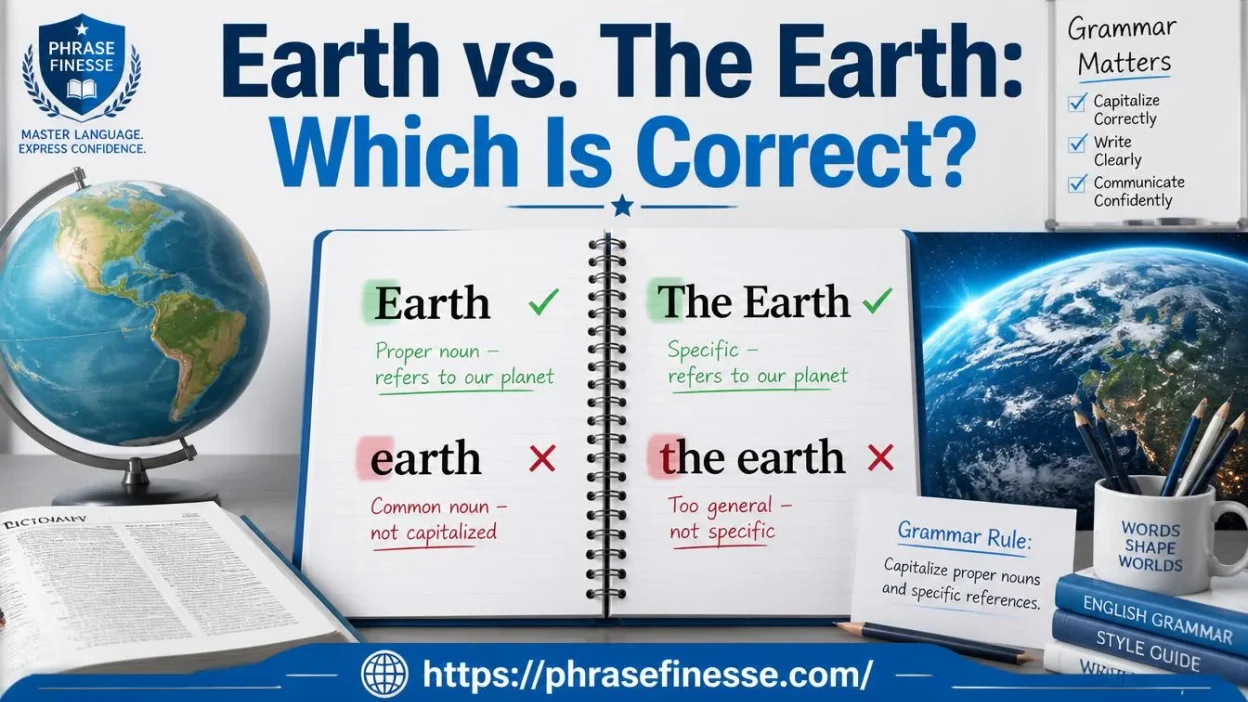
Have you ever stopped while writing and wondered whether you should say Earth or the Earth? It’s a surprisingly common question, even among experienced writers. In this guide, Earth vs. The Earth: Which Is Correct? , you’ll discover when each form is correct, why capitalization rules matter, and how to apply them confidently in English usage, grammar, and formal writing.
Whether you’re drafting an academic paper, a business email, or everyday content, understanding this distinction improves consistency and credibility.
The difference between Earth and the Earth depends on grammar, context, and whether the word functions as a proper noun or a common noun. This article explains the underlying grammar rules, explores real-world examples, and highlights common mistakes that many learners and native speakers still make.
You’ll also learn how this choice affects business communication, broadcasting, project management, meetings, calendar entries, online booking systems, scheduling, and time management, where accurate language supports clear and professional communication.
By the end of this guide, you’ll know exactly when to capitalize Earth, when to include the definite article the, and how to avoid confusing or inconsistent usage.
With practical examples, expert explanations, and easy-to-follow comparisons, you’ll build stronger writing habits and gain greater confidence in English grammar, capitalization, and precise word choice across both professional and everyday writing.
Quick Answer:
The short answer is simple:
- Earth is correct when referring to the planet as a proper noun.
- The Earth is also correct when referring to the planet, especially in descriptive or general contexts.
- earth is correct when referring to soil, dirt, or ground.
- the earth is correct when referring to land, ground, or soil in a general sense.
Quick Comparison Table
| Form | Meaning | Capitalized? |
| Earth | The planet | Yes |
| The Earth | The planet | Yes |
| earth | Soil, dirt, ground | No |
| the earth | Ground, land, soil | No |
Examples
| Sentence | Correct Form |
| Earth is the third planet from the Sun. | Earth |
| The Earth revolves around the Sun. | The Earth |
| The farmer tilled the earth. | earth |
| Fresh earth covered the roots. | earth |
The key factor is meaning. Once you identify whether you’re discussing the planet or the ground beneath your feet, the choice becomes much easier.
Why Both “Earth” and “The Earth” Are Correct
One reason people get confused is that both forms appear in reputable publications. You’ll find scientists writing Earth, while journalists frequently write the Earth.
The truth is that both forms are grammatically correct.
When “Earth” Is Preferred
Writers often omit the article when discussing Earth as a celestial body alongside other planets.
This approach is especially common in:
- Astronomy
- Planetary science
- Space exploration
- Academic writing
- Scientific publications
Examples
- Earth rotates on its axis every day.
- Earth has one natural satellite.
- Earth belongs to the solar system.
- Earth formed approximately 4.54 billion years ago.
Notice how these examples treat Earth like Mars, Venus, or Jupiter.
Planet Comparison
| Planet | Common Scientific Usage |
| Mercury | Mercury |
| Venus | Venus |
| Earth | Earth |
| Mars | Mars |
| Jupiter | Jupiter |
Scientists typically maintain consistency across all planetary names.
When “The Earth” Is Preferred
In everyday English, people often use the Earth because it sounds more natural.
You’ll frequently encounter this form in:
- News reports
- Environmental discussions
- Geography lessons
- General conversations
- Popular science articles
Examples
- The Earth is warming faster than expected.
- The Earth supports millions of species.
- The Earth travels around the Sun.
- The Earth experiences seasonal changes.
Here, the article emphasizes Earth as a unique object familiar to everyone.
Is Earth a Proper Noun?
Yes.
When referring to the planet, Earth is a proper noun.
A proper noun names a specific person, place, thing, or entity. Proper nouns require capitalization.
Examples of Proper Nouns
| Proper Noun | Category |
| Earth | Planet |
| Mars | Planet |
| Asia | Continent |
| Atlantic Ocean | Ocean |
| Sahara Desert | Desert |
Because Earth names a specific planet, it follows the same capitalization rules as other celestial bodies.
Correct Usage
- Earth contains vast oceans.
- Earth has a protective atmosphere.
- Earth supports diverse ecosystems.
Incorrect Usage
- earth is the third planet from the Sun.
- many species live on earth.
The lowercase version is incorrect when referring to the planet itself.
When Should “Earth” Be Capitalized?
The rule is surprisingly straightforward.
Capitalize Earth whenever it refers to the planet.
This applies regardless of where the word appears in the sentence.
Examples
- Earth is home to humanity.
- Scientists monitor Earth’s climate.
- Life exists on Earth.
- Earth orbits the Sun.
Notice another important detail.
Words such as Sun and Moon are often capitalized in scientific contexts when referring to specific celestial objects.
Scientific Example
“Earth completes one orbit around the Sun approximately every 365.25 days.”
This sentence treats Earth and Sun as named astronomical bodies.
Facts About Earth
| Fact | Figure |
| Average distance from Sun | 93 million miles (150 million km) |
| Age of Earth | About 4.54 billion years |
| Diameter | 7,917.5 miles (12,742 km) |
| Surface covered by water | Approximately 71% |
| Number of moons | 1 |
Because these facts concern the planet itself, Earth remains capitalized throughout.
When Should “Earth” Not Be Capitalized?
Lowercase earth refers to soil, dirt, land, or ground.
In this sense, it functions as a common noun rather than a proper noun.
Examples
- The gardener loosened the earth.
- Rain soaked the earth overnight.
- Workers moved tons of earth during construction.
- The smell of wet earth filled the air.
In these examples, the word has nothing to do with astronomy.
Instead, it refers to physical ground or soil.
How Context Changes Meaning
Consider these sentences:
| Sentence | Meaning |
| Earth is beautiful. | The planet |
| The earth is fertile. | Soil |
| Earth supports life. | The planet |
| Farmers cultivate the earth. | Ground |
The spelling changes only through capitalization, yet the meaning changes significantly.
This demonstrates why context matters so much.
Do You Need “The” Before Earth?
This question causes more confusion than capitalization.
The answer depends largely on style, context, and sentence structure.
Situations Where “The Earth” Is Common
Writers often include “the” when discussing Earth generally rather than scientifically.
Examples
- The Earth is our home.
- The Earth supports countless ecosystems.
- The Earth receives energy from the Sun.
- The Earth continues to change over time.
These examples sound natural in everyday conversation.
Situations Where “Earth” Is Common
Scientific writing often drops the article.
Examples
- Earth rotates every twenty-four hours.
- Earth contains liquid water.
- Earth formed billions of years ago.
- Earth lies within the Sun’s habitable zone.
Many researchers prefer this format because it mirrors the treatment of other planets.
A Practical Rule
Ask yourself:
Would you say “the Mars” or “the Jupiter”?
Probably not.
When Earth appears alongside other planets, dropping the article often sounds more consistent.
Example
- Mercury, Venus, Earth, and Mars are terrestrial planets.
Adding “the” here would seem awkward.
Earth Compared With Other Planets
Understanding planetary naming conventions helps explain why Earth often appears without an article.
Consider this list:
- Mercury
- Venus
- Earth
- Mars
- Jupiter
- Saturn
- Uranus
- Neptune
None of these names typically require “the.”
Examples
- Mars has two moons.
- Venus possesses a dense atmosphere.
- Jupiter is the largest planet.
- Earth contains liquid oceans.
The grammatical treatment remains consistent.
Why “The Earth” Survived in Everyday English
Historically, people viewed Earth differently from other planets.
For centuries, many cultures saw Earth as the center of existence rather than just another planet.
As a result, English developed phrases such as:
- The Earth
- The world
- The globe
These expressions remain deeply embedded in modern speech.
Earth vs. World vs. Globe
Although people often use these words interchangeably, they are not identical.
Earth
Earth refers primarily to the physical planet.
Example
- Earth has a molten core.
See More :6 Words to Describe Someone Who Is Always Negative
World
World often refers to human civilization, society, or life in general.
Example
- The world watched the event unfold.
This sentence refers to people rather than the planet itself.
Globe
Globe emphasizes shape or representation.
Example
- The teacher pointed to Australia on the globe.
Here, globe refers to a model rather than the actual planet.
Comparison Table
| Word | Primary Meaning |
| Earth | Physical planet |
| World | Human society or planet generally |
| Globe | Spherical object or model |
Understanding these distinctions improves precision in writing.
Earth in Scientific, Academic, and Style Guides
Professional writers often rely on style guides.
Fortunately, major guides generally agree on Earth capitalization.
Scientific Usage
Astronomers nearly always capitalize Earth when discussing the planet.
This aligns with naming conventions for other celestial bodies.
Example
- Earth’s magnetic field protects life from harmful solar radiation.
Academic Writing
Universities and scholarly publications generally capitalize Earth when referring to the planet.
Example
- Earth’s atmosphere contains approximately 78% nitrogen.
Consistency is especially important in research writing.
Style Guide Recommendations
AP Style
The Associated Press generally capitalizes Earth when referring to the planet.
Chicago Manual of Style
Chicago also supports capitalization when Earth denotes the planet.
Scientific Publications
Scientific journals overwhelmingly use Earth as a proper noun.
Case Study: Climate Reporting
Consider these headlines:
Correct
- The Earth experienced record temperatures last year.
Also Correct
- Earth experienced record temperatures last year.
Both work.
The choice depends on publication style and tone.
Common Mistakes Writers Make With Earth
Even experienced writers occasionally make mistakes.
Let’s examine the most common ones.
Lowercasing the Planet Name
Incorrect
- earth is the third planet from the Sun.
Correct
- Earth is the third planet from the Sun.
Because the sentence references the planet, capitalization is required.
Capitalizing Soil References
Incorrect
- The Earth in the flowerpot was dry.
Correct
- The earth in the flowerpot was dry.
Here, the word refers to soil.
Inconsistent Capitalization
Some writers alternate between Earth and earth within the same context.
Incorrect
- Earth is unique because earth supports life.
Correct
- Earth is unique because it supports life.
Consistency improves clarity.
Confusing Earth and World
Example
- The whole world celebrated.
Using Earth here would sound unnatural because people—not the planet—celebrated.
Earth vs. The Earth in Real Sentences
Examples often teach grammar better than rules.
1. Examples Using “Earth”
- Earth rotates from west to east.
- Earth possesses a powerful magnetic field.
- Earth supports millions of species.
- Earth lies within the habitable zone.
2. Examples Using “The Earth”
- The Earth continues to evolve.
- The Earth receives sunlight daily.
- The Earth experiences changing climates.
- The Earth remains the only known planet with confirmed life.
3. Examples Using “earth”
- The earth cracked during the drought.
- Heavy machinery moved the earth.
- Rain softened the earth overnight.
- Fresh earth surrounded the newly planted tree.
Easy Trick to Remember the Difference
Grammar becomes easier when you have a memory shortcut.
The Planet Test
Ask one simple question:
Are you talking about the planet?
If yes:
- Earth
- The Earth
Are you talking about soil or ground?
If yes:
- earth
- the earth
Helpful Examples From Everyday Writing
Environmental Writing
- The Earth is experiencing rising sea levels.
- Earth’s ecosystems face increasing pressure.
Both forms work because both refer to the planet.
Gardening Writing
- Rich earth improves plant growth.
- The earth retained moisture after rainfall.
Lowercase is required because the meaning is soil.
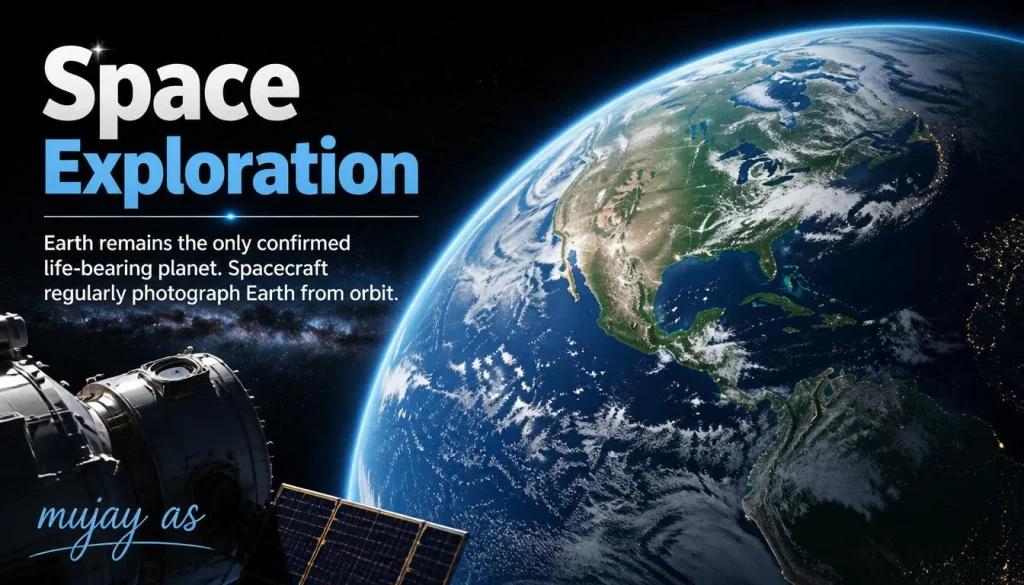
Space Exploration Writing
- Earth remains the only confirmed life-bearing planet.
- Spacecraft regularly photograph Earth from orbit.
Again, capitalization is necessary because the word names the planet.
FAQs
Is it correct to say Earth or the Earth?
Both are correct, but they serve different grammatical purposes. Earth is typically used as a proper noun when referring to the planet by name, while the Earth is used when the definite article is grammatically required or when referring to the planet as a physical object.
Examples:
- Earth is the third planet from the Sun.
- The Earth revolves around the Sun.
Why is Earth sometimes capitalized?
Earth is capitalized when it refers to the name of our planet because it is a proper noun. However, when earth refers to soil, dirt, or the ground, it is a common noun and should not be capitalized.
Examples:
- Astronauts returned safely to Earth.
- The flowers grow well in rich earth.
When should I use the before Earth?
Use the when the sentence naturally requires a definite article or when referring to the planet as a specific object.
Examples:
- The Earth has one natural satellite.
- Scientists are studying the Earth’s atmosphere.
Can I write earth with a lowercase “e”?
Yes, but only when you’re referring to soil, land, or the ground rather than the planet.
Examples:
- The gardener turned the earth before planting.
- Earth is home to millions of species.
Is the Earth more common than Earth?
Both forms are common in modern English. Earth is often used in scientific, astronomical, and educational writing, while the Earth frequently appears in general conversation and descriptive writing. The correct choice depends on the sentence rather than one form being universally better.
Does using Earth or the Earth affect formal writing?
Yes. Choosing the correct form improves grammar, capitalization, and professional writing quality. Using the appropriate version makes your writing more precise, especially in academic papers, business documents, and published content where consistency is important.
Conclusion
Understanding the difference between Earth and the Earth is more than a simple grammar exercise. It helps you write with greater accuracy, clarity, and consistency in both everyday and professional contexts. In most cases, Earth is capitalized when referring to our planet as a proper noun, while the Earth is used when the definite article naturally fits the sentence structure. The choice depends on grammar, context, and meaning rather than personal preference.
By following the capitalization rules and usage guidelines explained in this article, you can avoid common mistakes and improve your English writing. Whether you’re creating academic content, handling business communication, writing reports, or simply improving your grammar skills, using Earth and the Earth correctly will make your writing sound more polished, natural, and professional.

Emma Brooke is an English language specialist, editor, and content writer at Phrase Finesse, where she helps readers develop stronger writing and communication skills through clear, practical, and engaging content. With a passion for the English language, she specializes in simplifying grammar rules, vocabulary, spelling, punctuation, and word usage for learners at every level.
Emma has extensive experience creating educational content that is accurate, well-researched, and easy to understand. She is particularly skilled at explaining confusing word pairs, grammar concepts, idioms, sentence structure, and effective writing techniques, making complex topics approachable for students, professionals, educators, and English learners worldwide.