
Have you ever paused while writing an email, report, or sentence and wondered which form sounds right? Does Not vs. Do Not: The Correct Usage Guidehelps you settle that question with confidence. Although both expressions create a negative statement, they follow different grammatical patterns.
Choosing the correct form depends mainly on the subject of the sentence and whether you’re using a singular or plural subject. Getting this distinction right can make your English usage, grammar, and formal writing clearer and more consistent.
The difference becomes especially important in professional situations. You might use these expressions while discussing scheduling, time management, business communication, online booking, broadcasting, or upcoming meetings.
For example, a calendar notification, project update, or project management message may require precise wording. A small grammatical mistake can make an otherwise polished sentence sound awkward. Understanding when to use “does not” and “do not” gives you a simple rule you can apply across everyday and professional communication.
In this guide, you’ll learn exactly when to use “does not” and “do not,” how subject-verb agreement affects your choice, and why certain sentence structures require one form instead of the other.
You’ll also see clear examples, common mistakes, and practical explanations that make the rule easier to remember. By the end, you’ll have a reliable approach for maintaining grammatical accuracy, clarity, and consistency in both casual and formal writing.
Quick Answer:
Here’s the short answer:
- Use do not with I, you, we, they, and plural nouns.
- Use does not with he, she, it, and singular nouns.
Quick Reference Table
| Subject | Correct Form |
| I | Do not |
| You | Do not |
| We | Do not |
| They | Do not |
| He | Does not |
| She | Does not |
| It | Does not |
| Singular noun | Does not |
| Plural noun | Do not |
Examples
| Correct Sentence | Why It Is Correct |
| I do not agree. | “I” uses do not |
| They do not know. | “They” uses do not |
| He does not agree. | “He” uses does not |
| The dog does not bark. | Singular noun uses does not |
If you remember nothing else from this article, remember this:
He, she, it = does not. Everything else = do not.
Understanding the Role of Do and Does in English Grammar
Before comparing do not and does not, it’s helpful to understand where these words come from.
Both do and does are forms of the verb to do. However, in many sentences, they function as auxiliary verbs (also called helping verbs).
An auxiliary verb helps create:
- Negative statements
- Questions
- Emphasis
For example:
- I do not understand.
- Does she work here?
- They do know the answer.
Notice that do and does are not the main actions. Instead, they support the main verb.
Think of auxiliary verbs as the engine that helps the sentence move smoothly.
What Does “Do Not” Mean?
Do not is used to make a sentence negative when the subject is:
- I
- You
- We
- They
- Any plural noun
Essentially, do not means that something does not happen, is not true, or is not exist in the situation being described.
Examples
- I do not like cold weather.
- You do not need permission.
- We do not work on weekends.
- They do not understand the instructions.
With Plural Nouns
Plural nouns also use do not.
Examples:
- Students do not wear uniforms here.
- Dogs do not typically eat chocolate safely.
- Employees do not have access to this room.
Notice how every sentence uses a plural subject.
What Does “Does Not” Mean?
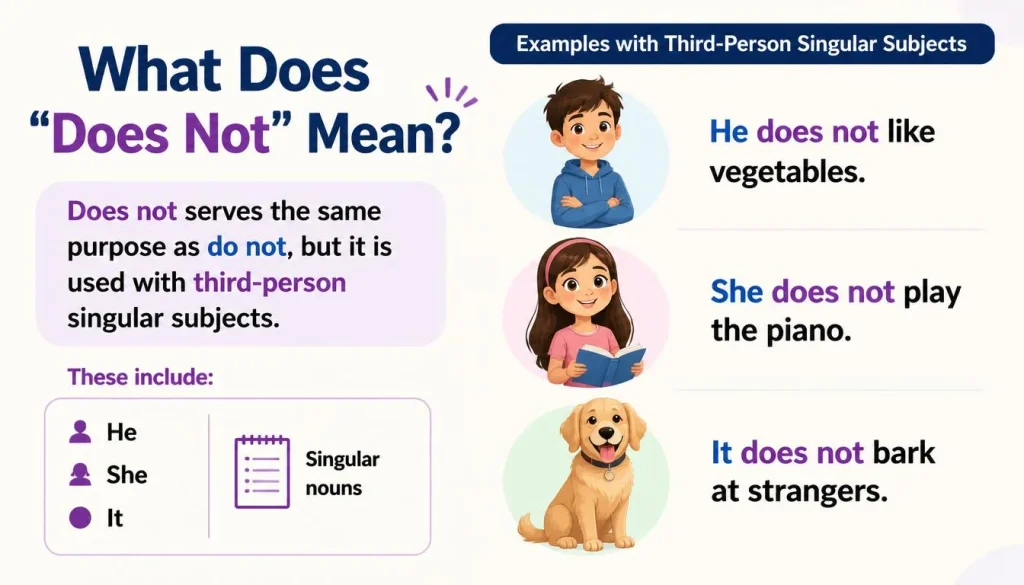
Does not serves the same purpose as do not, but it is used with third-person singular subjects.
These include:
- He
- She
- It
- Singular nouns
Examples
- He does not play tennis.
- She does not drive.
- It does not matter.
- The company does not offer refunds.
With Singular Nouns
Whenever one person, animal, place, or thing performs the action, does not is usually the correct choice.
Examples:
- The teacher does not allow phones.
- The dog does not bark often.
- My brother does not enjoy horror movies.
This rule forms the foundation of correct English grammar.
Why Subject-Verb Agreement Matters
The difference between do not and does not comes from a grammar concept called subject-verb agreement.
Subject-verb agreement means that verbs must match their subjects.
Singular Subjects
| Subject | Verb Form |
| He | Does |
| She | Does |
| It | Does |
| The student | Does |
Plural Subjects
| Subject | Verb Form |
| We | Do |
| They | Do |
| Students | Do |
| Dogs | Do |
English speakers naturally follow this pattern.
When the agreement is wrong, sentences sound awkward immediately.
Compare:
❌ He do not understand.
✅ He does not understand.
The second sentence sounds natural because the subject and verb agree.
Why Does Not Use the Base Verb Form
This is one area where many learners become confused.
Consider this sentence:
✅ He does not work.
Many beginners mistakenly write:
❌ He does not works.
Why?
Because they think the singular subject still requires the -s ending.
It doesn’t.
The Rule
When you use does, the helping verb already carries the singular marker.
As a result, the main verb returns to its basic form.
Correct Examples
- He does not work.
- She does not play.
- It does not rain often.
- The machine does not function correctly.
Incorrect Examples
- He does not works.
- She does not plays.
- It does not rains.
The auxiliary verb handles the grammar. The main verb stays simple.
Why Do Not Also Uses the Base Verb Form
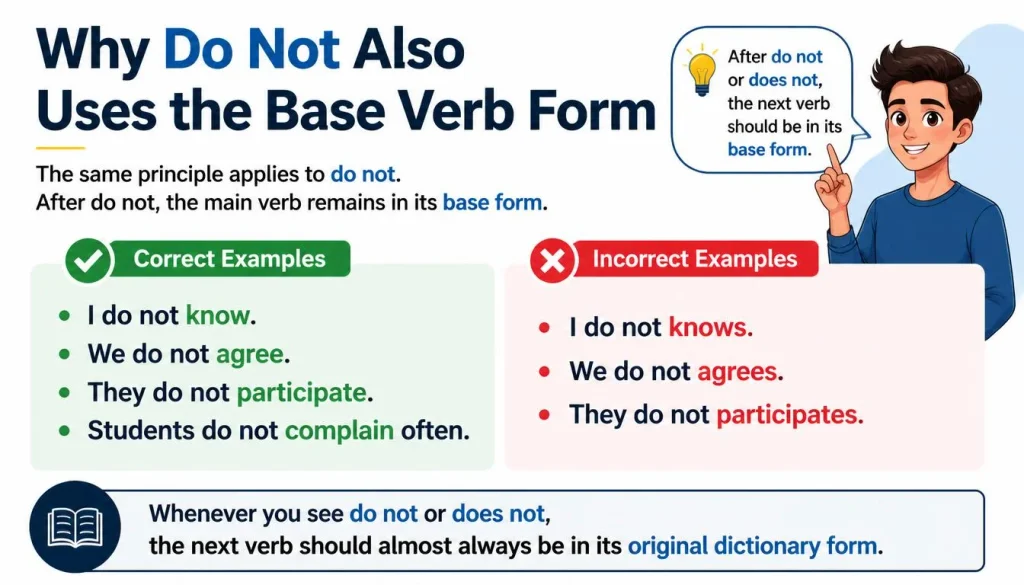
The same principle applies to do not.
After do not, the main verb remains in its base form.
Correct Examples
- I do not know.
- We do not agree.
- They do not participate.
- Students do not complain often.
Incorrect Examples
- I do not knows.
- We do not agrees.
- They do not participates.
Whenever you see do not or does not, the next verb should almost always be in its original dictionary form.
Do Not vs. Does Not: Side-by-Side Comparison
The easiest way to understand the difference is through comparison.
| Feature | Do Not | Does Not |
| Used with I | ✓ | ✗ |
| Used with You | ✓ | ✗ |
| Used with We | ✓ | ✗ |
| Used with They | ✓ | ✗ |
| Used with He | ✗ | ✓ |
| Used with She | ✗ | ✓ |
| Used with It | ✗ | ✓ |
| Used with Singular Nouns | ✗ | ✓ |
| Used with Plural Nouns | ✓ | ✗ |
Examples
| Subject | Correct Sentence |
| I | I do not understand. |
| We | We do not agree. |
| They | They do not know. |
| He | He does not understand. |
| She | She does not agree. |
| It | It does not work. |
Common Mistakes Beginners Make
Even advanced English learners occasionally make these errors.
Let’s examine the most common ones.
Read More : In Mind vs. On Mind: Difference Explained With Real Examples
Using Do Not with He, She, or It
Incorrect:
❌ He do not like pizza.
Correct:
✅ He does not like pizza.
Why?
Because he is singular.
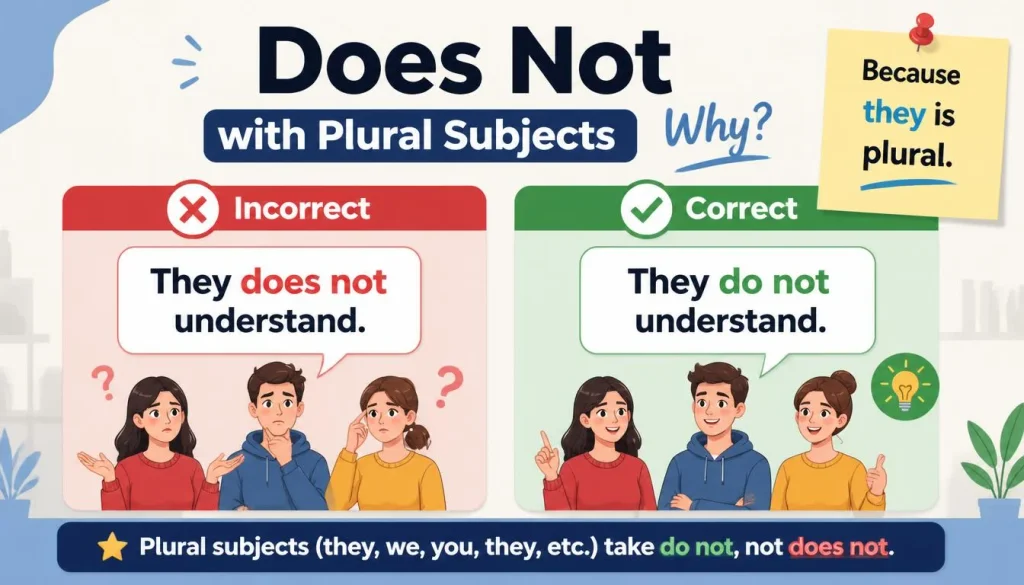
Using Does Not with Plural Subjects
Incorrect:
❌ They does not understand.
Correct:
✅ They do not understand.
Why?
Because they is plural.
Adding an Extra S to the Main Verb
Incorrect:
❌ She does not likes coffee.
Correct:
✅ She does not like coffee.
The helping verb already carries the singular form.
Misidentifying the Subject
Sometimes the real subject isn’t obvious.
Consider:
“The group of students does not agree.”
Many learners see “students” and choose do not.
However, the true subject is group, which is singular.
Therefore:
✅ The group does not agree.
Does Not and Do Not in Questions
Questions follow similar rules.
Using Do
- Do you understand?
- Do they know the answer?
- Do we need permission?
Using Does
- Does he understand?
- Does she know?
- Does it matter?
Again, the choice depends entirely on the subject.
Negative Questions
Examples:
- Do you not understand?
- Does he not know?
These forms are grammatically correct but less common in everyday conversation.
Don’t vs. Do Not
Many learners wonder whether they should write don’t or do not.
The answer depends on context.
What Is Don’t?
Don’t is simply a contraction of do not.
Examples
- I don’t know.
- We don’t agree.
- They don’t understand.
When to Use Don’t
Use it in:
- Casual conversations
- Text messages
- Emails to friends
- Informal writing
Benefits
- Sounds natural
- Reflects everyday speech
- Makes writing conversational
When to Use Do Not Instead of Don’t
There are situations where the full form works better.
Formal Writing
Examples:
- Employees do not have access.
- Visitors do not enter without permission.
Emphasis
Compare:
- I don’t agree.
- I do not agree.
The second version adds stronger emphasis.
Official Notices
You’ll often see:
- Do not enter.
- Do not touch.
- Do not park here.
These signs use the full form because it appears more authoritative.
Doesn’t vs. Does Not
Just as don’t contracts do not, doesn’t contracts does not.
Examples
- He doesn’t understand.
- She doesn’t agree.
- It doesn’t matter.
Everyday Use
In conversation, contractions dominate.
Most native speakers naturally say:
- She doesn’t know.
- He doesn’t work here.
instead of:
- She does not know.
- He does not work here.
When Does Not Is Better Than Doesn’t
The full form is often preferable when:
Adding Emphasis
- She does not agree.
- He does not support the proposal.
Writing Formally
Academic papers, business documents, and legal writing often avoid contractions.
Creating Strong Contrast
Example:
He does not dislike the idea. He simply prefers another option.
The emphasis becomes clearer.
Real-Life Examples of Do Not and Does Not
Understanding rules is useful. Seeing them in action is even better.
1.At School
- Students do not use calculators during this test.
- The teacher does not accept late assignments.
- We do not leave class early.
2.At Work
- Employees do not park in visitor spaces.
- The manager does not approve overtime automatically.
- Teams do not make budget decisions independently.
3.At Home
- My parents do not watch much television.
- My brother does not eat seafood.
- The dog does not sleep indoors.
4.While Traveling
- Travelers do not need a printed ticket.
- The airline does not allow oversized luggage.
- Passengers do not enter through this gate.
These examples show how frequently these structures appear in everyday English.
A Simple Memory Trick You’ll Never Forget
Grammar rules can feel overwhelming.
Fortunately, this one has an easy shortcut.
The One-Person Rule
Ask yourself:
Am I talking about one person or thing?
If yes:
➡ Use does not
Examples:
- The doctor does not agree.
- My sister does not drive.
If no:
➡ Use do not
Examples:
- Doctors do not agree.
- My sisters do not drive.
Practice Exercise
Choose the correct answer.
Questions
- She ___ understand the lesson.
- They ___ live nearby.
- The cat ___ eat vegetables.
- We ___ agree with the decision.
- John ___ work here anymore.
- Students ___ need uniforms.
- My brother ___ like spicy food.
- The teachers ___ arrive early.
Answers
- does not
- do not
- does not
- do not
- does not
- do not
- does not
- do not
If you answered most correctly, you’ve already mastered the rule.
Advanced Tip: Collective Nouns and Do Not vs. Does Not
Collective nouns sometimes create confusion.
Examples include:
- Team
- Family
- Committee
- Group
- Government
In American English, collective nouns are generally treated as singular.
Examples:
- The team does not agree.
- The committee does not support the proposal.
- The family does not travel often.
Even though many individuals are involved, the group acts as one unit.
That’s why does not is usually correct.
FAQs
1. What is the difference between “does not” and “do not”?
“Does not” and “do not” both create negative statements, but they work with different subjects. Use “does not” with singular third-person subjects, such as he, she, it, or a singular noun. Use “do not” with I, you, we, they, and plural nouns.
Examples:
- She does not understand the instructions.
- They do not understand the instructions.
2. Is it “he does not” or “he do not”?
The correct form is “he does not.” The subject he is singular, so it requires does rather than do.
Example:
- He does not attend every meeting.
The same rule applies to she and it.
3. Is “they does not” grammatically correct?
No. “They does not” is grammatically incorrect. The pronoun they takes do not, not does not.
Correct: They do not agree with the proposal.
Incorrect: They does not agree with the proposal.
4. Can “does not” and “do not” be used in formal writing?
Yes. Both “does not” and “do not” are completely acceptable in formal writing. In fact, these full forms often sound more formal than the contractions “doesn’t” and “don’t.”
For professional emails, reports, academic writing, and business communication, using the full forms can provide a more formal tone.
5. Does the verb after “does not” change?
Yes. When you use “does not,” the main verb stays in its base form.
Correct: She does not like the schedule.
Incorrect: She does not likes the schedule.
Likewise, use the base verb after “do not.”
Correct: They do not need another meeting.
6. Which is correct: “It does not” or “It do not”?
The correct expression is “it does not.” The pronoun it is singular, so it takes does.
Example:
- It does not appear on the calendar.
- It does not work with the current booking system.
Conclusion
Understanding “does not” vs. “do not” becomes much easier once you focus on the subject. Use “does not” with singular third-person subjects, while “do not” works with I, you, we, they, and plural subjects. The main verb then remains in its base form.
This simple rule can improve your grammar, English usage, formal writing, and business communication. Whether you’re writing an email, updating a project schedule, arranging meetings, or explaining an online booking process, choosing the right form makes your message clearer and more professional. When in doubt, identify the subject first, then choose “does not” or “do not” accordingly.




[…] See More : Does Not vs. Do Not: The Correct Usage Guide […]