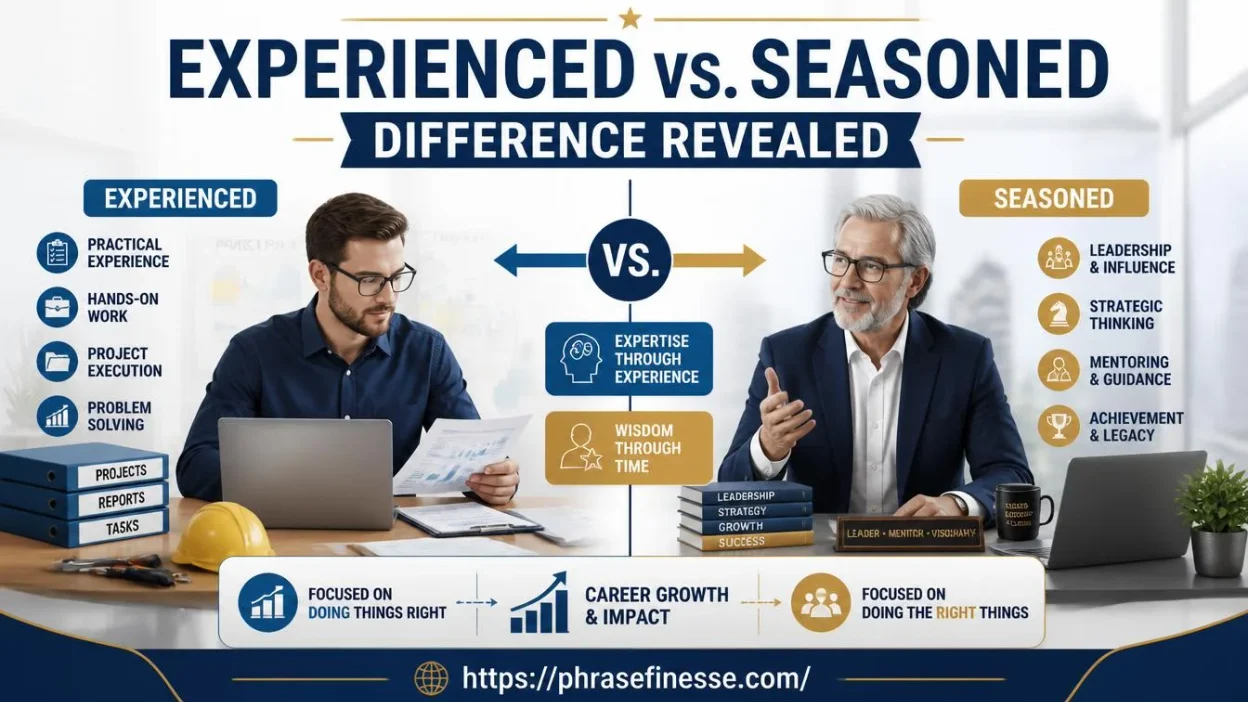
Aren’t experience and seasoned expertise really the same thing? Not quite. Experienced vs. Seasoned Difference Revealed explores a subtle distinction that often matters in professional communication, resumes, interviews, and formal writing.
Both terms describe someone with valuable knowledge, yet they can suggest different levels of depth, judgment, and practical understanding.
In everyday English usage, grammar, and workplace communication, choosing the right word can change your meaning. Someone may be experienced because they’ve handled a task repeatedly, while a seasoned professional often brings broader judgment developed through years of varied situations.
This distinction can appear in project management, meetings, scheduling, time management, online booking, and even broadcasting, where precision and context influence how your message sounds.
In this guide, you’ll discover the difference between experienced and seasoned, including their meanings, connotations, common usage, and practical examples.
You’ll also learn when each word works best and how to use them with consistency in professional and everyday writing. By the end, you’ll know whether experienced or seasoned better communicates the expertise you want to describe.
Quick Answer:
The simplest way to understand the difference is this:
Experience refers to accumulated practice. Seasoned refers to experience that has been refined by time, challenges, and wisdom.
Think of it like cooking.
Someone who has cooked dinner every night for three years is experienced. A chef who has spent decades mastering techniques, managing kitchens, solving problems under pressure, and mentoring others is seasoned.
Here’s a quick comparison:
| Feature | Experienced | Seasoned |
| Has practical knowledge | Yes | Yes |
| Has extensive expertise | Sometimes | Usually |
| Implies maturity | Not necessarily | Yes |
| Indicates strong judgment | Not always | Usually |
| Suitable for mid-level professionals | Yes | Less often |
| Suggests leadership | Not necessarily | Frequently |
| Implies proven track record | Sometimes | Often |
The Golden Rule
Every seasoned professional is experienced.
Not every experienced professional is seasoned.
That distinction makes all the difference.
What Does Experienced Mean?
The word experienced refers to someone who has gained knowledge, skill, or competence through direct involvement in an activity, profession, or situation.
An experienced person has done something enough times to understand how it works and how to perform it effectively.
Characteristics of an Experienced Person
An experienced individual typically:
- Has practical knowledge
- Understands common procedures
- Can complete tasks independently
- Has encountered typical challenges
- Possesses relevant skills
- Learns from previous situations
Experience develops through repetition.
The more you perform a task, the more comfortable and efficient you become.
For example:
- An experienced teacher understands classroom management.
- An experienced mechanic can diagnose common vehicle problems.
- An experienced writer knows how to structure content effectively.
However, experience alone doesn’t necessarily imply mastery.
Examples of Experienced in Sentences
Here are some natural examples:
- She is an experienced project manager with eight years in software development.
- The company hired an experienced accountant to oversee financial reporting.
- He’s an experienced traveler who has visited more than forty countries.
- The hospital employs highly experienced nurses in its emergency department.
Notice that these examples emphasize competence and familiarity rather than elite expertise.
Common Situations Where “Experienced” Is Used
You’ll often encounter the word in:
Professional Settings
- Resumes
- Cover letters
- Job descriptions
- LinkedIn profiles
Educational Environments
- Teachers
- Trainers
- Academic researchers
Everyday Contexts
- Sports
- Travel
- Parenting
- Hobbies
Because the term is broad, it works in many situations.
What Does Seasoned Mean?
The word seasoned goes beyond simple experience.
A seasoned person possesses extensive knowledge developed through years of practice, problem-solving, adaptation, and professional growth.
The term originally referred to wood being conditioned over time. Properly seasoned wood became stronger, more stable, and more reliable.
The same idea applies to people.
A seasoned professional has been “tested” by real-world challenges and emerged with greater wisdom.
Characteristics of a Seasoned Person
A seasoned individual often demonstrates:
- Deep expertise
- Strong judgment
- Strategic thinking
- Leadership capability
- Emotional intelligence
- Problem-solving skills
- Consistent performance
- Professional credibility
Unlike someone who merely accumulates years of work, a seasoned professional learns continuously and adapts effectively.
Examples of Seasoned in Sentences
Consider these examples:
- The company appointed a seasoned executive to lead the turnaround effort.
- Investors trusted the advice of a seasoned financial analyst.
- The courtroom fell silent as the seasoned attorney presented her argument.
- The organization hired a seasoned consultant to guide the restructuring process.
Each example suggests more than experience.
It suggests expertise combined with wisdom.
Where “Seasoned” Is Commonly Used
You’ll often find the term in:
- Executive leadership
- Consulting
- Law
- Finance
- Politics
- Entrepreneurship
- Military leadership
In these fields, judgment matters just as much as technical skill.
The Core Difference Between Experienced and Seasoned
Many people think the distinction comes down to years.
That’s only partly true.
The real difference lies in the quality and depth of knowledge gained through those years.
Experience vs. Expertise
| Factor | Experienced | Seasoned |
| Practical exposure | High | High |
| Knowledge depth | Moderate to high | Very high |
| Decision-making ability | Good | Exceptional |
| Leadership skills | Variable | Usually strong |
| Industry reputation | Optional | Often established |
| Ability to mentor others | Sometimes | Frequently |
| Strategic thinking | Developing | Advanced |
Experience teaches you what happened.
Seasoning teaches you why it happened and what to do next.
That’s a significant leap.
Why the Difference Matters
Choosing the correct word affects:
- Professional communication
- Hiring decisions
- Resume credibility
- Leadership perception
- Personal branding
Imagine describing yourself as a seasoned executive after only three years in management.
Most recruiters would likely view that description as exaggerated.
Accuracy builds trust.
Can Someone Be Experienced but Not Seasoned?
Absolutely.
In fact, this situation is extremely common.
Many professionals gain valuable experience without yet reaching seasoned status.
Case Study: The Software Developer
Consider two developers.
Developer A
- Five years of experience
- Built multiple applications
- Strong coding skills
- Excellent technical knowledge
Developer B
- Fifteen years of experience
- Led teams
- Managed crises
- Designed enterprise systems
- Mentored younger developers
- Guided business strategy
Both are experienced.
Only one is likely considered seasoned.
The difference lies in breadth, depth, and judgment.
Why Experience Alone Isn’t Enough
Several factors separate experience from seasoning:
Repetition Doesn’t Equal Growth
Someone can repeat the same task for years without expanding their expertise.
Complexity Matters
Handling difficult situations develops judgment.
Diversity of Challenges Matters
Exposure to different environments builds adaptability.
Reflection Matters
Seasoned professionals learn from successes and failures alike.
As leadership expert John Maxwell famously noted:
“Experience is not the best teacher. Evaluated experience is.”
That distinction is crucial.
Can Someone Be Seasoned Without Decades of Experience?
Surprisingly, yes.
Although seasoned usually implies many years of work, exceptional circumstances can accelerate development.
Situations Where It Can Happen
A professional may become seasoned relatively quickly through:
- High-pressure leadership roles
- Rapid career advancement
- Diverse project exposure
- Crisis management responsibilities
- Intensive industry involvement
For example, a startup founder might gain more practical business experience in seven years than someone else gains in twenty.
Important Limitation
Even so, using “seasoned” too early can sound inflated.
Most readers naturally associate the term with substantial experience and proven results.
When in doubt, it’s safer to use experienced.
Experienced vs. Seasoned in Job Descriptions
Employers often choose these words carefully.
Understanding their intent can improve your job search.
What Employers Mean by Experienced
When a company seeks an experienced professional, they’re usually looking for someone who:
- Meets minimum skill requirements
- Can work independently
- Requires limited supervision
- Understands industry basics
Examples:
- Experienced accountant
- Experienced marketer
- Experienced customer service representative
- Experienced technician
These roles typically focus on competence.
What Employers Mean by Seasoned
When employers seek seasoned professionals, they usually expect:
- Advanced expertise
- Leadership ability
- Strategic thinking
- Proven achievements
Examples:
- Seasoned executive
- Seasoned attorney
- Seasoned consultant
- Seasoned operations leader
These roles often involve significant responsibility.
Recruiter Interpretation
| Job Description Phrase | Likely Meaning |
| Experienced professional | Relevant work history |
| Highly experienced professional | Strong expertise |
| Senior professional | Advanced responsibility |
| Seasoned professional | Expert with proven judgment |
| Industry veteran | Long-established expert |
Understanding these signals can help you tailor applications more effectively.
Experienced vs. Seasoned on a Resume
Word choice matters enormously on resumes.
The right term enhances credibility.
The wrong term can raise skepticism.
When to Use Experienced
Use experienced if you:
- Have solid professional skills
- Possess relevant work history
- Are in a mid-career role
- Want accurate positioning
Example:
Experienced digital marketing specialist with seven years and content strategy expertise.
This sounds professional and believable.
When to Use Seasoned
Use seasoned if you have:
- Significant leadership experience
- Major accomplishments
- Industry recognition
- Long-term expertise
Example:
Seasoned operations executive with a proven record of scaling global supply chains across multiple regions.
This signals senior-level authority.
Resume Mistakes to Avoid
Overstating Expertise
Avoid using seasoned if your background doesn’t support it.
Using Buzzwords Without Evidence
Claims require proof.
Ignoring Context
Different industries interpret these words differently.
Forgetting Results
Always support experience with achievements.
For example:
Weak
Experienced sales manager.
Strong
Experienced sales manager who increased annual revenue by 35% across three regional markets.
Specifics create credibility.
Experienced vs. Seasoned in Everyday English
These words aren’t limited to workplaces.
People use them in everyday conversations too.
Travel Example
An experienced traveler may have visited many countries.
A seasoned traveler has likely dealt with:
- Lost luggage
- Flight cancellations
- Language barriers
- Unexpected emergencies
They know how to adapt quickly.
See More : What Does “Table Something” Mean? US vs. UK Usage
Sports Example
An experienced athlete understands the game.
A seasoned athlete understands:
- Competition psychology
- Team dynamics
- Pressure situations
- Long-term performance management
The distinction is subtle but important.
Parenting Example
A parent with one child may be experienced.
A parent who has raised several children through different life stages may be considered seasoned.
The latter often possesses greater perspective and practical wisdom.
Synonyms for Experienced
Depending on context, these alternatives may work better.
| Synonym | Meaning |
| Skilled | Strong practical ability |
| Competent | Reliable and capable |
| Proficient | Highly capable in specific tasks |
| Qualified | Meets required standards |
| Knowledgeable | Well-informed |
| Trained | Formally educated |
| Capable | Able to perform effectively |
Synonyms for Seasoned
These alternatives emphasize deeper expertise.
| Synonym | Meaning |
| Veteran | Long-term experience |
| Expert | Specialized mastery |
| Accomplished | Proven success |
| Distinguished | Highly respected |
| Established | Recognized authority |
| Master | Exceptional skill |
| Authority | Trusted specialist |
Each carries slightly different nuances.
Choose carefully based on context.
Common Mistakes People Make
Several misunderstandings repeatedly appear in professional communication.
Treating the Terms as Perfect Synonyms
While related, they are not identical.
Seasoned conveys more authority.
Experienced conveys competence.
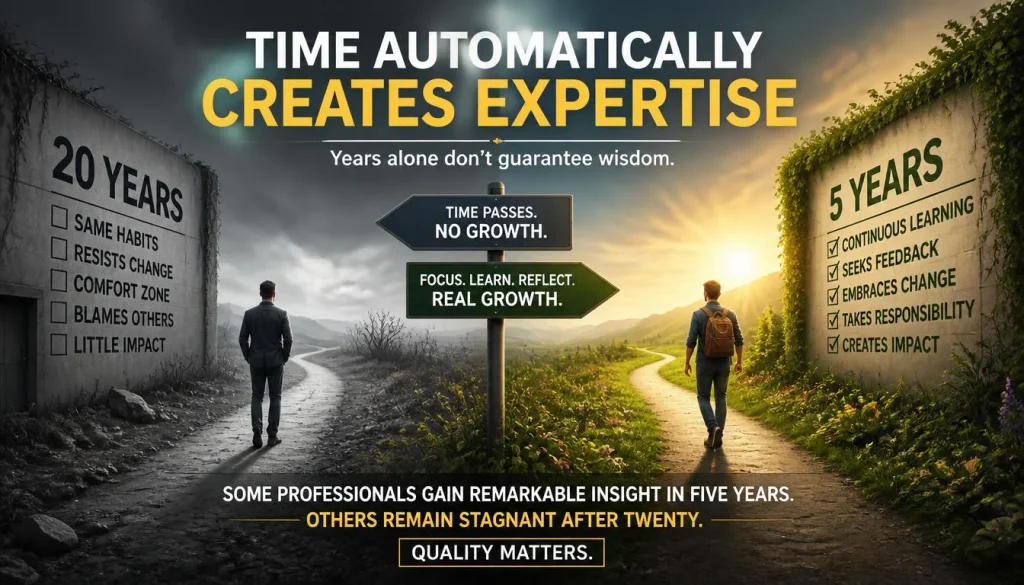
Assuming Time Automatically Creates Expertise
Years alone don’t guarantee wisdom.
Some professionals gain remarkable insight in five years.
Others remain stagnant after twenty.
Quality matters.
Using Seasoned as a Generic Compliment
Many people use seasoned simply because it sounds impressive.
That approach can backfire.
Readers often recognize exaggeration immediately.
Misreading Job Advertisements
A company seeking a seasoned leader usually expects strategic leadership experience.
An experienced professional may not automatically qualify.
Reading carefully improves application success.
Experienced vs. Seasoned: Side-by-Side Comparison Chart
| Question | Experienced | Seasoned |
| Has practical knowledge? | Yes | Yes |
| Has handled numerous challenges? | Often | Usually |
| Demonstrates mature judgment? | Sometimes | Frequently |
| Suitable for mid-career professionals? | Yes | Less commonly |
| Indicates leadership ability? | Not necessarily | Often |
| Implies industry recognition? | Rarely | Frequently |
| Suggests expert status? | Not always | Usually |
| Stronger professional compliment? | Moderate | Strong |
Which Word Should You Use?
The answer depends entirely on context.
Choose Experienced When
Use experienced if you want to emphasize:
- Practical knowledge
- Relevant work history
- Proven competence
- Professional capability
It’s accurate, versatile, and widely accepted.
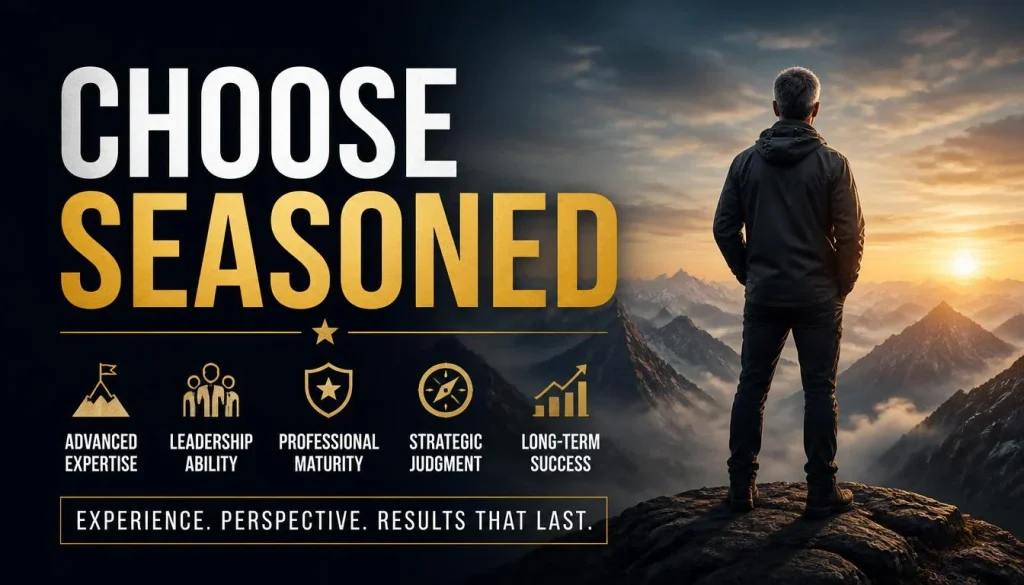
Choose Seasoned When
Use seasoned if you want to emphasize:
- Advanced expertise
- Leadership ability
- Professional maturity
- Strategic judgment
- Long-term success
The term carries greater weight.
Use it carefully.
FAQs
1. What is the difference between experienced and seasoned?
Experienced means someone has gained knowledge or skill through practice or repeated exposure. Seasoned usually suggests deeper expertise developed through extensive experience, varied situations, and sound judgment. Therefore, a seasoned professional is generally experienced, but an experienced person isn’t always described as seasoned.
2. Does seasoned mean more experienced than experienced?
Not necessarily, but seasoned often implies a greater depth of practical experience. It can suggest that someone has dealt with many different challenges and knows how to handle them effectively. For example, an experienced manager may understand daily operations, while a seasoned manager may also know how to navigate complex problems.
3. Is seasoned a formal word for experienced?
Yes. Seasoned works well in professional and formal writing, especially when describing someone’s expertise or maturity. However, it carries a stronger connotation than simply saying “experienced.” In a resume or business context, choose the word that accurately reflects the person’s actual level of expertise.
4. Can I use experienced and seasoned interchangeably?
Sometimes, but they don’t always create exactly the same meaning. Experienced focuses primarily on accumulated practice or exposure. Seasoned emphasizes experience combined with judgment, adaptability, and familiarity with challenging situations. Your choice should depend on the context and the impression you want to convey.
5. Is “seasoned professional” a good phrase?
Yes. Seasoned professional is a common phrase that describes someone with substantial experience and well-developed expertise. For example, “She is a seasoned professional with extensive experience in project management” clearly emphasizes both practical experience and professional maturity.
6. Which word should I use: experienced or seasoned?
Use experienced when you simply want to show that someone has performed a task or worked in a particular field. Choose seasoned when you want to emphasize extensive experience, maturity, confidence, or strong practical judgment. In professional business communication, the distinction can make your description more precise.
Conclusion
The difference between experienced and seasoned comes down to more than the number of years someone has worked. Experienced highlights knowledge or skill gained through practice, while seasoned often conveys deeper expertise, maturity, adaptability, and practical judgment.
When you choose between these words, consider the context, intended meaning, and level of expertise you want to communicate. Whether you’re writing a resume, describing a colleague, preparing formal documents, or improving your everyday English usage, the right word can make your message clearer and more precise.

Alyan Ashraf is an English language writer and editor at Phrase Finesse, where he specializes in grammar, vocabulary, spelling, word usage, and clear communication. Passionate about the English language, he creates practical, research-backed content that helps readers avoid common mistakes and write with greater accuracy and confidence.
Known for his clear writing style and attention to detail, Alyan simplifies complex language topics into easy-to-understand guides filled with real-world examples and actionable insights. His work covers confusing word pairs, grammar rules, idioms, punctuation, and everyday English usage, making learning both accessible and engaging for students, professionals, writers, and non-native English speakers.
Every article Alyan writes is carefully researched, fact-checked, and designed to meet high editorial standards. His goal is to help readers strengthen their English skills, expand their vocabulary, and communicate more effectively in academic, professional, and everyday settings.
Through Phrase Finesse, Alyan is committed to publishing trusted language resources that make mastering English simpler, clearer, and more enjoyable for learners around the world