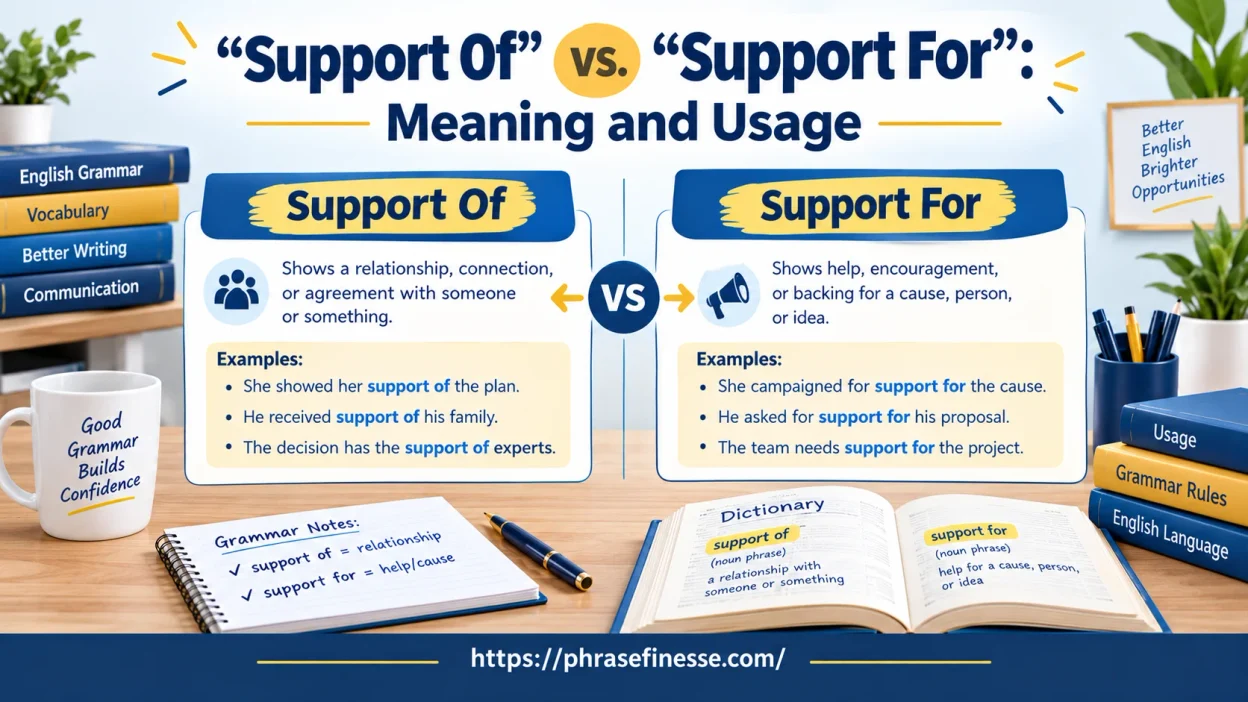
Absolutely. The introduction needs one key correction: “Support Of” vs. “Support For”: Meaning and Usage so the wording should focus on preposition choice rather than “correct spelling.” Here’s a polished version:Have you ever wondered whether “support of” or “support for” is the correct phrase? You’ll encounter both expressions in business communication, everyday writing, and formal documents.
Although they look similar, they serve different grammatical purposes. Choosing the right preposition depends on what you mean and how you use the word support in a sentence.
Understanding this distinction can make your writing clearer and more precise. You might use these phrases when discussing projects, policies, ideas, people, organizations, or decisions.
They also appear frequently in professional emails, reports, academic writing, and other forms of formal English. Using the appropriate expression helps you communicate your meaning without creating unnecessary ambiguity.
In this guide, you’ll learn the difference between “support of” and “support for,” including when to use each one.
We’ll examine clear definitions, practical examples, common sentence patterns, and real-world contexts. By the end, you’ll know which phrase fits your sentence and how to use both forms naturally and correctly.
Understanding “Support” Before Comparing “Support Of” And “Support For”
The word support has several meanings in English. It can function as both a noun and a verb, which affects how we use it with prepositions.
At its core, support means providing help, approval, encouragement, strength, or evidence for something or someone.
Consider these examples:
- Verb: “I support your decision.”
- Noun: “Thank you for your support.”
- Physical meaning: “The columns support the roof.”
- Evidence meaning: “The research supports this conclusion.”
Because the word has multiple meanings, the phrases support of and support for developed different uses over time.
A simple way to understand the difference is:
| Phrase | Main Idea |
| Support for | Approval, assistance, or backing directed toward something |
| Support of | The act, expression, or demonstration of supporting something |
Although the difference is subtle, context helps you choose the more natural option.

What Does “Support For” Mean?
The phrase “support for” is the more common expression in everyday English. It usually describes approval, encouragement, assistance, or backing given to a person, idea, organization, or cause.
When you use support for, the focus often falls on the thing receiving the support.
For example:
“There is growing support for renewable energy.”
Here, the sentence focuses on the public approval that renewable energy receives.
The supporters are not the main focus. The idea being supported is.
Using “Support For” To Show Approval Or Agreement
One of the most common uses of support for appears when discussing opinions, beliefs, movements, policies, or decisions.
Examples:
- There is strong support for the new education policy.
- The proposal received support for its innovative approach.
- Public support for climate action continues to increase.
- Many employees expressed support for the company’s new strategy.
In these examples, support for shows agreement or approval.
You can think of it like a spotlight shining on the idea being accepted.
Common situations where you’ll see “support for”:
- Political discussions
- Business decisions
- Social movements
- Public opinions
- Scientific ideas
- Community projects
Using “Support For” When Talking About Help Or Assistance
The phrase also describes practical or emotional help.
Examples:
- The organization provides support for small businesses.
- Students can receive support for academic challenges.
- The program offers financial support for families.
- She needed emotional support for dealing with stress.
Here, support for identifies who or what receives help.
Example comparison:
Support for employees
= Help provided to employees.
Support of employees
= The act of standing behind employees or defending them.
Both can work, but they highlight different ideas.
Common Real-Life Examples Of “Support For”
Business
Businesses often use support for when discussing customers, employees, or strategies.
Example:
“The company gained support for its environmentally friendly products.”
Meaning:
Customers approved of the products.
Education
Schools commonly use the phrase when discussing resources.
Examples:
- “The university offers support for international students.”
- “Teachers provide support for struggling learners.”
Healthcare
Healthcare organizations frequently use the phrase.
Examples:
- “Patients need support for managing chronic conditions.”
- “The program provides support for mental health awareness.”
Technology
Technology companies also use support for when discussing features or users.
Examples:
- “The software includes support for multiple languages.”
- “The device has support for wireless charging.”
In technology, support for often means compatibility.
“Support Of” Meaning And Usage
What Does “Support Of” Mean?
The phrase “support of” is also grammatically correct. However, it often sounds slightly more formal than support for.
It usually emphasizes:
- The action of supporting something
- Someone’s commitment to a cause
- A person’s role as a supporter
The phrase often focuses on the supporter rather than the thing receiving support.
Example:
“Her support of the charity helped thousands of people.”
The sentence highlights her action of supporting the charity.
Using “Support Of” To Describe Someone’s Actions
When you want to describe an individual’s or organization’s act of supporting something, support of often fits naturally.
Examples:
- His support of the local community inspired others.
- The company’s support of environmental programs is impressive.
- Her support of the project made success possible.
- Their support of the campaign attracted more volunteers.
Notice the focus:
- Who supported?
- How did they support?
- What action did they take?

Why “Support Of” Sounds More Formal
You’ll often find support of in:
- Academic writing
- Reports
- Speeches
- Formal announcements
- Historical descriptions
Example:
Formal:
“The organization’s support of scientific research contributed to major discoveries.”
Casual:
“The organization supported scientific research.”
Both sentences are correct. The first one emphasizes the organization’s contribution.
See More : What Does “Table Something” Mean? US vs. UK Usage
“In Support Of” — The Correct Expression
One of the most important phrases to remember is:
✅ in support of
❌ in support for
The expression “in support of” means showing agreement, approval, or encouragement.
Examples:
- Thousands gathered in support of equal rights.
- The team created a fundraiser in support of the hospital.
- They voted in support of the new proposal.
The phrase works like a fixed expression. Native speakers almost always use in support of.
Support Of Vs. Support For: Key Differences Explained
The difference between these phrases becomes clearer when you compare their purpose.
| Feature | Support For | Support Of |
| Frequency | More common in everyday English | More common in formal writing |
| Focus | The thing receiving support | The act of giving support |
| Meaning | Approval, assistance, backing | Demonstration of support |
| Tone | Neutral and conversational | Slightly formal |
| Example | “Support for the idea increased.” | “Her support of the idea was valuable.” |
Support For Vs. Support Of Examples Side By Side
| Sentence | Meaning |
| “There is support for the new law.” | People approve of the law. |
| “Their support of the new law was important.” | Their act of supporting the law mattered. |
| “The charity received support for its mission.” | The charity gained help or approval. |
| “Her support of the charity changed lives.” | Her contribution helped the charity. |
The difference is small, but the emphasis changes.
A Simple Trick To Choose Between “Support Of” And “Support For”
When you’re unsure, ask yourself one question:
Are you focusing on the thing being supported?
Use:
Support for
Example:
“There is increasing support for the new technology.”
The technology receives approval.
Are you focusing on the supporter’s action?
Use:
Support of
Example:
“His support of the new technology encouraged others.”
His action is the focus.
Common Mistakes With “Support Of” And “Support For”
Mistake: Using “In Support For”
Incorrect:
“They organized a protest in support for workers.”
Correct:
“They organized a protest in support of workers.”
Why?
Because “in support of” is an established English phrase.
Mistake: Thinking One Phrase Is Always Correct
Some writers believe support for is always right.
That’s not true.
Example:
Correct:
“Her support of the organization was appreciated.”
This sentence focuses on her contribution.
Mistake: Ignoring Context
Sometimes both phrases can work.
Example:
- “His support for the project was helpful.”
- “His support of the project was helpful.”
Both are grammatically acceptable.
However:
- Support for emphasizes approval or assistance.
- Support of emphasizes the act of supporting.
Case Study: How Meaning Changes With Context
Imagine a company launches a recycling program.
Sentence A:
“The company received support for its recycling program.”
Meaning:
Customers, employees, or the public approved the program.
Sentence B:
“The company’s support of the recycling program improved its reputation.”
Meaning:
The company’s own commitment helped the program succeed.
The topic remains the same, but the focus changes.
Examples Of “Support Of” And “Support For” In Different Contexts
Workplace Examples
Support for:
“Employees showed support for the new workplace policy.”
Meaning:
Employees approved the policy.
Support of:
“The manager’s support of employees improved morale.”
Meaning:
The manager actively helped employees.
Academic Examples
Support for:
“The study provides support for this theory.”
Meaning:
Evidence backs the theory.
Support of:
“The professor’s support of the research helped students succeed.”
Meaning:
The professor encouraged the research.
Community Examples
Support for:
“The project received support for its goals.”
Meaning:
People approved the goals.
Support of:
“Their support of the community created lasting change.”
Meaning:
Their actions benefited the community.
FAQs
1. Is “support of” grammatically correct?
Yes, “support of” is grammatically correct. It typically refers to backing, approval, or assistance involving a person, group, idea, policy, or cause. For example, “The organization expressed its support of the new policy.”
2. Is “support for” grammatically correct?
Yes, “support for” is also correct and often sounds more natural when you identify the specific person, idea, cause, or proposal receiving support. For example, “There is strong support for the proposal.”
3. What is the difference between “support of” and “support for”?
Both phrases can express approval or backing, but “support for” is generally more common when describing something that receives support. “Support of” can also be correct, particularly in formal writing or when emphasizing the act or relationship of supporting something.
4. Should I say “support for the project” or “support of the project”?
Both can be grammatically acceptable, but “support for the project” is usually the more natural choice in modern English. It clearly identifies the project as the thing receiving support.
5. Is “in support of” different from “support for”?
Yes. “In support of” is a longer expression that means acting or speaking to show approval or backing. For example, “Employees marched in support of the proposal.” Meanwhile, “support for the proposal” simply describes the backing that the proposal receives.
6. Which phrase should I use in professional writing?
In most professional situations, “support for” is a safe and natural choice when you’re describing approval or backing for something. However, “support of” remains correct in certain constructions. Always consider the complete sentence and the meaning you want to convey.
Conclusion
So, should you use “support of” or “support for”? Both phrases are grammatically correct, but they aren’t always interchangeable. “Support for” commonly identifies the person, idea, proposal, or cause receiving support, while “support of” can work in more formal or specific constructions.
When you’re unsure, look at what follows the phrase and ask what you’re trying to express. If you mean backing or approval for something, “support for” will often be the clearest choice. Learning this small distinction can make your professional writing, emails, reports, and everyday English sound more natural and precise.

Mia Rose is an English language specialist and editorial writer at Phrase Finesse, where she helps readers master grammar, vocabulary, spelling, and effective communication. Passionate about making English simple and practical, she creates well-researched, reader-friendly content that explains complex language concepts in a clear and engaging way.
With extensive experience in English language education, content writing, and editorial review, Mia specializes in grammar, punctuation, word choice, idioms, confusing word pairs, and writing style. Her articles are carefully researched, fact-checked, and designed to help students, professionals, writers, and English learners build confidence in both written and spoken English.