Have you ever wondered whether you should write “become” or “became” when describing a change? If you’re unsure, you’re not alone. Become or Became? Difference With Examples will help you understand exactly when to use each form.
These words look similar, but they serve different grammatical purposes and refer to different verb tenses. Once you understand their roles, you’ll find it much easier to choose the correct form in everyday English usage.
The key difference comes down to time and sentence structure. Become works as the base form and appears in several constructions, including the present tense, infinitive, and commands. Became, however, is the simple past form of become, so it describes something that happened in the past.
We’ll examine practical examples, common mistakes, sentence patterns, and the connection between grammar, formal writing, and everyday communication. You’ll also see how accurate verb choices support clarity in business communication, meetings, scheduling, online booking, broadcasting, calendar management, and project management.
By the end, you’ll know exactly when to use become and when to use became without second-guessing yourself. We’ll break down their meanings, grammatical functions, tense patterns, and real-world examples in a simple way.
Whether you’re writing an email, updating a calendar, preparing a report, or speaking in a meeting, consistency and correct verb usage can make your message clearer and more professional. Let’s explore the difference so you can use both forms confidently.
Quick Answer:
The simplest rule is this:
Became = simple past
Become = base form or past participle
The verb become means to start being something or to change into a different state, condition, role, or quality. Dictionaries list became as its past-tense form and become as its past participle.
Here’s the basic comparison:
| Word | Verb form | Typical use | Example |
| become | Base form | Present, infinitives, modals, future | I want to become a writer. |
| became | Simple past | Completed past change | She became a writer in 2020. |
| become | Past participle | Perfect tenses | She has become a writer. |
| becoming | Present participle | Continuous forms | She is becoming a writer. |
| becomes | Third-person singular present | Present simple | He becomes nervous easily. |
So, if you’re describing something that happened in the past, became will often be the right choice.
If another verb requires the base form or past participle, use become.
That one distinction solves most cases.
What Does “Become” Mean?
Become describes a change from one state, condition, role, or situation into another.
For example:
- She wants to become a doctor.
- The weather will become colder tonight.
- People become more confident with practice.
- The problem has become serious.
- He hopes to become a successful entrepreneur.
The verb can describe a physical change, an emotional shift, a professional development, or a broader transformation.
For instance, someone can become tired, become angry, become famous, become successful, or become a parent.
Cambridge defines become in this sense as meaning “to start to be,” while Merriam-Webster also describes it as coming to be or undergoing change or development.
Become as the Base Form
The base form is the dictionary form of a verb. With become, that form is simply become.
You’ll use it in several important structures.
After “to”
The infinitive follows this pattern:
to + become
Examples:
- I want to become a teacher.
- She hopes to become a lawyer.
- They plan to become business owners.
- He worked hard to become more confident.
- You need to become familiar with the process.
Notice that to became is never correct in standard English.
❌ She wants to became a doctor.
✅ She wants to become a doctor.
The word to introduces the infinitive, so the verb stays in its base form.
Become After Modal Verbs
Modal verbs also require the base form.
Common examples include:
- can become
- could become
- may become
- might become
- should become
- must become
- will become
- would become
For example:
- This could become a serious problem.
- She may become the team’s next leader.
- The situation will become clearer later.
- He might become more confident with experience.
- The process should become easier over time.
The pattern is straightforward:
modal + become
Not:
modal + became
Therefore:
❌ The situation will became worse.
✅ The situation will become worse.
What Does “Became” Mean?
Became is the simple past form of become.
You use it when you present a change as a completed event in the past.
Examples include:
- She became a doctor in 2020.
- He became interested in photography during college.
- The weather became colder overnight.
- They became close friends at school.
- The company became profitable after several years.
The important point isn’t simply that the event happened before now.
The sentence must also use the simple past structure.
Consider this example:
She became a manager in 2022.
The sentence presents her transition into management as a past event. The specific year makes that timeframe especially clear.
However, you don’t always need a stated date.
You can say:
She became more confident after gaining experience.
The phrase after gaining experience establishes the past context.
Become vs. Became: The Main Difference
The clearest way to understand become vs. became is to compare sentences describing similar changes.
| Become | Became |
| I want to become a writer. | I became a writer in 2021. |
| She will become a manager. | She became a manager last year. |
| They may become friends. | They became friends at college. |
| The situation could become difficult. | The situation became difficult yesterday. |
| People can become impatient. | People became impatient during the delay. |
The meaning of the verb remains similar. What changes is the grammatical form and timeframe.
Think of become as the flexible form that works with other grammatical structures.
Think of became as the form that independently carries the simple past.
That’s why these sentences work:
She became successful.
She has become successful.
She will become successful.
All three describe a change. Yet each sentence places that change in a different grammatical framework.
The Complete Verb Forms of Become
One reason become vs. became confuses learners is that become is an irregular verb.
Its main forms are:
| Form | Word | Example |
| Base form | become | I want to become successful. |
| Simple past | became | She became successful. |
| Past participle | become | She has become successful. |
| Present participle | becoming | She is becoming successful. |
| Third-person singular | becomes | He becomes nervous easily. |
The unusual part is easy to spot:
become → became → become
The first and third forms look identical.
That’s different from verbs such as go:
go → went → gone
It’s also different from write:
write → wrote → written
Because become uses the same spelling for its base form and past participle, learners sometimes mistakenly use became after auxiliary verbs.
That produces errors such as:
❌ She has became successful.
The correct version is:
✅ She has become successful.
When to Use “Become”
There are several common situations where become is the correct choice.
Use “Become” After “To”
Use the base form after to.
Examples:
- I want to become a teacher.
- She hopes to become famous.
- He plans to become a pilot.
- They need to become more organized.
- You have to become comfortable with change.
The grammatical formula is:
to + base verb
Since become is the base form, it follows to.
Use “Become” After Modal Verbs
Modal verbs don’t take the simple past form directly in these structures.
Examples:
- It can become expensive.
- It could become dangerous.
- The problem may become worse.
- She might become the next director.
- The company will become more efficient.
Again, the pattern is:
modal + become
This is why will became is incorrect.
Use “Become” in the Present Simple
You can also use become for general statements and repeated situations.
Examples:
- People become tired when they don’t get enough rest.
- Some problems become obvious only later.
- Children become more independent as they grow.
- I become nervous before important presentations.
With he, she, or it, the present form changes to becomes:
- She becomes nervous before interviews.
- He becomes frustrated easily.
- The situation becomes complicated quickly.
So don’t confuse become with becomes.
Use “Become” as a Past Participle
This is one of the most important rules.
The past participle of become is also become.
You use it with auxiliary verbs in perfect constructions.
Examples:
- She has become more confident.
- They have become close friends.
- He had become an expert before joining the company.
- The problem has become more serious.
- The situation had become difficult by then.
The formula is:
has/have/had + become
Never:
has/have/had + became
When to Use “Became”
Use became when the sentence uses the simple past.
This often happens when you’re describing a completed change that belongs to a past period.
Examples:
- She became a manager last year.
- He became interested in science at school.
- The room became quiet after the announcement.
- The weather became colder after sunset.
- They became friends during college.
Became With Specific Past Time
Certain expressions strongly support the simple past:
- yesterday
- last year
- last month
- in 2019
- two years ago
- during college
- after graduation
- when I was younger
- that morning
- later that evening
Examples:
She became a lawyer in 2019.
He became interested in music during college.
The company became profitable two years ago.
These sentences place the change inside a completed past timeframe.
Became Without a Specific Date
A common misconception says that became always needs a specific past-time expression.
That’s not true.
Consider:
The conversation became uncomfortable.
No date appears. Yet the sentence can still use the simple past because the surrounding context places the event in the past.
For example:
We discussed the issue for an hour. Eventually, the conversation became uncomfortable.
The first sentence establishes the past context. The second sentence naturally continues it.
“Has Become” vs. “Became”
This is one of the most important distinctions in everyday writing.
Compare:
She became a manager in 2020.
She has become an experienced manager.
Both sentences describe change. However, they present that change differently.
Became: A Past Event
Became presents the change as a simple past event.
She became a manager in 2020.
The sentence tells you when the transition happened.
Has Become: A Presently Relevant Result
Has become uses the present perfect.
She has become an experienced manager.
Here, the sentence emphasizes her current state or result.
The change happened over time, but its outcome matters now.
Cambridge provides examples such as “He has just become a father” and “Football has become big business,” illustrating this connection between a past change and a present state.
Compare the Meaning
| Sentence | Main focus |
| She became a manager in 2020. | The past transition |
| She has become an experienced manager. | Her current result |
| He became interested in history at school. | A past development |
| He has become interested in history. | His current interest |
| The city became popular after the festival. | A past change |
| The city has become popular. | Its current status |
The difference can be subtle.
Still, it’s meaningful.
See More : What Does “Table Something” Mean? US vs. UK Usage
“Have Become” vs. “Became”
Have become follows the same principle as has become, but the subject determines which auxiliary verb you need.
Use have become with:
- I
- you
- we
- they
- plural nouns
Examples:
- I have become more patient.
- You have become more confident.
- We have become better at communicating.
- They have become close friends.
- The students have become more independent.
Compare those with simple past:
- I became more patient after the experience.
- They became close friends at university.
- The students became more independent last year.
Again, became presents a past event.
Have become connects the change to the present.
“Had Become” vs. “Became”
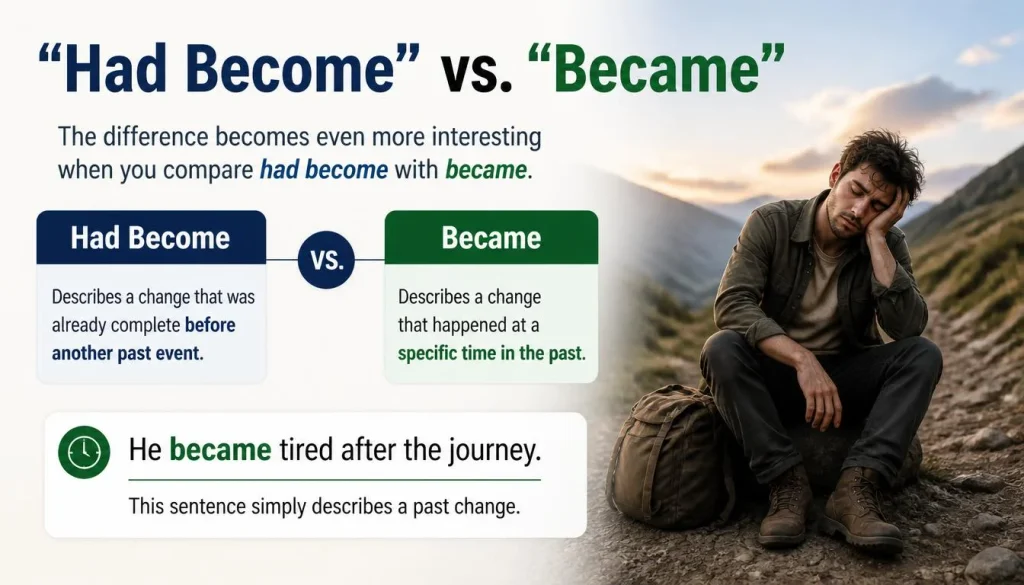
The difference becomes even more interesting when you compare had become with became.
Consider:
He became tired after the journey.
This sentence simply describes a past change.
Now compare:
He had become tired before the meeting started.
The second sentence contains two past events.
The first change happened before the second event.
The past perfect makes that sequence explicit.
The Timeline
Earlier past change → had become tired
Later past event → meeting started
For example:
By the time the doctor arrived, the patient had become increasingly weak.
The weakening happened before the doctor’s arrival.
That is why had become works naturally.
More Examples
- The situation had become serious before anyone reacted.
- She had become frustrated by the time the meeting ended.
- The roads had become dangerous before the storm arrived.
- He had become an experienced manager before joining the new company.
Using became instead wouldn’t always produce an impossible sentence, but it can remove the clear sequence that past perfect provides.
“Will Become” vs. “Became”
These forms point in opposite temporal directions.
Will become refers to a future change.
Became refers to a past change.
Compare:
- She will become a doctor next year.
- She became a doctor last year.
- The situation will become clearer soon.
- The situation became clearer yesterday.
- The city will become more crowded.
- The city became more crowded.
The grammar follows a simple pattern:
will + base verb
Therefore:
✅ will become
❌ will became
This same rule applies to other modal constructions:
- may become
- might become
- could become
- should become
- would become
“Did Become” vs. “Did Became”
This is another extremely common mistake.
When you use did, the main verb returns to its base form.
Therefore:
✅ Did she become a doctor?
❌ Did she became a doctor?
Why?
Because did already carries the past tense.
The structure is:
did + base verb
Examples:
- Did he become angry?
- When did they become friends?
- Why did she become interested in medicine?
- Did the situation become worse?
- How did he become successful?
The same principle applies to negative sentences:
- She did not become angry.
- They didn’t become close until later.
- He didn’t become famous overnight.
Notice that the verb remains become after didn’t.
“To Become” vs. “To Became”
This one is even simpler.
After to in an infinitive construction, use the base form.
Therefore:
❌ I want to became a writer.
✅ I want to become a writer.
More examples:
- She hopes to become a doctor.
- He wants to become financially independent.
- They plan to become homeowners.
- You need to become familiar with the rules.
- We expect the process to become easier.
A useful memory trick is:
To become, not to became.
The word to acts as a strong grammatical signal that the infinitive is coming.
Become vs. Became in Conditional Sentences
Conditional sentences can make verb choices look more complicated than they really are.
Consider:
If you work hard, you can become successful.
The modal can requires the base form become.
Now consider:
If she studied medicine, she could become a doctor.
Again, could requires become.
But look at a past conditional:
If he had accepted the offer, he might have become CEO.
Here, have become forms the perfect construction after might have.
The general pattern remains consistent:
- can + become
- could + become
- will + become
- would + become
- might have + become
- had + become
The surrounding auxiliary verbs determine the form.
Common Mistakes With Become and Became
These errors appear frequently because English uses several auxiliary structures.
| Incorrect | Correct | Reason |
| She has became successful. | She has become successful. | Has requires the past participle. |
| He will became a doctor. | He will become a doctor. | Will requires the base form. |
| Did she became angry? | Did she become angry? | Did carries the past tense. |
| She wants to became a writer. | She wants to become a writer. | Infinitives use the base form. |
| They had became friends. | They had become friends. | Had requires the past participle. |
| He became successful last year. | Correct | Simple past works here. |
| They have become successful. | Correct | Present perfect works here. |
Mistake: “Has Became”
This is probably the most important error to remember.
❌ The company has became successful.
✅ The company has become successful.
The reason is simple:
has + past participle
The past participle is become, not became.
Mistake: “Will Became”
❌ The situation will became worse.
✅ The situation will become worse.
The reason:
will + base form
The base form is become.
Mistake: “Did Became”
❌ When did she became interested?
✅ When did she become interested?
The reason:
did + base form
Once did carries the past tense, become stays in its base form.

Become vs. Became in Everyday English
Grammar becomes much easier when you see it in realistic situations.
Workplace Example
Imagine someone describing a career change.
Maya became a department manager in 2022.
This focuses on the past promotion.
Now consider:
Maya has become one of the company’s strongest managers.
This focuses on her current development and reputation.
The two sentences can describe the same person without saying the same thing.
Education Example
Daniel became interested in engineering during high school.
The sentence points to a past moment when his interest developed.
Now:
Daniel wants to become an engineer.
Here, the change hasn’t happened yet. It’s a goal.
Relationship Example
They became close friends during college.
That’s a completed past development.
Compare:
They have become like family.
The present relationship matters more than the exact moment when it developed.
Weather Example
Weather provides especially clear examples:
- The sky became dark.
- The sky is becoming darker.
- The sky will become darker.
- The sky has become darker.
- The sky had become dark before the rain started.
The underlying idea remains change.
The verb form changes because the sentence changes its tense or grammatical structure.
A Practical Case Study: Choosing the Right Form
Imagine this short story:
Emma moved to New York after college. At first, she struggled to adjust. Over time, she became more confident. She eventually became a successful designer. Today, she has become a respected professional. She hopes to become a creative director next year.
Notice how the forms work together:
| Sentence | Form | Why |
| She became more confident. | became | Completed past change |
| She became a successful designer. | became | Past event |
| She has become a respected professional. | has become | Present result |
| She hopes to become a creative director. | to become | Infinitive |
| She will become a creative director. | will become | Future possibility |
This small case study captures the entire rule.
The word doesn’t change because the meaning of become changes dramatically. It changes because the grammatical structure around it changes.
A Second Case Study: One Verb, Several Forms
Consider the following sequence:
The company became profitable in 2022. It has become much more competitive since then. It may become a market leader within the next few years.
Each sentence uses a different construction.
“Became profitable”
This describes a completed past transition.
“Has become more competitive”
This connects past development with the company’s present condition.
“May become a market leader”
This describes a possible future change.
The core verb remains the same.
Only its grammatical environment changes.
Become vs. Became: A Quick Decision Test
When you’re unsure which word to use, ask yourself a few questions.
Is it simple past?
If yes, use became.
She became a teacher in 2020.
Does another verb require the base form?
If yes, use become.
Examples:
- will become
- can become
- may become
- could become
- to become
- did become
Is it a perfect construction?
If yes, use become.
Examples:
- has become
- have become
- had become
- has been becoming
A compact formula makes the distinction easy:
Simple past → became
Base form → become
Past participle → become
Become vs. Became: Quick Comparison Chart
Keep this chart handy if you frequently hesitate between the two forms.
| Construction | Correct form | Example |
| Present simple | become/becomes | They become tired quickly. |
| Simple past | became | They became tired. |
| Infinitive | to become | They want to become successful. |
| Modal | can become | They can become successful. |
| Future | will become | They will become successful. |
| Present perfect | has/have become | They have become successful. |
| Past perfect | had become | They had become successful. |
| Question with did | did become | Did they become successful? |
| Continuous | becoming | They are becoming successful. |
This table reveals something important.
Became has a much narrower grammatical job than become.
You primarily use became as the simple past.
The form become, however, appears across several constructions.
FAQs
1. What is the difference between “become” and “became”?
Become is the base form of the verb, while became is its simple past form. Use become for present, future, infinitive, or modal constructions. Use became when describing a completed change that happened in the past.
- Present: She wants to become a manager.
- Past: She became a manager last year.
2. Is “became” the past tense of “become”?
Yes. Became is the simple past tense of become. The past participle is become, which can make this verb confusing because the base form and past participle look identical.
- Present: He becomes more confident.
- Past: He became more confident.
- Present perfect: He has become more confident.
3. Should I use “become” or “became” after “has”?
Use become, not became, after has or have. This construction requires the past participle.
Correct: She has become more experienced.
Incorrect: She has became more experienced.
The same rule applies to had: They had become close friends.
4. Can “become” refer to the future?
Yes. Become can describe a future change when you use it with a modal verb or another future construction.
For example:
- You will become more confident with practice.
- She may become the team leader.
- They hope to become successful entrepreneurs.
The word itself doesn’t always indicate present time. The surrounding sentence structure determines the meaning.
5. Which is correct: “I become” or “I became”?
Both can be correct, but they describe different situations. I become refers to a present, habitual, or general situation. I became refers to a completed change in the past.
- I become nervous before important meetings.
- I became nervous before yesterday’s meeting.
Choose the form based on when the action or change occurs.
6. What is the past participle of “become”?
The past participle of become is also become. Its three principal forms are:
| Verb Form | Example |
| Become | I want to become a writer. |
| Became | She became a writer last year. |
| Become | She has become a successful writer. |
Remembering these three forms can help you avoid common English grammar mistakes.
Conclusion
Understanding become vs. became becomes much easier when you focus on verb tense and sentence structure. Become serves as the base form and past participle, while became specifically expresses a completed past change.
When you describe something that happened previously, choose became. When your sentence requires the base form or past participle, use become. For example, you can say, “She became a manager last year,” but “She has become a manager” uses the past participle.
With a little practice, this distinction will become second nature. Pay attention to helping verbs, time references, and the overall structure of each sentence. That simple habit can improve your grammar, formal writing, business communication, and everyday English usage.