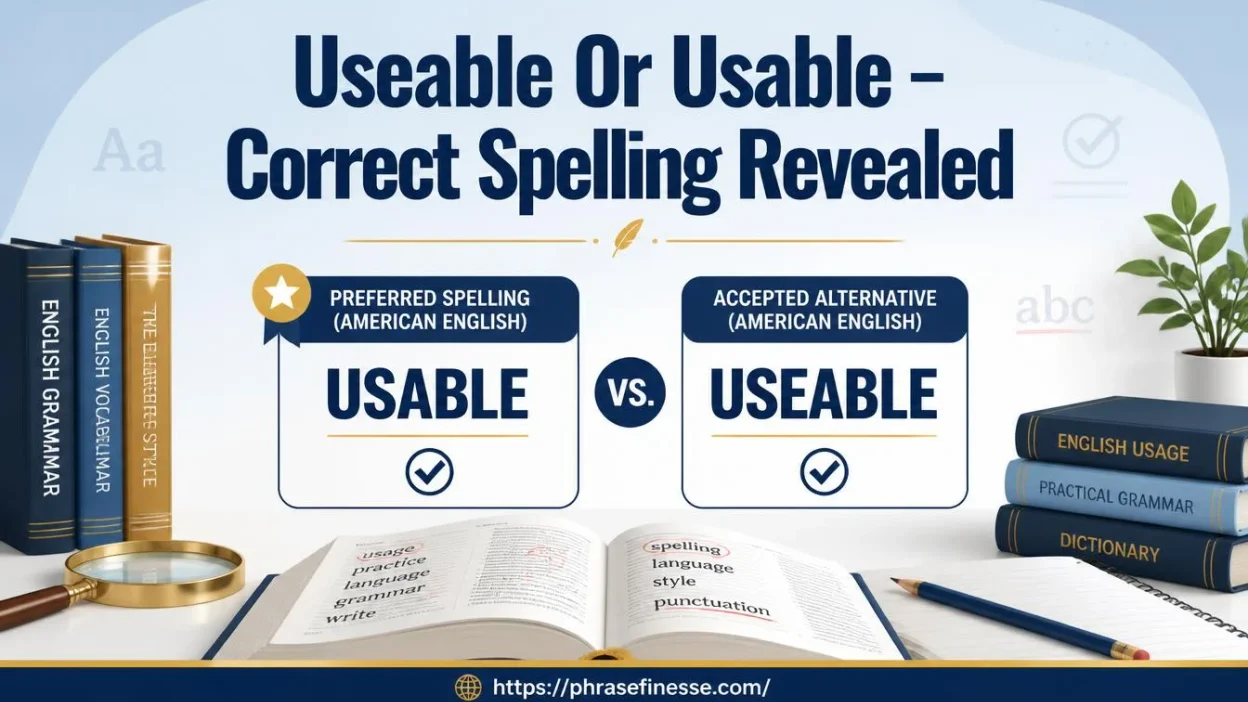
Useable Or Usable – Correct Spelling Revealed explains why usable is preferred, while useable remains a valid but less common spelling today.
When comparing useable and usable, the main distinction is spelling, not meaning. Both words describe something that can be used, but usable is the common spelling and preferred spelling in modern English.
Although useable is a recognized variant and an alternative spelling, it appears less often among readers and in written English. Both forms share the same definition and same meaning, so the choice usually comes down to word preference, spelling variation, and common usage.
In everyday English language use, usable is the safest choice for following standard English grammar, spelling rules, and English usage.
For example, an old computer may be still usable because it works properly, while a website may have a clean design and usable design. These examples show how usable relates to suitability for a particular purpose, practical use, and functionality.
The same principle applies to technical design, design contexts, and technical contexts, where usability and suitability matter. Although both forms are used interchangeably to describe something useful, their frequency of use and prevalence differ. You may encounter both in general contexts, but useable is not necessarily a mistake.
Consider your purpose, context, and specific technical connotation when making a spelling choice. Understanding word differences, spelling differences, spelling variations, word forms, word usage, language usage, English vocabulary, and alternative spellings helps you choose the correct spelling for an article or a question about English. Ultimately, a familiar form that suits your audience is usually the better option
Quick Answer:
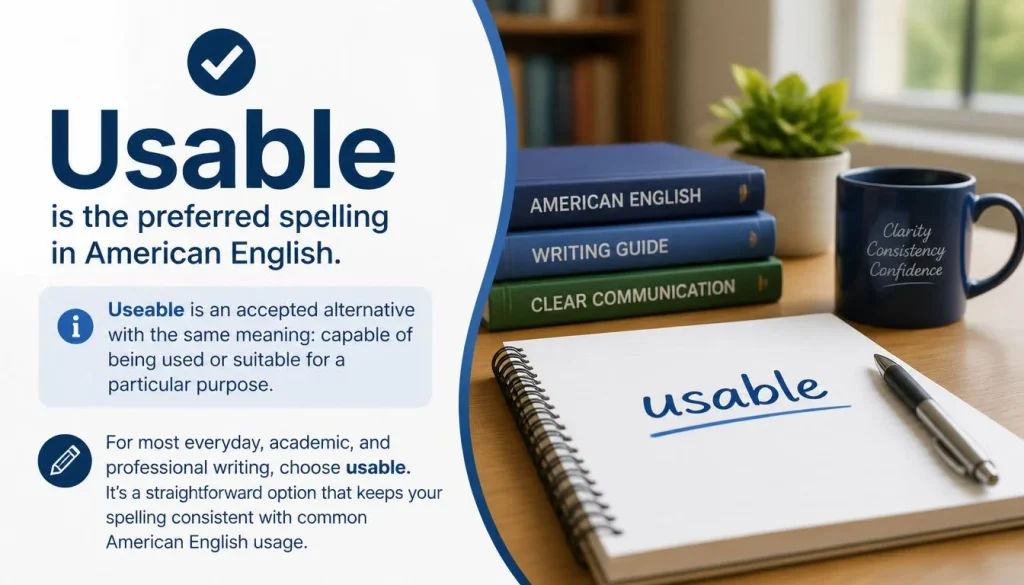
Usable is the preferred spelling in American English. Useable is an accepted alternative with the same meaning: capable of being used or suitable for a particular purpose.
For most everyday, academic, and professional writing, choose usable. It’s a straightforward option that keeps your spelling consistent with common American English usage.
| Question | Answer |
| Which spelling is preferred in American English? | Usable |
| Is useable a real word? | Yes, it’s a recognized spelling variant. |
| Do the two spellings mean different things? | No, they generally have the same meaning. |
| Are they pronounced differently? | No, they are generally pronounced the same way. |
| Which spelling should you use in formal writing? | Usable is the recommended default. |
For example:
- Correct and preferred: The software is easy to use and highly usable.
- Also accepted: The software is easy to use and highly useable.
The first sentence is the better default for standard American English writing. The second uses a recognized alternative rather than a different word.
What Does Usable Mean?
The word usable describes something that you can use for a particular purpose. It may work properly, be available when needed, or meet the basic requirements for a task. The exact meaning depends on the context.
According to the usable means capable of being used for a purpose. The also defines it as something fit, convenient, or ready for use.
Consider a laptop with an old battery. It might still run well when plugged into an outlet. Although the battery needs replacing, the laptop itself remains usable.
The same idea applies to many other things, including documents, buildings, data, tools, and online services. Something doesn’t have to be perfect to qualify as usable. It simply needs to serve its intended purpose.
The Two Main Meanings of Usable
The adjective usable generally communicates one of two closely related ideas.
1. Capable of being used
Something is usable when you can operate it, access it, or put it to work.
Examples:
- The damaged printer is still usable.
- We recovered a usable copy of the document.
- This old bicycle remains usable after a few repairs.
- The research team collected enough usable data for its analysis.
2. Suitable or available for practical use
Something can also be usable when it offers enough space, quality, or convenience for a particular purpose.
Examples:
- The apartment has 900 square feet of usable space.
- The software provides a usable interface for beginners.
- We need a usable plan before the project begins.
- Only a small portion of the building is usable after the storm.
Notice the difference between these meanings. The first focuses on whether something can be used at all. The second emphasizes whether it works well enough for a specific need.
Usable Does Not Always Mean Perfect
A common misunderstanding is that usable things must work flawlessly. That’s not what the word means.
Imagine finding an old wooden desk with a scratched surface and one loose drawer. You can still write on it, organize your papers, and keep your computer on top. The desk remains usable even though it needs some attention.
However, a desk with broken legs might not be usable until someone repairs it.
This distinction matters in everyday communication because usable describes practical suitability rather than perfection. Something may have flaws and still serve its intended purpose.
Why Do Usable and Useable Have Different Spellings?
The difference between usable and useable comes down to how English handles suffixes. Both spellings combine the idea of use with the suffix -able, which often means capable of or suitable for something.
The spelling question arises because English doesn’t apply one simple rule to every word ending in a silent e.
Consider these examples:
| Base word | Common spelling | Meaning |
| Use | Usable | Capable of being used |
| Move | Movable | Capable of being moved |
| Like | Likable | Easy to like |
| Name | Namable | Capable of being named |
| Change | Changeable | Capable of changing |
Some words drop the final e before adding -able. Others retain it because removing the letter could affect pronunciation or because the established spelling follows a different pattern.
For instance, changeable keeps the e to preserve the soft sound of the letter g. Without that letter, the spelling could suggest a different pronunciation.
The word usable follows the common pattern of dropping the final e. However, English also recognizes useable as an alternative spelling. The discusses this variation and identifies usable as the preferred form.
How the Suffix -Able Works
The suffix -able helps form adjectives that describe whether something can be done or whether something is suitable for a purpose.
For example:
- Readable: Easy enough to read.
- Washable: Able to be washed.
- Affordable: Within someone’s financial means.
- Understandable: Clear enough to understand.
- Reusable: Suitable for use again.
- Usable: Capable of being used.
These words share a useful pattern. They describe a quality or possibility rather than an action taking place at a particular moment.
For example, a washable jacket can be washed. A readable report is easy enough to read. Similarly, a usable tool can serve its intended purpose.
The spelling of each word depends on established English conventions. You can’t always determine the correct spelling by applying the same rule mechanically.
Does the Extra E Change the Meaning?
No. In this case, the additional e doesn’t create a different meaning.
Both usable and useable describe something that can be used or is fit for use. Dictionaries recognize the two spellings as variants rather than separate words with different definitions.
Compare these sentences:
- The map is usable for our hiking trip.
- The map is useable for our hiking trip.
Both sentences communicate the same idea. The writer considers the map suitable for the journey.
The difference is visual rather than semantic. For consistent American English writing, however, usable remains the simpler default.
Usable vs. Useable: Key Differences Explained
When comparing usable vs. useable, the most important point is that these forms don’t express different ideas. The distinction concerns spelling preference rather than grammar or meaning.
Here’s a closer comparison.
| Feature | Usable | Useable |
| Part of speech | Adjective | Adjective |
| Meaning | Capable of being used | Capable of being used |
| Pronunciation | /ˈjuːzəbəl/ | Generally the same |
| American English | Preferred default | Recognized alternative |
| British English | Common spelling | Also accepted |
| Formal writing | Recommended for consistency | Acceptable when following a chosen style |
| Common mistake | Assuming it must mean useful | Assuming it is always incorrect |
Dictionary entries support this distinction. Collins lists useable as an alternative spelling of usable in both American and British English. Cambridge provides its main entry under usable.
Which Spelling Should You Use in American English?
Choose usable unless a particular publication, organization, or style guide requires another form.
This recommendation works well for several reasons:
- It follows the main dictionary form used by major learner’s dictionaries.
- It avoids unnecessary spelling variation.
- It fits naturally into business writing, academic work, and online content.
- It aligns with related words such as usability and reusable.
Suppose you’re writing a software review. You might describe an application as having a usable interface. That wording is clear, familiar, and appropriate for an American audience.
Writing useable interface doesn’t automatically make the sentence wrong. However, the shorter spelling is a sensible choice when you’re deciding which form to use.
Is Useable Incorrect in Formal Writing?
Not necessarily. Calling useable universally incorrect would ignore its recognition in dictionaries.
The better question is whether the spelling fits your audience and editorial standards. If you’re following a company’s style guide, use the form it recommends. If no rule exists, choose usable and apply it consistently.
For example, a business might use usable throughout its product documentation. A writer who submits a document using useable may not have made a grammatical error, but an editor might still standardize the spelling.
Correctness and editorial preference aren’t always the same thing. A recognized variant can be acceptable even when another form is more widely preferred.
Read More : Joiners vs. Joiners: Which Is Correct?
Usable in a Sentence: Examples of Correct Usage
Examples make spelling rules easier to remember. Rather than memorizing a definition alone, look at how usable fits into everyday situations.
The following examples show how the word works in casual conversations, professional communication, technology, and data analysis.
Usable in Everyday English
In everyday English, usable often describes objects that still work or spaces that serve a practical purpose.
Examples:
- The old phone is still usable, although its screen has a small crack.
- We found a usable chair in the basement.
- Is this water bottle usable after washing it?
- The kitchen is small but perfectly usable.
- Most of the furniture survived the move and remains usable.
- The road should be usable again after the repairs.
- I need a usable bag for carrying groceries.
- The rain damaged the tent, leaving only one usable section.
Each example focuses on practical function. The object doesn’t necessarily look new or perform perfectly. It simply works well enough for the situation.
Consider the sentence, “The kitchen is small but perfectly usable.” The word usable tells you that the kitchen can serve its purpose despite its limited size.
That distinction helps readers understand the situation without requiring a long explanation.
Usable in Business and Professional Writing
Professional writing often uses usable to describe information, documents, plans, and resources that people can put into practice.
Examples:
- Please send a usable version of the report before the meeting.
- The team needs usable feedback to improve the proposal.
- We converted the figures into a usable format.
- The manager requested a usable action plan for next quarter.
- The client supplied usable information for the project.
- Our department needs more usable space for new employees.
- The presentation contains several usable ideas for the next campaign.
- Please ensure that the file remains usable on different devices.
In these examples, usable communicates practical value. A document might contain information yet remain difficult to work with because of poor formatting. A plan might look impressive but offer no clear next steps.
Calling something usable suggests that people can actually apply it to their work.
For example, consider the difference between these two statements:
- The report contains a large amount of information.
- The report contains usable information.
The first describes quantity. The second emphasizes whether the information can support a decision or task.
That distinction makes usable particularly helpful in business communication.
Usable in Technology and Software
Technology provides some of the clearest examples of the word’s meaning. A digital product can contain powerful features and still be difficult to operate.
Examples:
- The website needs a more usable navigation menu.
- The application remains usable on older smartphones.
- The software generates usable reports for the sales team.
- The damaged file contains no usable information.
- Developers created a usable interface for first-time visitors.
- The update made the dashboard more usable.
- The backup contains a usable copy of the original database.
- The device isn’t usable without its charging cable.
In technology, usable often refers to practical operation, access, or the quality of a user experience.
A website may offer dozens of features, but visitors can struggle if its menus are confusing. In that situation, the website may function technically while remaining difficult to use.
This is why designers often discuss usability, the quality of a product or system that affects how easily people can use it.
For example, a website with clear labels, readable text, and predictable navigation is generally easier to use than one with hidden menus and unclear instructions.
The related term usability is standard in user experience design. Writers should avoid assuming that the alternative spelling useable requires the related noun to be spelled useability in every context.
Usable in Data Analysis and Research
Researchers and analysts also use usable when discussing the quality of information gathered for a study.
Examples:
- The survey produced 300 usable responses.
- We removed incomplete entries before analyzing the data.
- Only a portion of the recordings contained usable audio.
- The research team needs usable evidence to test its hypothesis.
- The spreadsheet contains usable figures for the annual report.
- The experiment generated enough usable results for further analysis.
A dataset can contain thousands of entries without every entry being suitable for analysis. Some responses might be incomplete, duplicated, or unrelated to the research question.
In such cases, usable data means information that meets the requirements of the intended analysis.
For example, imagine a survey that receives 500 responses. If 40 respondents leave essential questions blank, researchers may exclude those entries from a particular analysis. The remaining responses might provide usable data for that specific purpose.
The number of usable responses depends on the research requirements. An entry that’s unsuitable for one analysis might still be useful for another.
This example illustrates an important point: usable is always connected to a purpose or standard.
Usable in a Sentence: Negative Forms
You can also use usable in negative sentences to explain that something cannot serve its intended purpose.
Examples:
- The damaged cable is no longer usable.
- We couldn’t recover a usable copy of the file.
- The room isn’t usable until the repairs are complete.
- The photographs were too blurry to provide usable evidence.
- Without the correct password, the account isn’t usable.
- The storm left several roads unusable.
The opposite of usable is unusable, which means not fit or not able to be used for the intended purpose.
Notice that unusable usually appears as one word. You don’t normally need to write not usable as two words when the single-word adjective communicates your meaning clearly.
Both forms can work, though. For example, “The room is not usable until Friday” is grammatically correct.
Is Useable a Real Word?
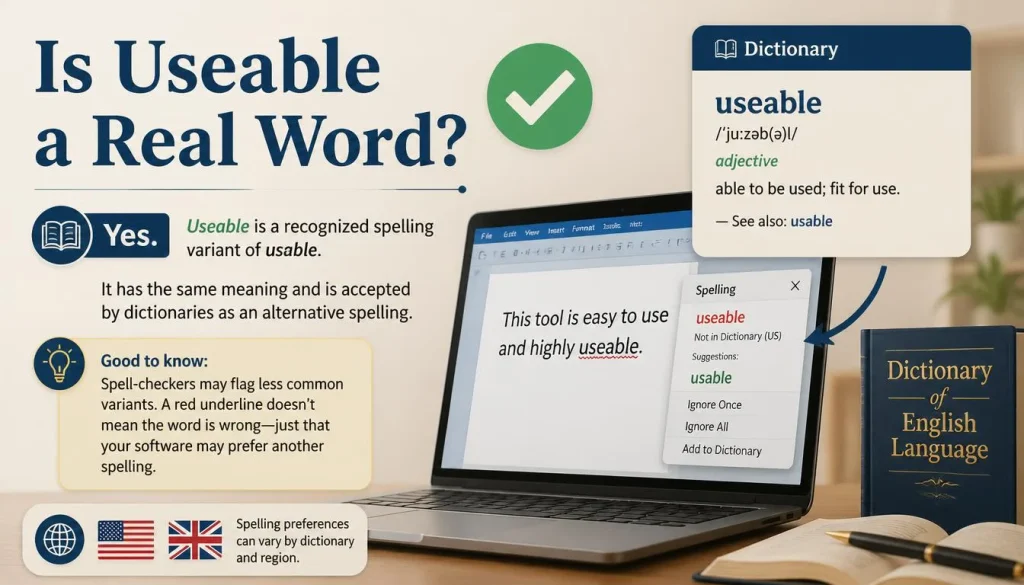
Yes. Useable is a recognized spelling variant of usable. It isn’t simply a misspelling invented by writers who misunderstand English grammar.
The identifies it as an alternative spelling of usable. Its definition points readers to the same basic meaning.
This distinction matters because online spell-checkers sometimes flag less common variants. A red underline doesn’t always prove that a word is invalid. It may indicate that the software follows a particular dictionary, regional setting, or preferred spelling.
For example, a word processor configured for American English might favor usable. A dictionary lookup can still confirm that useable exists as a recognized alternative.
Why Does Useable Appear in English Writing?
There are several reasons why you might encounter useable in published material.
First, English spelling includes variants. Some words have more than one accepted form, even when the forms share the same meaning.
Second, writers may follow different dictionaries or editorial preferences. A spelling used by one publication might be changed by another editor.
Third, writers sometimes preserve the final e when adding a suffix. That pattern appears in several English words, although it doesn’t apply uniformly.
The existence of useable doesn’t mean that you need to use it. It simply means you should distinguish between an accepted variant and an unmistakable spelling error.
Should You Change Useable to Usable When Editing?
If you’re editing American English content and have no reason to retain the longer spelling, changing useable to usable is a reasonable choice.
However, don’t make the change blindly in every situation. First, check whether the text follows a specific style guide or uses a consistent spelling system.
A practical editing process looks like this:
- Identify the audience and the expected variety of English.
- Check the preferred spelling in a reliable dictionary.
- Review the document for inconsistent forms.
- Standardize the spelling throughout the text.
- Check related terms such as usability and reusable.
This approach keeps your writing consistent without incorrectly labeling every variant as a grammatical mistake.
Usable vs. Useful: What’s the Difference?
Although usable and useful sometimes describe the same thing, they don’t mean exactly the same thing. The key difference is whether something can be used or whether it provides a benefit.
Usable means capable of being used or suitable for a particular purpose. Useful means helpful, beneficial, or valuable in achieving a goal.
Compare these examples:
| Sentence | Meaning |
| The old computer is usable. | The computer still works well enough to operate. |
| The old computer is useful. | The computer helps someone accomplish a task. |
| This guide is usable. | Readers can access and follow the guide. |
| This guide is useful. | The guide provides helpful information. |
| The room is usable. | The room can serve its intended function. |
| The room is useful. | The room meets someone’s particular needs. |
When Usable and Useful Overlap
Sometimes both adjectives describe the same situation.
For example:
- The online calculator is usable and useful.
- This reference book is both usable and useful for students.
- The software is usable enough to complete the task and useful for organizing results.
In these examples, usable emphasizes whether someone can operate or apply something. Meanwhile, useful highlights the benefit it provides.
A tool can be usable without being especially useful. An old calculator might work perfectly but offer little value to someone who already has a more advanced device.
Likewise, information can be useful in theory but difficult to access or apply. A complicated report might contain valuable insights yet remain challenging to navigate.
When you understand this distinction, you can choose the adjective that communicates your intended meaning more precisely.
Common Spelling Mistakes to Avoid
The spelling choice itself is simple, but a few common misunderstandings can lead to inconsistent writing.
Treating Useable as Always Incorrect
The first mistake is assuming that useable is never acceptable.
Dictionaries recognize it as a spelling variant. Therefore, the better approach is to understand the preference for usable without incorrectly describing every instance of useable as a spelling error.
Switching Between Usable and Useable
Using both spellings in the same article can make your writing look inconsistent.
For example:
Incorrectly inconsistent: The software offers a usable interface. Its reporting tools are also useable.
The sentence remains understandable, but the spelling changes without a clear reason.
A more consistent version would be:
Preferred: The software offers a usable interface. Its reporting tools are also usable.
Consistency is especially important in blog posts, product documentation, reports, and other long-form content.
Confusing Usable With Useful
These words overlap in meaning, but replacing one with the other can change your message.
Consider the sentence, “The file is usable.” It tells readers that they can open or work with the file.
By contrast, “The file is useful” suggests that its contents help someone achieve a goal.
Before choosing either adjective, ask yourself what you want to emphasize: practical usability or actual benefit.
Assuming Every Word Ending in E Follows the Same Rule
English spelling has patterns, but those patterns aren’t universal.
For example, movable commonly drops the final e, while changeable retains it. The spelling depends partly on pronunciation and established convention.
Don’t assume that adding -able always requires dropping the final e. When you’re unsure, check a reliable dictionary.
Overlooking Related Words
Writers sometimes focus so closely on usable vs. useable that they overlook related forms.
These are common examples:
- Usability: The quality or ease of being used.
- Reusable: Suitable for use again.
- Unusable: Not suitable or capable of being used.
- Usably: In a way that allows something to be used.
Choosing the standard forms helps maintain consistency across related words. For example, usability is the usual spelling in discussions about software design and user experience.
How to Remember the Correct Spelling of Usable
You don’t need a complicated grammar rule to remember this spelling. A few simple habits will help you choose the preferred form whenever you write.
- Use usable as your default. This is the straightforward choice for American English.
- Remember the basic meaning. If something can serve its intended purpose, it is usable.
- Check a dictionary when uncertain. The provides a reliable definition and pronunciation.
- Keep your spelling consistent. Avoid switching between usable and useable without a reason.
- Review your related vocabulary. Remember the standard forms usability, reusable, and unusable.
A simple memory trick is to think of usable as the spelling that gets straight to the point. You can recognize the word use inside it, followed by -able, which expresses possibility or suitability.
Although this shortcut won’t explain every English spelling pattern, it works well for this particular word.
Frequently Asked Questions
1. Is usable or useable the correct spelling?
Usable is the more common and generally preferred spelling in modern English. Useable is also an accepted variant, but it appears less frequently in everyday and professional writing.
2. Do usable and usable have the same meaning?
Yes, usable and useable have the same meaning. Both describe something that can be used or is suitable for a particular purpose.
3. Is useable grammatically incorrect?
No, useable is not grammatically incorrect. It is a recognized spelling variant of usable, although most readers are more familiar with the shorter form.
4. Why is usable more common than useable?
Usable is more common because English often favors shorter spelling forms when both versions are recognized. Over time, usable has become the standard choice in most modern writing.
5. Should I use usable in formal writing?
Yes, usable is generally the better choice for formal writing, academic work, business communication, and professional documents. It is widely recognized and helps keep your writing consistent with common English usage.
6. Can I use usable in a sentence?
Yes, you can use usable in many everyday and professional contexts. For example, “The old computer is still usable” means the computer continues to work well enough for its intended purpose.
Conclusion
Choosing between useable and usable is simple once you understand their spelling differences. Both words have the same meaning, but usable is much more common in modern English.
Although useable is an accepted alternative, usable is usually the safer option for everyday communication, academic writing, and professional documents. Using the more familiar spelling can help your writing look clear and consistent.
The next time you describe a tool, computer, website, or product that works for its intended purpose, choose usable. It is widely recognized, easy to understand, and appropriate for most writing situations.

Alyan Ashraf is an English language writer and editor at Phrase Finesse, where he specializes in grammar, vocabulary, spelling, word usage, and clear communication. Passionate about the English language, he creates practical, research-backed content that helps readers avoid common mistakes and write with greater accuracy and confidence.
Known for his clear writing style and attention to detail, Alyan simplifies complex language topics into easy-to-understand guides filled with real-world examples and actionable insights. His work covers confusing word pairs, grammar rules, idioms, punctuation, and everyday English usage, making learning both accessible and engaging for students, professionals, writers, and non-native English speakers.
Every article Alyan writes is carefully researched, fact-checked, and designed to meet high editorial standards. His goal is to help readers strengthen their English skills, expand their vocabulary, and communicate more effectively in academic, professional, and everyday settings.
Through Phrase Finesse, Alyan is committed to publishing trusted language resources that make mastering English simpler, clearer, and more enjoyable for learners around the world