Have you ever paused while writing a sentence and wondered whether “Independent From” Or “Independent Of”? Which Is Correct? is the correct choice? You’re not alone. These two prepositional phrases often appear interchangeable, yet their usage can depend on meaning, context, and English grammar.
Whether you’re writing an email, preparing formal writing, or simply trying to improve your English usage, choosing the right expression helps you communicate with greater clarity and consistency.
In this guide, you’ll learn the key difference between independent from and independent of, including when each phrase sounds natural and appropriate. We’ll examine grammar rules, common sentence patterns, practical examples, and formal versus everyday usage.
You’ll also see how the choice can affect professional business communication, especially when discussing project management, scheduling, time management, meetings, online booking, broadcasting, or a calendar system. These examples will make the distinction easier to recognize and apply.
By the end, you’ll know which expression to choose without second-guessing your sentence. More importantly, you’ll understand the English usage principle behind the choice rather than memorizing a single rule.
If you want your writing to sound polished, precise, and natural, understanding the difference between “independent from” and “independent of” is a small but valuable step toward stronger formal writing.
Quick Answer:
Both “independent of” and “independent from” can be grammatically correct. The better choice depends primarily on the meaning you want to express.
In general:
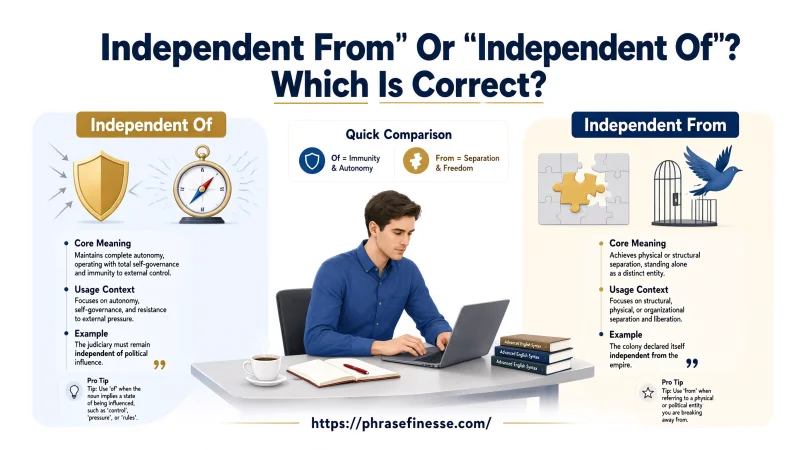
- Independent of usually means not dependent on, not influenced by, or not controlled by something.
- Independent from often emphasizes separation from or freedom from another person, organization, country, or authority.
- Independent of is often the safer choice in formal, academic, technical, and abstract contexts.
- Independent from works naturally when the idea involves separation or becoming free from a previous relationship or authority.
Consider these examples:
The results were independent of the participant’s age.
Here, the meaning is that age did not affect the results.
The company became independent from its parent organization.
Here, the focus is on separation between two organizations.
Quick comparison
| Expression | Main idea | Typical context |
| Independent of | Not dependent on or influenced by | Research, decisions, factors, organizations |
| Independent from | Separate or freed from | Countries, organizations, parents, former authorities |
| Independently of | Without depending on or being influenced by | Formal and academic writing |
| Independently from | Separately from | Less common and more context-dependent |
The distinction isn’t an absolute grammatical law. English allows some overlap, so context and intended meaning matter.
What Does “Independent” Mean?
Before comparing the prepositions, it helps to understand the adjective independent itself.
Independent generally describes someone or something that does not rely on another person, thing, or institution. It can also describe something that operates without outside control or influence.
The word has several closely related meanings.
Independent means not controlled by someone else
For example:
The organization is independent and makes its own decisions.
The organization doesn’t operate under the direct control of another organization.
Independent means not relying on something
For example:
She became financially independent after starting her own business.
The emphasis is on self-sufficiency.
Independent means unaffected by something
For example:
The outcome is independent of political pressure.
The political pressure does not determine the outcome.
Independent can describe political self-government
For example:
The country became independent after years of political struggle.
Here, independence refers to freedom from external political authority.
These different meanings explain why English can use more than one preposition after independent.
What Does “Independent Of” Mean?
“Independent Of” Meaning and Usage
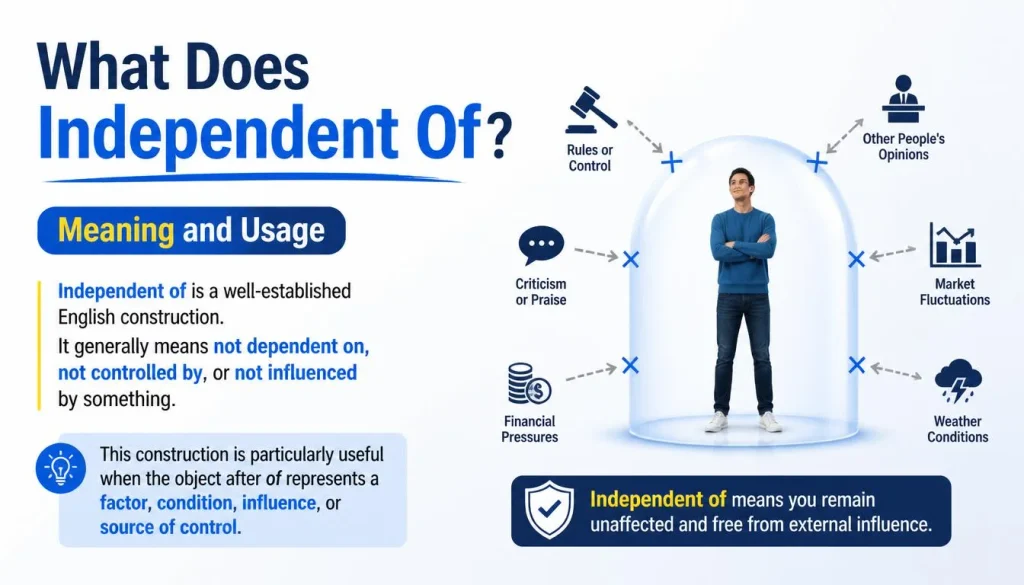
Independent of is a well-established English construction. It generally means not dependent on, not controlled by, or not influenced by something.
This construction is particularly useful when the object after of represents a factor, condition, influence, or source of control.
For example:
The decision was independent of public opinion.
The decision wasn’t determined by public opinion.
Another example is:
The system operates independently of the main network.
The system can function without relying on the main network.
When should you use “independent of”?
Use independent of when you want to communicate one of these ideas:
- Not influenced by something
- Not controlled by something
- Not dependent on something
- Not affected by something
- Separate in function or operation
- Unrelated to a particular factor
Let’s examine each use.
Independent of means “not influenced by”
Her decision was independent of her friends’ opinions.
The opinions existed, but they didn’t determine her decision.
Similarly:
The committee’s recommendation was independent of political pressure.
The recommendation wasn’t based on political influence.
Independent of means “not dependent on”
The project’s success is independent of external funding.
The project can succeed without depending on that funding.
This meaning appears frequently in academic writing, scientific writing, business reports, and technical documentation.
Independent of means “not affected by”
The treatment’s effectiveness appeared to be independent of the patient’s age.
The person’s age didn’t appear to determine the treatment’s effectiveness.
This construction is especially common when writers discuss variables, conditions, results, and relationships.
Independent of means “outside the control of”
The final decision is independent of the sales department.
This means the sales department doesn’t control the decision.
“Independent Of” in Formal Writing
If you’re writing a professional report, academic paper, business document, or formal email, independent of is often a particularly useful construction.
Consider:
The findings were independent of the researchers’ expectations.
This sounds precise because it clearly establishes a relationship between the findings and the researchers’ expectations.
You can also write:
The committee operates independently of senior management.
The sentence communicates institutional independence without necessarily suggesting that the committee separated from management.
Other useful examples include:
- The results were independent of external funding.
- The decision remained independent of political considerations.
- The analysis was independent of the original hypothesis.
- The committee must remain independent of management.
- The system operates independently of the central database.
Notice the common theme. These sentences focus on influence, dependence, control, or relationship, rather than physical or organizational separation.
What Does “Independent From” Mean?
“Independent From” Meaning and Usage
Independent from is also an established English construction. It often places greater emphasis on separation from another entity.
The expression works particularly well when someone or something becomes free from an earlier relationship, authority, institution, or source of support.
For example:
The company became independent from its former parent organization.
The important idea is that the company and parent organization were previously connected, but that relationship changed.
Another example:
She wanted to become financially independent from her parents.
The sentence emphasizes separation from financial dependence.
When does “independent from” work naturally?
Common contexts include:
- Political independence
- Organizational separation
- Corporate independence
- Financial independence
- Personal independence
- Freedom from former authority
- Separation from a previous institution
Political independence
One of the clearest contexts for independent from involves political separation.
The territory became independent from the former colonial government.
The sentence describes a change in political status.
The phrase can therefore work naturally when a country, territory, or political entity becomes free from another governing power.
Organizational independence
Consider:
The nonprofit became independent from the university.
This suggests that the nonprofit was previously connected to the university and later separated from it.
Compare that with:
The nonprofit is independent of the university.
This version emphasizes the nonprofit’s lack of dependence or control relationship.
Both can work, but the emphasis changes.
Financial independence
Independent from can also describe personal financial separation:
He became financially independent from his parents.
The sentence emphasizes the transition away from financial dependence.
However, you could say:
His financial security is independent of his parents’ income.
That sentence focuses on the relationship between two financial conditions rather than the process of separation.
“Independent Of” vs. “Independent From”: The Core Difference
The Main Difference Between “Independent Of” and “Independent From”
The easiest way to understand the distinction is to focus on what relationship you’re describing.
Independent of usually focuses on a lack of dependence, influence, or control.
Independent from often focuses on separation or freedom from another entity.
Think of the difference this way:
Independent of = “not dependent on.”
Independent from = “separate or freed from.”
This isn’t a rigid rule. Native English usage can overlap, and some sentences can reasonably use either expression.
Compare these sentences
The result is independent of income.
This means income doesn’t determine the result.
Now consider:
The organization became independent from its parent company.
This describes a separation between two organizations.
The first sentence describes a relationship between a result and a factor.
The second describes a change in organizational status.
“Independent Of” vs. “Independent From” Examples
The distinction becomes much clearer when you compare examples side by side.
| Context | Preferred expression | Example |
| Influence | Independent of | The decision was independent of public opinion. |
| Research variable | Independent of | The results were independent of age. |
| External factor | Independent of | The outcome was independent of weather conditions. |
| Organizational control | Independent of | The board is independent of management. |
| Political separation | Independent from | The country became independent from colonial rule. |
| Corporate separation | Independent from | The company became independent from its parent organization. |
| Financial separation | Independent from | She became financially independent from her parents. |
| Former authority | Independent from | The institution became independent from government control. |
Remember that these are usage tendencies, not unbreakable grammar laws.
“Independent Of” in Science and Research
The phrase independent of has a particularly important role in technical and academic English.
Researchers frequently need to explain that one variable doesn’t affect another.
For example:
The measured response was independent of temperature.
The sentence tells the reader that changes in temperature did not affect the measured response.
Another example:
The findings were independent of sample size.
Again, the writer describes a relationship between variables.
Why “of” works so naturally here
The preposition of commonly connects independent to the factor from which something is not dependent.
You can think of the structure as:
independent + of + factor
Examples:
- independent of age
- independent of income
- independent of temperature
- independent of location
- independent of external influence
- independent of political pressure
- independent of previous experience
This makes independent of especially useful in scientific, statistical, and analytical writing.
See More : Analysis On or Analysis Of? Easy Preposition Guide
“Independent From” in Politics and History
Political history provides some of the clearest examples of independent from.
When a territory changes its political relationship with another authority, from can emphasize the source of the separation.
For example:
The territory became independent from the empire.
The sentence describes a movement from one political condition to another.
The same principle can apply to organizations:
The institution became independent from the government.
Here, the writer highlights a change in institutional relationship.
However, independent of can also be used:
The institution is independent of government influence.
Now the focus isn’t necessarily on a historical separation. Instead, the sentence emphasizes lack of influence or control.
That distinction is subtle but useful.
“Independent From” in Business English
Business writing often requires careful choices because independent can describe several different relationships.
Consider:
The subsidiary is independent of its parent company.
This could mean the subsidiary operates without the parent’s control.
Now compare:
The subsidiary became independent from its parent company.
This more strongly suggests that the subsidiary previously belonged to or depended on the parent company and later separated.
Business examples
- The division operates independently of the company’s main office.
- The new business became independent from its former parent organization.
- The audit committee must remain independent of management.
- The brand became financially independent from its original investor.
- The department operates independently of the marketing team.
The intended meaning should guide your choice.
“Independent Of” for Ideas, Decisions, and Opinions
Another important use of independent of involves intellectual or personal judgment.
For example:
Her conclusion was independent of personal opinion.
This means personal opinion didn’t influence the conclusion.
You could also write:
The judge’s decision should remain independent of political pressure.
Here, independent of clearly communicates freedom from outside influence.
More examples:
- His judgment was independent of popular opinion.
- The recommendation was independent of financial incentives.
- Her analysis remained independent of the company’s interests.
- The decision was independent of personal preferences.
These are all natural uses of independent of because the sentences describe influence and dependence.
“Independent From” vs. “Independent Of” in Personal Contexts
Personal independence creates some interesting overlap.
Consider:
She became independent from her parents.
This suggests a transition toward separation or self-sufficiency.
You could also say:
She became independent of her parents.
This can emphasize that she no longer depends on them.
Both are possible, but the nuance differs.
Compare the emphasis
Independent from her parents
→ emphasizes separation or distance.
Independent of her parents
→ emphasizes lack of dependence or influence.
For example:
He is financially independent from his parents.
This can emphasize the fact that he no longer relies on them financially.
His career decisions are independent of his parents’ expectations.
This emphasizes that his parents’ expectations don’t influence his decisions.
That distinction is useful in everyday English.
Is “Independent From” Correct in Formal English?
Yes, “Independent From” Can Be Correct
One of the biggest mistakes is assuming that independent from is always grammatically incorrect.
It isn’t.
English dictionaries and established usage recognize independent from as a legitimate construction. The important question is whether it fits the intended meaning.
For example:
The country became independent from its former ruler.
There is nothing inherently ungrammatical about this sentence.
Likewise:
She became financially independent from her family.
This can be perfectly understandable and natural.
However, if you’re describing lack of influence or dependence, independent of will often be the more idiomatic choice.
Is “Independent Of” Always Better?
No. Context Still Matters
It’s tempting to conclude that you should simply replace every instance of independent from with independent of.
That’s not a good rule.
Consider:
The country became independent from the empire.
The phrase independent from naturally communicates separation.
Changing it to:
The country became independent of the empire.
is possible in some contexts, but it can shift the emphasis toward the country’s status or relationship rather than the act or process of separation.
Likewise:
The company became independent from its parent organization.
clearly suggests a structural change.
The writer is telling us that something happened between the two organizations.
Common Mistakes With “Independent From” and “Independent Of”
Mistake: Treating “Independent From” as Always Wrong
This is probably the most common misconception.
Independent from has legitimate uses. Don’t automatically mark it as incorrect.
Instead, ask what the writer means.
Mistake: Using “Independent From” for Every Abstract Relationship
Consider:
The results are independent from age.
Although readers will understand it, independent of age is generally the more established choice for this type of relationship.
Better:
The results are independent of age.
Mistake: Using “Independent Of” When Separation Is the Main Idea
Suppose a company formally separates from its parent organization.
The company became independent from its parent company.
This wording clearly communicates separation.
Replacing it automatically with independent of may weaken that particular emphasis.
Mistake: Ignoring Context
The preposition should reflect the relationship between the two elements.
Ask yourself:
Am I describing dependence or separation?
That question will often solve the problem immediately.
“Independently Of” vs. “Independently From”
The adjective independent isn’t the only related form that causes confusion.
Writers sometimes wonder whether they should use independently of or independently from.
“Independently of”
Independently of is a common formal construction meaning without being affected by, influenced by, or dependent on something.
Examples:
The two researchers worked independently of one another.
The system operates independently of the central server.
She made the decision independently of her colleagues.
This construction is especially useful in formal and academic writing.
“Independently from”
Independently from can occur when the writer wants to emphasize separate action or operation.
However, when the intended meaning is simply without dependence or influence, independently of is often the more natural choice.
For example:
The department operates independently of the main office.
This clearly expresses operational independence.
A Simple Rule for Choosing Between “Of” and “From”
If you struggle with this distinction, use this practical test.
Choose “independent of” when you mean:
- not dependent on
- not influenced by
- not controlled by
- not affected by
- unrelated to a particular factor
Examples:
The outcome is independent of income.
The decision was independent of political pressure.
The committee is independent of management.
Consider “independent from” when you mean:
- separated from
- freed from
- detached from
- no longer connected to
- no longer under the authority of
Examples:
The company became independent from its parent organization.
The country became independent from colonial rule.
She became financially independent from her parents.
The easiest memory trick
OF → dependence or influence
FROM → separation or freedom
It’s not a universal rule, but it’s a highly practical guide for everyday writing.
Case Study: Choosing the Right Expression
Let’s look at one example where the difference becomes especially clear.
Imagine a research organization that receives funding from a government agency.
You could write:
The research findings were independent of government funding.
This means the findings weren’t dependent on or affected by that funding.
Now imagine the organization previously belonged to the government but has recently separated.
You could write:
The research organization became independent from the government.
This describes a structural or institutional separation.
What changed?
The subject stayed roughly the same, but the relationship changed.
Independent of describes a condition of non-dependence.
Independent from can describe a state of separation.
This is why context matters more than memorizing a simple right-or-wrong rule.
Case Study: Business Communication
Imagine a company creates an audit committee.
If you want to explain that management cannot control the committee, write:
The audit committee is independent of management.
The focus is on lack of control.
Now imagine the audit committee was previously part of management and has been structurally separated.
You might write:
The audit committee became independent from management.
The focus is now on separation.
This distinction can make business communication more precise.
Case Study: Academic Writing
Suppose you’re writing about an experiment.
You want to explain that the results weren’t affected by the participants’ ages.
The natural construction is:
The results were independent of the participants’ ages.
Using from would be less natural for this particular meaning.
Why?
Because age is being treated as a variable or influencing factor, not as an entity from which the results physically or institutionally separated.
This is an excellent example of why independent of is especially useful in academic writing.
Case Study: Political Writing
Now consider a historical statement:
The territory became independent from the colonial government.
Here, from makes sense because the sentence describes political separation.
The territory was previously governed by another authority. Its new status represents a break from that authority.
You could also encounter independent of in political writing, especially when discussing a current condition:
The commission is independent of government control.
The commission may have been created separately, but the sentence’s main concern is whether the government controls it.
How Native-Like Usage Depends on Meaning
English prepositions rarely follow perfectly mechanical rules.
Words often develop conventional partnerships called collocations. These combinations become familiar because English speakers repeatedly use them together.
Independent of is a particularly strong collocation in contexts involving:
- variables
- influence
- control
- dependence
- conditions
- opinions
- decisions
- external factors
Meanwhile, independent from naturally appears in contexts involving:
- separation
- political independence
- organizational independence
- financial independence
- previous relationships
- former authorities
This is why looking at the whole sentence is more useful than memorizing isolated grammar rules.
“Independent From” Or “Independent Of” in Everyday English
In casual conversation, speakers may use both constructions without consciously analyzing the distinction.
For example:
I’m financially independent from my parents.
Most listeners will understand the intended meaning immediately.
You might also hear:
I’m financially independent of my parents.
This is also grammatical and can sound slightly more formal.
The important point is that everyday English often tolerates variation and overlap.
Formal writing, however, benefits from choosing the construction that most accurately expresses your intended relationship.
Which Form Should You Use in Formal Writing?
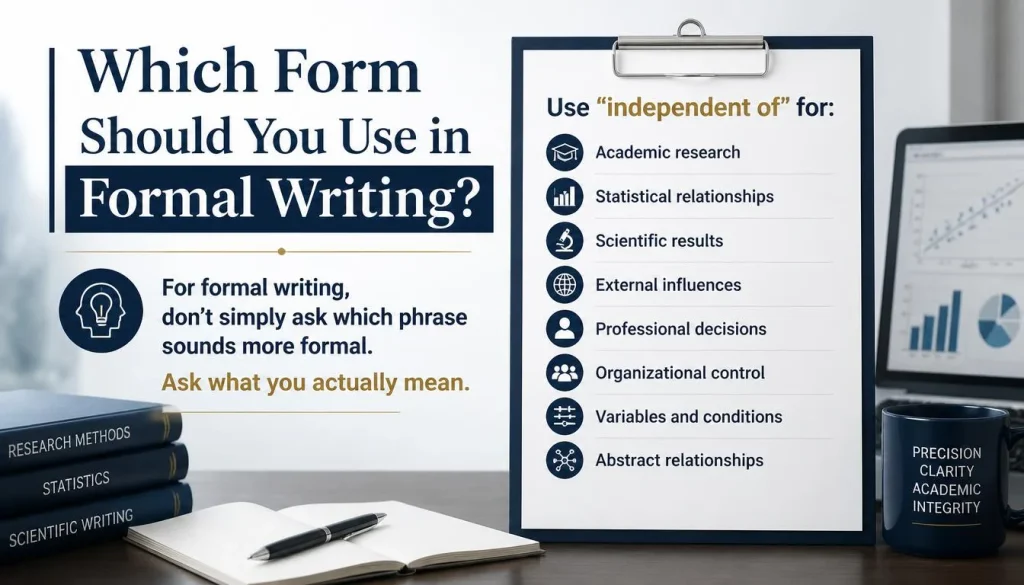
For formal writing, don’t simply ask which phrase sounds more formal.
Ask what you actually mean.
Use “independent of” for:
- Academic research
- Statistical relationships
- Scientific results
- External influences
- Professional decisions
- Organizational control
- Variables and conditions
- Abstract relationships
Examples:
The results were independent of location.
The committee operates independently of management.
The conclusion was independent of political considerations.
Use “independent from” for:
- Political separation
- Organizational separation
- Corporate restructuring
- Personal financial separation
- Freedom from a former authority
Examples:
The territory became independent from the former government.
The company became independent from its parent organization.
He became financially independent from his family.
Quick Reference: “Independent Of” vs. “Independent From”
| If you mean… | Recommended choice | Example |
| Not influenced by | Independent of | The decision is independent of politics. |
| Not affected by | Independent of | The outcome is independent of temperature. |
| Not dependent on | Independent of | Success is independent of luck. |
| Not controlled by | Independent of | The board is independent of management. |
| Separate from an organization | Independent from | The division became independent from the parent company. |
| Political separation | Independent from | The territory became independent from the former ruler. |
| Financial separation | Independent from | She became financially independent from her parents. |
| Freedom from former authority | Independent from | The institution became independent from government control. |
Again, treat the table as a practical guide, not an absolute grammatical formula.
FAQs
1. Is “independent from” or “independent of” correct?
Both “independent from” and “independent of” can be grammatically correct. However, “independent of” is generally more common and widely accepted, especially in formal writing. “Independent from” can work when you want to emphasize separation from a particular person, organization, system, or influence.
2. What is the difference between “independent from” and “independent of”?
The main difference involves usage and emphasis. “Independent of” usually describes freedom from dependence, control, or influence. “Independent from” often emphasizes separation or detachment from something specific. In many contexts, however, the two expressions can overlap.
3. Should I use “independent of” in formal writing?
Yes. “Independent of” is usually the safer choice for formal writing, academic writing, professional communication, and business communication. For example, “The department operates independently of the main organization” sounds natural and professional.
4. Can I say “independent from the company”?
Yes, “independent from the company” can be grammatically acceptable when the intended meaning emphasizes separation. However, “independent of the company” is often more idiomatic when you mean that something does not depend on, report to, or receive control from the company.
5. Is “independent of” more common than “independent from”?
Yes. “Independent of” is the more established and broadly preferred construction in standard English. It frequently appears when describing freedom from dependence, influence, control, or connection. Still, context determines which expression communicates your intended meaning best.
6. What is the easiest way to remember the difference?
A useful rule is to think of “independent of” as the default choice for freedom from dependence or influence. Use “independent from” when you specifically want to emphasize separation or distance from something. When in doubt, “independent of” will usually be the more natural option.
Conclusion
Choosing between “independent from” and “independent of” can seem confusing, but the distinction becomes clearer once you consider the intended meaning. “Independent of” is generally the more common and versatile expression, particularly when describing freedom from dependence, control, or influence. “Independent from” can also be correct when the sentence emphasizes separation or detachment.
The key is to focus on context rather than memorizing an inflexible rule. If you’re discussing formal writing, professional communication, or everyday English usage, choosing the expression that best reflects your intended relationship will make your sentence clearer and more natural. When no special emphasis on separation exists, “independent of” is usually the safest choice.

Mia Rose is an English language specialist and editorial writer at Phrase Finesse, where she helps readers master grammar, vocabulary, spelling, and effective communication. Passionate about making English simple and practical, she creates well-researched, reader-friendly content that explains complex language concepts in a clear and engaging way.
With extensive experience in English language education, content writing, and editorial review, Mia specializes in grammar, punctuation, word choice, idioms, confusing word pairs, and writing style. Her articles are carefully researched, fact-checked, and designed to help students, professionals, writers, and English learners build confidence in both written and spoken English.