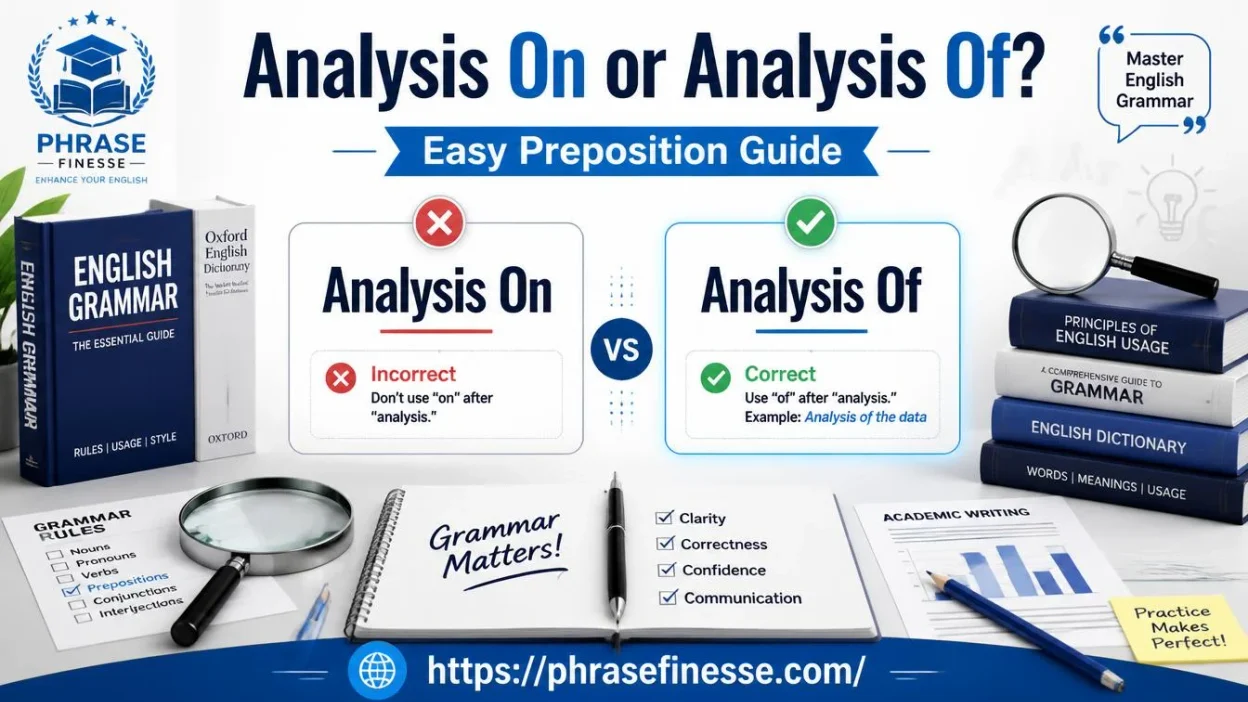
Have you ever paused over a sentence because you weren’t sure whether to write “analysis on” or “analysis of”? You’re not alone. Choosing the right preposition can affect clarity, precision, and formal writing.
In this guide, Analysis On or Analysis Of? Easy Preposition Guide explains the difference between these constructions and shows you which form works naturally in modern English usage. You’ll also learn how context influences preposition choice, especially in professional and academic communication.
Getting this small detail right can improve everything from reports and research papers to business communication. The same principle applies when you write about scheduling, time management, online booking, broadcasting, or meetings.
Whether you’re discussing a calendar, reviewing a project management strategy, or describing research findings, natural grammar helps your message sound polished and consistent. In most situations, “analysis of” is the standard and more idiomatic choice when you mean an examination or detailed study of something.
This guide breaks down the grammar in simple, practical terms. You’ll see clear examples, common mistakes, and useful alternatives that make your writing more precise. We’ll also explain when “analysis on” may appear, why it often sounds less natural, and how to choose the right construction with confidence.
By the end, you’ll have a straightforward rule you can apply across academic writing, professional documents, reports, and everyday English while maintaining accuracy and consistency.
Quick answer
Use “analysis of” when you mean an examination or detailed study of something. For example, “The report provides an analysis of customer behavior.” “Analysis on” is sometimes used, especially when writers mean an analysis concerning a particular topic, but it’s usually less natural in standard formal English. In most cases, “analysis of” remains the clearer and more idiomatic option for formal writing, academic work, and professional business communication.
In this guide, you’ll learn when to use each preposition and why the distinction matters. We’ll examine practical examples from meetings, project management, scheduling, time management, online booking, broadcasting, and calendar communication. You’ll also see
how English usage and consistency can make your writing sound more polished without making it complicated.
Is It “Analysis On” or “Analysis Of”?
The short answer is simple:
✅ Analysis of is the standard and preferred expression.
❌ Analysis on is usually considered unnatural or less idiomatic in modern English.
When you analyze something, that thing becomes the object of the analysis. Because of this relationship, English speakers naturally use the preposition of.
Examples
- Analysis of customer behavior
- Analysis of market trends
- Analysis of research findings
- Analysis of survey results
- Analysis of financial performance
These phrases sound natural because they directly identify what is being examined.
Quick Comparison Table
| Phrase | Correct? | Notes |
| Analysis of data | ✅ | Standard English |
| Analysis of a report | ✅ | Preferred form |
| Analysis of results | ✅ | Common in academic writing |
| Analysis on data | ❌ | Usually unnatural |
| Analysis on a report | ❌ | Rarely used |
| Analysis on climate policy | ⚠️ | Occasionally seen |
What Does “Analysis Of” Mean?
The phrase analysis of means a detailed examination of a specific subject, object, event, dataset, text, or situation.
In grammar terms, of connects the noun analysis to the thing being analyzed.
Think of it this way:
Analysis of X = Examination of X
The relationship is direct and clear.
Examples
- Analysis of customer feedback
- Analysis of stock market trends
- Analysis of Shakespeare’s plays
- Analysis of election results
- Analysis of economic growth
In every example, the word following of is the subject under examination.
Why “Of” Works So Naturally
English contains many nouns that describe an action or process. These nouns frequently take of when identifying their object.
Consider these examples:
| Noun | Standard Pairing |
| Examination | Examination of |
| Investigation | Investigation of |
| Study | Study of |
| Review | Review of |
| Analysis | Analysis of |
Because native speakers hear these patterns constantly, they sound natural and familiar.
Why “Analysis Of” Is the Preferred Expression
Language isn’t always governed by strict logic. Often, common usage determines what sounds correct.
In this case, analysis of dominates modern English.
Academic Writing
Research papers almost always use analysis of.
Examples:
- Analysis of survey responses
- Analysis of experimental data
- Analysis of historical documents
Business Writing
Companies regularly publish:
- Analysis of market conditions
- Analysis of sales performance
- Analysis of customer satisfaction
Journalism
News organizations often present:
- Analysis of election outcomes
- Analysis of economic indicators
- Analysis of policy changes
The pattern remains consistent across industries.
Frequency Matters
One reason analysis of feels more natural is frequency.
Native speakers encounter it thousands of times in:
- Books
- Journals
- Newspapers
- Academic databases
- Corporate reports
- Government publications
As a result, readers instantly recognize it as standard English.
Can “Analysis On” Ever Be Correct?
This is where things become slightly more nuanced.
Although analysis of is generally preferred, analysis on does occasionally appear.
However, its usage is limited.
Examples Sometimes Found
- Analysis on climate change policy
- Analysis on international trade
- Analysis on artificial intelligence adoption
In these cases, on introduces a broader topic rather than a specific object.
Even then, many editors would still rewrite the sentence.
Preferred Alternatives
Instead of:
- Analysis on customer behavior
Use:
- Analysis of customer behavior
Instead of:
- Analysis on market trends
Use:
- Analysis of market trends
Instead of:
- Analysis on economic performance
Use:
- Analysis of economic performance
The revised versions sound more natural and professional.
Why Some Writers Use “Analysis On”
Several factors contribute to this mistake.
Influence of Similar Expressions
People often see phrases like:
- Article on technology
- Book on economics
- Discussion on education
- Report on climate change
Since on commonly introduces topics, writers sometimes assume it works with analysis too.
Unfortunately, English doesn’t always follow predictable patterns.
Influence of Non-Native English
Many languages use equivalent structures that translate directly to analysis on.
When translated into English, the result can sound slightly unnatural even though the meaning remains understandable.
Analysis Of vs Analysis On: Side-by-Side Comparison
The differences become clearer when viewed together.
| Feature | Analysis Of | Analysis On |
| Standard English | ✅ Yes | ⚠️ Rare |
| Academic Writing | ✅ Common | ❌ Uncommon |
| Business Writing | ✅ Preferred | ❌ Rare |
| Professional Reports | ✅ Standard | ❌ Usually avoided |
| Natural to Native Speakers | ✅ Very natural | ⚠️ Less natural |
| Recommended Choice | ✅ Yes | ❌ Usually no |
The table highlights an important reality:
Analysis of wins almost every time.
Common Contexts Where “Analysis Of” Is Used
The phrase appears across countless disciplines.
Let’s examine some major categories.
Analysis Of in Academic Writing
Universities rely heavily on analytical writing.
Students and researchers regularly produce:
- Analysis of literary themes
- Analysis of survey data
- Analysis of historical events
- Analysis of scientific findings
Example
A psychology researcher might write:
“The study included an analysis of participant responses collected over six months.”
This construction sounds precise and professional.
Analysis Of in Business
Businesses depend on analysis to make informed decisions.
Common examples include:
| Business Area | Example |
| Sales | Analysis of revenue growth |
| Marketing | Analysis of campaign performance |
| Finance | Analysis of cash flow |
| Customer Service | Analysis of customer complaints |
| Operations | Analysis of workflow efficiency |
Without proper analysis, companies essentially fly blind.
Analysis Of in Science
Scientific research revolves around evidence.
Scientists regularly conduct:
- Analysis of laboratory samples
- Analysis of genetic material
- Analysis of environmental data
- Analysis of chemical compounds
Precision matters greatly in scientific writing, which is another reason analysis of remains dominant.
Analysis Of in Literature
Literary analysis represents one of the most common academic assignments.
Students often perform:
- Analysis of symbolism
- Analysis of character development
- Analysis of narrative structure
- Analysis of themes
For example:
“The essay provides an analysis of power dynamics in the novel.”
This structure immediately communicates what is being examined.
Analysis Of in Media and Journalism
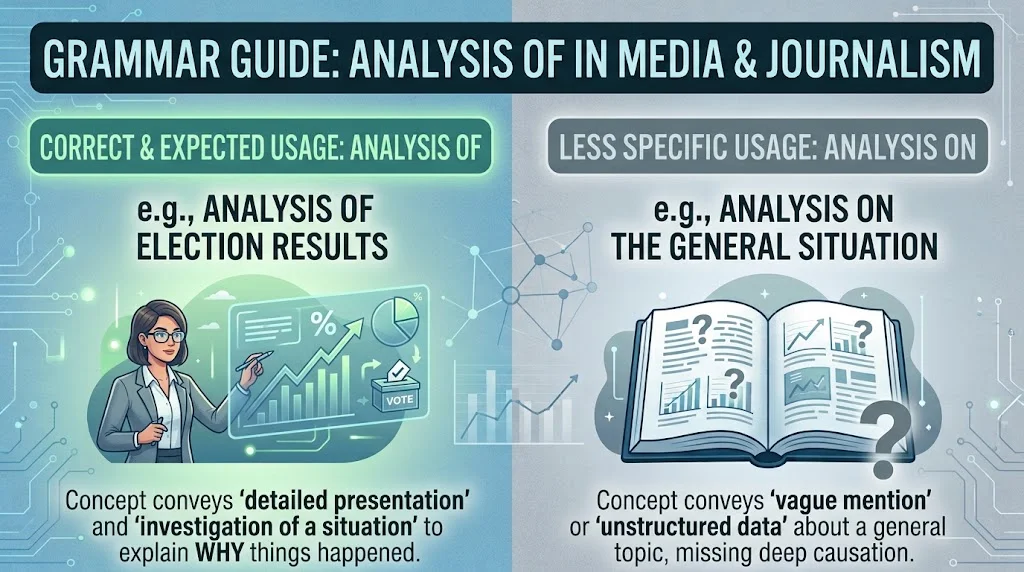
Modern journalism frequently includes expert analysis.
Examples include:
- Analysis of election results
- Analysis of geopolitical developments
- Analysis of economic indicators
- Analysis of sporting performances
Readers expect these pieces to explain not just what happened but why it happened.
Real-World Examples of Correct Usage
Here are examples that mirror professional writing.
Academic Example
“The researchers conducted an analysis of over 5,000 survey responses.”
Financial Example
“The report includes an analysis of quarterly earnings.”
Healthcare Example
“Doctors completed an analysis of patient outcomes.”
Technology Example
“The company published an analysis of cybersecurity threats.”
Sports Example
“Commentators offered an analysis of the team’s defensive strategy.”
Each sentence follows the same pattern:
Analysis of + subject being examined
See More : In Mind vs. On Mind: Difference Explained With Real Examples
Common Mistakes Writers Make
Even experienced writers occasionally misuse prepositions.
Let’s examine the most common errors.
Using “On” Instead of “Of”
Incorrect
- Analysis on sales data
- Analysis on customer behavior
- Analysis on market performance
Correct
- Analysis of sales data
- Analysis of customer behavior
- Analysis of market performance
Confusing Analysis With Report
Another source of confusion comes from similar nouns.
Consider these examples:
| Expression | Preferred Form |
| Report | Report on |
| Article | Article on |
| Discussion | Discussion on |
| Analysis | Analysis of |
Because report on is correct, writers sometimes mistakenly assume analysis on follows the same pattern.
It usually doesn’t.
Translating Directly From Another Language
Literal translation often creates awkward English.
Although readers may understand the intended meaning, the phrasing can sound unusual.
Professional editing frequently replaces analysis on with analysis of.
Case Study: How One Word Changes Professional Writing
Imagine two consultants preparing reports for a client.
Version A
Analysis on customer retention trends
Version B
Analysis of customer retention trends
Both communicate roughly the same idea.
However, Version B sounds more polished, natural, and professional.
That difference may seem small, but business communication often depends on details.
Clear language builds credibility.
Awkward language can create unnecessary distractions.
Similar Preposition Questions People Ask
The confusion surrounding analysis on and analysis of often appears with other nouns.
Understanding these patterns can improve your writing overall.
Study Of or Study On?
Both can appear.
Examples:
- Study of human behavior ✅
- Study on sleep patterns ✅
A study is often conducted on a topic but can also be a study of something.
Usage depends on context.
Research Of or Research On?
Correct:
- Research on climate change
Less common:
- Research of climate change
In this case, on usually wins.
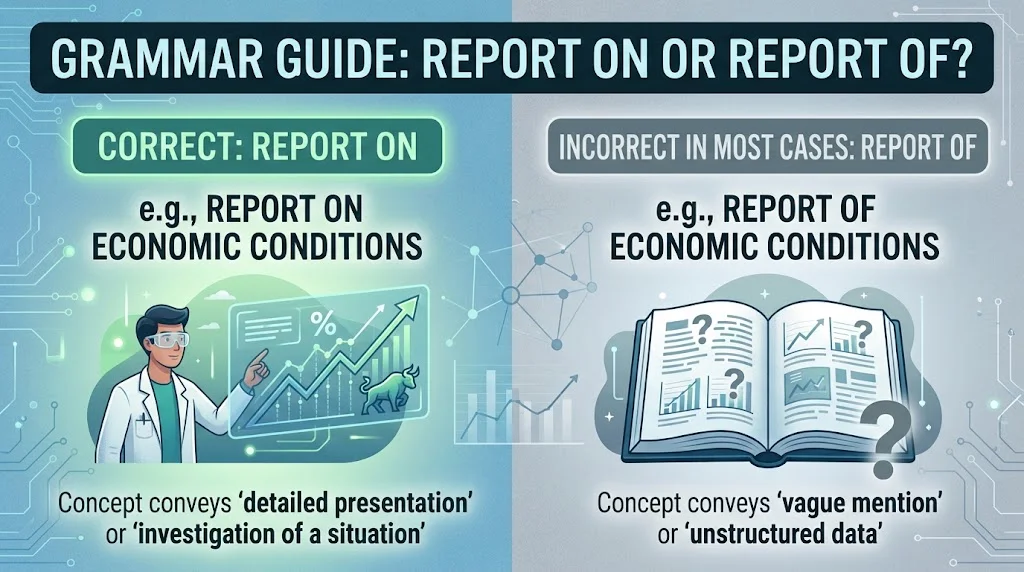
Report Of or Report On?
Correct:
- Report on economic conditions
Incorrect in most cases:
- Report of economic conditions
Discussion Of or Discussion On?
Both occur.
Examples:
- Discussion of the findings
- Discussion on environmental policy
Style guides may prefer one over the other depending on context.
Key Pattern to Remember
Many nouns pair naturally with particular prepositions.
Memorizing these combinations helps improve fluency.
| Expression | Preferred Preposition |
| Analysis | Of |
| Examination | Of |
| Investigation | Of |
| Report | On |
| Research | On |
| Article | On |
| Discussion | Of / On |
A Simple Trick to Remember the Difference
Here’s an easy rule.
Ask yourself:
What is being examined?
If you can identify a specific thing being analyzed, use of.
Formula
Analysis + Thing Being Examined
= Analysis Of
Examples:
- Analysis of customer feedback
- Analysis of financial statements
- Analysis of social media trends
- Analysis of employee performance
- Analysis of website traffic
This simple formula works in almost every situation.
Memory Shortcut
Think about a microscope.
A scientist places an object under the microscope and examines it closely.
The object becomes the focus.
Similarly:
- Analysis of data
- Analysis of results
- Analysis of behavior
The thing under examination follows of.

Expert Writing Advice
Many professional editors recommend a simple approach:
When in doubt, choose “analysis of.”
Why?
Because it aligns with standard usage across:
- Academia
- Journalism
- Government reports
- Scientific research
- Business communication
Using analysis of significantly reduces the chance of sounding unnatural.
Quick Reference Table
| Situation | Recommended Phrase |
| Academic paper | Analysis of |
| Research report | Analysis of |
| Business presentation | Analysis of |
| Scientific study | Analysis of |
| Marketing report | Analysis of |
| Financial review | Analysis of |
| General writing | Analysis of |
FAQs
1. Is it “analysis on” or “analysis of”?
“Analysis of” is usually the correct and more natural expression. Use it when you mean a detailed examination or study of something.
Example:
- The report includes an analysis of customer behavior.
- We completed an analysis of the survey results.
2. Can I use “analysis on” in English?
Yes, “analysis on” can appear in English, but it’s less common and often sounds unnatural. Writers sometimes use it when referring to research or discussion concerning a particular subject.
For most formal and academic contexts, “analysis of” remains the safer choice.
3. Why is “analysis of” more common?
The noun analysis typically takes of when you identify the subject being examined. The phrase clearly shows what the analysis examines.
For example, “an analysis of the data” means the data is the subject of the examination.
4. Is “analysis of” appropriate for academic writing?
Yes. “Analysis of” works naturally in academic papers, research reports, essays, and other forms of formal writing.
Example:
The study presents an analysis of economic trends over the past decade.
It sounds precise and professional without adding unnecessary complexity.
5. What are some alternatives to “analysis of”?
Depending on your meaning, you can use phrases such as “examination of,” “assessment of,” “evaluation of,” “review of,” or “study of.”
For example:
- Analysis of the results
- Examination of the results
- Evaluation of the results
- Review of the results
The best choice depends on the type and purpose of your analysis.
6. How can I remember whether to use “analysis on” or “analysis of”?
A simple rule works in most situations: use “analysis of” when you mean an examination of something.
Think of it this way: if you can replace analysis with examination, “of” will usually sound natural.
Example:
- An analysis of the report
- An examination of the report
So, when you’re unsure, “analysis of” will generally be your best choice.
Conclusion
Choosing between “analysis on” and “analysis of” may seem like a minor grammar decision, but the right preposition makes your writing sound more natural and precise. In most contexts, “analysis of” is the standard choice when you’re describing an examination or detailed study of something.
Use “analysis of” confidently in academic writing, professional reports, business communication, and everyday English. While “analysis on” can appear in certain contexts, it usually isn’t the most idiomatic option. When clarity and consistency matter, the simple choice is usually the strongest one.

Alyan Ashraf is an English language writer and editor at Phrase Finesse, where he specializes in grammar, vocabulary, spelling, word usage, and clear communication. Passionate about the English language, he creates practical, research-backed content that helps readers avoid common mistakes and write with greater accuracy and confidence.
Known for his clear writing style and attention to detail, Alyan simplifies complex language topics into easy-to-understand guides filled with real-world examples and actionable insights. His work covers confusing word pairs, grammar rules, idioms, punctuation, and everyday English usage, making learning both accessible and engaging for students, professionals, writers, and non-native English speakers.
Every article Alyan writes is carefully researched, fact-checked, and designed to meet high editorial standards. His goal is to help readers strengthen their English skills, expand their vocabulary, and communicate more effectively in academic, professional, and everyday settings.
Through Phrase Finesse, Alyan is committed to publishing trusted language resources that make mastering English simpler, clearer, and more enjoyable for learners around the world



[…] See More : Analysis On or Analysis Of? Easy Preposition Guide […]