Have you ever wondered whether “Relationship To” vs. “Relationship With”: Correct Version is the right choice for your sentence? This small preposition can change the meaning, tone, and grammatical accuracy of your writing.
Although both “relationship to” and “relationship with” are correct expressions, they typically serve different purposes. Understanding that distinction helps you communicate ideas more precisely in English usage, grammar, and formal writing.
The difference often depends on what kind of connection you want to describe. “Relationship with” commonly emphasizes a direct relationship between people, organizations, or entities, while “relationship to” often describes a connection, relevance, or association with something.
You may encounter both forms in business communication, meetings, project management, and everyday conversations. Choosing the right phrase can also improve clarity when discussing scheduling, time management, a calendar, online booking, or broadcasting arrangements.
In this guide, you’ll learn exactly when to use “relationship to” and when “relationship with” is more natural. We’ll explain their meanings, grammatical patterns, key differences, and practical examples in clear contexts.
You’ll also see common mistakes and learn how to maintain consistency across professional and everyday writing. By the end, you’ll have a simple framework for choosing the correct preposition confidently.
Quick Answer:
The simplest way to understand the difference is to look at what the sentence emphasizes.
| Phrase | Typical emphasis | Example |
| Relationship with | A connection, interaction, bond, or ongoing association | “I have a close relationship with my brother.” |
| Relationship to | How someone or something relates to a particular person, thing, or subject | “What is your relationship to the patient?” |
| Relationship between | The connection involving two explicitly named people or things | “The relationship between the two companies improved.” |
Here’s the crucial point: these aren’t three rigid grammatical boxes. English allows some overlap.
For instance, Oxford lists relationship with somebody for personal and family connections. It also records relationship to something for connections between things and ideas.
Cambridge offers a more specific usage rule. When you use the pattern “have a relationship with someone,” Cambridge says to use with, not to.
The easiest rule
If you want to say that you have a relationship with someone, choose with.
I have a good relationship with my parents.
Not:
❌ I have a good relationship to my parents.
That’s one of those cases where a tiny preposition makes a sentence sound noticeably more natural.
What Does “Relationship With” Mean?
“Relationship with” usually describes the connection between a person and another person, group, organization, or sometimes thing.
The phrase often emphasizes interaction, experience, communication, or the quality of a connection.
For example:
- “She has a close relationship with her sister.”
- “He has a difficult relationship with his father.”
- “We have a strong relationship with our customers.”
- “The manager developed a good relationship with her team.”
- “They maintain a professional relationship with several clients.”
Oxford’s dictionary examples use relationship with for family, working, romantic, customer, community, and other interpersonal contexts.
Why does “with” sound natural here?
Think about what with suggests.
The word naturally points toward connection and interaction. Two people communicate, cooperate, argue, trust each other, work together, or share experiences.
That’s why these combinations feel natural:
- a close relationship with someone
- a strong relationship with someone
- a healthy relationship with someone
- a difficult relationship with someone
- a professional relationship with someone
- a working relationship with someone
- a romantic relationship with someone
In other words, with often puts the relationship itself in the spotlight.
When to Use “Relationship With”
Use “Relationship With” for Personal Relationships
When you’re talking about family, friends, partners, or other personal connections, with is usually the best choice.
Consider these examples:
“I have a close relationship with my mother.”
“She has a complicated relationship with her brother.”
“He’s built a strong relationship with his children.”
“They’ve always had a good relationship with each other.”
Each sentence describes an ongoing interpersonal connection.
The focus isn’t merely on identifying who is related to whom. Instead, the sentence tells us something about the nature of the connection.
Use “Relationship With” for Professional Relationships
The same pattern works in business and workplace English.
For example:
- “I have a good relationship with my manager.”
- “The company has strong relationships with its suppliers.”
- “She maintains excellent relationships with her clients.”
- “The sales team developed a productive relationship with the customer.”
- “He has a difficult relationship with his supervisor.”
This construction works especially well with words describing relationship quality.
Common combinations
| Expression | Example |
| close relationship with | “She has a close relationship with her aunt.” |
| strong relationship with | “We have a strong relationship with our customers.” |
| good relationship with | “He has a good relationship with his manager.” |
| healthy relationship with | “She has a healthy relationship with her parents.” |
| professional relationship with | “I maintain a professional relationship with my clients.” |
| working relationship with | “He has a productive working relationship with his team.” |
| difficult relationship with | “They have a difficult relationship with their neighbor.” |
| strained relationship with | “The dispute created a strained relationship with the supplier.” |
Why “Have a Relationship With” Usually Takes “With”
Here’s where the grammar becomes particularly clear.
Cambridge specifically addresses the pattern “have a relationship with someone.” Its guidance says to use with, not to.
So write:
✅ I have a good relationship with my parents.
Not:
❌ I have a good relationship to my parents.
Likewise:
✅ “She has a close relationship with her sister.”
❌ “She has a close relationship to her sister.”
And:
✅ “He has a professional relationship with his clients.”
❌ “He has a professional relationship to his clients.”
A useful pattern to memorize
Think of this structure:
have + a/an + adjective + relationship + with + person
For example:
I have a strong relationship with my brother.
She has a healthy relationship with her parents.
We have a professional relationship with the company.
He has a difficult relationship with his manager.
This pattern is so common that learning it as a complete phrase can prevent unnecessary hesitation.
What Does “Relationship To” Mean?
Now comes the interesting part.
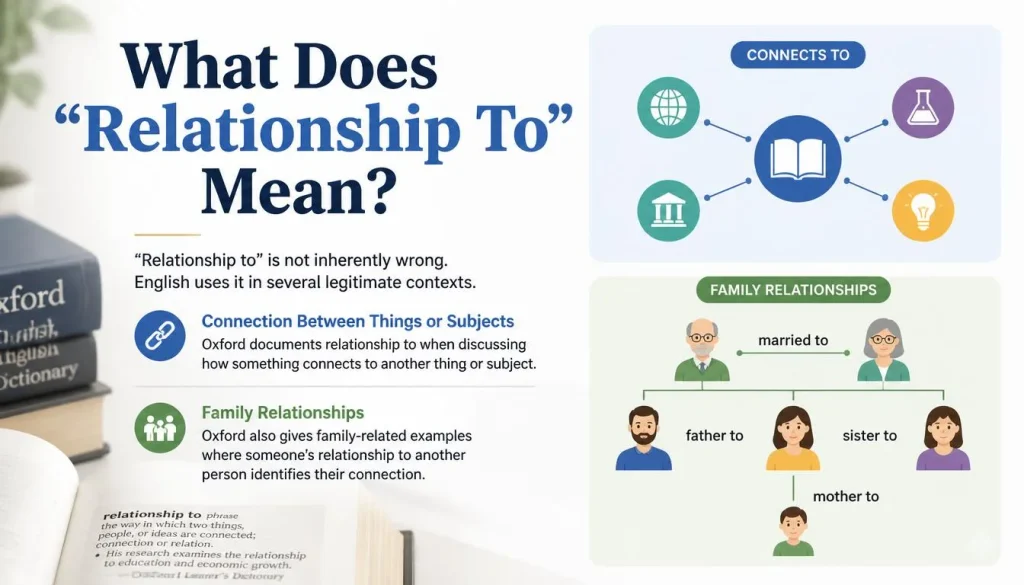
“Relationship to” is not inherently wrong. English uses it in several legitimate contexts.
Oxford documents relationship to when discussing how something connects to another thing or subject. It also gives family-related examples where someone’s relationship to another person identifies their connection.
For example:
“The comment bore no relationship to the subject.”
Here, to identifies the subject that provides the reference point.
You could also write:
“The study examines the relationship of exercise to mental performance.”
Or:
“The policy has a direct relationship to public safety.”
In these examples, to doesn’t describe a warm interpersonal bond. Instead, it establishes a connection between one thing and another.
When to Use “Relationship To”
Use “Relationship To” to Identify a Person’s Relation
This use commonly appears in forms, official questions, legal contexts, medical settings, and family discussions.
For example:
“What is your relationship to the patient?”
A possible answer might be:
“I’m her brother.”
Another example:
“What is your relationship to the applicant?”
Possible answer:
“I’m his father.”
Here, relationship to can function almost like relation to.
The question isn’t primarily asking whether you have a warm, difficult, close, or distant bond. It wants to know how you are connected to that person.
That distinction matters.
Compare These Two Questions
“What is your relationship with Sarah?”
This can ask about the nature of your connection.
Maybe Sarah is:
- your friend
- your coworker
- your partner
- your manager
- your neighbor
It could also invite a description of whether the relationship is close, difficult, professional, or romantic.
Now consider:
“What is your relationship to Sarah?”
This can sound more like a request to identify your specific connection or role.
You might answer:
“I’m her father.”
Or:
“I’m her legal guardian.”
Or:
“I’m her employer.”
The difference isn’t always absolute. Native speakers can use these questions in overlapping ways. Context determines what the speaker actually wants to know.
See More : Does “Government” Mean “Mind Control” in Latin? The Truth
“Relationship To” for Forms and Official Documents
This is one of the most useful contexts for understanding relationship to.
Imagine an application asks:
Relationship to Applicant: ______
The expected answer might be:
- Father
- Mother
- Spouse
- Brother
- Sister
- Guardian
- Employer
- Colleague
The phrase works because the form wants to establish your connection to the named person.
Common examples
| Form wording | Likely information requested |
| Relationship to applicant | Your connection to the applicant |
| Relationship to patient | Your connection to the patient |
| Relationship to employee | Your connection to the employee |
| Relationship to child | Your family or legal relation |
| Relationship to emergency contact | Your connection to that contact |
You may also encounter “relationship with” on forms. That doesn’t automatically make the form incorrect. Official documents sometimes use different wording depending on their purpose.
The safest approach is simple: follow the wording and instructions provided by the specific form.
“Relationship With” vs. “Relationship To” in Family Contexts
Family relationships make the distinction particularly interesting because both forms can appear.
“Relationship With” focuses on the bond
“I have a close relationship with my father.”
The sentence tells us about the quality of the connection.
You could expand it:
“I have a close relationship with my father because we talk every evening.”
The relationship itself is the subject of attention.
“Relationship To” can identify the family connection
“What is your relationship to the child?”
The expected response might be:
“I’m her grandfather.”
Here, the speaker identifies the family relation.
Oxford’s dictionary explicitly records both patterns in its discussion of family relationships. It includes examples involving relationship to and relationship with.
Side-by-side comparison
| Sentence | Main focus |
| “I have a close relationship with my father.” | The quality of the bond |
| “What is your relationship to the child?” | The speaker’s family connection |
| “She has a difficult relationship with her sister.” | The nature of their interaction |
| “His relationship to the patient is unclear.” | His connection or role |
“Relationship To” Can Describe Things, Ideas, and Subjects
Here’s an important point that often gets lost in simple grammar explanations.
Relationship to isn’t limited to people.
Oxford lists examples involving the relationship of one thing to another and gives constructions such as “relationship to something.”
Consider these examples:
- “The theory’s relationship to modern science remains debated.”
- “The evidence has a direct relationship to the investigation.”
- “The fee bears little relationship to the service provided.”
- “The concept has a close relationship to economic development.”
- “The character’s relationship to power shapes the novel.”
In each case, to establishes a connection to a reference point.
Relationship to a subject
“This argument has little relationship to the original question.”
Here, to means something close to in connection with or in relation to.
Relationship to a concept
“The research explores language’s relationship to identity.”
The sentence doesn’t describe two people interacting. It describes how one concept connects to another.
That is a perfectly legitimate use of relationship to.
“Relationship With” Can Also Describe Things
Don’t assume with only works for people.
English can use relationship with for organizations, systems, communities, and even abstract entities.
For example:
- “The company has a strong relationship with the community.”
- “The organization has a productive relationship with local authorities.”
- “The technology has a complex relationship with human behavior.”
- “The artist’s work has an unusual relationship with tradition.”
Oxford also documents relationship with something when describing connections between things.
This is why rigid rules can cause trouble. English usage isn’t a set of railway tracks with only one possible route.
“Relationship Between” Is Another Important Option
If you’re comparing two explicitly named people, groups, concepts, or things, relationship between can be the clearest construction.
For example:
“The relationship between the two companies has improved.”
“Scientists studied the relationship between sleep and memory.”
“The relationship between parents and children changes over time.”
“Researchers examined the relationship between income and education.”
Why use “between”?
Between explicitly places two entities on either side of the relationship.
Think of it as:
A ↔ B
The relationship exists between A and B.
That’s particularly useful in academic, scientific, business, and analytical writing.
Relationship With vs. Relationship To vs. Relationship Between
The three constructions become easier to understand when placed side by side.
| Construction | Typical function | Example |
| relationship with | Describes a connection or interaction | “She has a good relationship with her manager.” |
| relationship to | Describes relation or connection to a reference point | “What is your relationship to the patient?” |
| relationship between | Explicitly identifies two sides of a connection | “The relationship between the companies changed.” |
Oxford’s entries support all three patterns in different contexts.
“Relationship To” vs. “Relationship With” in Professional English
Workplace writing creates plenty of opportunities to use these expressions.
Suppose you’re describing a company’s customers.
“The company has a strong relationship with its customers.”
That’s natural because the sentence describes an ongoing business connection.
Now consider:
“The consultant’s relationship to the organization changed after the merger.”
Here, the writer may be focusing on the consultant’s position or connection to the organization, rather than the quality of their interactions.
More examples
Relationship with:
- “We have a productive relationship with our suppliers.”
- “She has an excellent relationship with her manager.”
- “The firm maintains close relationships with its clients.”
- “The director built a strong relationship with the team.”
Relationship to:
- “His relationship to the organization remains unclear.”
- “The report examines the policy’s relationship to economic growth.”
- “The regulation has a direct relationship to public safety.”
The distinction is subtle, but it gives your writing greater precision.
Case Study: Choosing the Right Preposition
Imagine a hospital receptionist needs to ask a patient’s visitor for information.
Version A
“What is your relationship with the patient?”
This can work perfectly well. The receptionist might simply want to understand who the visitor is and how they know the patient.
Version B
“What is your relationship to the patient?”
This sounds more focused on identifying the visitor’s specific relation to the patient.
The answer might be:
“I’m her son.”
Now imagine the hospital wants to understand the emotional nature of the connection.
“How would you describe your relationship with the patient?”
That’s clearly asking about the quality and nature of the relationship.
The wording changes because the question changes.
Common Mistakes With “Relationship To” and “Relationship With”
Mistake: Assuming “Relationship To” Is Always Wrong
This is the biggest misconception.
“Relationship to” is a legitimate English construction.
Oxford documents it for connections between things and for certain family-related uses.
So this statement is too broad:
❌ “Relationship to is always incorrect.”
A better rule is:
“Relationship to” is correct in specific contexts, but “relationship with” is normally preferred for the common interpersonal pattern “have a relationship with someone.”
Mistake: Using “To” After “Have a Relationship”
This is where Cambridge provides a direct correction.
❌ “I have a good relationship to my parents.”
✅ “I have a good relationship with my parents.”
Cambridge specifically recommends with in this construction.
So if you’re writing a sentence with have a relationship, the safest everyday pattern is:
have a relationship with someone
Mistake: Treating the Two Prepositions as Perfect Synonyms
Although the phrases overlap, replacing one with the other can shift the emphasis.
Compare:
“She has a strong relationship with her manager.”
This emphasizes their connection.
Now:
“Her relationship to the company changed after the merger.”
This can emphasize her position or connection relative to the company.
The difference may be subtle. Yet subtle distinctions often make formal writing more precise.
Mistake: Choosing the Preposition Without Considering Context
Prepositions aren’t decorative pieces.
They help establish relationships between ideas.
Before choosing to or with, ask:
What exactly am I trying to describe?
Are you describing:
- a bond?
- an interaction?
- a family role?
- a professional connection?
- a person’s relation to someone?
- a connection between concepts?
- relevance to a particular subject?
Once you answer that question, the correct construction becomes much easier to identify.
“Relationship To” vs. “Relationship With”: Side-by-Side Examples
Here’s a practical reference you can bookmark.
| Example | Better choice | Reason |
| “I have a close ___ my sister.” | with | Describes the personal bond |
| “What is your ___ the patient?” | to | Identifies the person’s relation |
| “She has a difficult ___ her boss.” | with | Describes interpersonal interaction |
| “What is his ___ the company?” | to | Focuses on his connection or role |
| “We have a strong ___ our customers.” | with | Describes an ongoing business connection |
| “The study examines the ___ exercise to health.” | to | Connects one concept to another |
| “What is your ___ the applicant?” | to | Identifies the specific relation |
| “He has a good ___ his coworkers.” | with | Describes workplace interaction |
| “The policy bears little ___ the issue.” | to | Indicates relevance or connection |
| “The ___ between the teams improved.” | between | Names both sides of the connection |
How to Choose the Right Preposition
When you’re stuck, use this quick decision process.
Ask whether you’re describing a bond
If yes, with is usually your best choice.
“She has a close relationship with her brother.”
Ask whether you’re identifying someone’s relation
If yes, to may be more appropriate.
“What is your relationship to the applicant?”
Ask whether you’re connecting two named things
If yes, consider between.
“The relationship between supply and demand is complex.”
Ask whether you’re using “have a relationship”
If yes, use with when referring to someone.
“I have a good relationship with my parents.”
That’s the pattern Cambridge explicitly recommends.
A Simple Memory Trick
Here’s a useful shortcut:
With = connection or interaction.
To = relation or reference point.
Between = two sides of a connection.
1.Think of with as two people standing together.
2.Think of to as an arrow pointing toward a reference point.
3.Think of between as a line connecting two named points.
For example
With:
“My relationship with my sister is strong.”
To:
“What is your relationship to the patient?”
Between:
“The relationship between the two departments is improving.”
This isn’t an ironclad grammatical formula. It’s a memory aid that helps you make the right choice quickly.
Is “Relationship To” Grammatically Correct?
Yes, it can be.
The important issue is context.
Oxford explicitly records relationship to something when describing how things are connected. It also includes examples involving a person’s relationship to another person.
For example:
“The comment bore no relationship to the subject.”
That’s standard English.
Likewise:
“What is your relationship to the patient?”
That’s also a natural construction in an appropriate context.
What you should avoid is assuming that because relationship to is grammatical, it works equally well everywhere.
For example:
❌ “I have a close relationship to my parents.”
In standard everyday English, with is the better choice here:
✅ “I have a close relationship with my parents.”
Cambridge specifically highlights this distinction.
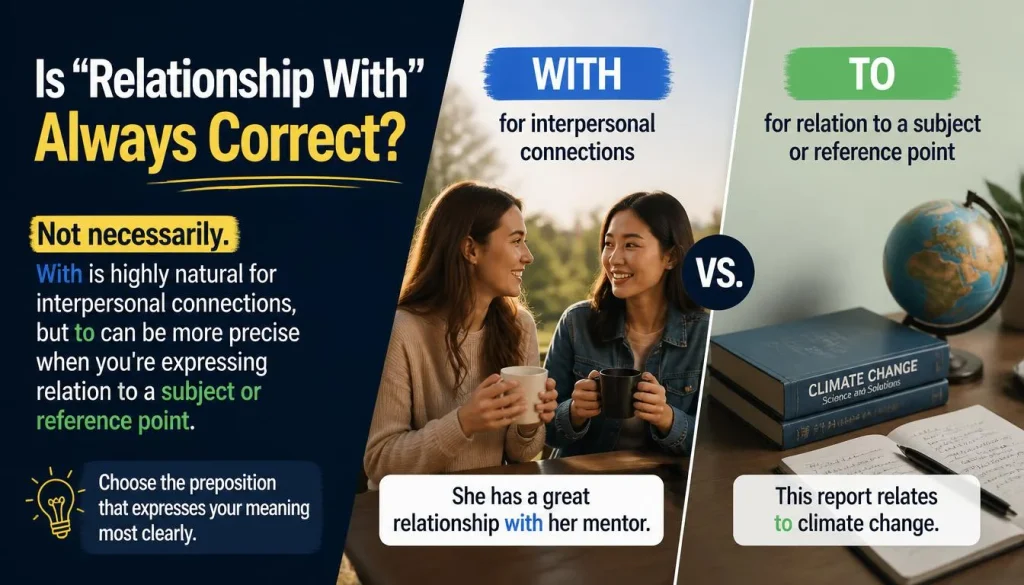
Is “Relationship With” Always Correct?
Not necessarily.
With is highly natural for interpersonal connections, but to can be more precise when you’re expressing relation to a subject or reference point.
Compare:
“The research has a strong relationship with current social trends.”
This can work if you’re emphasizing an association.
But:
“The research has a strong relationship to the central question.”
Here, to clearly points toward the question as a reference point.
Likewise:
“The fee bears little relationship to the service provided.”
Oxford gives this kind of construction as an example of relationship to something.
The lesson is simple: don’t force “with” into every sentence just because it is common.
FAQs
1. Is it “relationship to” or “relationship with”?
Both “relationship to” and “relationship with” are grammatically correct. “Relationship with” usually describes a direct connection between people or organizations, while “relationship to” often describes a connection, association, or relevance to something.
2. What is the difference between “relationship to” and “relationship with”?
The main difference is the type of connection being emphasized. “Relationship with” generally focuses on an interaction or association between two parties. “Relationship to” often focuses on how one person, thing, or idea relates to another.
3. Is “relationship with” more common for people?
Yes. “Relationship with” is especially natural when discussing interpersonal connections. For example, “She has a close relationship with her sister” describes a direct personal connection.
4. When should I use “relationship to”?
Use “relationship to” when you want to emphasize relevance, association, or connection to something. For example, “The report examines the relationship of inflation to consumer spending” focuses on how two concepts are connected.
5. Can “relationship to” and “relationship with” be interchangeable?
Not always. Although they can sometimes describe similar connections, replacing one preposition with the other can change the emphasis or make a sentence sound unnatural. Consider the meaning and context before choosing the preposition.
6. Which phrase is better in formal writing?
Neither phrase is automatically better. “Relationship with” works well for direct relationships, while “relationship to” often suits analytical or conceptual connections. In formal writing, choose the version that accurately expresses the relationship you mean.
Conclusion
Choosing between “relationship to” and “relationship with” becomes much easier once you understand the type of connection each phrase emphasizes. “Relationship with” generally describes a direct relationship or interaction, particularly between people or organizations. “Relationship to” more often highlights relevance, association, or a connection between ideas, subjects, or things.
The key is to focus on meaning rather than memorization. When you’re describing an active or direct connection, “with” will often be the natural choice. When you’re explaining how something relates to, corresponds with, or connects to another subject, “to” may be more appropriate.
By paying attention to context, English usage, and sentence meaning, you can choose the correct preposition with confidence. This simple distinction can make your formal writing, professional communication, and everyday English clearer and more precise.

Emma Brooke is an English language specialist, editor, and content writer at Phrase Finesse, where she helps readers develop stronger writing and communication skills through clear, practical, and engaging content. With a passion for the English language, she specializes in simplifying grammar rules, vocabulary, spelling, punctuation, and word usage for learners at every level.
Emma has extensive experience creating educational content that is accurate, well-researched, and easy to understand. She is particularly skilled at explaining confusing word pairs, grammar concepts, idioms, sentence structure, and effective writing techniques, making complex topics approachable for students, professionals, educators, and English learners worldwide.