Have you ever wondered whether “Sync” vs. “Synch”: Which Is Correct? Both spellings appear frequently in everyday English, especially in technology, scheduling, and business communication. You may see people write “sync your calendar” or “synch the files,” yet the difference can create uncertainty.
So, which form should you use in professional writing? Understanding their meanings, origins, and usage patterns can help you choose the right spelling with confidence.
In modern English, sync is the more common and widely accepted form, particularly in technology and digital contexts. It commonly describes making systems, devices, files, or information match or update together. Meanwhile, synch is a recognized variant that reflects the pronunciation of the word “synchronize.”
You may encounter it in online booking, broadcasting, meetings, and other contexts involving coordination. This article will explain the difference between sync and synch, including their grammatical roles, meanings, and appropriate usage.
Whether you’re writing an email, managing a calendar, coordinating scheduling, or documenting a project management workflow, spelling consistency matters. Choosing the right form can make your formal writing and everyday English usage clearer and more professional.
We’ll examine real-world examples, common mistakes, and practical guidelines so you can use sync and synch naturally. By the end, you’ll know which spelling works best for different situations and why sync is generally the preferred choice.
Quick Answer:
If you’re in a hurry, here’s the answer.
| Situation | Preferred Spelling |
| Modern English | Sync ✅ |
| Computers and software | Sync ✅ |
| Smartphones and apps | Sync ✅ |
| Business communication | Sync ✅ |
| Older publications | Synch (less common) |
| Dictionaries | Both accepted |
The Bottom Line
- Sync is the modern standard.
- Synch is an accepted but dated spelling.
- Unless you’re quoting an older source or matching an established style, choose sync.
What Does “Sync” Mean?
The word sync is a shortened form of synchronize, which means to make two or more things happen at the same time or work together correctly.
Although it began as an abbreviation, sync has become a standalone word. You’ll find it in dictionaries, software interfaces, business meetings, and casual conversations.
Depending on the context, sync can function as several parts of speech.
| Part of Speech | Example |
| Verb | Please sync your files. |
| Noun | The sync completed successfully. |
| Adjective (compound) | Cloud-sync settings |
Technology Examples
Most people encounter sync while using digital devices.
For example:
- Sync your contacts.
- Sync your calendar.
- Sync your phone with your laptop.
- Sync your smartwatch.
- Sync your music library.
In each example, information moves between devices until everything matches.
Business Examples
Outside technology, sync often means to coordinate.
Examples include:
- Let’s sync before tomorrow’s presentation.
- We need to sync our schedules.
- The marketing and sales teams should stay in sync.
Here, the meaning shifts from data transfer to teamwork and coordination.
Entertainment Examples
The word also appears in music, film, and television.
Examples include:
- Lip-sync performance
- Audio sync
- Video sync
- Sync licensing
In these cases, sync refers to matching sound with visuals or licensing music for media productions.
What Does “Synch” Mean?
Synch means exactly the same thing as sync.
It is also a shortened version of synchronize.
The only real difference is spelling.
Historically, writers used synch because it mirrors the pronunciation of the first syllable in synchronize more closely. The letters “ch” hint at the final sound in the abbreviated word.
For example:
- Synch your watches.
- Everything is in synch.
- The recordings were synched.
These sentences remain grammatically correct, although many readers now perceive the spelling as old-fashioned.
Why Isn’t “Synch” Common Today?
Language naturally evolves.
As computers became part of everyday life during the 1980s and 1990s, software companies preferred shorter interface labels.
Instead of displaying:
Synchronize
Developers shortened it to:
Sync
The shorter version fit buttons, menus, and icons more easily.
Eventually, millions of users encountered sync every day on phones, computers, and cloud services. Over time, it became the dominant spelling.
Why Are There Two Spellings?
Many English abbreviations evolve over time.
Sometimes multiple shortened forms compete until one becomes more popular.
That’s exactly what happened here.
The Original Word
Everything starts with:
Synchronize
The word entered English from Greek roots relating to time.
The prefix syn- means together.
The root chronos refers to time.
So synchronize literally means bringing things together in time.
Early Abbreviations
As the full word became common, speakers naturally shortened it.
Two spellings appeared:
- Sync
- Synch
Both represented the same pronunciation.
Newspapers, magazines, and technical manuals used both versions for decades.
The Rise of Computing
Technology changed everything.
Software designers wanted labels that were:
- Short
- Easy to recognize
- Simple to type
- Visually clean
Compare these interface buttons:
❌ Synchronize
✅ Sync
The second option is shorter, easier to scan, and fits neatly into buttons and menus.
As smartphones, operating systems, and cloud storage became mainstream, sync spread worldwide.
Modern Standardization
Today you’ll see sync almost everywhere:
- Phone settings
- Cloud storage
- Calendar apps
- Email software
- Gaming consoles
- Streaming services
- Smart TVs
- Fitness trackers
The technology industry effectively standardized the spelling.
Sync vs. Synch: The Key Differences
Although both spellings are accepted, they’re no longer equally common.
| Feature | Sync | Synch |
| Modern spelling | ✅ Yes | Rare |
| Used in software | ✅ Standard | Almost never |
| Professional writing | ✅ Preferred | Acceptable but uncommon |
| Dictionaries | Main entry | Variant |
| Appears in apps | Very common | Rare |
| Contemporary business writing | Preferred | Less common |
Summary
Think of sync as today’s standard.
Think of synch as yesterday’s spelling that still remains technically correct.
Why “Sync” Became the Standard
Several practical reasons explain why sync won.
It’s Shorter
Modern communication rewards brevity.
Whether you’re designing software or writing a text message, shorter words improve readability.
Instead of:
Synchronize Files
Most software displays:
Sync Files
Users understand the meaning instantly.
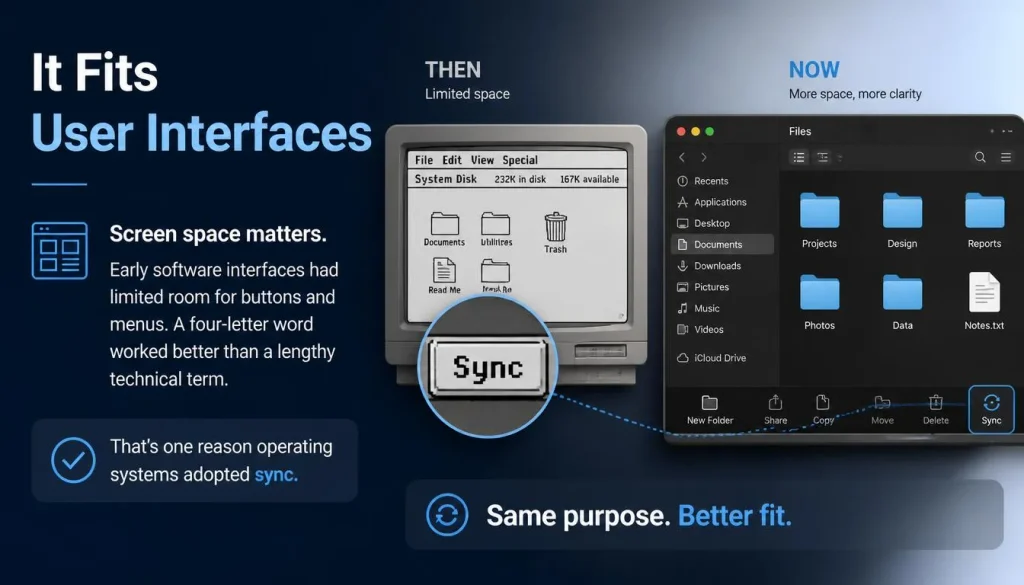
It Fits User Interfaces
Screen space matters.
Early software interfaces had limited room for buttons and menus.
A four-letter word worked better than a lengthy technical term.
That’s one reason operating systems adopted sync.
It Became a Verb
Interestingly, sync evolved beyond abbreviation.
Today people say things like:
- I’ll sync it later.
- We synced our calendars.
- Everything synced automatically.
- The devices are syncing now.
This natural verb usage helped cement the spelling.
Global Technology Reinforced It
Millions of people interact daily with features labeled:
- Sync Contacts
- Sync Photos
- Sync Settings
- Sync Drive
- Sync Files
- Auto Sync
Repeated exposure influences language.
When billions of users repeatedly encounter one spelling, it naturally becomes the dominant choice.
How Major Dictionaries Treat the Words
Most modern dictionaries recognize both spellings, although they don’t give them equal emphasis.
| Dictionary | Sync | Synch |
| Merriam-Webster | Main entry | Variant |
| Cambridge Dictionary | Preferred | Cross-referenced |
| Collins Dictionary | Preferred | Variant |
| American Heritage | Preferred | Variant |
What This Means
If you write sync, every major dictionary accepts it.
If you write synch, dictionaries generally recognize it as an alternative spelling rather than the preferred modern form.
That distinction matters in professional writing, where consistency and current usage carry more weight than historical alternatives.
Is “Synch” Wrong?
No.
That’s one of the biggest misconceptions surrounding this topic.
Many people assume synch is a misspelling simply because they rarely see it anymore.
In reality, it remains a legitimate variant listed by respected dictionaries.
However, being correct doesn’t always mean being the best choice.
Consider another example from English:
- Toward
- Towards
Both are correct, but one may be more common depending on the variety of English and the style guide you’re following.
The same principle applies here.
Sync has become the preferred spelling because it reflects modern usage, especially in technology, business, and digital communication. If your goal is clear, contemporary writing, sync is almost always the stronger option.
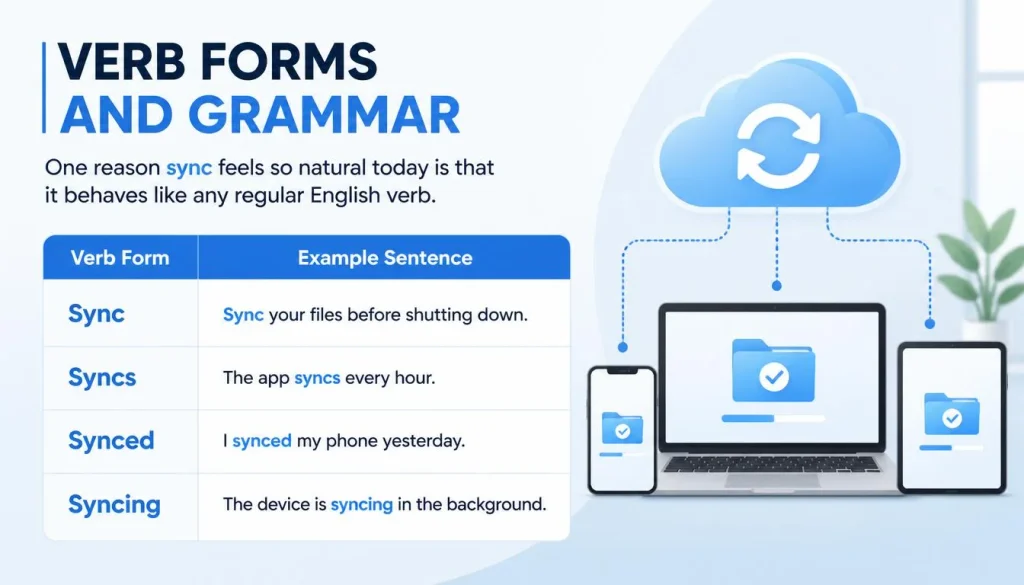
Verb Forms and Grammar
One reason sync feels so natural today is that it behaves like any regular English verb.
| Verb Form | Example Sentence |
| Sync | Sync your files before shutting down. |
| Syncs | The app syncs every hour. |
| Synced | I synced my phone yesterday. |
| Syncing | The device is syncing in the background. |
The older spelling follows the same grammatical pattern:
| Variant Form | Example |
| Synch | Synch the devices. |
| Synches | The program synches automatically. |
| Synched | The files were synched. |
| Synching | The app is synching data. |
Although these forms are grammatically valid, synced and syncing appear far more frequently in modern publications, user manuals, and software documentation.
See More : “Both Of You” vs. “You Both” Difference Explained
Examples of “Sync” in Everyday Sentences
Understanding a word becomes much easier when you see it in real-life situations. Although sync originated as a technical abbreviation, it now appears in countless everyday contexts.
Technology
Technology remains the most common setting for the word.
Examples:
- Please sync your phone before installing the update.
- The app automatically syncs your contacts across devices.
- Your photos will sync to the cloud once you’re connected to Wi-Fi.
- Make sure your smartwatch is synced with your phone.
- The files finished syncing in just a few minutes.
Business Communication
In workplaces, sync often means to coordinate, align, or share updates rather than transfer data.
Examples:
- Let’s sync before tomorrow’s client meeting.
- We should sync our project timelines.
- The marketing and sales teams are finally in sync.
- Can we sync up this afternoon?
- Everyone stayed in sync, so the launch went smoothly.
Education
Teachers and students frequently use the term when discussing online learning platforms.
Examples:
- The learning portal automatically syncs your grades.
- Remember to sync your notes across devices.
- The school calendar didn’t sync correctly.
Photography and Video
Photography introduces another important meaning.
Examples:
- Adjust the flash sync speed.
- The editor had to sync the audio with the video.
- Poor synchronization caused the dialogue to fall out of sync.
Music
Musicians and producers also rely on the word.
Examples:
- The drummer stayed perfectly in sync with the bassist.
- The soundtrack must sync with the film.
- Audio and video remained perfectly synced throughout the performance.
Sports
Even athletes use the expression metaphorically.
Examples:
- The rowing team stayed completely in sync.
- Their movements were perfectly synchronized.
- Every player worked in sync during the final minutes.
Common Expressions Using “Sync”
Several everyday phrases include the word sync. Many people use these expressions without realizing they all relate to coordination or timing.
| Expression | Meaning | Example |
| In sync | Working together perfectly | The dancers stayed in sync. |
| Out of sync | Not matching correctly | The subtitles are out of sync. |
| Sync up | Coordinate or meet | Let’s sync up tomorrow. |
| Lip-sync | Match mouth movements to recorded audio | The performer lip-synced the song. |
| Auto-sync | Synchronize automatically | Turn on auto-sync for backups. |
| Cloud sync | Synchronization through cloud storage | Cloud sync keeps your files updated. |
| Data sync | Matching information between systems | Data sync happens every hour. |
“In Sync”
This phrase extends well beyond technology.
You might hear:
- Our schedules are in sync.
- Their ideas are in sync.
- The orchestra played in sync.
- The couple seemed completely in sync.
It suggests harmony, coordination, or agreement.
“Out of Sync”
The opposite phrase describes mismatches.
Examples include:
- The audio is out of sync.
- Their expectations were out of sync.
- The clocks drifted out of sync.
- Our calendars became out of sync after the update.
“Sync Up”
This informal phrasal verb has become especially common in business English.
Examples:
- Let’s sync up next week.
- We’ll sync up after lunch.
- The teams need to sync up before launch.
Although informal, it’s widely accepted in modern workplaces.
Common Mistakes to Avoid
Even though the spelling seems straightforward, several mistakes appear repeatedly.
Mistake 1: Assuming “Synch” Is Incorrect
❌ Wrong assumption
Synch is a misspelling.
✅ Correct
Synch is an accepted but less common spelling.
Mistake 2: Mixing Both Spellings
Consistency matters.
Avoid writing:
- Sync your phone.
- Synched yesterday.
- Syncing today.
- Synch automatically.
Instead, choose one spelling and stick with it throughout your document.
Modern editors almost always recommend using sync consistently.
Mistake 3: Using “Synchronize” Everywhere
Some writers assume longer words always sound more professional.
Not necessarily.
Compare these examples.
Less natural
Please synchronize your contacts before proceeding.
More natural
Please sync your contacts before proceeding.
In software documentation, help articles, and everyday communication, sync usually sounds clearer and more approachable.
Mistake 4: Confusing “Sync” With “Backup”
These actions aren’t identical.
| Sync | Backup |
| Keeps files matching across devices | Creates a copy for recovery |
| Changes appear everywhere | Original files remain separate |
| Two-way or one-way | Usually one-way |
| Used daily | Used for protection |
For example, deleting a synced file may remove it from every connected device. A backup, however, stores a separate copy that you can restore later.
Should You Ever Use “Synch”?
Yes—but only in a few situations.
Quoting Historical Material
If you’re reproducing older documents, preserve the original spelling.
Example:
The 1970 technical manual instructed users to “synch the recording equipment.”
Changing the quotation would reduce historical accuracy.
Following Existing House Style
Some organizations maintain long-standing documentation that uses synch consistently.
When updating those materials, matching the established style may be appropriate.
Academic Discussions About Language
Linguists and language historians sometimes discuss both spellings to illustrate how English evolves.
Outside these contexts, sync remains the better choice.
Style Guide Recommendations
Although most style guides don’t publish a dedicated rule for sync vs. synch, their general advice favors modern, widely accepted spellings.
| Writing Context | Recommended Choice |
| Academic writing | Sync |
| Journalism | Sync |
| Technical documentation | Sync |
| Business communication | Sync |
| Marketing | Sync |
| Software interfaces | Sync |
| Product manuals | Sync |
| Website content | Sync |
The guiding principle is simple:
Use the spelling your audience expects.
Today, that spelling is almost always sync.
Sync vs. Synchronize: Which Should You Use?
Another common question isn’t about sync versus synch. Instead, it’s about sync versus synchronize.
Both are correct, but they suit different situations.
| Sync | Synchronize |
| Short and conversational | More formal |
| Common in apps and software | Common in academic writing |
| Preferred in interfaces | Preferred in technical specifications |
| Easy to scan | More descriptive |
Choose “Sync” When:
- Writing help articles
- Creating website content
- Writing software instructions
- Sending emails
- Giving everyday directions
- Writing blog posts
Choose “Synchronize” When:
- Drafting legal documents
- Writing scientific papers
- Preparing formal technical standards
- Using the complete terminology intentionally
In most situations, sync feels more natural because readers encounter it every day.
Real-World Case Study: How Technology Standardized “Sync”
The evolution of sync offers an excellent example of how technology shapes language.
Before the Digital Age
Earlier technical manuals and engineering documents frequently used both sync and synch interchangeably. There wasn’t a universally preferred abbreviation.
The Software Revolution
As personal computers became household devices, software developers faced a practical challenge.
Buttons, menus, and icons had limited space.
A label reading “Synchronize Settings” consumed far more room than “Sync Settings.”
The shorter version also proved easier to recognize at a glance.
Over time, operating systems, smartphones, cloud storage services, email platforms, and productivity apps consistently adopted sync.
Today, users see the word countless times each day:
- Sync Calendar
- Sync Contacts
- Sync Photos
- Sync Drive
- Sync Files
- Sync Passwords
That widespread exposure transformed sync from a simple abbreviation into the standard form used across industries.
Quick Reference Cheat Sheet
| Question | Answer |
| Is sync correct? | ✅ Yes |
| Is synch correct? | ✅ Yes |
| Which spelling is more common? | Sync |
| Which spelling appears in software? | Sync |
| Which spelling should students use? | Sync |
| Which spelling do editors prefer? | Sync |
| Is “synched” wrong? | No, but synced is more common |
| Is “syncing” preferred over “synching”? | Yes |
FAQs
1. Is “sync” or “synch” correct?
Both sync and synch are accepted spellings. However, sync is much more common in modern English, especially in technology and business contexts. For example, “Please sync your calendar” is the more natural choice.
2. Is “synch” a misspelling of “sync”?
No. Synch isn’t necessarily a misspelling. It’s an established variant based on the word synchronize. However, sync has become the standard and more widely preferred spelling, particularly in digital and technical English.
3. Should I use “sync” in formal writing?
Yes. Sync is appropriate in many forms of professional and formal writing. It works especially well when discussing technology, scheduling, calendar management, data, or business communication. In highly formal contexts, you can also use synchronize when greater formality is appropriate.
4. What does “sync” mean?
Sync means to make two or more things occur, operate, or remain consistent together. It can describe coordinating devices, files, schedules, or information. For example, “The app automatically syncs your calendar with your email.”
5. Is “sync up” correct?
Yes, sync up is a common informal expression meaning to coordinate, communicate, or become aligned. For example, “Let’s sync up before the meeting.” In more formal writing, coordinate, discuss, or align may sound more polished.
6. Which spelling should I use: “sync” or “synch”?
In most situations, choose sync. It’s shorter, more common, and especially prevalent in technology, online booking, broadcasting, project management, and everyday communication. Use synch only when a particular style guide, organization, or context specifically prefers it.
Conclusion
When choosing between “sync” and “synch,” you don’t need to overthink the spelling. Both forms are recognized in English, but sync is the clear modern preference. It’s especially common in technology, scheduling, calendar management, and professional communication.
Synch isn’t incorrect, but it appears less frequently. If you’re writing an email, creating documentation, managing a project, or discussing digital tools, sync will usually sound more natural and familiar.
The key is consistency. Choose sync for most contemporary English usage, particularly when clarity and simplicity matter. When a more formal tone is needed, you can also use the full verb synchronize.


