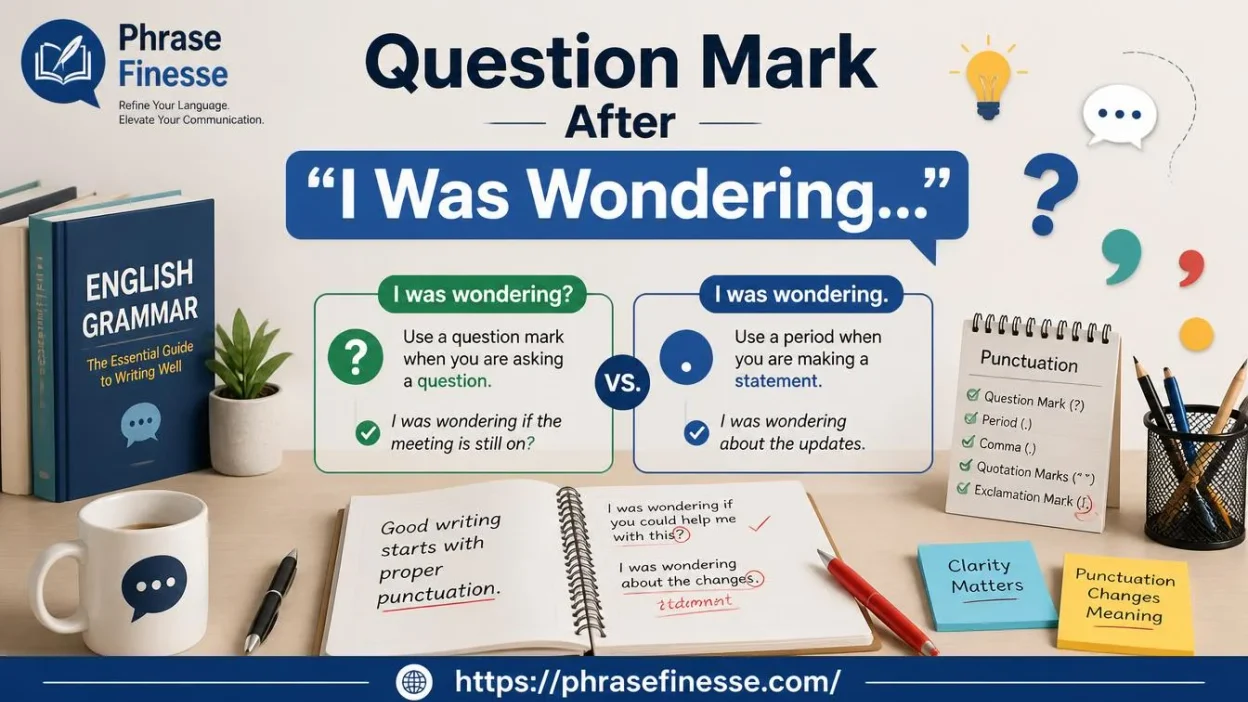
Have you ever paused while writing a message and wondered whether “I was wondering…” should end with a question mark or a period? This common grammar challenge often creates confusion in emails, conversations, and professional messages.
In this Question Mark After “I Was Wondering…”, you’ll learn when to use a question mark, how sentence structure affects meaning, and why this phrase can function differently in English usage and formal writing.
The phrase “I was wondering…” is often used to make requests, ask questions politely, or introduce an idea in a softer way. Understanding its correct punctuation helps improve business communication, meetings, scheduling, and everyday conversations.
Whether you are writing an email, creating an online booking request, managing a calendar, or preparing professional content, choosing the right punctuation adds clarity and consistency to your writing.
This complete guide explores the grammar rules behind “I was wondering…”, explains when a question mark after the phrase is appropriate, and provides 15 practical examples for different situations.
You’ll also discover how punctuation choices influence time management, project management, broadcasting, and other forms of written communication where accuracy and professionalism matter. By the end, you’ll have a clear understanding of how to use this phrase confidently in any context.
Using “I Was Wondering…” in Casual Conversations
In everyday speech, people often use “I was wondering…” to make questions sound softer.
A direct question can sometimes feel abrupt:
Where are you going?
Adding the phrase creates a friendlier tone:
I was wondering, where are you going?
The speaker still wants an answer, but the wording feels more relaxed.
Examples of Casual Direct Questions
✅ I was wondering, are you free this weekend?
✅ I was wondering, did you watch that new movie?
✅ I was wondering, can you give me a ride home?
These sentences use question marks because they directly ask something.
Using “I Was Wondering…” in Academic Writing
Academic writing usually prefers a more formal style. Because of this, writers often use indirect questions.
Examples:
I was wondering whether this theory applies to modern research.
I was wondering if additional evidence supports this conclusion.
I was wondering how this approach affects student learning.
These sentences end with periods because they present thoughts or inquiries rather than asking direct questions.
Why Academic Writing Prefers Indirect Questions
Indirect questions often sound:
- More analytical.
- Less conversational.
- More appropriate for research discussions.
Instead of directly challenging an idea, writers can introduce curiosity in a smoother way.
Example:
Direct:
Why does this method fail in certain situations?
Academic style:
I was wondering why this method fails in certain situations.
The second version sounds more reflective.
“I Was Wondering…” in Customer Service Communication
Customer service messages often rely on polite language because they aim to maintain positive relationships.
Examples:
I was wondering if you could provide an update on my order status.
I was wondering whether my refund has been processed.
I was wondering if there are any available appointments next week.
These sentences work well because they avoid sounding demanding.
Compare:
❌ Why hasn’t my refund arrived?
✅ I was wondering if you could provide an update on my refund status.
The second sentence encourages cooperation.
Is “I Was Wondering…” Too Informal for Professional Writing?
Many people wonder whether “I was wondering…” sounds professional enough.
The answer is yes. It is widely accepted in workplace communication.
The phrase creates a polite and respectful tone without sounding overly formal.
For example:
Less polite:
Send the file before Friday.
More professional:
I was wondering if you could send the file before Friday.
Very formal:
I would appreciate it if you could provide the file before Friday.
The best choice depends on your relationship with the reader and the situation.
Professional Alternatives to “I Was Wondering…”
Although “I was wondering…” works well, different situations may require different expressions.
| Alternative Phrase | Tone | Example |
| Could you please… | Direct and professional | Could you please review this document? |
| Would you mind… | Very polite | Would you mind sharing the details? |
| I would appreciate it if… | Formal | I would appreciate it if you could respond soon. |
| May I ask… | Respectful | May I ask when the report will be ready? |
| I wanted to ask… | Friendly | I wanted to ask about the new schedule. |
“I Was Wondering” vs. Similar Expressions
Several phrases look similar but have different meanings.
Understanding these differences improves your writing accuracy.
“I Was Wondering” vs. “I Wondered”
These expressions describe curiosity, but they focus on different moments.
I Was Wondering
This usually describes a current or recent thought.
Example:
I was wondering if you could help me with this task.
The speaker is making a request now.
I Wondered
This usually describes a past moment of curiosity.
Example:
I wondered why the meeting ended early.
The speaker is describing something they thought about in the past.
Comparison Table
| Phrase | Meaning | Example |
| I was wondering | Current polite request or curiosity | I was wondering if you had time to talk. |
| I wondered | Past curiosity | I wondered why he left early. |
“I Was Wondering” vs. “I Wonder”
The difference between these phrases is subtle.
I Wonder
This sounds more immediate.
Example:
I wonder where my keys are.
The person is thinking about the answer right now.
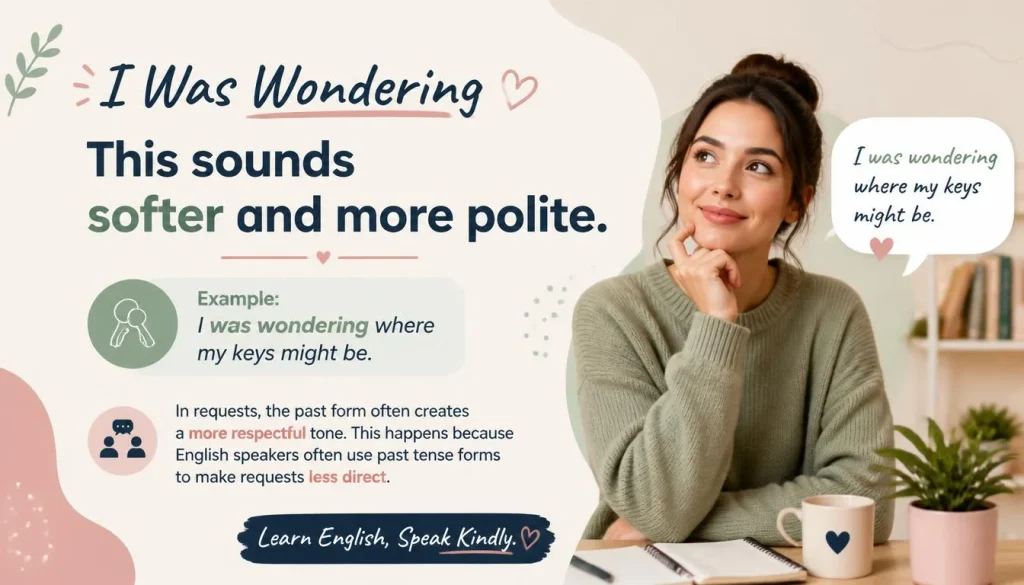
I Was Wondering
This sounds softer and more polite.
Example:
I was wondering where my keys might be.
In requests, the past form often creates a more respectful tone.
This happens because English speakers often use past tense forms to make requests less direct.
Examples:
- Could you help me?
- Could you possibly help me?
- I was wondering if you could help me.
Each version becomes slightly softer.
See More : Patronizing vs. Condescending: What’s the Difference?
Real-Life Examples: Choosing the Correct Punctuation
Understanding rules becomes easier with examples.
Example: Asking a Friend
Correct:
I was wondering, are you coming to the party tonight?
Why?
Because the speaker directly asks a question.
Example: Sending a Work Email
Correct:
I was wondering if you could send the updated presentation.
Why?
Because the sentence contains an indirect request.
Example: Asking for Information
Correct:
I was wondering whether the office closes at five.
Why?
Because “whether the office closes at five” is an embedded question.
A Simple Test to Choose Between a Question Mark and Period
When you are unsure about punctuation after “I was wondering…”, use this quick method.
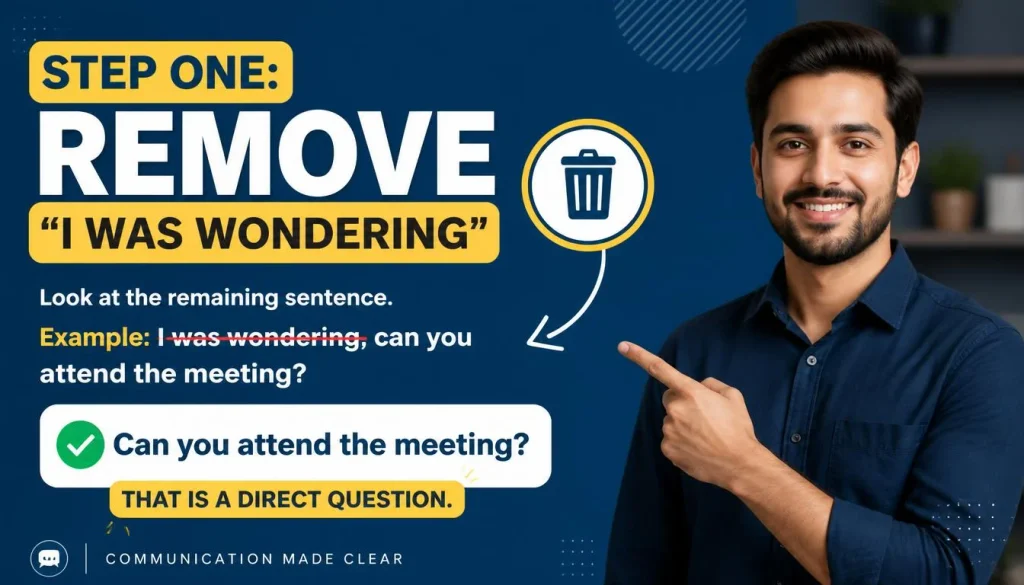
Step One: Remove “I was wondering”
Look at the remaining sentence.
Example:
I was wondering, can you attend the meeting?
Remove the opening phrase:
Can you attend the meeting?
That is a direct question.
Use:
✅ Question mark
Now try:
I was wondering if you can attend the meeting.
Remove the opening phrase:
If you can attend the meeting.
That is not a direct question.
Use:
✅ Period
Grammar Tip: Question Words Do Not Always Mean Question Marks
Many writers assume that words like:
- Who
- What
- When
- Where
- Why
- How
always require question marks.
That is not true.
These words can appear inside statements.
Examples:
Question:
Where are you going?
Statement:
I was wondering where you are going.
Question:
Why did she leave?
Statement:
I was wondering why she left.
The punctuation depends on the entire sentence structure.
FAQs
1. Should I use a question mark after “I was wondering”?
Yes, you can use a question mark after “I was wondering” when the sentence is a direct or indirect question that expects an answer. For example, “I was wondering, could you help me with this project?” uses a question mark because the speaker is making a polite request.
However, if “I was wondering…” introduces a statement or reflection rather than a question, a period is usually more appropriate.
2. Is “I was wondering if…” followed by a question mark?
Yes, a question mark is often used when “I was wondering if…” introduces a polite question. For example:
- I was wondering if you could review my report?
This style is common in conversations and informal emails. In more formal writing, some writers prefer a period because the sentence is grammatically structured as a statement:
- I was wondering if you could review my report.
Both forms appear in real-world communication, but the choice depends on tone and context.
3. Is “I was wondering…” a question or a statement?
The phrase “I was wondering…” can act as both a statement and a question opener. Its meaning depends on what follows.
- As a question: I was wondering, are you available for a meeting tomorrow?
- As a statement: I was wondering about the changes made to the schedule.
Understanding the sentence purpose helps you choose the correct punctuation.
4. Should “I was wondering” be used in formal emails?
Yes, “I was wondering” is widely accepted in formal writing because it sounds polite and respectful. Professionals often use it in emails, requests, and business communication.
For example:
- I was wondering if you could send the updated calendar by Friday.
This phrasing creates a softer tone compared with direct requests.
5. What is the difference between “I was wondering” and “I wonder”?
The difference is mainly about tone and timing. “I wonder” sounds more direct and present-focused, while “I was wondering” sounds more polite and less demanding.
Examples:
- I wonder when the meeting starts. (Direct curiosity)
- I was wondering when the meeting starts. (Polite inquiry)
Both phrases are correct, but the second option often works better in professional communication.
6. Can I use “I was wondering…” in professional messages?
Yes, you can use “I was wondering…” in professional messages, including emails, scheduling requests, and project discussions. It helps maintain a courteous tone while asking for information or assistance.
For example:
- I was wondering if we could reschedule our meeting for next week?
Using correct punctuation with this phrase improves readability, professionalism, and overall English grammar accuracy.
Conclusion
Understanding when to use a question mark after “I was wondering…” helps you write clearer and more effective sentences. While this phrase often introduces polite questions, the correct punctuation depends on whether you are asking for information or simply making a statement.
In everyday conversations, emails, and professional settings, “I was wondering…” remains a useful expression for making requests politely. By paying attention to sentence structure, grammar rules, and writing context, you can improve your formal writing, business communication, and overall confidence with English punctuation.
Whether you are preparing emails, organizing meetings, managing scheduling tasks, or writing professional content, using the correct punctuation creates better clarity and consistency. Mastering this small grammar detail can make your communication sound more natural, respectful, and polished.

[…] See More : Question Mark After “I Was Wondering…” […]