Have you ever hesitated over whether to write “One or More Is” or “One or More Are”: Which Is Correct?You’re not alone. This small grammar choice can create confusion in formal writing, workplace messages, and everyday English usage.
The correct form depends on what the phrase refers to and how the sentence is structured. Understanding this distinction helps you write with greater grammatical accuracy, clarity, and consistency.
The confusion becomes more noticeable in professional contexts. Consider business communication, scheduling, meetings, project management, or online booking, where phrases such as “one or more options” appear frequently. You might also encounter similar constructions in calendar updates, broadcasting notices, instructions, and administrative documents.
Choosing between “one or more is” and “one or more are” isn’t simply a matter of choosing the verb that sounds natural. It involves understanding subject-verb agreement, the role of the noun that follows the phrase, and the intended meaning of the sentence.
In this guide, you’ll learn exactly when to use “one or more is” and when “one or more are” is the better choice. We’ll explain the underlying grammar rule, examine clear examples, and address common mistakes that can weaken your writing.
You’ll also see how context affects verb agreement in professional and everyday sentences. By the end, you’ll have a simple, reliable way to choose the correct form and maintain consistency whenever you use “one or more” in your writing.
Quick Answer:
If you’re looking for the practical rule, start here:
Use “one or more are” when “one or more” refers to plural countable nouns.
For example:
- One or more employees are absent.
- One or more files are missing.
- One or more answers are correct.
- One or more problems are causing the delay.
- One or more components are defective.
The Chicago Manual of Style specifically addresses the construction “one or more components” and recommends “are” because the noun components is plural.
Here’s the basic pattern:
| Construction | Usual verb | Example |
| one + singular noun | is | One employee is absent. |
| one or more + plural noun | are | One or more employees are absent. |
| one or more of + plural noun | are | One or more of the employees are absent. |
| two or more + plural noun | are | Two or more employees are absent. |
| more than one + singular noun | is | More than one employee is absent. |
The last example matters because “more than one” follows a different agreement pattern. Don’t assume that every phrase containing one behaves the same way.
Why “One or More Are” Is Usually Correct
The key lies in the noun being quantified.
Consider this sentence:
One or more employees are working remotely.
The phrase one or more tells you the possible quantity. The noun employees tells you what that quantity refers to.
Because employees is plural, the verb are fits the construction.
Think of the phrase as a range:
one employee → two employees → three employees → potentially many employees
The sentence deliberately leaves the exact number open. It could be one employee. It could be several. What matters grammatically is that the noun being quantified appears in its plural form.
The structure looks like this:
one or more + plural noun + plural verb
For example:
- one or more customers are
- one or more documents are
- one or more questions are
- one or more errors are
- one or more departments are
This isn’t merely a stylistic preference. The Chicago Manual of Style directly recommends the plural construction when the noun is plural.
The easiest way to see the difference
Compare these two sentences:
One student is absent.
One or more students are absent.
The first sentence identifies exactly one student. Therefore, is makes sense.
The second sentence allows for one student or several students. The noun becomes students, and the standard agreement is are.
The Noun After “One or More” Matters
Here’s the most useful lesson from this entire topic:
Don’t let the word “one” make the decision by itself.
Instead, examine the complete noun phrase.
Singular example
One employee is absent.
The noun is employee. It’s singular.
Plural example
One or more employees are absent.
The noun is employees. It’s plural.
The difference is easy once you slow the sentence down.
| Sentence | Noun | Number | Verb |
| One employee is absent. | employee | Singular | is |
| One or more employees are absent. | employees | Plural | are |
| One manager is responsible. | manager | Singular | is |
| One or more managers are responsible. | managers | Plural | are |
| One document is missing. | document | Singular | is |
| One or more documents are missing. | documents | Plural | are |
This is why “one or more employees are” sounds natural to most careful writers. The phrase refers to a potentially plural set of employees.
When to Use “One or More Are”
The plural construction appears in a wide range of everyday sentences.
With plural countable nouns
Use are when one or more modifies a plural count noun.
Examples include:
- One or more students are waiting outside.
- One or more files are corrupted.
- One or more customers are affected.
- One or more accounts are overdue.
- One or more meetings are scheduled for Friday.
- One or more questions are still unanswered.
- One or more errors are preventing the program from running.
- One or more employees are responsible for the report.
Notice the recurring pattern.
One or more + plural noun + are
That pattern is especially useful in professional and technical writing because it makes the intended scope clear.
With “one or more of”
The same principle applies when the phrase becomes one or more of.
Examples:
- One or more of the reports are incomplete.
- One or more of the employees are working late.
- One or more of these files are damaged.
- One or more of the applicants are qualified.
- One or more of the machines are malfunctioning.
The Chicago Manual of Style also recognizes constructions such as “one or more attached forms” as a clear way to express the possibility of singular or plural reference.
With technical writing
Technical documents use this construction constantly because conditions often allow for an unknown number of items.
For example:
One or more devices are connected to the network.
Or:
One or more settings are preventing the application from launching.
The plural verb keeps the grammar aligned with the plural noun.
Why “One” Doesn’t Automatically Require “Is”
This is where many writers get tripped up.
They see one at the beginning and instinctively reach for is.
That instinct works in a sentence such as:
One applicant is eligible.
But it doesn’t automatically work here:
One or more applicants are eligible.
The expression isn’t simply one anymore. It is one or more, which introduces an indefinite quantity.
A useful comparison is “a number of”:
A number of employees are absent.
You wouldn’t normally write:
A number of employees is absent.
The noun employees points toward plural agreement.
English contains many quantifying expressions that don’t behave exactly like their individual words might suggest. That’s why grammar works better when you analyze the whole construction rather than mechanically matching the first word with a verb.
Is “One or More Is” Ever Correct?
Yes, but this is where precision matters.
It would be misleading to say that “one or more is” never occurs. Actual English contains both singular and plural constructions, and usage discussions have documented variation. One analysis cited in the English Language & Usage discussion notes that writers may choose singular agreement when they conceptualize one or more as a single case or principle, while plural agreement responds to the plural things being discussed.
That doesn’t mean “one or more is” should replace “one or more are” in ordinary sentences.
Quite the opposite.
For most practical writing, especially when a plural noun appears directly after the phrase, are is the safer and clearer choice.
Consider this sentence
One or more is available.
What’s missing?
The reader doesn’t know exactly what one or more refers to.
Is it:
- one or more options?
- one or more seats?
- one or more appointments?
- one or more files?
- one or more solutions?
The sentence may be understandable from context, but it lacks precision.
Now compare it with:
One or more options are available.
That’s immediately clearer.
Or:
At least one option is available.
That version is even cleaner if the writer wants to emphasize the minimum quantity.
Why “One or More Is” Can Sound Natural
There’s a subtle semantic reason for the confusion.
When someone writes:
One or more is required.
They may mentally treat one or more as a single requirement or condition.
The thought isn’t necessarily:
One thing is required, or two things are required, or three things are required.
Instead, the writer may mean:
The condition “one or more” is required.
That conceptual shift can encourage singular agreement.
English sometimes allows this kind of notional agreement, where the meaning a speaker has in mind influences grammatical number.
The Chicago Manual of Style recognizes that English agreement can depend on how a construction functions in context. For example, it notes that some apparently plural combinations can be treated as singular when they express a single idea.
Still, there’s an important practical distinction:
Possible doesn’t always mean preferable.
If you can make the sentence clearer by naming the noun, do it.
“One or More” vs. “More Than One”
These expressions look similar, but they don’t necessarily take the same verb.
That’s a particularly important distinction.
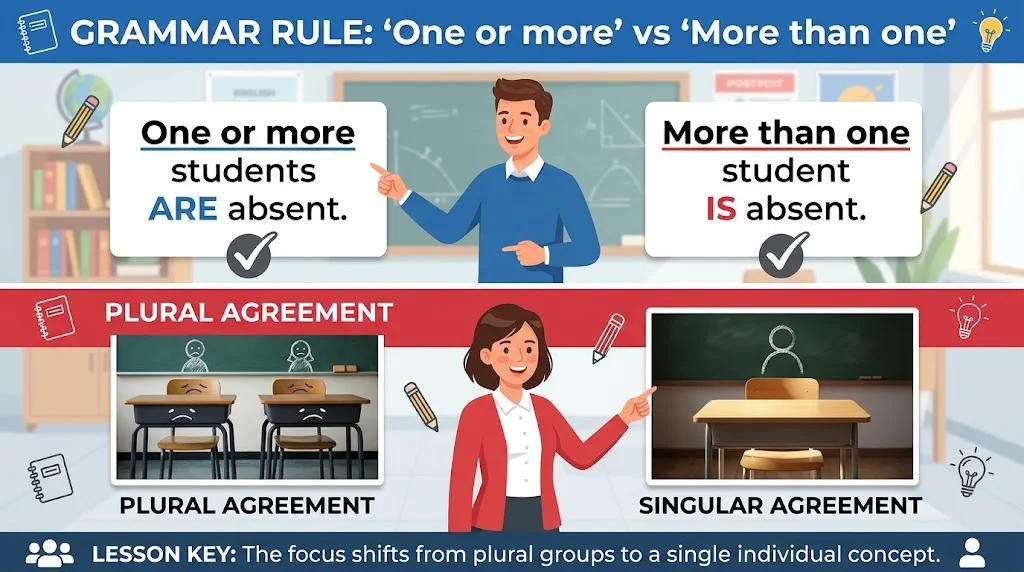
One or more
One or more students are absent.
More than one
More than one student is absent.
Why does the second sentence use is?
Because more than one traditionally takes a singular noun and singular verb in this construction:
More than one student is absent.
That pattern can feel counterintuitive. After all, more than one logically means at least two.
Yet grammar doesn’t always follow simple mathematical logic.
English has several established expressions whose grammatical number differs from what their literal numerical meaning might suggest.
Compare them directly
| Expression | Example | Verb |
| one | One student is absent. | Singular |
| one or more | One or more students are absent. | Plural |
| more than one | More than one student is absent. | Singular |
| two or more | Two or more students are absent. | Plural |
| a number of | A number of students are absent. | Plural |
| the number of | The number of students is increasing. | Singular |
This table is worth remembering because it prevents several common agreement errors at once.
“One or More of Them Is” or “One or More of Them Are”?
In ordinary usage, “one or more of them are” is the natural choice when them refers to multiple people or things.
For example:
One or more of them are responsible for the mistake.
Or:
One or more of them are missing from the folder.
The phrase of them identifies a plural group. The verb are reflects that plural reference.
The same pattern appears with explicit nouns:
- One or more of the students are absent.
- One or more of the files are corrupted.
- One or more of the cars are blocking the entrance.
- One or more of the reports are incomplete.
The Chicago Manual of Style specifically recommends the plural construction for “one or more components” and explains that the plural noun signals plural agreement.
Common Mistakes With “One or More”
Mistake: Using “Is” Just Because of “One”
Incorrect in standard plural construction:
One or more employees is responsible for the error.
Preferred:
One or more employees are responsible for the error.
The noun employees is plural.
Mistake: Making the Noun Singular
Another problem sometimes appears like this:
One or more employee is responsible.
This doesn’t work as the standard construction because one or more normally requires the noun to appear in its plural form.
Write:
One or more employees are responsible.
The Chicago Manual of Style makes this point especially clearly in its guidance on “one or more components.”
Mistake: Assuming “One or More” Always Means “Are”
Although are is the standard choice with plural count nouns, don’t turn the rule into a mechanical formula.
For example:
One or more is required.
Rather than automatically changing it to “one or more are required,” ask what the sentence actually means.
If the writer means:
At least one document is required.
Then “At least one document is required” is far better.
The goal isn’t to win a grammar argument. The goal is to make the sentence unmistakable.
One or More Is vs. One or More Are: Examples
Here’s a practical collection of examples.
| Sentence | Best choice | Explanation |
| One student is absent. | ✅ is | Student is singular. |
| One or more students are absent. | ✅ are | Students is plural. |
| One employee is responsible. | ✅ is | Exactly one employee. |
| One or more employees are responsible. | ✅ are | The noun is plural. |
| One or more files are missing. | ✅ are | Files is plural. |
| One or more of the files are missing. | ✅ are | Plural group. |
| One or more options are available. | ✅ are | Options is plural. |
| One or more is available. | ⚠️ Context-dependent | The noun is omitted. |
| One or more are available. | ⚠️ Context-dependent | Also elliptical without a stated noun. |
| One or more employees is absent. | ❌ Usually avoid | Conflicts with the plural noun. |
| One or more employee is absent. | ❌ Avoid | The noun form is wrong for this construction. |
The last few examples demonstrate an important principle:
Clarity often solves what grammar alone cannot.
A Simple Test for Choosing “Is” or “Are”
When you’re editing a sentence, use this four-step test.
Find the noun
Look at what one or more modifies.
One or more employees …
The noun is employees.
Check whether the noun is plural
If it’s a plural count noun, are will normally follow.
One or more employees are …
Check the meaning
Ask what the sentence actually means.
Does it refer to:
- one or more individual items?
- a group of possible items?
- a single requirement?
- an abstract condition?
That distinction can affect the best wording.
Rewrite if necessary
If the sentence feels awkward, don’t force is or are into place.
Try:
At least one option is available.
Or:
One or more options are available.
Often, one of these versions will express the idea much more cleanly.
One or More in Formal and Professional Writing
This construction appears frequently in workplace documents.
Consider a policy statement:
One or more employees are required to approve the request.
The meaning is clear. The company needs at least one employee, with the possibility of several.
Now compare:
One or more is required to approve the request.
That version forces the reader to reconstruct the missing noun.
What is required? Who is required?
Good professional writing doesn’t make readers perform unnecessary detective work.
Business writing examples
- One or more managers are required to approve the expense.
- One or more departments are affected by the change.
- One or more documents are required before processing can begin.
- One or more team members are available to assist.
- One or more accounts are currently under review.
These sentences are direct, precise, and easy to scan.
See More : Does “Government” Mean “Mind Control” in Latin? The Truth
One or More in Academic Writing
Academic writing often uses the expression when describing possible variables, causes, findings, or studies.
For example:
One or more factors are responsible for the observed difference.
Or:
One or more studies are needed to confirm the findings.
Or:
One or more variables are associated with the outcome.
The plural verb works naturally because the nouns are plural.
If the writer wants to emphasize a minimum rather than a potentially plural set, at least one can sometimes be more precise:
At least one study is needed to confirm the findings.
That distinction is useful.
One or more emphasizes an open range.
At least one emphasizes the minimum requirement.
One or More in Technical Writing
Technical writing has an especially strong need for precise agreement.
Consider:
One or more devices are connected to the network.
This tells the reader that the system contains at least one device. There may be several.
Another example:
One or more configuration files are missing.
The plural noun makes are the natural choice.
Technical instructions frequently benefit from this structure because it describes conditions without pretending to know an exact quantity.
Examples
- One or more servers are offline.
- One or more settings are incorrect.
- One or more files are corrupted.
- One or more devices are disconnected.
- One or more errors are preventing installation.
In each case, the same grammatical architecture appears.
One or More in Legal and Policy Writing
Legal and policy documents often use one or more because a rule may apply whether one item exists or several do.
For example:
One or more violations may result in disciplinary action.
Here, violations is plural and may result works naturally with the plural subject.
Another example:
One or more parties are entitled to request a review.
The noun parties is plural.
However, legal drafting sometimes treats an entire requirement as a single condition. That’s one reason isolated sentences can produce different agreement choices.
The safest approach isn’t to invent an exception whenever is appears. Instead, ask:
What exactly is the subject, and what does it mean in context?
That question gets you much closer to the actual grammar.
Case Study: Fixing Three Realistic Sentences
Case Study: A workplace policy
Original:
One or more employee is required to approve the request.
Two things need attention.
First, employee should become plural after one or more.
Second, the plural noun requires are.
Better:
One or more employees are required to approve the request.
If the policy means exactly one person must approve it, use:
At least one employee is required to approve the request.
The second version may actually be clearer.
Case Study: A software notification
Original:
One or more is preventing the application from starting.
What’s missing?
The reader doesn’t know whether the problem involves files, settings, services, or another component.
Better:
One or more configuration files are preventing the application from starting.
Now the noun is explicit.
If the application requires only one minimum item, another rewrite could be:
At least one configuration file is required for the application to start.
The rewrite doesn’t merely fix grammar. It improves technical precision.
Case Study: An academic sentence
Original:
One or more is responsible for the difference in results.
This sentence sounds vague because one or more has no stated noun.
Better:
One or more factors are responsible for the difference in results.
Or, if the writer wants to stress the minimum:
At least one factor is responsible for the difference in results.
Both versions work. The best choice depends on what the writer wants to emphasize.
“One or More” vs. “One or Two”
It’s also useful to compare one or more with another familiar expression.
One or two students are absent.
One or more students are absent.
Both use are because the quantified noun is plural.
The difference is semantic:
- one or two limits the possible quantity.
- one or more leaves the upper quantity open.
So:
One or two employees are attending.
and:
One or more employees are attending.
Both follow the same broad agreement pattern.
What About “One or More Is Required”?
This sentence deserves special attention because it appears frequently in forms, instructions, and policies.
One or more is required.
Grammatically, the sentence is difficult to evaluate without knowing what one or more represents.
For example, imagine a form that says:
Select one or more.
A later instruction might say:
One or more is required.
The intended meaning could be at least one selection is required.
A clearer version would be:
At least one selection is required.
Or:
One or more selections are required.
The second version preserves the original structure. The first is often more concise.
Which version is best?
| Intended meaning | Better wording |
| Minimum of one selection | At least one selection is required. |
| One or several selections | One or more selections are required. |
| General requirement with known context | At least one is required. |
This illustrates an important writing principle:
A grammatical sentence isn’t always the clearest sentence.
Strong editing considers both.
The Proximity Principle and “One or More”
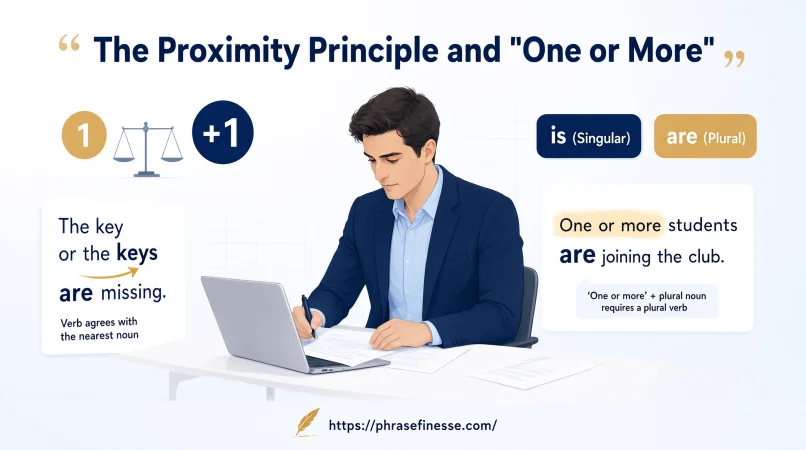
Another useful concept is the proximity principle.
In some constructions involving or, the verb tends to agree with the nearest noun or pronoun. The Chicago Manual of Style explicitly recommends using the nearest noun or pronoun to determine agreement in certain compound constructions.
For example:
Your parents or the babysitter says no.
The nearest subject is singular babysitter, so says follows.
Reverse the order:
The babysitter or your parents say no.
Now the nearest subject is plural parents, so say follows.
With one or more employees, the plural noun is the relevant noun:
one or more employees are
This helps explain why the plural form feels structurally natural.
However, don’t reduce the entire grammar rule to “always use the nearest word.” English agreement involves more than proximity. The construction and intended meaning still matter.
Why “One or More” Creates So Much Confusion
The phrase combines two ideas that seem to pull in opposite directions.
“One” points toward singularity
Examples:
- one student is
- one file is
- one employee is
“More” opens the door to plurality
Examples:
- more students are
- more files are
- more employees are
Put them together:
one or more students are
The phrase therefore expresses at least one member of a potentially plural group.
That’s why the construction can feel odd when you first encounter it. The phrase begins with a singular numeral but ultimately modifies a plural noun.
Think of one or more as a quantity range rather than as a simple singular subject.
Minimum: 1
Maximum: more than 1
That distinction makes the grammar easier to see.
A Useful Editing Trick: Replace “One or More” With “Some”
Here’s a handy mental test.
Take:
One or more employees are available.
Temporarily replace one or more with some:
Some employees are available.
The plural agreement suddenly feels obvious.
This isn’t a universal grammar test, but it can help you recognize the underlying plural meaning.
Another useful substitution is:
At least one employee is available.
That version highlights the minimum quantity.
So you can think of the two expressions this way:
- one or more employees are available → emphasizes an unknown quantity
- at least one employee is available → emphasizes the minimum of one
Both can be useful. They simply spotlight different parts of the meaning.
Quick Reference: One or More Agreement Rules
Keep this table handy when editing.
| Pattern | Preferred construction | Example |
| One + singular noun | is | One manager is available. |
| One or more + plural noun | are | One or more managers are available. |
| One or more of + plural noun | are | One or more of the managers are available. |
| Two or more + plural noun | are | Two or more managers are available. |
| More than one + singular noun | is | More than one manager is available. |
| At least one + singular noun | is | At least one manager is available. |
| One or more without an explicit noun | Context-dependent | One or more are/is available. |
The most important row is the second one.
One or more + plural noun → are
That’s the pattern you’ll use most often.
FAQs
1. Is “one or more is” grammatically correct?
Yes, “one or more is” can be grammatically correct in certain contexts. It usually appears when the speaker treats the combination as a single possibility, condition, or unit. For example, “One or more is required to complete the process” can be appropriate when the emphasis is on fulfilling one requirement.
2. Should I use “one or more are” instead?
Use “one or more are” when you’re referring to multiple people, objects, or things that can individually perform the action. For example, “One or more employees are responsible for the report” treats the employees as separate individuals. The surrounding noun and sentence meaning usually determine the appropriate verb.
3. Is “one or more” singular or plural?
“One or more” can take either a singular or plural verb, depending on the construction and intended meaning. When it refers to multiple separate items, “are” is generally appropriate. When the expression functions as a singular condition or concept, “is” may be suitable.
4. Which is more common: “one or more is” or “one or more are”?
“One or more are” is often more natural when “one or more” modifies a plural noun. For example, “One or more documents are missing.” However, “one or more is” can be correct when the sentence focuses on a single qualifying item or a singular concept.
5. Does “one or more” always require a plural noun?
Not necessarily. The noun that follows “one or more” is commonly plural because the phrase allows for multiple items. However, the grammatical structure can vary depending on the sentence. Always consider the noun, verb, and intended meaning together rather than applying a fixed rule.
6. How can I avoid mistakes with “one or more”?
Look at what “one or more” actually represents in your sentence. If you’re discussing separate people or things, a plural verb such as “are” will often fit. If the expression represents a single condition, requirement, or unit, “is” may be appropriate. Reading the complete sentence aloud can also reveal awkward agreement.
Conclusion
Choosing between “one or more is” and “one or more are” becomes much easier when you focus on meaning and subject-verb agreement. The phrase doesn’t automatically determine the verb by itself. Instead, the surrounding noun, sentence structure, and intended meaning all influence the correct choice.
In everyday English usage, professional communication, formal writing, and workplace contexts, accuracy matters. Whether you’re writing about scheduling, meetings, project requirements, or business processes, using the appropriate verb makes your message clearer and more polished.
When in doubt, identify what the sentence treats as the grammatical subject. Then choose the verb that agrees with that subject. With this simple approach, you can use “one or more” confidently while keeping your writing accurate, natural, and consistent.

Mia Rose is an English language specialist and editorial writer at Phrase Finesse, where she helps readers master grammar, vocabulary, spelling, and effective communication. Passionate about making English simple and practical, she creates well-researched, reader-friendly content that explains complex language concepts in a clear and engaging way.
With extensive experience in English language education, content writing, and editorial review, Mia specializes in grammar, punctuation, word choice, idioms, confusing word pairs, and writing style. Her articles are carefully researched, fact-checked, and designed to help students, professionals, writers, and English learners build confidence in both written and spoken English.