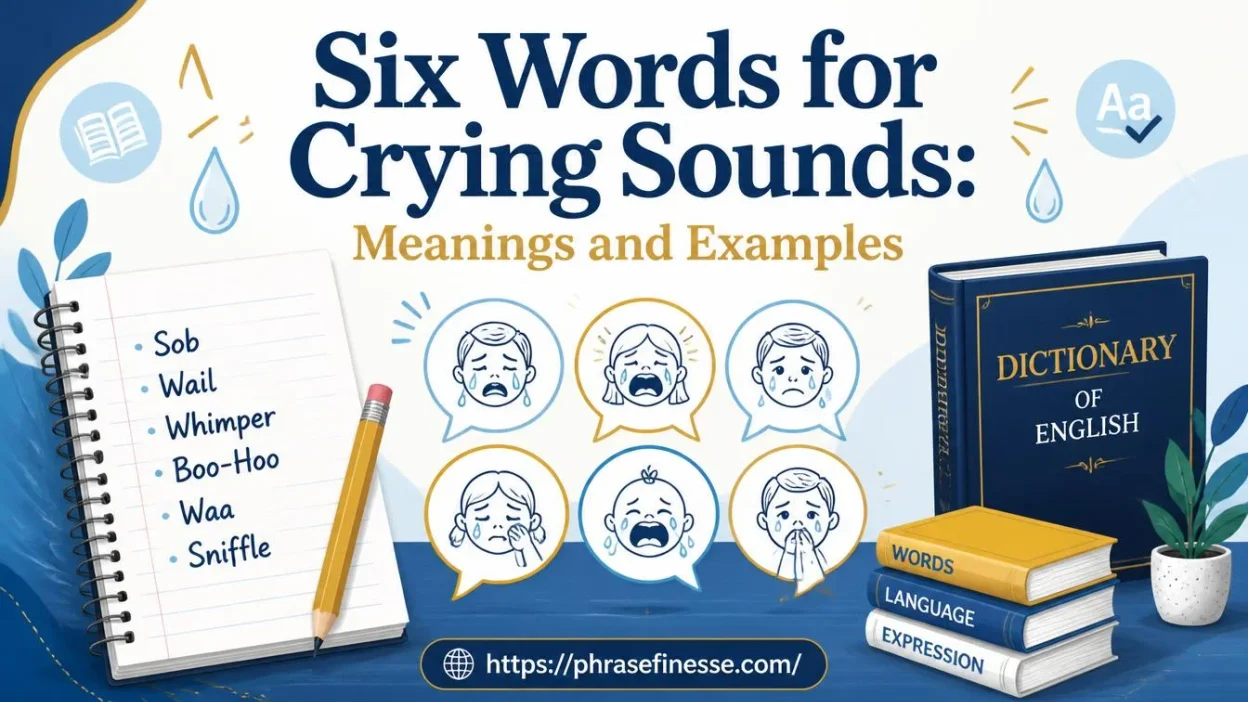
Six Words for Crying Sounds: Meanings and Examples help writers show how a character’s crying sounds instead of simply saying they cry in a scene. When you’re describing a crying sound, regular words like cry may not fully capture what someone actually makes.
Cry onomatopoeia and onomatopoeia describe a word created to imitate a sound, helping readers experience what a person or character does. Useful options include boohoo, blubber, sob sob, and waah. Each crying word creates a different impression. Boohoo suggests loud, emotional crying, while sob sob suggests repeated, broken sobs.
Waah can represent a loud cry, while blubber can describe someone crying while speaking. In writing, these best options can engage readers because they can almost hear the sound made by the characters.
According to the Oxford Dictionary, to hear means to perceive a sound through the ear. Sounds travel as vibrations through air or another medium, allowing a person to perceive them. This makes sound useful when you want to describe sounds rather than simply name an emotion.
Writers can connect this approach with the five senses: see, smell, hear, taste, and touch. Using the senses in writing helps writers show and not tell what someone is experiencing. Instead of saying a character is sad, you can use a specific crying sound to make the moment feel more direct.
What Is Cry Onomatopoeia?
Cry onomatopoeia refers to words that imitate or represent the sounds made during crying. The term onomatopoeia comes from Greek and describes words whose pronunciation resembles the sound they represent.
Some classic examples include:
- Buzz
- Bang
- Splash
- Tick-tock
- Meow
Similarly, crying has its own collection of sound words.
Instead of merely telling readers that someone cried, these words allow them to hear the emotion.
Consider the difference.
She cried after hearing the news.
Now compare it with:
She sobbed quietly, her shoulders trembling with every breath.
The second sentence creates a much stronger image because the sound itself becomes part of the story.
Why Writers Use Crying Sound Words
Whether you’re writing fiction or nonfiction, descriptive sounds add realism.
They help readers:
- Visualize scenes more clearly
- Understand emotional intensity
- Differentiate between sadness, fear, frustration, and grief
- Create stronger dialogue
- Make storytelling more immersive
Think of onomatopoeia as the soundtrack to your writing. Without it, emotional scenes can feel flat.
Crying Sound vs. Emotion Words
Many people confuse crying sounds with emotion words.
Here’s the difference.
| Crying Sound | Emotion Word |
| Sob | Sad |
| Whimper | Afraid |
| Wail | Devastated |
| Boo-hoo | Upset (often exaggerated) |
| Sniffle | Emotional |
Notice that the words on the left imitate sounds or describe vocal expressions, while the words on the right describe feelings.
Common Crying Sounds in English
The following words appear most often in books, comics, films, and everyday conversation.
| Crying Sound | Common Situation |
| Boo-hoo | Mocking or exaggerated crying |
| Sob | Genuine sadness |
| Sniffle | Quiet crying or recovering from tears |
| Waa (Wah) | Babies or humorous crying |
| Whimper | Fear, pain, or nervousness |
| Wail | Loud grief or intense sorrow |
Each one has a different emotional weight.
Let’s look at them individually.
Boo-Hoo
Among all crying expressions, boo-hoo is probably the most recognizable.
Unlike many other crying sounds, this one often carries a playful, sarcastic, or exaggerated tone.
You might hear someone jokingly say:
“Boo-hoo! Nobody ate my cookies.”
In this sentence, the speaker isn’t expressing genuine heartbreak. Instead, they’re exaggerating disappointment for humorous effect.
Meaning of Boo-Hoo
Boo-hoo imitates loud, dramatic crying.
It often represents:
- Pretend sadness
- Childlike complaints
- Mock sympathy
- Exaggerated disappointment
Although children genuinely say “boo-hoo” while crying, adults usually use it sarcastically.
Pronunciation
Boo-hoo
Pronounced: /BOO-hoo/
The repeated vowel sound mimics exaggerated sobbing.
When to Use Boo-Hoo
This word works well in:
- Informal conversations
- Comic books
- Children’s stories
- Humorous dialogue
- Satirical writing
Avoid using it in serious academic writing or emotional scenes involving genuine grief.
Example Sentences
- “Boo-hoo! I lost my favorite pen,” Jake joked.
- The cartoon villain shouted “Boo-hoo!” after losing the contest.
- She rolled her eyes and sarcastically replied, “Boo-hoo. Life isn’t always fair.”
Common Contexts
| Situation | Appropriate? |
| Children’s books | ✔ |
| Comics | ✔ |
| Casual dialogue | ✔ |
| Academic essays | ✘ |
| Serious novels | Rarely |
Writing Tip
Because boo-hoo sounds intentionally dramatic, it can quickly undermine a serious emotional moment. Reserve it for scenes where humor, irony, or exaggeration fits the tone.
Sob
If one word perfectly captures genuine crying, it’s sob.
Unlike boo-hoo, sob usually describes authentic emotional pain.
You’ll find it everywhere—from classic literature and modern novels to newspapers and everyday conversations.
Meaning of Sob
A sob is a deep, broken cry interrupted by irregular breathing.
People often sob when experiencing:
- Grief
- Heartbreak
- Relief
- Overwhelming happiness
- Emotional shock
Notice that sobbing isn’t always caused by sadness. People sometimes sob after joyful reunions or life-changing events.
Pronunciation
Sob
Pronounced: /sob/
The short, sharp sound reflects the abrupt nature of sobbing.
Why Sob Feels So Real
Unlike many onomatopoeic words, sob functions as both:
- A noun
- A verb
Examples:
- She sobbed throughout the movie.
- A loud sob escaped his lips.
That flexibility makes it one of the most useful emotional words in English.
Example Sentences
- She sobbed uncontrollably after reading the letter.
- A quiet sob broke the silence.
- The child buried his face in his mother’s shoulder and sobbed softly.
- He tried to speak, but another sob interrupted his sentence.
Sob vs. Cry
Many learners assume these words mean exactly the same thing.
Not quite.
| Cry | Sob |
| General term | Specific type of crying |
| May include tears only | Includes audible breathing sounds |
| Mild or intense | Usually intense emotion |
| Very broad meaning | More descriptive |
Every sob is a cry.
Not every cry is a sob.
That’s an important distinction for both writers and English learners.
Common Expressions with Sob
English contains many natural phrases built around this word.
Examples include:
- Sob quietly
- Sob uncontrollably
- Burst into sobs
- Choke back a sob
- Stifle a sob
- Sob with relief
These collocations appear frequently in novels because they sound natural.
Writing Tip
Instead of writing:
She cried loudly.
Consider:
She sobbed so hard that she could barely catch her breath.
The second sentence paints a clearer emotional picture.
Sniffle
Not every emotional scene needs dramatic tears.
Sometimes sadness arrives quietly.
That’s where sniffle shines.
This word describes the soft sound people make as they breathe through a runny nose after crying.
It’s subtle, believable, and incredibly common.
Meaning of Sniffle
A sniffle is the repeated inhaling sound made through the nose.
People sniffle because of:
- Crying
- Allergies
- A cold
- Emotional stress
When connected with crying, sniffle usually suggests that the worst tears have already passed.
Pronunciation
Sniffle
Pronounced: /SNIF-uhl/
The soft consonants naturally imitate quiet breathing.
Sniff vs. Sniffle
These two words often confuse English learners.
Here’s the difference.
| Sniff | Sniffle |
| One quick inhale | Repeated soft nose sounds |
| Smelling something | Usually connected to crying or illness |
| Brief action | Ongoing sound |
For example:
✔ She sniffled after the funeral.
✔ He sniffed the flowers.
Those two verbs describe completely different actions.
Example Sentences
- Emma sniffled quietly before answering the question.
- He wiped his eyes and sniffled.
- The little boy sniffled into his sleeve.
- She tried to hide her emotions, but everyone heard her sniffles.
When to Use Sniffle
This word works particularly well when you want to show restrained emotion.
Common situations include:
- Someone trying not to cry
- Recovering after tears
- Quiet sadness
- Emotional speeches
- Family dramas
Because sniffles are quiet, they often make scenes feel even more authentic.
Quick Comparison of the First Three Crying Sounds
| Word | Emotion | Volume | Best Used For |
| Boo-hoo | Exaggerated sadness | Medium | Humor and sarcasm |
| Sob | Deep emotion | Medium to loud | Genuine grief or relief |
| Sniffle | Mild sadness | Quiet | Recovering after crying |
Each word creates a different emotional effect.
Choosing the right one can transform an ordinary sentence into a memorable scene.
“The right sound word doesn’t just tell readers someone cried—it lets them hear the emotion.”
What’s Coming Next
In the next part of this guide, you’ll learn about three more powerful crying sound words:
- Waa (Wah)
- Whimper
- Wail
You’ll also discover:
- A complete comparison table of all six words.
- How to choose the right crying sound for different emotions.
- Common mistakes writers make.
- How crying sound words appear in literature, comics, and children’s books.
- Frequently asked questions.
- A practical conclusion with writing tips.
Waa (Wah)
When people think about a baby crying, the sound “waa” or “wah” often comes to mind. This simple sound appears frequently in children’s books, cartoons, comics, and humorous writing.
Unlike words like sob or wail, waa usually does not describe the emotional reason behind crying. Instead, it represents the actual noise a baby or young child might make.
Meaning of Waa
Waa is an onomatopoeic crying sound that imitates a loud baby cry.
It commonly represents:
- Hunger
- Discomfort
- Frustration
- A child’s need for attention
- Playful or exaggerated crying
Because babies cannot explain what they need, writers often use waa as a simple way to show their emotions.
Pronunciation
Waa
Pronounced: /wah/
The open vowel sound creates the impression of a long, loud cry.
Waa vs. Wah: Which Spelling Is Correct?
Both spellings exist.
| Spelling | Common Usage |
| Waa | Children’s books, comics, written sound effects |
| Wah | More common representation of the actual sound |
There is no major difference in meaning.
For example:
- The baby went “waa waa” in the nursery.
- The cartoon character cried “wah!” after falling down.
Why Writers Use Waa
The word works because it immediately creates a mental picture.
When readers see:
“Waa! Waa! The baby cried from the crib.”
They instantly imagine a baby crying loudly.
It is simple, memorable, and visually expressive.
Example Sentences
- “Waa! Waa!” echoed from the nursery at midnight.
- The cartoon baby shouted “wah!” whenever someone took away his toy.
- The newborn began to cry with a loud waa that filled the room.
Common Contexts
| Writing Type | Use of Waa |
| Baby books | Very common |
| Comics | Common |
| Children’s stories | Common |
| Serious adult fiction | Rare |
| Formal writing | Not recommended |
Writing Tip
Use waa carefully. It works perfectly for babies and playful situations, but it can sound childish when used for adults.
A grieving adult usually does not “waa.” They might sob, whimper, or wail instead.
Whimper
Some cries are loud and impossible to ignore. Others are small, weak, and almost hidden.
The word whimper describes the second type.
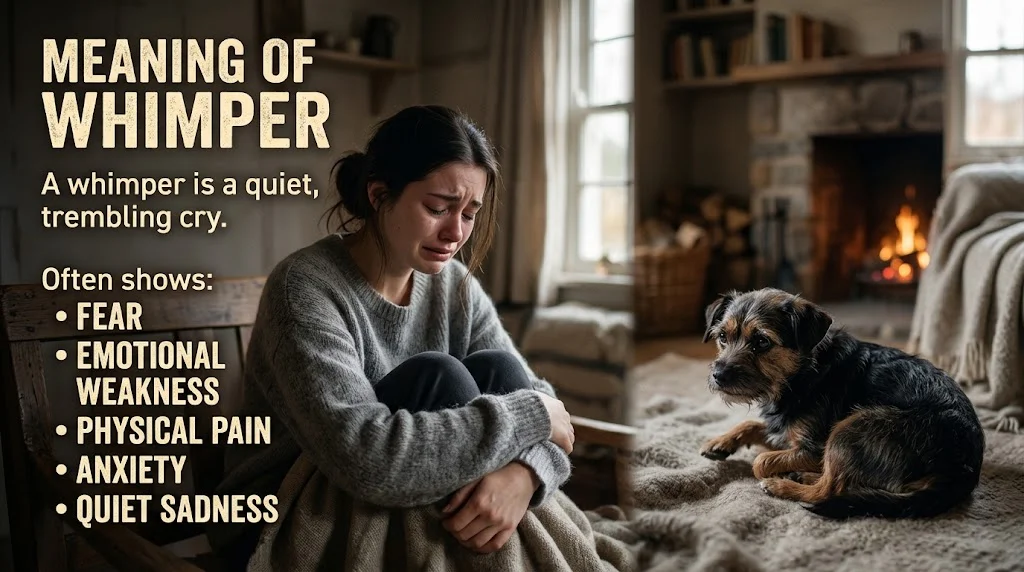
A whimper is a soft, low crying sound often connected with fear, pain, nervousness, or sadness.
Meaning of Whimper
A whimper is a quiet, trembling cry.
People and animals can both whimper.
For humans, it often shows:
- Fear
- Emotional weakness
- Physical pain
- Anxiety
- Quiet sadness
For animals, especially dogs, the word is extremely common.
Example:
The injured puppy let out a soft whimper.
Pronunciation
Whimper
Pronounced: /WHIM-per/
The gentle sound of the word matches the quiet nature of the cry.
Whimper vs. Sob
Although both words relate to crying, they create different images.
| Whimper | Sob |
| Quiet and weak | Strong emotional crying |
| Often linked with fear or pain | Usually linked with sadness |
| Small sound | Broken breathing and tears |
| Can describe animals | Mostly describes humans |
Compare these examples:
Whimper:
The frightened child whimpered as the thunder grew louder.
Sob:
She sobbed after hearing the heartbreaking news.
The first shows fear. The second shows emotional devastation.
Example Sentences
- The injured man whimpered as he waited for help.
- She let out a small whimper when she saw the damage.
- The puppy whimpered beside the empty food bowl.
- The child tried to stay brave but eventually began to whimper.
Common Contexts
Whimper works especially well in:
- Horror stories
- Emotional scenes
- Animal stories
- Character development
- Descriptions of fear
Writers often use it to show vulnerability.
Writing Tip
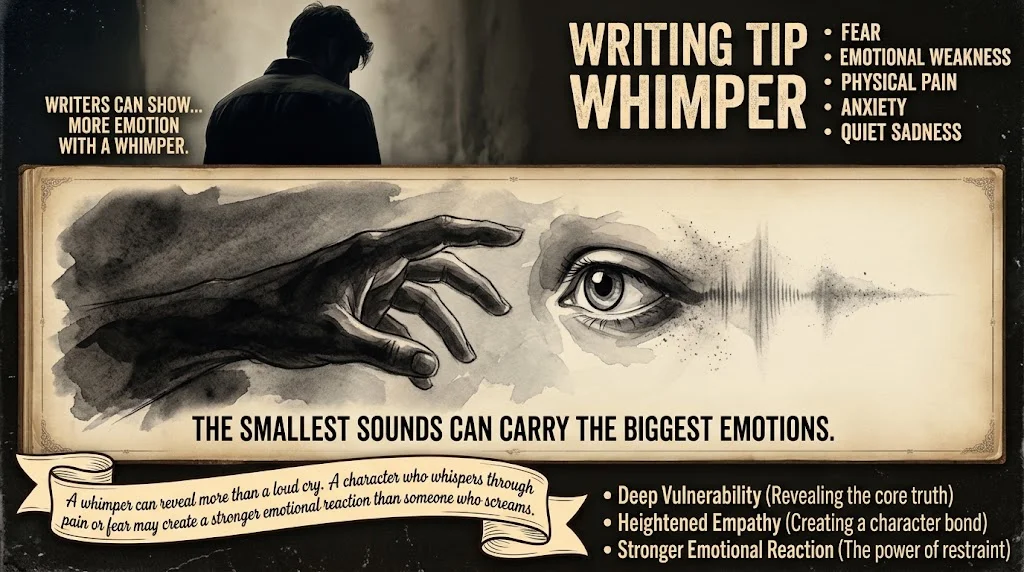
A whimper can reveal more than a loud cry.
A character who whispers through pain or fear may create a stronger emotional reaction than someone who screams.
Sometimes the smallest sounds carry the biggest emotions.
Wail
When emotions become overwhelming, a person may not simply cry. They may wail.
A wail is one of the strongest crying words in English because it suggests intense grief, pain, or despair.
See More : Can I Start a Sentence With “Then”? Grammar Rules
Meaning of Wail
A wail is a long, loud, high-pitched cry.
People often wail during moments of:
- Deep grief
- Extreme pain
- Shock
- Desperation
- Major loss
The word appears frequently in stories about tragedies because it creates a powerful emotional image.
Pronunciation
Wail
Pronounced: /wayl/
The long vowel sound mirrors the extended nature of the cry.
Wail vs. Cry
The word cry is broad.
A person can cry quietly while reading an emotional letter. However, someone who wails usually expresses overwhelming emotion.
| Cry | Wail |
| General emotional response | Extreme emotional reaction |
| Can be quiet or loud | Usually loud |
| Everyday usage | Dramatic situations |
| Broad meaning | Strong intensity |
Example Sentences
- The mother wailed after hearing the tragic news.
- A loud wail came from the crowd.
- The character’s wail echoed through the empty hallway.
- She wailed in grief after losing her beloved pet.
Common Contexts
Wail appears often in:
- Historical writing
- Tragedy scenes
- News reports
- Dramatic novels
- Horror stories
However, because it is intense, you should avoid using it for ordinary sadness.
Someone who tears up during a movie probably does not wail.
Complete Comparison Table: Crying Sound Words
Choosing the right crying sound depends on emotion, volume, and situation.
| Word | Meaning | Emotion | Sound Level | Best Used For |
| Boo-hoo | Dramatic or exaggerated crying | Fake sadness or humor | Medium | Jokes and casual speech |
| Sob | Deep emotional crying | Grief, sadness, relief | Medium | Serious emotional moments |
| Sniffle | Small nose sounds after crying | Mild sadness | Quiet | Subtle emotional scenes |
| Waa | Baby crying sound | Need or discomfort | Loud | Babies and cartoons |
| Whimper | Soft, weak cry | Fear, pain, sadness | Quiet | Vulnerable moments |
| Wail | Loud, prolonged cry | Extreme grief | Very loud | Tragedy and intense emotion |
How to Choose the Right Crying Sound Word
The strongest writing does not simply add a sound word. It chooses the word that matches the emotion.
A useful way to decide is to ask:
How intense is the emotion?
Mild Emotion
Use:
- Sniffle
- Soft cry
Example:
She sniffled while reading the old birthday card.
The emotion exists, but she still has control.
Deep Sadness
Use:
- Sob
Example:
He sobbed when he realized his childhood home was gone.
This suggests powerful emotional pain.
Fear or Pain
Use:
- Whimper
Example:
The injured dog whimpered beneath the table.
The sound feels fragile and helpless.
Extreme Grief
Use:
- Wail
Example:
The mourners wailed during the funeral ceremony.
The emotion has reached its peak.
Humor or Exaggeration
Use:
- Boo-hoo
Example:
“Boo-hoo, you have to wait five minutes,” she joked.
This creates a playful mood.
Crying Sound Words by Emotion
Different emotions create different types of crying.
| Emotion | Best Words |
| Sadness | Sob, sniffle |
| Fear | Whimper |
| Pain | Whimper, wail |
| Grief | Wail, sob |
| Humor | Boo-hoo |
| Childhood crying | Waa |
Common Mistakes When Using Crying Sound Words
Even experienced writers sometimes choose the wrong crying word.
Here are common mistakes to avoid.
Using Boo-Hoo in Serious Situations
Boo-hoo usually sounds playful.
Incorrect:
The widow boo-hooed after losing her husband.
This sentence creates an unintended humorous tone.
Better:
The widow sobbed quietly after losing her husband.
Confusing Sob and Wail
A sob is emotional but controlled.
A wail is intense and dramatic.
Incorrect:
He wailed softly while watching a sad movie.
The words conflict because wailing usually suggests a powerful reaction.
Using Sniff Instead of Sniffle
A sniff does not always mean crying.
Example:
She sniffed the perfume.
This means she smelled something.
However:
She sniffled after crying.
This clearly connects the sound with tears.
Overusing Sound Effects
Too many crying sounds can make writing feel unnatural.
Compare:
She cried. Sob. Sniffle. Wail. Boo-hoo. Tears fell.
This feels forced.
A better approach:
She tried to hold back her tears, but a quiet sob escaped.
One strong word often works better than several weak ones.
Crying Sound Words in Literature and Comics
Writers use crying sounds differently depending on the medium.
Novels
Authors usually avoid direct sound effects and focus on description.
Example:
His voice cracked as he fought back a sob.
This approach allows readers to experience the emotion.
Comics
Comic writers often use direct sound words.
Examples:
- Waa!
- Sob!
- Sniff!
- Boo-hoo!
Because comics combine pictures and text, sound effects help readers immediately understand the action.
Children’s Books
Children’s books frequently use simple crying sounds.
Examples:
- Wah-wah
- Boo-hoo
- Sob
These words are easy for young readers to recognize.
FAQs
1. What is a crying sound called?
A crying sound can be described with onomatopoeia, such as boohoo, sob sob, or waah.
2. What are good words to describe a crying sound?
Some useful words include boohoo, blubber, sob sob, and waah. Each one can suggest a different type of crying.
3. Is “boohoo” an onomatopoeia?
Yes. Boohoo is commonly used as an onomatopoeic word to represent loud or emotional crying.
4. What word describes someone crying while speaking?
Blubber can describe someone who cries while trying to speak, often making their speech difficult to understand.
5. What does “sob sob” mean?
Sob sob represents repeated, broken crying sounds. It works well when you want readers to imagine quiet or emotional sobbing.
6. Why use crying sound words in writing?
Crying sound words help writers show and not tell. They let readers imagine what a character sounds like and experience the scene more vividly.
Conclusion
Choosing the right crying sound can make your writing feel more natural and expressive. Words such as boohoo, blubber, sob sob, and waah help readers understand how a character sounds while crying. Each word creates a slightly different emotional effect.
Using these onomatopoeia words also helps you show and not tell. Instead of simply saying that a character is crying, you can describe the sound and let readers imagine the moment. This approach can make scenes feel more vivid and emotionally engaging.
When you’re describing a crying sound, choose a word that fits the character and situation. Whether the crying is quiet, loud, broken, or emotional, the right crying word can add detail and personality to your writing. With these options, you can make your characters’ emotions easier for readers to experience.

Mia Rose is an English language specialist and editorial writer at Phrase Finesse, where she helps readers master grammar, vocabulary, spelling, and effective communication. Passionate about making English simple and practical, she creates well-researched, reader-friendly content that explains complex language concepts in a clear and engaging way.
With extensive experience in English language education, content writing, and editorial review, Mia specializes in grammar, punctuation, word choice, idioms, confusing word pairs, and writing style. Her articles are carefully researched, fact-checked, and designed to help students, professionals, writers, and English learners build confidence in both written and spoken English.