What happens when you need to connect one idea to another in your writing? Can I Start a Sentence With “Then”? Grammar RulesThe answer is yes, and this small word can play a surprisingly useful role in English sentences. “Then” can introduce a consequence, continue a sequence, or shift the reader from one point to the next.
You’ll see it in everyday conversations as well as formal writing, business communication, and professional documents.
Understanding how “then” works can make your writing sound more natural and organized. For example, you might use it when explaining scheduling, describing time management steps, discussing an online booking process, or explaining what happens before and after meetings.
In contexts involving a calendar, broadcasting, or project management, “then” can create a clear connection between actions and events. The key lies in using it with the right sentence structure and maintaining grammatical consistency.
In this guide, you’ll learn whether “then” can start a sentence, when that usage sounds natural, and when another structure may work better. We’ll examine examples from everyday English usage, professional communication, and grammar to show how context affects the choice.
You’ll also learn how punctuation, sentence flow, and meaning can change when “then” appears at the beginning. By the end, you’ll know how to use “then” confidently and correctly without making your writing sound awkward or repetitive.
Can I Start a Sentence With “Then”?
Yes, you can start a sentence with “Then.”
There is no grammar rule that prevents you from beginning a sentence with this word. In fact, many professional writers, authors, teachers, and journalists use “Then” as a sentence opener.
The confusion usually comes from outdated writing advice. Some people believe that starting sentences with certain words makes writing informal or incorrect. English grammar does not work that way.
Words like:
- Then
- However
- Therefore
- Meanwhile
- Also
- Finally
can all begin sentences when they connect ideas properly.
When “Then” starts a sentence, it usually acts as an adverb. It tells readers what happens next or explains a relationship between ideas.
Examples:
✅ Then, the team reviewed the final report.
✅ Then she realized she had left her phone at home.
✅ Then came the moment everyone had been waiting for.
Each sentence uses “Then” correctly.
The word simply guides the reader from one point to another.
Think of “Then” like a signpost on a road. It tells your reader, “Here’s what happens next.”
What Does “Then” Mean in English?
The meaning of “Then” changes depending on how you use it. Although it looks like a simple word, it performs several important jobs in English grammar.
Understanding these uses helps you decide when starting a sentence with “Then” makes sense.
| Use of “Then” | Meaning | Example |
| Sequence | Shows the next event | I finished my work. Then I went home. |
| Time reference | Refers to a specific moment | I was living in London then. |
| Result | Shows a consequence | If you study hard, then you will improve. |
| Logical conclusion | Shows a deduction | If that is true, then we need another solution. |
“Then” as a Sequence Word
The most common use of “Then” is showing the order of events.
It answers the question:
“What happened next?”
You’ll often see this use in:
- Stories
- Instructions
- Recipes
- Tutorials
- Daily conversations
Examples:
First, turn on the computer. Then open the application.
She grabbed her coat. Then she walked outside.
The meeting ended. Then everyone returned to work.
Without “Then,” the relationship between events may feel less clear.
Compare these examples:
Without “Then”:
She completed the project. She sent the files to her manager.
The meaning is understandable, but the connection feels slightly disconnected.
With “Then”:
She completed the project. Then she sent the files to her manager.
The second version creates a smoother timeline.
Can You Begin a Sentence With “Then” in Formal Writing?
Yes. You can start a sentence with “Then” in formal writing, but you should use it thoughtfully.
Many people assume formal writing requires complicated words. That is not true.
Good formal writing focuses on:
- Clarity
- Accuracy
- Logical organization
- Smooth transitions
A simple word used correctly is often better than an unnecessarily complex alternative.
For example:
Clear formal writing:
The researchers collected the data. Then they analyzed the results.
This sentence works well because the sequence is obvious.
Overly complicated version:
The researchers collected the data. Subsequently, they proceeded with an examination of the obtained results.
Although the second sentence sounds more formal, it feels heavier and less natural.
Sometimes, simple words create stronger writing.
When Should You Start a Sentence With “Then”?
Starting a sentence with “Then” works best in specific situations.
When Showing a Sequence of Events
The strongest use of “Then” is connecting actions that happen one after another.
This is especially useful when explaining a process.
Examples:
Mix the ingredients thoroughly. Then place the mixture in the oven.
The customer submitted the request. Then the support team reviewed the issue.
She graduated from college. Then she started her first job.
In each example, “Then” helps the reader follow the timeline.
When Creating a Storytelling Effect
Writers often use “Then” to create movement and suspense.
It helps readers feel that something new is happening.
For example:
The room was completely silent. Then the lights suddenly went out.
The second sentence creates a shift. The reader immediately expects something important to happen.
This technique appears frequently in:
- Fiction writing
- Personal stories
- Speeches
- Presentations
A single “Then” can change the pace of a paragraph.
When Showing a Result or Consequence
“Then” can also introduce a result.
This commonly appears with if-then statements.
Examples:
If you complete the training, then you can apply for the position.
If the weather improves, then we will continue the event.
Here, “Then” connects a condition with its outcome.
The structure looks like this:
If + condition → then + result
| Condition | Result |
| If you save money | Then you can afford the purchase |
| If you practice regularly | Then you will improve |
| If the plan works | Then we will expand |
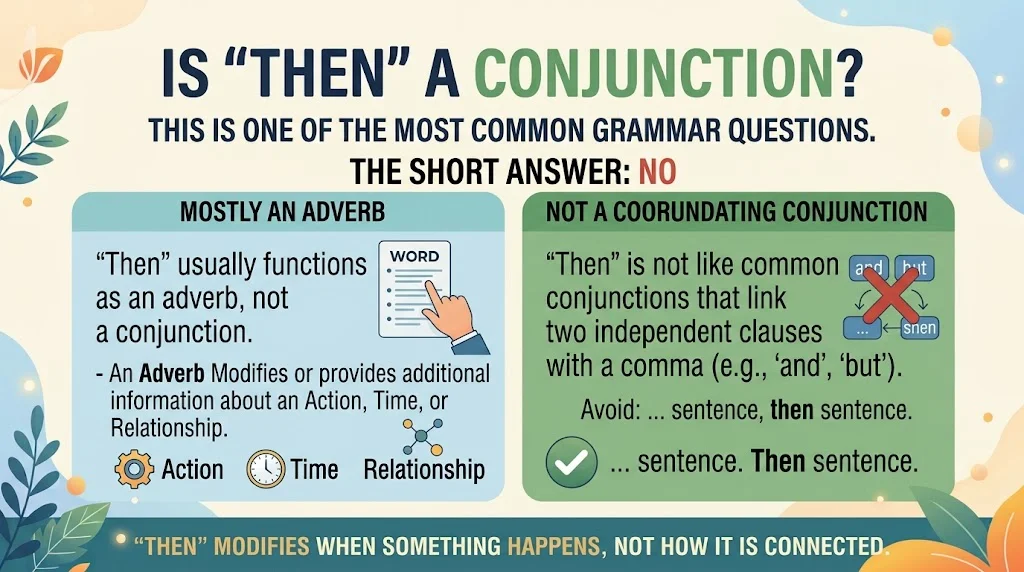
Is “Then” a Conjunction?
This is one of the most common grammar questions.
The short answer:
No, “Then” is usually not a conjunction.
Most of the time, “Then” functions as an adverb.
An adverb modifies or provides additional information about an action, time, or relationship.
Example:
She finished dinner. Then she washed the dishes.
Here, “Then” tells us when the second action happened.
However, “Then” often appears with conjunctions, especially in conditional sentences.
Example:
If you want better results, then you need to practice.
In this sentence, “if” creates the condition, while “then” introduces the result.
Should There Be a Comma After “Then” at the Beginning of a Sentence?
The comma after “Then” depends on how the word functions.
Sometimes the comma improves readability. Sometimes it is unnecessary.
When You Use a Comma After “Then”
Use a comma when “Then” acts as an introductory transition.
Examples:
Then, the company announced a new strategy.
Then, everyone understood what had happened.
The comma creates a small pause.
It tells readers that “Then” introduces the next idea.
When You Don’t Need a Comma After “Then”
You can leave out the comma when “Then” directly connects with the action.
Examples:
Then she opened the door.
Then he walked away.
Then we started the meeting.
Both styles can be correct depending on tone and rhythm.
“Then” vs “Than”: The Common Grammar Mistake
One of the biggest mistakes writers make is confusing “Then” with “Than.”
Although they sound similar, they have completely different meanings.
| Word | Meaning | Example |
| Then | Refers to time, sequence, or result | We ate dinner, then we watched a movie. |
| Than | Used for comparisons | She is taller than her brother. |
A simple trick:
- Then = Time
- Than = Comparison
Remember the phrase:
“Then tells when. Than compares.”
Incorrect:
❌ She is older then me.
Correct:
✅ She is older than me.
Incorrect:
❌ Finish your work, than relax.
Correct:
✅ Finish your work, then relax.
Common Mistakes When Starting a Sentence With “Then”
Although starting a sentence with “Then” is grammatically correct, writers often misuse it. The problem usually isn’t the word itself. The issue comes from using it in the wrong place, repeating it too much, or confusing its meaning.
Understanding these mistakes will help you write clearer and more polished sentences.
Mistake: Using “Then” in Every Sequence
One of the most common problems is overusing “Then” when describing several actions.
For example:
❌ I woke up. Then I brushed my teeth. Then I ate breakfast. Then I left for work.
The sentences are grammatically correct, but the repeated use of “Then” makes the writing feel mechanical.
It sounds like a checklist rather than natural communication.
A better version:
✅ I woke up, brushed my teeth, ate breakfast, and left for work.
Or:
✅ I woke up early. After breakfast, I left for work.
The goal is not to remove “Then” completely. The goal is to use it where it adds value.
Mistake: Using “Then” When Another Transition Word Fits Better
“Then” shows sequence or results. It does not replace every transition word.
Sometimes another word communicates your meaning more accurately.
Compare these examples:
Incorrect meaning:
The project failed. Then, we needed a new approach.
This sentence suggests that the second event happened afterward. However, the writer probably wants to show a cause-and-effect relationship.
A better option:
The project failed. Therefore, we needed a new approach.
Or:
The project failed. As a result, we needed a new approach.
Choosing the Right Transition Word
| Purpose | Better Transition Words | Example |
| Sequence | Then, next, afterward | Then we started the next task. |
| Cause and effect | Therefore, consequently, as a result | The road was closed. Therefore, we took another route. |
| Contrast | However, although, nevertheless | The plan looked good. However, it needed improvements. |
| Addition | Also, furthermore, in addition | The service is affordable. Also, it is reliable. |
A strong writer chooses words based on meaning, not habit.
Mistake: Confusing “Then” With “Afterward”
Many writers use “Then” and “Afterward” interchangeably. Although they are similar, they create slightly different effects.
“Then”
“Then” feels immediate and direct.
Example:
She opened the email. Then she replied.
The reply happened right after opening the email.
“Afterward”
“Afterward” feels broader. It simply means something happened later.
Example:
She opened the email. Afterward, she discussed it with her manager.
The discussion may not have happened immediately.
| Word | Feeling | Example |
| Then | Immediate next step | He finished lunch. Then he left. |
| Afterward | Later event | He finished lunch. Afterward, he went shopping. |
Mistake: Adding a Comma Every Time You Write “Then”
Many people believe “Then” always needs a comma when it starts a sentence.
That is not true.
The comma depends on the sentence structure.
Comma Example:
✅ Then, the company released the updated policy.
Here, “Then” works as an introductory transition.
No Comma Example:
✅ Then she realized the truth.
Here, “Then” connects directly with the action.
Both versions are acceptable.
The difference is often about rhythm and emphasis.
Mistake: Using “Then” Instead of “Than”
This mistake appears frequently because the words sound alike.
However, their meanings are completely different.
Remember:
Then = time
Than = comparison
Examples:
✅ I was younger then.
(At that time)
✅ My car is faster than yours.
(Comparison)
Starting a Sentence With “Then” vs Using It in the Middle
You can place “Then” in different parts of a sentence. Each position creates a slightly different tone.
“Then” at the Beginning
Starting with “Then” emphasizes the next event.
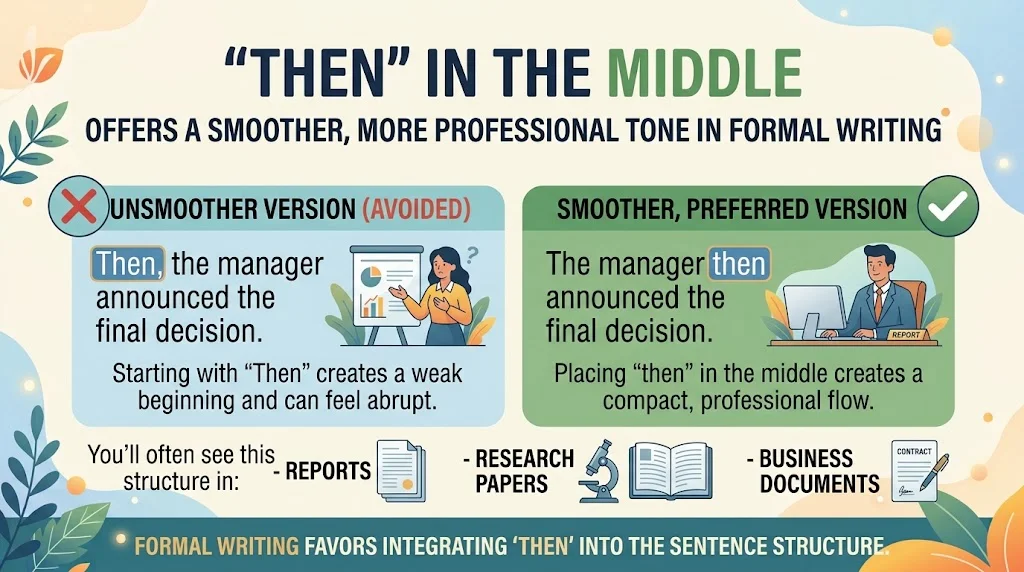
Example:
Then, the manager announced the final decision.
This creates a feeling of progression.
It works well in:
- Stories
- Instructions
- Explanations
“Then” in the Middle
Using “Then” in the middle often sounds smoother in formal writing.
Example:
The manager then announced the final decision.
This version feels more compact and professional.
You’ll often see this structure in:
- Reports
- Research papers
- Business documents
Read More : What Does “Table Something” Mean? US vs. UK Usage
“Then” at the End
Placing “Then” at the end is common in conversations.
Example:
I didn’t understand the problem then.
This means:
I didn’t understand the problem at that time.
Comparison Table: Different Positions of “Then”
| Position | Example | Main Purpose |
| Beginning | Then we started the meeting. | Shows what happens next |
| Middle | We then started the meeting. | Creates formal flow |
| End | We started the meeting then. | Refers to a past moment |
Can You Start an Essay Sentence With “Then”?
Yes, but use it strategically.
Beginning every paragraph with “Then” can make your writing feel repetitive.
However, using it occasionally can improve organization.
Example:
The researchers collected information from hundreds of participants. Then, they analyzed the results to identify patterns.
This works because “Then” clearly connects two steps in the research process.
How Professional Writers Use “Then”
Good writing is not about avoiding simple words. It is about using familiar words effectively.
Many professional writers use “Then” because it helps readers follow ideas.
Example: Business Writing
The team reviewed customer feedback. Then, they created a new improvement plan.
The sentence is clear and easy to understand.
Example: Instructions
Select your preferred payment method. Then enter your account details.
The reader immediately knows the order of actions.
Example: Storytelling
The crowd waited quietly. Then the speaker walked onto the stage.
The word creates anticipation.
Better Alternatives to Starting Every Sentence With “Then”
Although “Then” is useful, variety makes writing stronger.
Here are alternatives depending on your meaning.
| Meaning | Alternative | Example |
| Next event | Next | Next, we reviewed the final section. |
| Later time | Afterwards | Afterwards, they celebrated the achievement. |
| Formal sequence | Subsequently | Subsequently, the company expanded operations. |
| Result | Therefore | Therefore, the team changed its strategy. |
| Unexpected event | Suddenly | Suddenly, the situation changed. |
| Final step | Finally | Finally, we completed the process. |
Case Study: Improving a Paragraph With Too Many “Then” Sentences
Consider this paragraph:
Then the customer contacted support. Then the employee checked the account. Then the employee explained the issue. Then the customer accepted the solution.
The paragraph is understandable, but it feels repetitive.
A stronger version:
The customer contacted support first. The employee checked the account and explained the issue. Then, the customer accepted the solution.
The improved version keeps “Then” where it creates the strongest connection.
Examples of Sentences Starting With “Then”
Everyday Conversation
- Then I remembered where I left my keys.
- Then we decided to order dinner.
- Then she called me with the news.
Academic Writing
- Then, the researchers compared the results from both groups.
- Then, the study examined the possible causes of the problem.
Business Writing
- Then, the marketing team reviewed customer responses.
- Then, the company introduced new safety guidelines.
Storytelling
- Then the door opened slowly, and everyone became quiet.
- Then the unexpected announcement changed everything.
Instructions
- Then add the remaining ingredients to the mixture.
- Then save the document before closing the program.
Can You Start a Sentence With “Then” After a Period?
Yes.
In fact, this is one of the most common ways people use “Then.”
Example:
The meeting ended at noon. Then everyone returned to their offices.
The first sentence establishes the situation. The second sentence shows what happened afterward.
This structure works because readers naturally look for connections between ideas.
Using “Then” in Different Types of Writing
Creative Writing
“Then” can control pacing.
Example:
She searched every corner of the room. Then she found the hidden letter.
The word creates a moment of discovery.
Academic Writing
“Then” can explain steps clearly.
Example:
The researchers collected the samples. Then they analyzed the chemical properties.
It helps readers follow a process.
Professional Writing
“Then” improves instructions and workflows.
Example:
Complete the registration form. Then submit your application.
Clear directions reduce confusion.
FAQs
1. Can I start a sentence with “then”?
Yes, you can start a sentence with “then.” English grammar allows “then” to appear at the beginning, especially when it introduces a sequence, result, or transition. For example: “Then, we reviewed the final proposal.” This structure works in both casual and professional writing when the context is clear.
2. Should there be a comma after “then” at the beginning of a sentence?
A comma after “then” is often helpful when it functions as an introductory transition. For example, “Then, we moved on to the next topic.” However, punctuation can depend on the sentence’s rhythm and how “then” functions. In shorter sentences, writers sometimes omit the comma when “then” connects closely to the verb.
3. Is starting a sentence with “then” grammatically correct?
Yes. Starting a sentence with “then” is grammatically correct when you use it appropriately. It commonly indicates what happens next or shows a logical consequence. For instance, “Then we discussed the project timeline” clearly presents the next step in a sequence.
4. Can I use “then” at the beginning of a sentence in formal writing?
Yes, “then” can appear in formal writing. You might use it to organize instructions, explain a process, or describe events in chronological order. However, avoid beginning too many consecutive sentences with “then,” as repetition can weaken your writing style.
5. What are other words I can use instead of “then”?
Depending on your meaning, alternatives include “next,” “afterward,” “subsequently,” “thereafter,” “at that point,” and “following that.” Choose the option that matches your tone and context. For example, “next” sounds conversational, while “subsequently” often suits more formal writing.
6. What does “then” mean when it starts a sentence?
When “then” starts a sentence, it usually means “next,” “after that,” or “as a result.” Its exact meaning depends on the surrounding context. For example, “Then, she called the client” indicates sequence, while “Then, the plan needs to change” can introduce a consequence.
Conclusion
So, can you start a sentence with “then”? Absolutely. There’s nothing grammatically wrong with placing “then” at the beginning of a sentence. In fact, it can improve clarity when you need to show sequence, timing, or a logical result.
The important thing is to use “then” purposefully. Whether you’re writing an email, explaining scheduling, describing a process, or working on formal documents, context matters. Use it naturally, vary your sentence structure, and avoid unnecessary repetition.
Ultimately, good English usage isn’t about avoiding words simply because they appear at the beginning of sentences. It’s about choosing words that communicate your meaning clearly and maintain smooth, consistent writing.

Mia Rose is an English language specialist and editorial writer at Phrase Finesse, where she helps readers master grammar, vocabulary, spelling, and effective communication. Passionate about making English simple and practical, she creates well-researched, reader-friendly content that explains complex language concepts in a clear and engaging way.
With extensive experience in English language education, content writing, and editorial review, Mia specializes in grammar, punctuation, word choice, idioms, confusing word pairs, and writing style. Her articles are carefully researched, fact-checked, and designed to help students, professionals, writers, and English learners build confidence in both written and spoken English.