“I Would Appreciate” vs. “I Will Appreciate”: Which Is Correct? helps you choose the right expression, tone, and usage in polite English naturally. Both phrases are grammatically correct, but they aren’t always interchangeable.
The meaning, tone, usage, and context guide your word choice. I would appreciate usually works best for polite requests in formal communication, emails, business messages, workplace situations, professional situations, professional communication, formal writing, business communication, customer service, academic writing, and professional writing.
It gives your message a polite, professional, and respectful tone, while I will appreciate points toward future appreciation and future gratitude. For example, “I would appreciate your support on this project” makes a request sound natural and confident, while “I will appreciate your support” expresses definite gratitude for an expected action.
The purpose and intended meaning also affect how your communication is received.
In my experience helping English learners and professionals improve their English writing, I’ve seen this small difference create a big impact. Many English learners have common questions about these expressions because each phrase has a different purpose.
A useful comparison is walking through a maze with two paths, where choosing between chocolate and vanilla depends on the right choice for the situation.
This guide explains the nuances with clear, easy examples and addresses common mistakes in informal communication, everyday conversations, and professional settings. The right sentence structure and correct usage help you express appreciation, gratitude, or a polite request without sounding awkward.
I have faced this puzzle while helping people after an English learning course or during English grammar study. The answer is straightforward once you understand the grammar, meanings, and contextually correct use.
Once you’ve figured out how these phrases work, you’ll know which option fits, communicate, communicate appreciation, and create a more natural received message with natural English. This approach helps you discover the difference and use each expression with greater confidence.
Quick Answer:
The short answer is:
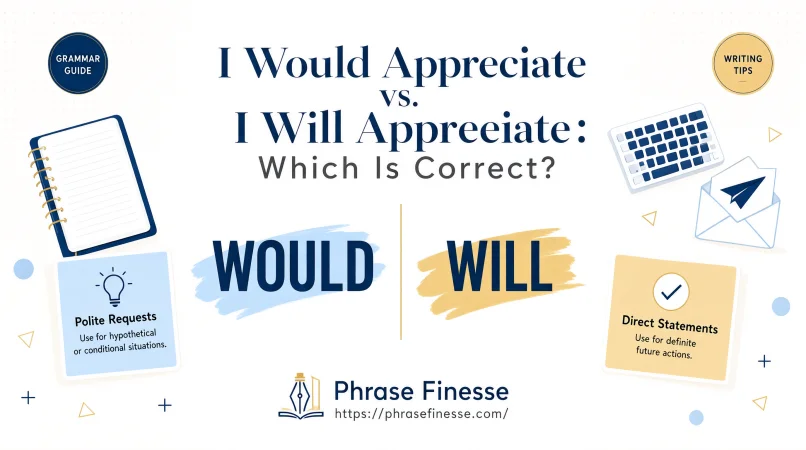
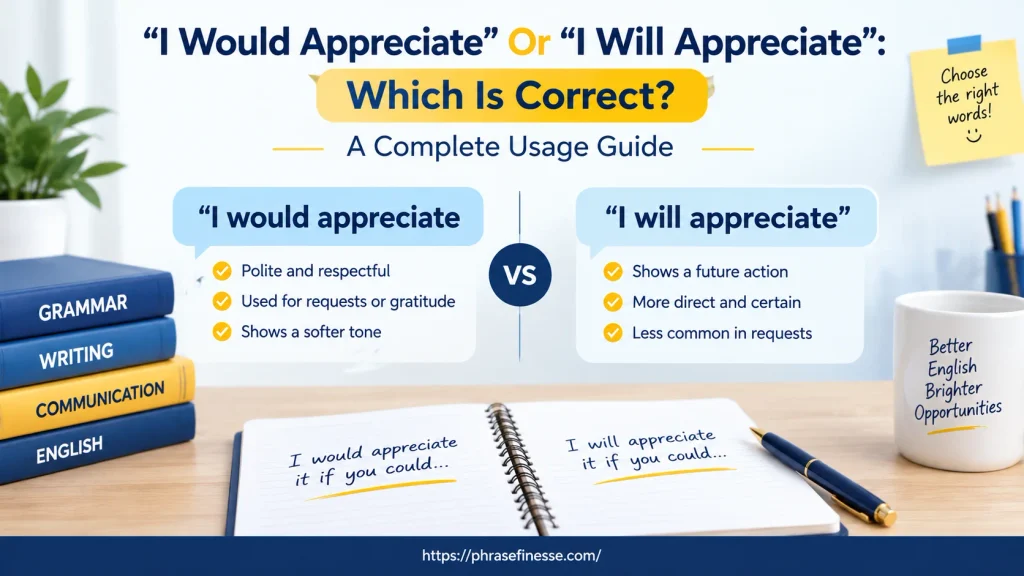
Use “I would appreciate” when you are making a polite request.
Use “I will appreciate” when you are talking about future gratitude.
Here’s a simple comparison:
| Phrase | Meaning | Common Use |
| I would appreciate | A polite request or conditional expression of thanks | Emails, workplace requests, formal communication |
| I will appreciate | A future feeling of gratitude | Future experiences, memories, long-term appreciation |
Examples:
Polite request:
✅ I would appreciate your help with this project.
Meaning:
- You are politely asking for assistance.
Future gratitude:
✅ I will appreciate your kindness forever.
Meaning:
- You believe you will continue feeling grateful in the future.
A useful way to remember the difference:
- Would = request
- Will = future certainty
Think of “would” as opening a door politely. It gives the other person room to respond.
Think of “will” as looking ahead on a timeline. It describes something you expect to happen later.
What Does “I Would Appreciate” Mean?
The phrase “I would appreciate” is a polite expression used when you want to request something, show respect, or express conditional gratitude.
The word “would” works as a modal verb. It creates a softer tone than direct statements.
Compare these two sentences:
Direct:
Send me the documents by Friday.
Polite:
I would appreciate your sending me the documents by Friday.
Both sentences communicate the same basic idea, but the second one sounds more professional and considerate.
The speaker is not simply demanding an action. Instead, they are showing that the other person’s effort matters.
Why “I Would Appreciate” Sounds More Polite
English speakers often use indirect language when making requests.
This does not mean they are being unclear. Instead, they are showing courtesy.
For example:
“I would appreciate it if you could review this proposal.”
This sentence contains two polite elements:
- Would appreciate → softens the request
- Could review → makes the action sound optional rather than forced
Compare:
| Less Polite | More Polite |
| Send me the file. | I would appreciate it if you could send me the file. |
| Reply quickly. | I would appreciate your response when you have time. |
| Fix this issue. | I would appreciate your help resolving this issue. |
In professional environments, tone matters. A request that sounds respectful often receives a better response.
Using “I Would Appreciate” in Formal and Professional Writing
The phrase “I would appreciate” is especially common in professional communication.
You will often see it in:
- Business emails
- Job applications
- Customer service messages
- Academic communication
- Workplace requests
- Official letters
It works well because it maintains professionalism without sounding cold.
“I Would Appreciate” in Workplace Emails
Imagine you need your manager to review a document.
A direct message might sound demanding:
“Please check my report.”
A more professional version:
“I would appreciate your feedback on my report before the meeting.”
The second sentence respects the reader’s role and time.
More workplace examples:
- I would appreciate your guidance on this matter.
- I would appreciate your approval before moving forward.
- I would appreciate your input during the planning process.
- I would appreciate your assistance with this task.
These phrases work because they create cooperation rather than pressure.
The Grammar Structure of “I Would Appreciate”
The phrase can appear in several common patterns.
Structure: I Would Appreciate + Noun
This pattern uses a thing or action as the object of appreciation.
Examples:
- I would appreciate your support.
- I would appreciate your feedback.
- I would appreciate your advice.
- I would appreciate your consideration.
This structure works well in formal writing.
Structure: I Would Appreciate It If + Subject + Verb
This is one of the most common patterns in English.
The formula is:
I would appreciate it if + person + action
Examples:
- I would appreciate it if you could reply by Monday.
- I would appreciate it if you reviewed this document.
- I would appreciate it if you arrived on time.
The word “it” acts as a placeholder for the requested action.
Common Mistake: Forgetting “It” After “Appreciate”
Many learners write:
❌ I would appreciate if you could help me.
Although some people use this structure informally, standard English usually prefers:
✅ I would appreciate it if you could help me.
The word “it” completes the expression and makes the sentence sound natural.
More examples:
❌ I would appreciate if you send the details.
✅ I would appreciate it if you could send the details.
❌ I would appreciate if you explain the process.
✅ I would appreciate it if you could explain the process.
What Does “I Will Appreciate” Mean?
The phrase “I will appreciate” expresses future gratitude.
Unlike “I would appreciate,” it usually does not make a request. Instead, it describes a feeling you expect to have later.
The word “will” shows certainty about the future.
For example:
I will appreciate this experience when I look back on it.
The speaker is saying that future reflection will create appreciation.
When “I Will Appreciate” Sounds Natural
Although “I will appreciate” is less common in requests, it works perfectly in certain situations.
Talking About Future Experiences
When you expect something to become valuable later, use will appreciate.
Examples:
- I will appreciate this lesson throughout my career.
- I will appreciate the memories we created together.
- I will appreciate this opportunity for years to come.
- I will appreciate the time you spent helping me.
These sentences focus on future emotions.
Expressing Long-Term Gratitude With “I Will Appreciate”
Sometimes people use “I will appreciate” to emphasize lasting thankfulness.
For example:
I will appreciate everything you have done for me.
This means:
- Your actions matter now.
- Your kindness will continue to matter in the future.
Other examples:
- I will appreciate your support during this difficult period.
- I will appreciate your generosity forever.
- I will appreciate this chance to grow professionally.
Why “I Will Appreciate” Often Sounds Strange in Requests
A common mistake is using “will” when asking someone to do something.
For example:
❌ I will appreciate if you send me the report.
This sentence is understandable, but it sounds unnatural.
Why?
Because “will appreciate” focuses on a future reaction. It sounds like you are predicting your gratitude rather than politely requesting help.
A better sentence:
✅ I would appreciate it if you could send me the report.
The second sentence clearly communicates a polite request.
“I Would Appreciate” vs. “I Will Appreciate”: Detailed Comparison
| Feature | I Would Appreciate | I Will Appreciate |
| Grammar form | Conditional expression | Future tense |
| Main purpose | Making polite requests | Expressing future gratitude |
| Tone | Respectful and professional | Personal and reflective |
| Common location | Emails, letters, workplace messages | Conversations about future feelings |
| Example | I would appreciate your feedback. | I will appreciate this memory forever. |
When Should You Use “I Would Appreciate”?
Understanding when to use “I would appreciate” becomes easier when you remember its main purpose: it politely asks for an action, favor, opinion, or support.
This phrase works especially well when you want someone to do something but you also want to maintain a respectful tone.
A request can sound completely different depending on the words you choose.
Compare:
Send me the updated file.
This sounds like an instruction.
Now compare:
I would appreciate it if you could send me the updated file.
This sounds cooperative and professional.
The second sentence recognizes that the other person has their own time, responsibilities, and priorities.
Read More : “Relationship To” vs. “Relationship With”: Correct Version
Using “I Would Appreciate” When Asking for Help
One of the most common uses of “I would appreciate” is requesting assistance.
Whether you are asking a colleague, teacher, customer, or friend, this phrase helps your request sound considerate.
Examples:
- I would appreciate your help with this assignment.
- I would appreciate your advice before making a decision.
- I would appreciate your support during this process.
- I would appreciate your assistance in resolving this issue.
These sentences do more than request help. They also show that you value the other person’s contribution.

Using “I Would Appreciate” in Workplace Communication
Professional communication depends heavily on tone.
A workplace message should be clear without sounding demanding. The phrase “I would appreciate” helps you achieve that balance.
For example, imagine you need a manager to approve a project.
A direct sentence:
Please approve the project today.
A more professional version:
I would appreciate your approval so we can move forward with the project.
The second version sounds less like a command and more like a respectful collaboration.
Common workplace situations where “I would appreciate” fits:
| Situation | Example Sentence |
| Requesting feedback | I would appreciate your feedback on this proposal. |
| Asking for approval | I would appreciate your approval before proceeding. |
| Requesting information | I would appreciate any additional details you can provide. |
| Asking for assistance | I would appreciate your help with this task. |
| Following up | I would appreciate an update when you have a chance. |
Using “I Would Appreciate” in Formal Emails
Formal emails often require polite language.
You may need to request information, follow up on a conversation, or ask someone to complete an action. In these situations, “I would appreciate” sounds natural and professional.
Example email sentence:
I would appreciate your response regarding the updated contract terms.
This sentence politely asks for a reply without creating pressure.
Other examples:
- I would appreciate your confirmation by Friday.
- I would appreciate your consideration of my request.
- I would appreciate the opportunity to discuss this further.
- I would appreciate any feedback you can provide.
When Should You Use “I Will Appreciate”?
Although “I will appreciate” is less common in requests, it has a clear purpose.
Use it when you are talking about future appreciation, future gratitude, or something you expect to value later.
The focus is not on asking someone to act. The focus is on your future feelings.
Using “I Will Appreciate” for Future Experiences
Sometimes an experience does not seem important immediately. However, you may recognize its value later.
That is where “I will appreciate” works well.
Examples:
- I will appreciate the lessons I learned from this experience.
- I will appreciate this opportunity for many years.
- I will appreciate these memories when I look back.
- I will appreciate the time we spent together.
These sentences describe gratitude that continues into the future.
Using “I Will Appreciate” to Express Lasting Gratitude
The phrase can also show deep appreciation for something meaningful.
For example:
I will appreciate everything you have done for me.
This means the person’s actions have lasting importance.
It is similar to saying:
- Your kindness matters now.
- Your help will continue to matter.
- I won’t forget what you did.
More examples:
- I will appreciate your generosity for the rest of my life.
- I will appreciate your guidance throughout my career.
- I will appreciate this chance to improve myself.
Common Mistakes With “I Would Appreciate” and “I Will Appreciate”
Many English learners understand both phrases but use them in the wrong situations.
Let’s look at the most common mistakes.
Mistake: Using “I Will Appreciate” for a Request
Incorrect:
❌ I will appreciate your reply as soon as possible.
This sounds like a prediction rather than a request.
The speaker seems to be saying, “When you reply, I know I will feel grateful.”
However, if you want someone to reply, use would.
Correct:
✅ I would appreciate your reply as soon as possible.
Or:
✅ I would appreciate it if you could reply at your earliest convenience.
Mistake: Using “I Would Appreciate” When Talking About the Past
The phrase “I would appreciate” usually refers to a possible action or request.
It does not normally describe gratitude for something that already happened.
Incorrect:
❌ I would appreciate your help yesterday.
Better:
✅ I appreciate your help yesterday.
Or:
✅ I appreciated your help yesterday.
The correct choice depends on whether you mean present gratitude or past gratitude.
Mistake: Making Requests Too Indirect
While polite language is useful, a request should still be clear.
For example:
I would appreciate your thoughts.
This is polite, but it may leave the reader wondering what you need.
A clearer version:
I would appreciate your thoughts on the marketing plan before Thursday’s meeting.
The best professional writing combines politeness with specific information.
Better Alternatives to “I Would Appreciate”
Although “I would appreciate” is useful, repeating the same phrase too often can make your writing feel repetitive.
Here are some alternatives.
| Alternative | Tone | Example |
| I would be grateful | Warm and respectful | I would be grateful for your assistance. |
| I would be thankful | Friendly | I would be thankful for your support. |
| I’d appreciate it if | Conversational | I’d appreciate it if you could review this. |
| I kindly request | Formal | I kindly request your attention to this matter. |
| Your assistance would be appreciated | Very formal | Your assistance would be appreciated during this process. |
“I Would Appreciate” vs. “I Appreciate”: What Is the Difference?
Many people confuse “I appreciate” and “I would appreciate.”
They look similar, but they serve different purposes.
| Phrase | Meaning | Example |
| I appreciate | Present gratitude | I appreciate your help with this project. |
| I would appreciate | Polite request | I would appreciate your help with this project. |
The difference is simple:
- I appreciate = You already received something and feel thankful.
- I would appreciate = You are requesting something and expressing possible gratitude.
Compare:
I appreciate your feedback.
Meaning:
- You already received the feedback.
I would appreciate your feedback.
Meaning:
- You are asking someone to provide feedback.
Case Study: Choosing the Right Phrase in a Professional Email
Imagine Sarah needs her coworker to review a presentation before an important meeting.
Version 1:
I will appreciate your review of this presentation.
This sentence is grammatically possible, but it sounds unusual. It focuses on Sarah’s future gratitude rather than the request.
Version 2:
I would appreciate your review of this presentation before tomorrow’s meeting.
This version works better because it clearly asks for help.
Why Version 2 succeeds:
- It sounds professional.
- It communicates the request clearly.
- It respects the reader’s time.
- It avoids sounding demanding.
The phrase “would appreciate” acts like a bridge between a request and a thank-you.
Examples of “I Would Appreciate” and “I Will Appreciate” in Different Situations
Business Examples
Request:
I would appreciate your feedback on the quarterly report.
Future gratitude:
I will appreciate the experience I gain from working on this project.
Email Examples
Request:
I would appreciate it if you could confirm the meeting time.
Future gratitude:
I will appreciate your support throughout this transition.
Academic Examples
Request:
I would appreciate your comments on my research paper.
Future gratitude:
I will appreciate the knowledge I gained from this course.
Personal Examples
Request:
I would appreciate your understanding during this difficult situation.
Future gratitude:
I will appreciate these memories for the rest of my life.
Can You Say “I Would Appreciate It If You Could…”?
Yes. In fact, this is one of the most common and polite request structures in English.
The structure is:
I would appreciate it if you could + verb
Examples:
- I would appreciate it if you could send the documents today.
- I would appreciate it if you could explain the process.
- I would appreciate it if you could join the meeting.
This structure works because it combines two polite elements:
- Would appreciate → shows respect
- Could → makes the request softer
It sounds like you are inviting cooperation rather than giving an order.
Is “I Will Appreciate” Incorrect?
No. “I will appreciate” is completely correct English.
The problem is not grammar. The issue is context.
Many people use it incorrectly because they assume the word “will” makes a request sound more polite. However, will usually expresses certainty about the future.
Correct examples:
1.✅ I will appreciate your kindness forever.
2.✅ I will appreciate this opportunity throughout my career.
3.✅ I will appreciate these lessons as I grow.
Incorrect use in a request:.
❌ I will appreciate if you send the file.
Better:
✅ I would appreciate it if you could send the file.
FAQs
1. Is “I would appreciate” grammatically correct?
Yes, “I would appreciate” is grammatically correct and very common in polite English. It is especially useful when making a request in professional emails, business communication, workplace messages, and formal writing. For example, “I would appreciate your feedback on this report” politely asks someone to provide feedback.
2. Is “I will appreciate” grammatically correct?
Yes, “I will appreciate” is also grammatically correct. However, it usually emphasizes future gratitude rather than simply making a polite request. For example, “I will appreciate your help during the presentation” suggests that you expect to feel grateful when the person helps you.
3. Should I say “I would appreciate” or “I will appreciate” in an email?
In most professional emails, “I would appreciate” is the more natural choice when you’re making a request. For example, “I would appreciate it if you could send me the updated document.” It sounds polite, respectful, and professional without being too formal.
4. Does “I would appreciate” sound more polite than “I will appreciate”?
Generally, yes. “I would appreciate” is commonly used to soften a request and make it sound more courteous. “I will appreciate” can sound more direct because it focuses on your future reaction to an expected action. However, the exact tone depends on the complete sentence and context.
5. Can I use “I will appreciate your help”?
Yes, you can. “I will appreciate your help” is grammatically correct when you’re referring to future gratitude. For example, “I will appreciate your help with this project.” However, if you’re simply asking someone for help, “I would appreciate your help” will usually sound more natural and polite.
6. What is the easiest way to remember the difference?
A simple rule is to remember that “I would appreciate” usually makes a polite request, while “I will appreciate” usually expresses future gratitude. Use “would” when you’re politely asking for something and “will” when you’re emphasizing that you’ll be grateful after something happens.
Conclusion
“I would appreciate” and “I will appreciate” are both correct expressions, but they serve slightly different purposes. “I would appreciate” is generally the better choice when you’re making a polite request, particularly in professional emails, workplace communication, formal writing, and business situations. It creates a respectful tone while clearly communicating what you need.
On the other hand, “I will appreciate” focuses more on future gratitude. It works when you want to emphasize that you’ll be thankful for someone’s future action or assistance. Although the difference may seem small, understanding it can help you choose more natural wording and avoid awkward sentences in professional and everyday English.
When you’re unsure which expression to use, remember this simple distinction: “I would appreciate” is usually for polite requests, while “I will appreciate” is usually for future appreciation.
Once you understand the context and intended meaning, choosing between the two becomes much easier. With regular practice, you’ll be able to use both expressions confidently in emails, conversations, and formal English writing.