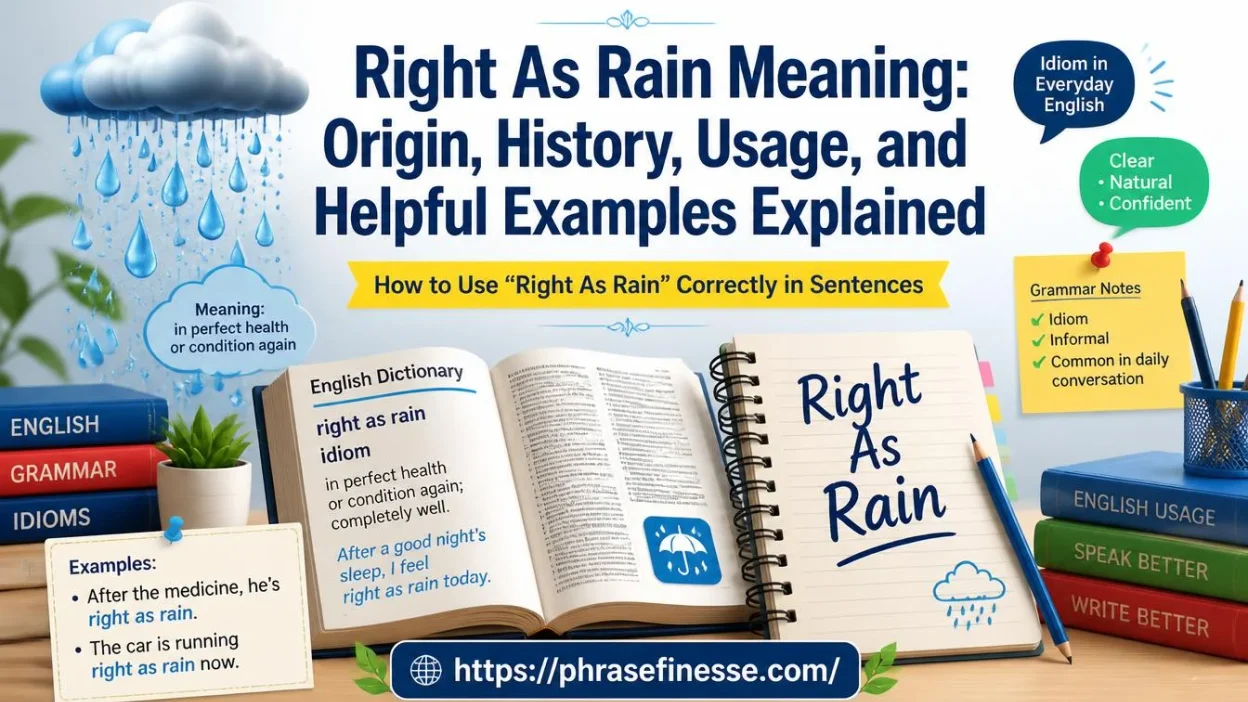
Have you ever heard someone say they felt “Right As Rain” and wondered what it actually means? This guide to How to Use “Right As Rain” Correctly in Sentences.explains the expression in clear, practical English. You’ll discover its meaning, origin, correct English usage, and how to use it confidently in everyday conversations and formal writing.
Although this classic idiom originally described someone who felt healthy or completely well, it now appears in many personal and professional contexts. You may encounter it in business communication, broadcasting, emails, presentations, or casual discussions. Understanding its proper grammar, tone, and context helps you communicate with greater consistency, whether you’re discussing project management, meetings, time management, scheduling, or even organizing a calendar for work.
In this article, you’ll learn where the phrase came from, what it truly means, and when it sounds natural in modern English. You’ll also explore helpful examples, common mistakes, alternative expressions, and practical tips for using the idiom with confidence. Whether you’re improving your vocabulary, writing professionally, or communicating during online booking, workplace collaboration, or daily conversations, this guide will help you use “Right As Rain” accurately and naturally.
Using “Right As Rain” to Describe Health Recovery
The most common use of right as rain involves someone feeling healthy again.
When a person has been sick, tired, injured, or stressed, they can say they are right as rain once they recover.
Examples:
“I felt terrible yesterday, but after getting some sleep, I’m right as rain.”
Meaning:
The speaker feels completely better.
“The doctor said I’ll be right as rain after a few days of rest.”
Meaning:
The person expects to recover soon.
“Grandpa had a rough week, but he’s right as rain now.”
Meaning:
Grandpa has returned to good health.
Why This Usage Is So Common
Health recovery is one of the easiest situations where the meaning of the phrase becomes clear.
People naturally describe recovery with images of renewal:
- A plant grows after rain.
- A dry field becomes healthy after rainfall.
- A person feels refreshed after rest.
The expression creates the same emotional picture.
Using “Right As Rain” for Problems and Situations
Although many people use this phrase for health, it can also describe situations that have improved.
A problem may appear overwhelming at first. After someone fixes it, everything becomes right as rain.
Examples:
“The website was down this morning, but the technical team fixed it. Everything is right as rain now.”
Meaning:
The website works normally again.
“We had some confusion during the project, but after the meeting, everything was right as rain.”
Meaning:
The issue was resolved.
Business and Workplace Examples
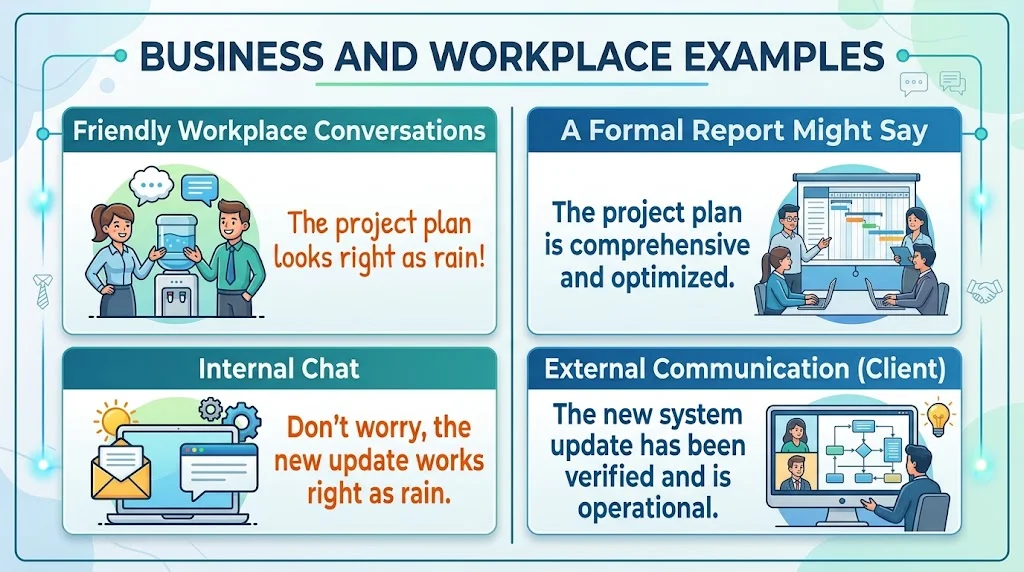
In professional settings, people usually choose more formal words. However, in friendly workplace conversations, right as rain can sound natural.
Examples:
“Once we update the schedule, the entire process will be right as rain.”
“The customer complaint was handled, and everything is right as rain.”
The phrase adds a relaxed and positive tone.
Using “Right As Rain” for Objects and Machines
Many English learners assume this idiom only applies to people. That is not true.
You can use it for objects, equipment, vehicles, and systems.
Examples:
“The old printer stopped working, but after the repair, it’s right as rain.”
Meaning:
The printer works properly again.
“The bike needed a few adjustments, but now it’s right as rain.”
Meaning:
The bike is in excellent condition.
Objects That Can Be Described as “Right As Rain”
| Object | Example |
| Car | “The car is right as rain after the service.” |
| Computer | “The computer is right as rain after the update.” |
| Phone | “My phone is right as rain after the repair.” |
| Machine | “The machine is right as rain again.” |
Is “Right As Rain” Formal or Informal?
The phrase is mostly informal and conversational.
It works well when speaking with:
- Friends.
- Family members.
- Coworkers.
- Customers in casual conversations.
However, you may want to avoid it in:
- Academic writing.
- Legal documents.
- Scientific reports.
- Formal business proposals.
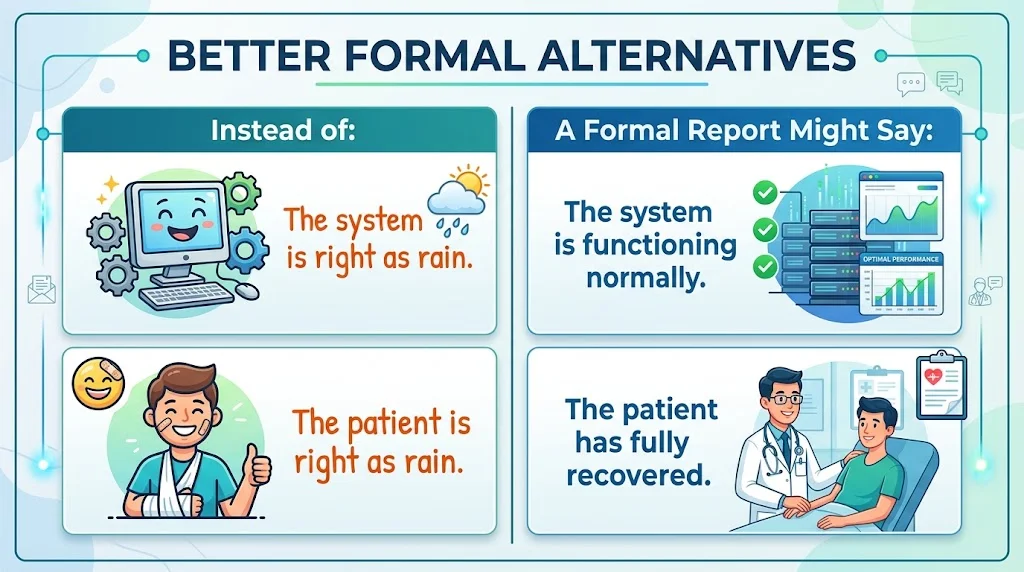
Better Formal Alternatives
Instead of:
“The system is right as rain.”
A formal report might say:
“The system is functioning normally.”
Instead of:
“The patient is right as rain.”
A medical document might say:
“The patient has fully recovered.”
Common Mistakes When Using “Right As Rain”
Although the phrase looks simple, English learners sometimes use it incorrectly.Let’s look at the most common mistakes.
See More: Could You Please vs. Could You Kindly: Differences & Usage
Mistake: Taking the Phrase Literally
A common misunderstanding is thinking the phrase describes actual weather.
Example of incorrect interpretation:
“He was right as rain because he stood outside in the rain.”
This does not make sense.
The phrase has nothing to do with being wet or standing under rainfall.
The correct meaning is:
“He recovered and feels completely fine.”
Mistake: Changing the Expression
Idioms usually have fixed wording.
The correct phrase is:
✅ Right as rain
Common incorrect versions include:
❌ Right like rain
❌ Right as the rain
❌ Right than rain
❌ Right as rainy weather
Changing the wording makes the expression sound unnatural to native speakers.
Mistake: Using It in Very Serious Situations
Although right as rain is positive, it has a cheerful and casual feeling.
For example, saying:
“The patient is right as rain after the accident.”
may sound too casual in a serious medical context.
Better:
“The patient has recovered well after the accident.”
The idiom works best when the situation allows a friendly tone.
Real-Life Case Studies of “Right As Rain” Usage
Case Study: Recovering After an Illness
Imagine someone catches a seasonal cold.
For several days, they feel exhausted and unable to complete normal activities. After proper rest, fluids, and recovery time, they return to their regular routine.
They might say:
“I was feeling awful last week, but I’m right as rain now.”
The phrase communicates both physical recovery and emotional relief.
Case Study: Fixing a Business Problem
A small company experiences website problems during a busy sales period.
Customers cannot complete purchases, and employees become concerned.
After the technical team fixes the issue, the manager says:
“The website is right as rain again.”
The phrase shows that the problem has disappeared and normal operations have returned.
Why “Right As Rain” Remains Popular Today
Many older expressions disappear because people stop using them. However, “right as rain” continues to survive because it expresses a common human experience.
Everyone understands the feeling of:
- Being tired and recovering.
- Facing problems and solving them.
- Experiencing difficulty and finding balance again.
The phrase also creates a positive image.
Instead of simply saying:
“Everything is okay.”
You can say:
“Everything is right as rain.”
The second option feels warmer and more expressive.
Similar Idioms About Recovery and Improvement
English contains many expressions that describe positive changes.
Back on Your Feet
Meaning:
Recovered after illness, injury, or difficulty.
Example:
“After a week of rest, she’s back on her feet.”
As Good As New
Meaning:
Something has returned to excellent condition.
Example:
“The old watch looks as good as new after repairs.”
Fit As a Fiddle
Meaning:
Very healthy and energetic.
Example:
“Even at 70, he’s fit as a fiddle.”
All Better
Meaning:
No longer experiencing a problem.
Example:
“Don’t worry. The child is all better now.”

Back to Normal
Meaning:
Returned to the usual condition.
Example:
“After the storm, life slowly returned to normal.”
FAQs
1. What does “Right As Rain” mean?
“Right As Rain” means completely healthy, perfectly fine, or in excellent condition. It often describes someone who has recovered from illness or a situation that has been resolved successfully.
2. Where did the phrase “Right As Rain” originate?
The phrase is believed to have originated in Britain during the late 19th century. Although its exact origin remains uncertain, it has long been associated with the idea of being perfectly well or entirely satisfactory.
3. Is “Right As Rain” still commonly used?
Yes. Although it’s considered a traditional idiom, “Right As Rain” is still widely understood and used by native English speakers, especially in casual conversations, books, newspapers, and media.
4. Can I use “Right As Rain” in formal writing?
You can, but only when the tone is appropriate. The expression works best in informal writing, conversational articles, speeches, and friendly business communication. In highly academic or legal writing, more formal alternatives such as fully recovered or completely satisfactory may be better choices.
5. What are some synonyms for “Right As Rain”?
Common alternatives include:
- Fit as a fiddle
- In good health
- Feeling great
- Back to normal
- Perfectly fine
- In excellent condition
Each carries a similar meaning, though the level of formality may differ.
6. How can I use “Right As Rain” correctly in a sentence?
Here are two examples:
- After a few days of rest, she was right as rain and returned to work.
- The software update fixed the issue, and everything was right as rain again.
These examples show that the idiom can describe both people and situations that have returned to a normal or excellent.
Conclusion
The idiom “Right As Rain” has remained popular for generations because it expresses a simple yet powerful idea: feeling completely healthy, satisfied, or in excellent condition. While its exact historical origin isn’t certain, its meaning has stayed remarkably consistent in both British and international English.
Today, you’ll still hear it in everyday conversations, literature, and even professional settings where a natural, friendly tone is appropriate.
Understanding the meaning, origin, and correct usage of “Right As Rain” allows you to use the expression naturally and avoid common mistakes.
Whether you’re improving your English grammar, expanding your vocabulary, or becoming more confident in formal writing and business communication, mastering well-known idioms like this makes your language more fluent, engaging, and authentic.

Emma Brooke is an English language specialist, editor, and content writer at Phrase Finesse, where she helps readers develop stronger writing and communication skills through clear, practical, and engaging content. With a passion for the English language, she specializes in simplifying grammar rules, vocabulary, spelling, punctuation, and word usage for learners at every level.
Emma has extensive experience creating educational content that is accurate, well-researched, and easy to understand. She is particularly skilled at explaining confusing word pairs, grammar concepts, idioms, sentence structure, and effective writing techniques, making complex topics approachable for students, professionals, educators, and English learners worldwide.