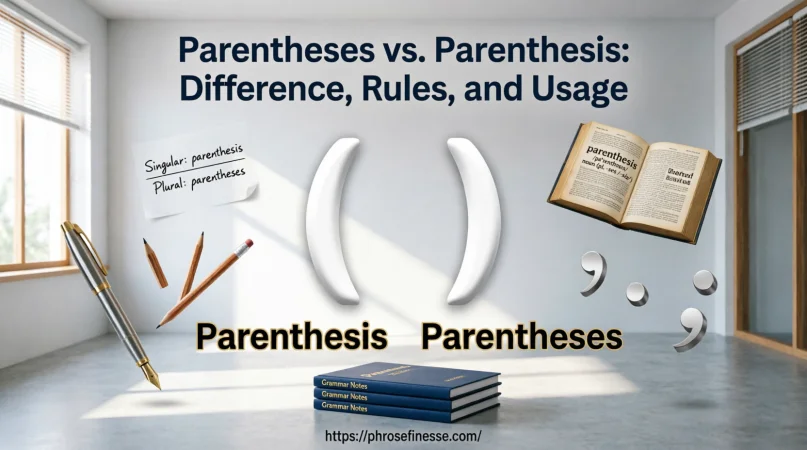
Have you ever paused while writing and wondered whether you should use parenthesis or parentheses? You’re not alone.Parentheses vs. Parenthesis: Difference, Rules, and Usage is a common grammar question that confuses students, professionals, and everyday writers alike.
Understanding this distinction improves English usage, strengthens grammar, and helps you communicate with greater consistency in both casual and formal writing.
Although the difference seems small, choosing the correct term can make your writing clearer and more professional. Whether you’re preparing business communication, managing project management documents, organizing a calendar, sending meetings notes, creating broadcasting scripts, or writing content about online booking, punctuation matters.
Even topics like scheduling and time management benefit from accurate grammar because precise writing reduces confusion and improves readability.
In this guide, you’ll learn exactly when to use parenthesis and when to use parentheses, along with easy-to-follow grammar rules, practical examples, common mistakes, and expert usage tips.
By the end, you’ll confidently apply the correct form in every context, making your writing more polished, accurate, and reader-friendly while following modern standards of English grammar and effective communication.
What Is a Parenthesis?
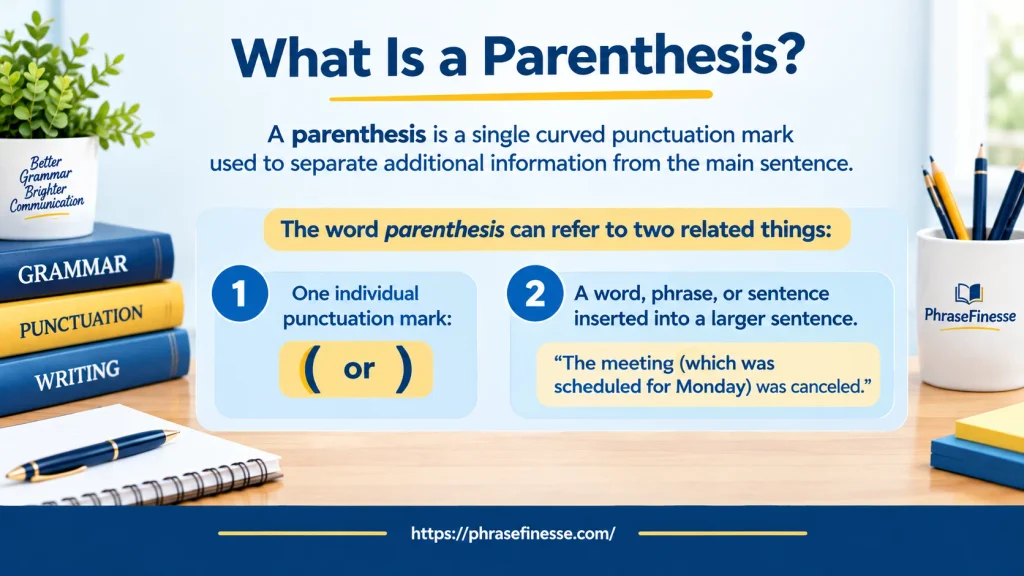
A parenthesis is a single curved punctuation mark used to separate additional information from the main sentence.
The word parenthesis can refer to two related things:
- One individual punctuation mark: ( or )
- A word, phrase, or sentence inserted into a larger sentence
Although writers usually use parentheses as a pair, each individual mark has its own name.
The two symbols are:
- Opening parenthesis: (
- Closing parenthesis: )
Think of a parenthesis like one side of a doorway. It helps create an opening or closing space, but it usually works together with another mark.
Examples of a Single Parenthesis
Here are examples where someone refers to one mark:
- “You forgot to add the closing parenthesis at the end of the sentence.”
- “The editor removed an unnecessary opening parenthesis.”
- “This paragraph contains an unmatched parenthesis.”
In each example, the speaker refers to only one punctuation mark.
What Does Parenthesis Mean in Writing?
Beyond punctuation, parenthesis also refers to extra information placed inside a sentence.
This additional information usually explains, clarifies, or adds context. However, the sentence should still make sense without it.
Example:
“My sister (who lives in California) visits us every summer.”
The phrase “who lives in California” is a parenthesis because it adds information about the sister.
Remove it:
“My sister visits us every summer.”
The sentence still works.
That’s the main purpose of a parenthesis: to provide helpful details without changing the main message.
The Origin and Meaning of the Word Parenthesis
The word parenthesis comes from the Greek word parentithenai, which means “to put beside” or “to insert.”
This original meaning explains how parentheses work today.
When writers place information inside parentheses, they are inserting a thought beside the main sentence.
For example:
“The company launched its first product (a mobile application) in 2015.”
The phrase inside the parentheses sits beside the main idea. It adds information but does not control the sentence.
This idea of “placing something beside” is why parentheses are often described as a tool for adding side comments or explanations.
What Are Parentheses?
Parentheses are a pair of curved punctuation marks used together to include additional information in writing.
The symbol looks like this:
( )
The opening parenthesis starts the extra information.
The closing parenthesis ends it.
Example:
“The meeting starts at 9 a.m. (please arrive 15 minutes early).”
The phrase inside the parentheses gives extra information. The main sentence remains complete without it.
Why Parentheses Usually Come in Pairs
Unlike some punctuation marks, parentheses usually need a partner.
An opening parenthesis creates an expectation that a closing parenthesis will follow.
Think of parentheses like quotation marks or bookends. One side alone feels incomplete.
Incorrect:
The project deadline is Friday (submit your work before noon.
The reader expects the missing closing parenthesis.
Correct:
The project deadline is Friday (submit your work before noon).
The pair creates a complete thought.
Parentheses vs. Parenthesis: The Main Difference
The difference between parentheses and parenthesis comes down to number and usage.
| Feature | Parenthesis | Parentheses |
| Form | Singular | Plural |
| Meaning | One curved mark or inserted thought | A pair of curved marks |
| Symbols | ( or ) | ( ) |
| Common use | Referring to one punctuation mark | Adding information in writing |
| Example | “The closing parenthesis is missing.” | “Put the explanation inside parentheses.” |
The easiest way to remember:
One = parenthesis
More than one = parentheses
Because most writing uses both curved marks together, you’ll probably see parentheses more often.
How to Use Parentheses Correctly in Writing
Parentheses have several important uses. They can make writing clearer when used carefully.
However, they should support your message rather than interrupt it.
Using Parentheses to Add Extra Information
The most common use of parentheses is adding information that isn’t essential to the sentence.
Example:
“Emma Watson (the actress and activist) spoke at the event.”
The main sentence:
“Emma Watson spoke at the event.”
The information inside the parentheses adds context but does not change the basic meaning.
Writers often use parentheses for:
- Background details
- Explanations
- Short comments
- Additional facts
- Clarifications
Using Parentheses for Clarifications and Explanations
Sometimes readers need a quick explanation of a term or idea.
Parentheses help provide that explanation without interrupting the flow.
Examples:
“The World Health Organization (WHO) provides health guidance worldwide.”
The abbreviation WHO becomes clear immediately.
Another example:
“Photosynthesis (the process plants use to convert sunlight into energy) is essential for plant growth.”
The parenthetical explanation helps readers understand the scientific term.
Using Parentheses for Dates and Numbers
Parentheses frequently appear in formal writing when writers include extra facts.
Dates
Example:
“William Shakespeare (1564–1616) wrote many famous plays.”
The dates provide useful information without becoming the focus.
Numbers
Example:
“The package weighs five pounds (2.3 kilograms).”
The conversion helps readers understand the measurement.
Financial Information
Example:
“The company reported revenue growth of 12% ($5 million increase) this year.”
The parenthetical detail explains the figure.
Using Parentheses in Academic Writing
Academic writers often use parentheses for citations, references, and additional explanations.
Example:
“Climate change affects global weather patterns (NASA, 2024).”
The citation identifies the source without interrupting the sentence.
Common academic uses include:
- Research citations
- Abbreviations
- Definitions
- Additional explanations
- Statistical information
Academic Example Table
| Purpose | Example |
| Citation | (Johnson, 2023) |
| Definition | Biodiversity (the variety of life forms) |
| Data | Growth increased by 15% (2024 report) |
| Abbreviation | National Aeronautics and Space Administration (NASA) |
Using Parentheses in Business Writing
Professional writing often uses parentheses to clarify information quickly.
Examples:
“The meeting will take place on Monday (March 18).”
“Please contact the human resources department (HR) for assistance.”
Businesses commonly use parentheses for:
- Dates
- Department names
- Abbreviations
- Instructions
- Additional notes
However, professional writers should avoid filling documents with too many parenthetical statements. Too many interruptions can make important information harder to follow.
See More :Invite vs. Invitation: Difference and Usage Examples
Using Parentheses in Everyday Writing
In casual writing, parentheses often show personal comments or side thoughts.
Example:
“I finally finished the report (after three cups of coffee).”
The sentence feels conversational because the parentheses create a small aside.
People commonly use parentheses in:
- Text messages
- Emails
- Personal blogs
- Social media posts
They work almost like a quiet whisper from the writer.
Parentheses vs. Parenthetical: What Is the Difference?
The word parenthetical often appears alongside parentheses.
A parenthetical is something placed inside parentheses or something that acts like an aside.
Examples:
- “The sentence includes a parenthetical remark.”
- “The parenthetical information provides extra details.”
Compare these terms:
| Word | Meaning | Example |
| Parenthesis | One curved mark or inserted thought | Add a closing parenthesis |
| Parentheses | Pair of curved marks | Use parentheses here |
| Parenthetical | Something added as extra information | A parenthetical comment |
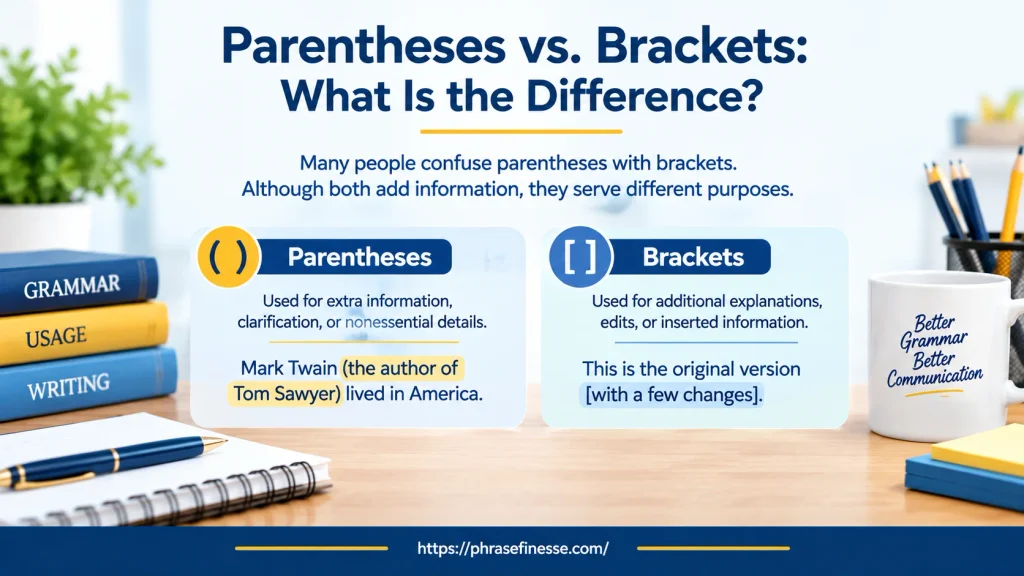
Parentheses vs. Brackets: What Is the Difference?
Many people confuse parentheses with brackets.
Although both add information, they serve different purposes.
| Punctuation | Symbol | Main Purpose |
| Parentheses | ( ) | Adding extra information |
| Brackets | [ ] | Adding clarification inside quoted material |
| Braces | { } | Mathematics and specialized fields |
Parentheses Example:
“The author (who won several awards) published a new book.”
Brackets Example:
“The researcher wrote, ‘The results [from the second experiment] surprised everyone.’”
Brackets often appear when writers add their own explanation inside someone else’s quotation.
Common Mistakes With Parenthesis and Parentheses
Understanding the rules helps you avoid frequent grammar mistakes.
Mistake: Using Parenthesis When You Mean Parentheses
Incorrect:
“Place the information inside a parenthesis.”
Correct:
“Place the information inside parentheses.”
Why?
Because the information normally sits between two marks.
Mistake: Forgetting the Closing Parenthesis
Incorrect:
“The event begins tomorrow (arrive early.”
Correct:
“The event begins tomorrow (arrive early).”
An unfinished pair distracts readers and makes your writing look careless.
Mistake: Overusing Parentheses
Parentheses work best when they add value.
Too many can make writing feel crowded.
Example:
“The company (which started in 2010) announced (during Tuesday’s meeting) that it would expand (into three new markets).”
This sentence feels overloaded.
A clearer version:
“The company started in 2010. During Tuesday’s meeting, it announced plans to expand into three new markets.”
Sometimes a full sentence works better than a parenthetical phrase.
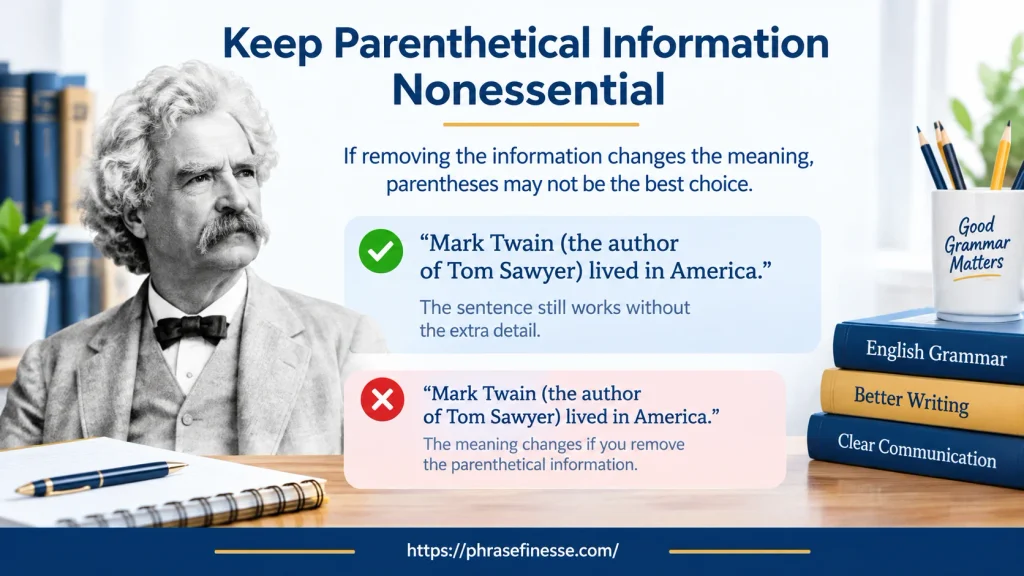
Keep Parenthetical Information Nonessential
If removing the information changes the meaning, parentheses may not be the best choice.
Good:
“Mark Twain (the author of Tom Sawyer) lived in America.”
The sentence still works without the extra detail.
Place Periods Correctly With Parentheses
The placement of periods depends on whether the parentheses contain a complete sentence.
Period Outside Parentheses
Use this when the parentheses are part of a larger sentence.
Example:
“The company opened its new office in London (after months of planning).”
Period Inside Parentheses
Use this when the entire sentence appears inside parentheses.
Example:
“The company opened its new office in London. (The building contains 20 floors.)”
Parentheses in Different Writing Styles
Different types of writing use parentheses in different ways.
| Writing Type | Common Uses |
| Academic | Citations, definitions, research details |
| Business | Dates, abbreviations, instructions |
| Journalism | Background information |
| Casual writing | Personal comments and side notes |
| Technical writing | Explanations and measurements |
A Quick Case Study: Improving a Sentence With Parentheses
Consider this sentence:
“The manager (who joined the company in 2018) announced (during the afternoon meeting) that the company (which operates internationally) will expand.”
The sentence contains too many interruptions.
A better version:
“The manager, who joined the company in 2018, announced during the afternoon meeting that the international company will expand.”
The improved version feels smoother because the important information stays connected.
Lesson: Parentheses should clarify your writing, not create obstacles.
FAQs
1. What is the difference between parenthesis and parentheses?
A parenthesis is the singular form and refers to one punctuation mark or one parenthetical element. Parentheses is the plural form and usually refers to the pair of curved punctuation marks ( ) used to enclose additional information.
2. Is it correct to say “a parentheses”?
No. The correct singular expression is a parenthesis. Since parentheses is already plural, saying “a parentheses” is grammatically incorrect.
3. When should I use parentheses in writing?
Use parentheses to include extra information, explanations, dates, abbreviations, citations, or brief comments that are helpful but not essential to the main sentence.
Example:
The conference (scheduled for Monday) has been postponed.
4. Are parentheses the same as brackets?
No. Parentheses ( ) and brackets [ ] serve different purposes. Parentheses add supplementary information, while brackets are commonly used for editorial notes, clarifications, or modifications within quoted material.
5. Can a sentence end with a parenthesis?
Yes. If the parenthetical information appears at the end of a sentence, the period usually comes after the closing parenthesis.
Example:
The meeting was rescheduled (see the updated calendar).
6. Why do people confuse parenthesis and parentheses?
The words look and sound very similar because they share the same root. Many writers mistakenly use them interchangeably, forgetting that parenthesis is singular and parentheses is plural. Remembering this simple number rule helps eliminate the confusion.
Conclusion
Understanding the difference between parenthesis and parentheses is easier once you remember that the distinction is simply singular vs. plural. A parenthesis refers to one punctuation mark or one parenthetical element, while parentheses refers to the pair of curved punctuation marks used to enclose additional information in a sentence.
Using the correct term improves English grammar, enhances formal writing, and ensures greater consistency across academic, business, and everyday communication. Whether you’re drafting emails, preparing reports, writing blog posts, or editing professional documents, choosing the right word demonstrates attention to detail and strengthens your writing.
Whenever you’re unsure, think about the number involved. If you’re referring to a single mark or a single explanatory element, use parenthesis. If you’re talking about the complete pair of punctuation marks, use parentheses. With this simple rule in mind, you’ll avoid one of the most common grammar mistakes and write with greater confidence.

Alyan Ashraf is an English language writer and editor at Phrase Finesse, where he specializes in grammar, vocabulary, spelling, word usage, and clear communication. Passionate about the English language, he creates practical, research-backed content that helps readers avoid common mistakes and write with greater accuracy and confidence.
Known for his clear writing style and attention to detail, Alyan simplifies complex language topics into easy-to-understand guides filled with real-world examples and actionable insights. His work covers confusing word pairs, grammar rules, idioms, punctuation, and everyday English usage, making learning both accessible and engaging for students, professionals, writers, and non-native English speakers.
Every article Alyan writes is carefully researched, fact-checked, and designed to meet high editorial standards. His goal is to help readers strengthen their English skills, expand their vocabulary, and communicate more effectively in academic, professional, and everyday settings.
Through Phrase Finesse, Alyan is committed to publishing trusted language resources that make mastering English simpler, clearer, and more enjoyable for learners around the world