Have you ever paused while writing and wondered whether Coach’s, Coaches’, or Coaches is the correct form? If so, you’re not alone. Coaches or Coach’s or Coaches’? (Correct Possessive Explained) is a common grammar question that often causes confusion in both everyday and professional writing. Understanding the difference is essential for clear English usage, accurate formal writing, and strong communication.
A misplaced apostrophe can change meaning and affect readability. Whether you’re drafting emails, preparing reports, managing business communication, organizing meetings, updating a calendar, or handling project management tasks, correct possessive forms help maintain consistency and professionalism. The same principle applies to content related to scheduling, time management, online booking, and broadcasting, where precise language improves clarity and reduces misunderstandings.
In this guide, you’ll learn when to use Coach’s for singular possession, Coaches’ for plural possession, and Coaches as a simple plural noun. We’ll break down each form with clear explanations, practical examples, and easy-to-follow rules. By the end, you’ll know exactly which version fits your sentence and how to avoid one of the most common punctuation mistakes in modern English grammar.
After the introduction, a comparison table and real-world examples can help reinforce the rules and improve reader engagement.
Quick Answer
Before diving deeper, here’s the short version.
| Form | Grammar Function | Meaning | Example |
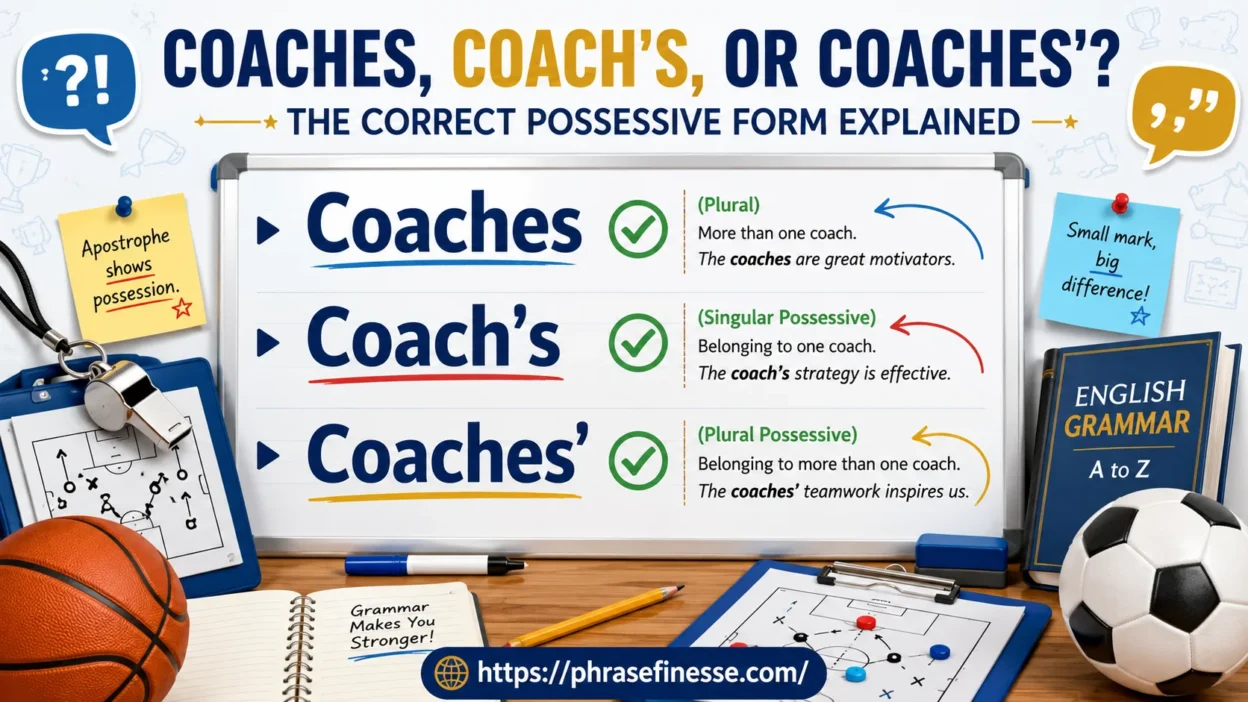
| Coaches | Plural noun | More than one coach | The coaches attended the conference. |
| Coach’s | Singular possessive noun | Something belonging to one coach | The coach’s strategy worked perfectly. |
| Coaches’ | Plural possessive noun | Something belonging to multiple coaches | The coaches’ meeting lasted two hours. |
The Simple Rule
Remember this formula:
- Coaches = more than one coach
- Coach’s = belonging to one coach
- Coaches’ = belonging to multiple coaches
If possession isn’t involved, don’t use an apostrophe.
If ownership exists, determine whether one coach or several coaches own the thing you’re describing.
What Does “Coaches” Mean?
The word coaches is simply the plural form of coach.
You use it whenever you’re referring to two or more coaches.
No ownership is involved. No apostrophe is needed.
Examples of Coaches
- The coaches gathered before the tournament.
- Several coaches attended the leadership workshop.
- The coaches reviewed player performance reports.
- Youth soccer coaches often volunteer their time.
- The coaches discussed training methods.
In each example, the word identifies multiple coaches. Nothing belongs to them.
Common Situations Where “Coaches” Appears
You will frequently encounter the plural form in:
- Sports organizations
- Schools and universities
- Corporate coaching programs
- Executive coaching firms
- Professional development seminars
- Training conferences
Example in Context
Imagine a football conference with 50 team leaders present.
You could write:
The coaches met to discuss new safety regulations.
Since the sentence refers to many coaches, the plural form is correct.
What Does “Coach’s” Mean?
The word coach’s is a singular possessive noun.
It shows that something belongs to one coach.
The apostrophe comes before the “s” because ownership belongs to a single individual.
Examples of Coach’s
- The coach’s office is near the gym.
- The coach’s game plan impressed everyone.
- The coach’s decision changed the outcome.
- The coach’s whistle echoed across the field.
- The coach’s leadership inspired the team.
Each example describes something owned, created, controlled, or associated with one coach.
Understanding Possession
Possession doesn’t always mean physical ownership.
It can also indicate:
- Responsibility
- Association
- Authority
- Creation
- Influence
For example:
The coach’s philosophy emphasizes discipline.
The philosophy isn’t a physical object. However, it belongs conceptually to that coach.
Quick Test
Replace the phrase with:
Belonging to the coach
If the sentence still makes sense, coach’s is probably correct.
Example:
- The coach’s strategy
- The strategy belonging to the coach
The meaning remains intact.
What Does “Coaches'” Mean?
The word coaches’ is a plural possessive noun.
It indicates that something belongs to multiple coaches.
The apostrophe appears after the “s” because the noun is already plural.
Examples of Coaches’
- The coaches’ meeting began at noon.
- The coaches’ recommendations were adopted.
- The coaches’ lounge was renovated.
- The coaches’ feedback improved the program.
- The coaches’ opinions influenced the decision.
In each case, multiple coaches share ownership or association.
Understanding Shared Possession
Suppose five basketball coaches attend a planning session.
You would write:
The coaches’ meeting lasted three hours.
The meeting belongs collectively to several coaches.
Quick Test
Replace the phrase with:
Belonging to the coaches
Example:
- The coaches’ recommendations
- The recommendations belonging to the coaches
The sentence still works.
Understanding the Grammar Behind These Forms
To master these words, you need to understand four basic grammar categories.
Singular Nouns
A singular noun refers to one person, place, thing, or idea.
Examples:
- Coach
- Teacher
- Manager
- Player
- Mentor
Plural Nouns
Plural nouns refer to more than one person or thing.
Examples:
- Coaches
- Teachers
- Managers
- Players
- Mentors
Singular Possessive Nouns
These show ownership by one person.
Examples:
- Coach’s strategy
- Teacher’s classroom
- Manager’s report
- Player’s uniform
- Mentor’s advice
Plural Possessive Nouns
These show ownership by multiple people.
Examples:
- Coaches’ strategies
- Teachers’ classrooms
- Managers’ reports
- Players’ uniforms
- Mentors’ advice
Understanding these four categories eliminates most apostrophe mistakes.
Read More: Agencies or Agency’s or Agencies’? Choose Correct one!
Visual Grammar Breakdown
The easiest way to remember the rule is through a simple chart.
| Meaning | Correct Form |
| One coach | Coach |
| More than one coach | Coaches |
| Belonging to one coach | Coach’s |
| Belonging to multiple coaches | Coaches’ |
Visual Formula
One Coach
↓
Coach
One Coach + Ownership
↓
Coach’s
Multiple Coaches
↓
Coaches
Multiple Coaches + Ownership
↓
Coaches’
This formula works for thousands of English nouns.
Real-World Examples in Sports Writing
Sports journalism uses these forms constantly.
Understanding them improves both readability and credibility.
1. Using Coaches
- The coaches reviewed game footage.
- Several coaches attended the scouting event.
- Experienced coaches often mentor younger staff members.
2. Using Coach’s
- The coach’s strategy surprised opponents.
- The coach’s leadership transformed the program.
- The coach’s comments attracted media attention.
3. Using Coaches’
- The coaches’ association issued a statement.
- The coaches’ conference featured guest speakers.
- The coaches’ concerns were addressed by officials.
Case Study: Sports Report
Consider these headlines:
❌ The coachs strategy led to victory.
❌ The coaches strategy led to victory.
✅ The coach’s strategy led to victory.
Only the third headline correctly shows singular possession.
Real-World Examples in Education
Schools frequently employ coaches for academics, athletics, and student development.
1. Examples of Coaches
- Academic coaches support student success.
- Career coaches help graduates find employment.
- Reading coaches improve literacy programs.
2. Examples of Coach’s
- The coach’s lesson plan received approval.
- The coach’s recommendations improved outcomes.
- The coach’s evaluation helped the student.
3. Examples of Coaches’
- The coaches’ workshop focused on communication skills.
- The coaches’ training materials were updated.
- The coaches’ feedback shaped the curriculum.
Real-World Examples in Business Coaching
The coaching industry extends far beyond sports.
Today, organizations invest heavily in leadership coaching, executive coaching, and performance coaching.
Coaches
- Executive coaches attended the summit.
- Business coaches shared growth strategies.
- Leadership coaches presented new frameworks.
Coach’s
- The coach’s methodology focuses on accountability.
- The coach’s approach emphasizes measurable results.
- The coach’s experience adds credibility.
Coaches’
- The coaches’ collective expertise benefited attendees.
- The coaches’ recommendations improved productivity.
- The coaches’ network expanded internationally.
Common Mistakes and How to Avoid Them
Even experienced writers make apostrophe mistakes.
Here are the most common errors.
Mistake: Using Coach’s as a Plural
Incorrect:
Three coach’s attended the seminar.
Correct:
Three coaches attended the seminar.
Why?
No ownership exists.
Mistake: Forgetting Possession
Incorrect:
The coaches office is upstairs.
Correct:
The coach’s office is upstairs.
Ownership exists. One coach owns the office.
Mistake: Misplacing the Apostrophe
Incorrect:
The coaches’s meeting begins at 10.
Correct:
The coaches’ meeting begins at 10.
The noun is already plural.
Only one apostrophe is needed.
Mistake: Guessing Instead of Counting
Many writers add apostrophes without determining ownership.
Instead, ask:
- How many coaches are involved?
- Is possession present?
Answering those two questions almost always reveals the correct form.
Coach’s vs. Coaches’: Side-by-Side Comparison
This is where most confusion occurs.
| Phrase | Meaning |
| Coach’s office | Office belonging to one coach |
| Coaches’ office | Office shared by multiple coaches |
| Coach’s decision | Decision made by one coach |
| Coaches’ decision | Decision made collectively by multiple coaches |
| Coach’s recommendation | Recommendation from one coach |
| Coaches’ recommendation | Recommendation from several coaches |
Notice how a tiny apostrophe changes the ownership structure entirely.
Similar Grammar Examples
The same pattern applies throughout English.
Teacher, Teacher’s, Teachers’
| Form | Meaning |
| Teacher | One teacher |
| Teachers | Multiple teachers |
| Teacher’s | Belonging to one teacher |
| Teachers’ | Belonging to multiple teachers |
Manager, Manager’s, Managers’
| Form | Meaning |
| Manager | One manager |
| Managers | Multiple managers |
| Manager’s | One manager’s possession |
| Managers’ | Multiple managers’ possession |
Player, Player’s, Players’
| Form | Meaning |
| Player | One player |
| Players | Multiple players |
| Player’s | Belonging to one player |
| Players’ | Belonging to several players |
Recognizing the pattern makes grammar far less intimidating.
Special Cases and Style Guide Considerations
English contains a few exceptions and stylistic differences.
Singular Names Ending in S
Different style guides handle these differently.
Examples:
- James’s report
- Chris’s strategy
- Ross’s presentation
Many modern style guides recommend adding apostrophe plus s.
AP Style Considerations
The Associated Press style often omits the extra “s” for some proper names ending in s.
Examples:
- James’ report
- Chris’ strategy
However, many academic and business style guides prefer:
- James’s report
- Chris’s strategy
The most important rule is consistency.
Choose a style and apply it throughout your document
How to Know Which Form to Use Every Time
A simple decision process removes uncertainty.
Step One: Determine Quantity
Ask:
How many coaches are involved?
- One coach
- Multiple coaches
Step Two: Determine Possession
Ask:
Does something belong to them?
- Yes
- No
Step Three: Apply the Rule
| Situation | Correct Form |
| One coach | Coach |
| Multiple coaches | Coaches |
| One coach owns something | Coach’s |
| Multiple coaches own something | Coaches’ |
The Two-Question Method
Whenever you’re unsure, ask:
- How many coaches?
- Is there possession?
That’s it.
Those two questions solve nearly every coaches, coach’s, or coaches’ problem.
Why Apostrophe Mistakes Matter
Some people dismiss apostrophe errors as minor.
In reality, punctuation influences credibility.
Readers often associate grammar accuracy with:
- Professionalism
- Attention to detail
- Expertise
- Trustworthiness
For businesses, schools, sports organizations, and publishers, clear grammar strengthens communication.
Example
Compare these statements:
The coaches recommendations improved performance.
The coaches’ recommendations improved performance.
The second sentence immediately appears more polished and authoritative.
Small details matter.
FAQs
1. What is the difference between “Coach’s” and “Coaches’”?
Coach’s shows possession by one coach, while Coaches’ shows possession by multiple coaches. For example, the coach’s strategy refers to one coach, whereas the coaches’ strategy refers to several coaches.
2. Is “Coaches” a possessive noun?
No. Coaches is simply the plural form of coach. It refers to more than one coach and does not show ownership. For example, The coaches attended the conference.
3. When should I use “Coach’s”?
Use Coach’s when something belongs to one coach. Examples include the coach’s whistle, the coach’s office, or the coach’s decision.
4. When should I use “Coaches’”?
Use Coaches’ when something belongs to multiple coaches. For example, the coaches’ meeting, the coaches’ recommendations, or the coaches’ lounge.
5. How can I quickly determine the correct possessive form?
Ask yourself who owns the thing. If one coach owns it, use Coach’s orIf multiple coaches own it, use Coaches’. If there is no ownership, use Coaches.
6. Why is correct apostrophe usage important in professional writing?
Correct grammar, formal writing, and business communication improve clarity and credibility. Proper apostrophe placement helps maintain consistency and prevents misunderstandings in emails, reports, project management documents, and other professional materials.
Conclusion
Understanding the difference between Coach’s, Coaches’, and Coaches is simpler once you remember the basic rule: Coach’s shows possession by one coach, Coaches’ shows possession by multiple coaches, and Coaches is only the plural form. While the distinction may seem small, correct apostrophe usage plays a major role in clear English usage, professional grammar, and effective communication.
Whether you’re writing academic papers, business documents, sports articles, or everyday messages, using the correct form demonstrates attention to detail and maintains consistency. Keep the ownership rule in mind, and you’ll be able to choose the right version confidently every time.

Mia Rose is an English language specialist and editorial writer at Phrase Finesse, where she helps readers master grammar, vocabulary, spelling, and effective communication. Passionate about making English simple and practical, she creates well-researched, reader-friendly content that explains complex language concepts in a clear and engaging way.
With extensive experience in English language education, content writing, and editorial review, Mia specializes in grammar, punctuation, word choice, idioms, confusing word pairs, and writing style. Her articles are carefully researched, fact-checked, and designed to help students, professionals, writers, and English learners build confidence in both written and spoken English.