Have you ever met someone who shares your exact first name and wondered what to call them? Finding the right expression can make everyday English usage much clearer, especially when you need to distinguish between two people with identical names. In this guide, we’ll explore Four Words for Someone With the Same Name as You including the subtle differences in meaning, tone, and context. These terms can help you communicate naturally without creating confusion.
Whether you’re writing an email, introducing colleagues, or managing business communication, word choice matters. Some expressions sound casual and friendly, while others work better in formal writing, professional meetings, or workplace conversations. You’ll also learn when each term fits best, along with practical examples that make the distinctions easy to remember. This approach supports clarity and consistency in both spoken and written communication.
Beyond names, precise language plays an important role in many everyday situations. You might encounter these terms while organizing scheduling, updating a calendar, handling online booking, or coordinating project management tasks. They can even appear in contexts involving broadcasting, where identifying people accurately matters. By the end of this article, you’ll know the four useful terms for someone who shares your name and how to use each one confidently.
Quick Answer:
The best word for someone with the same name as you is namesake.
A namesake is a person or thing that has the same name as another person or thing. The Cambridge Learner’s Dictionary gives the especially direct definition: someone who has the same name as you.
Here are four useful terms or expressions:
| Word or expression | Meaning | Best use |
| Namesake | Someone who shares your name | Best standard English word |
| Person with the same name | A literal description of the person | Clear, everyday English |
| Homonym | A linguistic term for words with certain identical forms or sounds | Language-related contexts, not usually people |
| Tocayo | A Spanish word for someone with the same name | Spanish-language contexts |
Of these, namesake is the word to remember.
For example:
“I met my namesake at the conference.”
That sentence naturally tells the reader that another person has the same name.
What Is a Namesake?
Namesake is the most precise common English word for someone who shares your name.
Cambridge defines namesake as a person or thing having the same name as another person or thing. Its learner’s definition is even more direct: someone who has the same name as you.
The word works for people, places, organizations, animals, and other named things. That flexibility makes it more useful than many alternatives.
For example:
- “I finally met my namesake.”
- “She discovered that another writer was her namesake.”
- “The town is the namesake of a famous explorer.”
- “The new restaurant shares its name with its historic namesake.”
When you’re talking specifically about another person with your name, namesake is usually the cleanest choice.
What Does “My Namesake” Mean?
My namesake means a person who has the same name as you.
Consider this exchange:
“Who was that man you were talking to?”
“He was my namesake.”
The second speaker means that the man has the same name.
You can also say:
- “She’s my namesake.”
- “He’s a namesake of mine.”
- “I met one of my namesakes.”
- “We discovered that we were namesakes.”
The possessive form my namesake sounds especially natural when you’re identifying the relationship from your own perspective.
Is “Namesake” Gender-Neutral?
Yes. Namesake applies to people of any gender.
You don’t need a special feminine or masculine form.
For example:
- “She is my namesake.”
- “He is my namesake.”
- “They are my namesakes.”
The word itself doesn’t indicate gender.
Namesake Can Also Mean Someone You Were Named After
Here’s where the word gets slightly more interesting.
Namesake can describe someone who shares your name, but it can also refer to a person or thing after which someone or something was named.
Imagine a boy named Daniel after his grandfather Daniel.
The grandfather may be described as the boy’s namesake.
For example:
“Daniel was named after his grandfather, who became his namesake.”
This usage connects namesake with the phrase named after.
Cambridge separately defines name as the act of giving someone or something a name and recognizes the construction name someone or something after someone or something.
That creates two closely related ideas:
- Same name: Two people have the same name.
- Named after: One person received their name in honor of another.
Context usually makes the intended meaning clear.
Example of the Same-Name Meaning
“I met another Michael at work. He’s my namesake.”
Here, nothing suggests that one Michael was named after the other.
Example of the Named-After Meaning
“Michael was named after his grandfather. His grandfather was his namesake.”
Here, the family connection explains why they share a name.
Why This Distinction Matters
If you’re writing a formal article, biography, or academic piece, don’t assume every reader will interpret namesake in exactly the same way.
When precision matters, simply explain the relationship.
For example:
“The two men share the same name but aren’t related.”
Or:
“She was named after her grandmother.”
Those sentences remove any possible ambiguity.
Person With the Same Name: The Simplest Alternative
Sometimes the best expression isn’t a specialized vocabulary word.
If you want maximum clarity, simply say person with the same name.
It’s longer than namesake, but almost impossible to misunderstand.
For example:
“I met a person with the same name as me at the airport.”
You could shorten that to:
“I met my namesake at the airport.”
Both sentences communicate the basic idea.
The difference is style.
Namesake is compact and idiomatic. Person with the same name is literal and extremely clear.
When Should You Use “Person With the Same Name”?
This expression works particularly well when:
- You’re explaining the concept to English learners.
- The audience may not know the word namesake.
- You’re writing instructions or documentation.
- You want to avoid any possible ambiguity.
- You need to emphasize that the similarity involves the name itself.
For example, a customer-service representative might write:
“There is another person with the same name in our records.”
That sounds clearer and more practical than:
“There is another namesake in our records.”
The first sentence focuses on the actual administrative issue.
“Same Name” Is Often the Most Natural Phrase
English speakers don’t always need a special noun.
In everyday conversation, same name is often perfectly natural.
Consider these examples:
- “We have the same name.”
- “She has the same name as me.”
- “He has the same first name.”
- “We have the same first and last name.”
- “There’s another person here with my name.”
These expressions may sound more conversational than namesake in certain situations.
“Same Name” vs. “Namesake”
The distinction is mostly one of phrasing and emphasis.
| Expression | Example | Tone |
| Same name | “We have the same name.” | Natural and conversational |
| Namesake | “He’s my namesake.” | More concise and vocabulary-rich |
| Person with the same name | “She’s a person with the same name.” | Literal and highly clear |
| Same full name | “We have the same full name.” | Precise |
If you’re simply chatting with a friend, “We have the same name” may be all you need.
If you’re writing an article about vocabulary, namesake is the stronger word.
Can You Call Someone With the Same Name a Homonym?
This is where many people take a wrong turn.
Homonym is a linguistic term. It doesn’t normally mean “a person who has the same name as me.”
Depending on the dictionary and linguistic framework, homonym refers to words that share spelling, pronunciation, or both while having different meanings. It belongs to the study of language rather than ordinary naming relationships.
So this sentence sounds unusual:
“John is my homonym.”
A native English speaker would generally prefer:
“John is my namesake.”
Or:
“John has the same name as me.”
Why the Confusion Happens
The words homonym and namesake both involve some form of sameness.
However, they’re talking about different things.
Think of it this way:
Homonym → words
Namesake → namesakes or named entities
For example, linguistic discussion might examine words that have the same spelling but different meanings. A person named Sarah who meets another Sarah isn’t normally described as a homonym.
That’s a case of shared naming, not a standard example of a homonym.
Should You Ever Use “Homonym” for a Person?
In ordinary English, it’s better not to.
If the person shares your name, use:
- namesake
- same-name person
- person with the same name
- someone who shares my name
Those choices communicate the intended meaning much more naturally.
What Does “Tocayo” Mean?
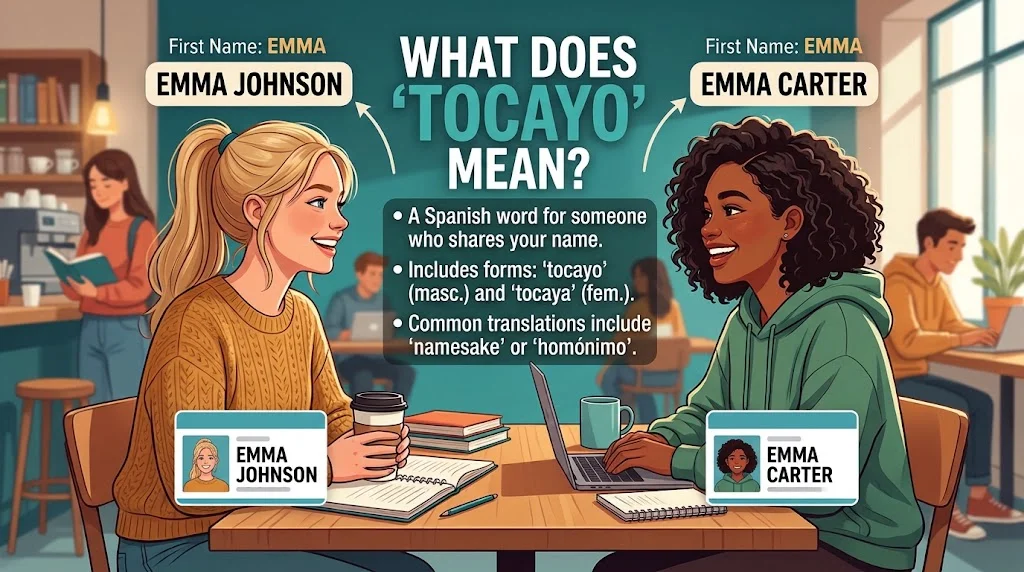
Tocayo is a Spanish word for someone who shares your name.
The feminine form tocaya may also appear depending on the person being described.
This is a useful term to know if you’re dealing with Spanish-language vocabulary or a bilingual context. Cambridge lists Spanish translations of namesake that include tocayo-related forms, along with homónimo and homónima.
However, tocayo isn’t a standard English synonym that you would normally use in an English article or professional email.
For example, an English speaker would typically say:
“He’s my namesake.”
A Spanish speaker may use the corresponding Spanish terminology.
When Is “Tocayo” Useful?
The word can be useful when:
- You’re discussing Spanish vocabulary.
- You’re writing about bilingual communication.
- You’re explaining cultural naming terminology.
- You’re translating between English and Spanish.
- You’re studying words for shared names across languages.
The key point is simple: tocayo is relevant, but it belongs to Spanish rather than standard English usage.
Four Words or Expressions for Someone With the Same Name
If the goal is to find practical alternatives, the following four choices cover the most useful territory.
Namesake
Namesake is the best direct English noun.
“Maria is my namesake.”
It sounds natural, concise, and polished.
Person With the Same Name
This expression states the meaning directly.
“I met a person with the same name as me.”
It’s especially useful when clarity matters more than brevity.
Homonym
Homonym is related to language and identical word forms or sounds. It isn’t normally the right word for two people who share a personal name.
“The two words are homonyms.”
That is a much more natural use than:
“Those two people are homonyms.”
Tocayo
Tocayo is the Spanish term for someone with the same name.
“Tocayo” can be useful when discussing Spanish vocabulary or translation.
It shouldn’t replace namesake in ordinary English writing.
Namesake vs. Same Name: Which Should You Choose?
Choosing between these expressions depends on what you want the sentence to accomplish.
| If you want to… | Best choice |
| Use one precise English noun | Namesake |
| Speak casually | We have the same name |
| Make the meaning unmistakable | Person with the same name |
| Describe identical full names | Same full name |
| Discuss linguistic terminology | Homonym, when technically appropriate |
| Use Spanish terminology | Tocayo |
There’s no need to force namesake into every sentence.
Language works best when the word fits the situation.
What Do You Call Two People With the Same Name?
Two people with the same name can be called namesakes.
The singular form is:
namesake
The plural form is:
namesakes
For example:
“James and I are namesakes.”
Or:
“The two writers are namesakes.”
You can also say:
“We share the same name.”
The second option sounds particularly natural in casual speech.
Singular vs. Plural
| Number | Correct form | Example |
| One person | namesake | “He is my namesake.” |
| Two people | namesakes | “We are namesakes.” |
| Several people | namesakes | “The group includes several namesakes.” |
Namesakes is correct.
Namesake’s is possessive, not plural.
See More : “Both Of You” vs. “You Both” Difference Explained
What If You Have the Same First Name?
Having the same first name doesn’t necessarily mean you have identical names.
Suppose your name is:
Emma Johnson
You meet someone named:
Emma Carter
You share a first name, but your full names differ.
You could say:
“We have the same first name.”
You could also describe Emma Carter as your namesake, since namesake can refer to people with the same name.
However, in a context where the distinction matters, same first name is more precise.
Examples
“My coworker and I have the same first name.”
“I met another Emma who works in marketing.”
“She’s my namesake, although our last names are different.”
These sentences make the relationship easy to understand.
What If You Have the Same First and Last Name?
Things become more interesting when two people share the same full name.
Suppose two unrelated people are both named:
Daniel Robert Miller
You can say:
“We have the same full name.”
You can also say:
“He’s my namesake.”
If you’re dealing with official documents, however, don’t rely on namesake to explain the situation.
Administrative systems often distinguish people using additional information such as:
- Date of birth
- Middle name
- Address
- Identification number
- Email address
- Employer
- Other identifying details
The phrase same full name is therefore often more practical in formal or administrative contexts.
Cambridge defines full name as all the parts of a person’s name taken together.
“Namesake” Examples in Everyday English
Seeing the word in different contexts makes its meaning much easier to grasp.
Casual Conversation
“I met another Alex yesterday. He’s my namesake.”
“Funny enough, my new neighbor is my namesake.”
“We laughed when we realized we were namesakes.”
Workplace
“There’s another Sarah on the team. She’s my namesake.”
“Please make sure the report goes to the correct David. We have two namesakes in the department.”
School or University
“I discovered that another student was my namesake.”
“Our professor mentioned his namesake during the lecture.”
Family
“My grandfather is my namesake.”
“She was named after her mother, who is her namesake.”
Writing
“The author later met his namesake at a literary event.”
“The two researchers share the same name but have no family connection.”
These examples show how flexible the word can be.
A Practical Case Study: Two People With the Same Name
Imagine a company hires two employees named Michael Carter.
At first, everyone assumes they’re the same person. Emails get misdirected. Meeting invitations go to the wrong employee. Even the office directory causes confusion.
Someone might casually say:
“We have two people with the same name.”
That’s perfectly clear.
In a more polished explanation, the company might say:
“The department now has two employees who share the same full name.”
Calling them namesakes is grammatically possible, but it doesn’t solve the administrative problem.
This example highlights an important principle:
A synonym isn’t automatically the best choice in every context.
Namesake identifies a naming relationship. It doesn’t distinguish identities.
That’s why professional writing sometimes benefits from the plain phrase same full name.
Common Mistakes With “Namesake”
Although namesake looks simple, several misconceptions surround it.
Mistake: Assuming It Always Means “Named After”
Some people believe namesake only applies when one person receives their name from another.
That interpretation is too narrow.
Cambridge defines namesake broadly as a person or thing with the same name as another.
So two unrelated people can be namesakes simply because they share a name.
Mistake: Using “Homonym” Instead
A person with the same name isn’t normally your homonym.
Homonym belongs to linguistic terminology. Namesake is the natural word for a shared name.
Mistake: Thinking Namesake Implies Family
It doesn’t.
Two namesakes may have no biological or legal relationship whatsoever.
For example:
“I met my namesake at a conference, but we’d never met before.”
Nothing in that sentence suggests the two people are related.
Mistake: Assuming Namesake Means Identical Full Names
Not necessarily.
Depending on context, two people may share a given name or another naming element while having different complete names.
If exact identity matters, say same full name.
Mistake: Writing “Namesake’s” When You Mean Plural
The plural is:
namesakes
The possessive singular is:
namesake’s
Compare:
- “They are namesakes.”
- “That is my namesake’s book.”
The apostrophe changes the grammatical function.
How to Use “Namesake” Correctly in Formal Writing
Formal writing benefits from precision.
If you’re writing a report, essay, biography, or professional article, consider whether namesake communicates the exact relationship you mean.
For example:
“The researcher later met his namesake.”
That’s concise and polished.
However, if the reader needs to know that the two people have identical full names, write:
“The researcher later met another person with the same full name.”
The second version sacrifices elegance for precision.
That’s sometimes the right trade-off.
Formal Examples
- “The author met her namesake during the conference.”
- “The two scholars share the same name but aren’t related.”
- “The child was named after his grandfather, who became his namesake.”
- “The organization was established in a city that later became its namesake.”
The best wording depends on the information the reader actually needs.
Namesake vs. Homonym vs. Tocayo
These three terms can appear together in searches about shared names, but they shouldn’t be treated as interchangeable.
| Term | Core meaning | Applies naturally to people? | English usage |
| Namesake | Person or thing with the same name | Yes | Standard |
| Homonym | Linguistic term involving words with the same form or sound | Not usually in this sense | Standard but different |
| Tocayo | Spanish term for someone with the same name | Yes | Spanish |
The distinction is straightforward once you separate names from words.
A namesake shares a name.
A homonym involves a linguistic relationship between words.
A tocayo is a Spanish-language term for someone who shares a name.
Is “Namesake” a Good Word in Everyday Conversation?
Absolutely.
Although it may sound slightly more polished than simply saying same name, it isn’t obscure or excessively formal.
For example:
“I met my namesake yesterday.”
That sentence sounds perfectly natural.
Still, everyday English often favors simpler constructions:
“We have the same name.”
Both work.
The choice depends on your audience and the tone you want.
If you’re speaking casually, the straightforward phrase may feel warmer. If you’re writing an article or want a concise noun, namesake fits beautifully.
Other Natural Ways to Say Someone Has Your Name
You don’t always need a single-word synonym.
Here are several natural alternatives:
- We have the same name.
- She has the same name as me.
- He shares my name.
- She’s my namesake.
- He’s a person with the same name.
- We share the same first name.
- We have the same full name.
- They have identical names.
Each expression carries a slightly different emphasis.
For instance, shares my name sounds concise and natural:
“She shares my name.”
Meanwhile, same full name stresses that every relevant part of the name matches.
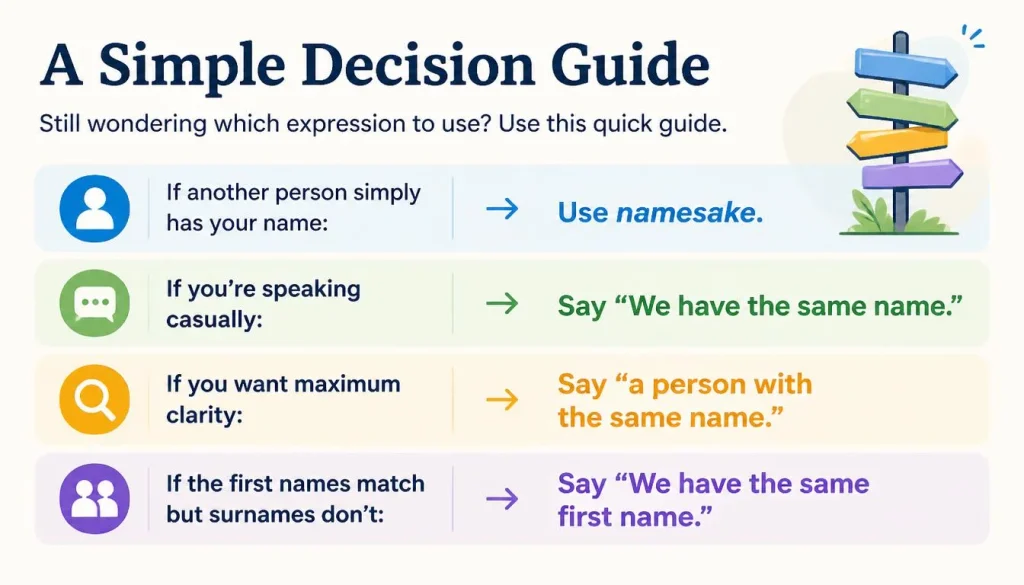
A Simple Decision Guide
Still wondering which expression to use?
Use this quick guide.
If another person simply has your name:
Use namesake.
If you’re speaking casually:
Say “We have the same name.”
If you want maximum clarity:
Say “a person with the same name.”
If the first names match but surnames don’t:
Say “We have the same first name.”
If the complete names match:
Say “We have the same full name.”
If you’re discussing Spanish:
Use tocayo where appropriate.
If you’re discussing words and linguistic relationships:
Use homonym only when its technical meaning fits.
This approach prevents most usage errors.
What Is the Best Word for Someone With the Same Name as You?
The best word is namesake.
It is concise, recognized, and directly connected to the idea of sharing a name. Cambridge explicitly defines namesake as a person or thing having the same name as another.
For everyday speech, however, don’t feel obligated to use a specialized noun.
“We have the same name” is completely natural.
In formal writing, choose the expression that gives the reader the exact information needed. If the distinction involves a first name, surname, or full name, state that detail directly.
Good writing isn’t about choosing the fanciest word.
It’s about choosing the right word for the job.
FAQs
1. What do you call someone who has the same name as you?
The most common term is namesake. A namesake is someone who shares your name or is named after you. In casual conversation, you can also say, “We have the same name.”
2. What is another word for someone with the same name?
Besides namesake, you can use terms such as name twin, same-named person, or eponym, depending on the context. However, these terms don’t always have exactly the same meaning or level of formality.
3. Does “namesake” mean someone named after you?
Yes, but namesake can have two related meanings. It can describe someone who shares your name or someone who was specifically named after you. Context usually makes the intended meaning clear.
4. Is “name twin” a correct term?
Yes. Name twin is an informal expression for someone who has the same name as you. It sounds friendly and conversational, so it works well in casual speech and social situations.
5. What do you call two people with the same first name?
You can simply say that they share the same first name. In informal situations, name twins can also describe them. If their full names are identical, you may need additional details to distinguish between them.
6. Is “namesake” formal or informal?
Namesake is a standard English word that works in both formal and informal contexts. However, its exact meaning depends on the situation. In professional business communication, a simple phrase such as “someone who shares my name” may sometimes provide greater clarity.
Conclusion
Knowing what to call someone who shares your name can make your communication more precise and natural. Namesake remains the most widely recognized term, while expressions such as name twin may sound more casual and conversational.
The key is to choose the expression that matches your situation. Whether you’re speaking casually, writing professionally, or focusing on everyday English usage, understanding these distinctions helps you communicate with greater confidence and consistency.

Alyan Ashraf is an English language writer and editor at Phrase Finesse, where he specializes in grammar, vocabulary, spelling, word usage, and clear communication. Passionate about the English language, he creates practical, research-backed content that helps readers avoid common mistakes and write with greater accuracy and confidence.
Known for his clear writing style and attention to detail, Alyan simplifies complex language topics into easy-to-understand guides filled with real-world examples and actionable insights. His work covers confusing word pairs, grammar rules, idioms, punctuation, and everyday English usage, making learning both accessible and engaging for students, professionals, writers, and non-native English speakers.
Every article Alyan writes is carefully researched, fact-checked, and designed to meet high editorial standards. His goal is to help readers strengthen their English skills, expand their vocabulary, and communicate more effectively in academic, professional, and everyday settings.
Through Phrase Finesse, Alyan is committed to publishing trusted language resources that make mastering English simpler, clearer, and more enjoyable for learners around the world