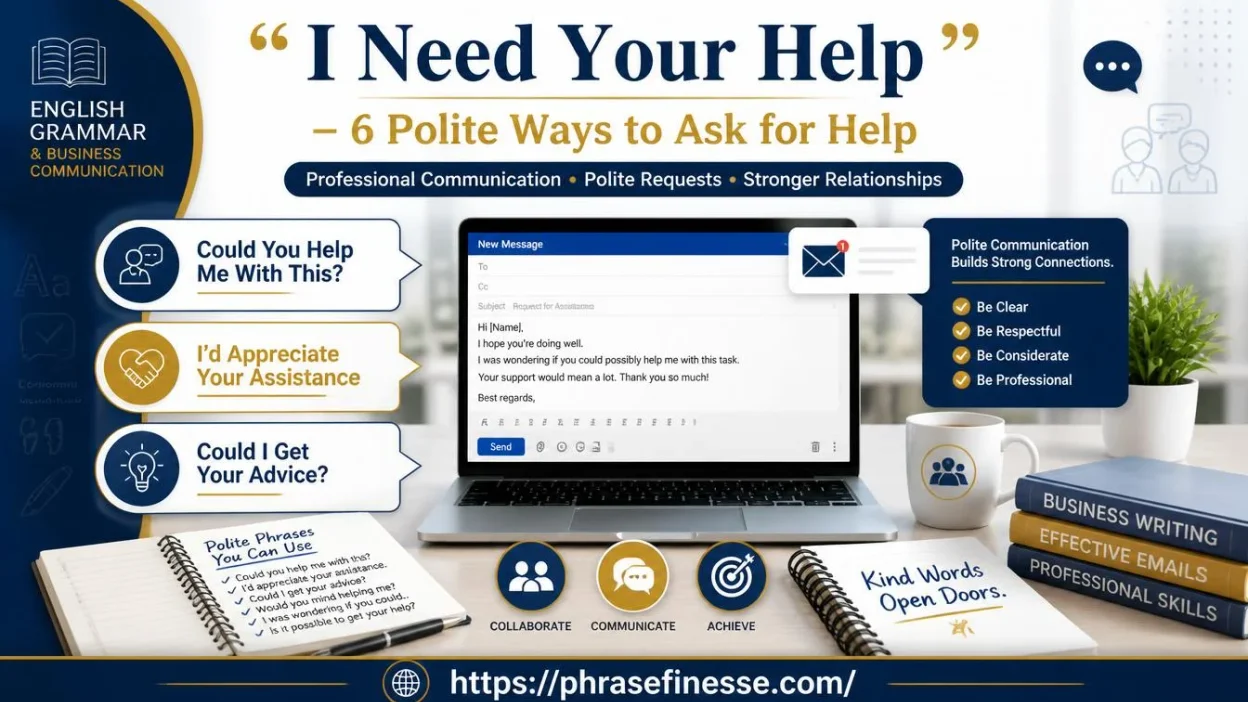
Have you ever wondered whether saying “I Need Your Help” – 6 Polite Ways to Ask for Help is the most effective way to request assistance? While the phrase is clear, choosing the right words can make your request sound more polite, professional, and considerate.
Whether you’re communicating in business communication, formal writing, emails, meetings, or everyday conversations, the way you ask for help often shapes the response you receive.
The English language offers several natural alternatives that fit different situations, from workplace discussions and project management to scheduling, time management, and calendar coordination.
In this guide, you’ll discover when to use each expression, how they differ in tone, and which option works best for professional and personal settings. You’ll also find practical examples that improve your English usage, strengthen your grammar, and help you communicate with greater consistency and confidence.
Beyond simple word substitutions, this article explains the subtle differences in politeness, context, and intent behind each alternative.
Whether you’re requesting assistance with online booking, coordinating broadcasting tasks, organizing meetings, or writing a professional message, these carefully chosen phrases will help you sound respectful, natural, and credible while making your communication more effective.
Is It Polite to Say “I Need Your Help”?
The phrase “I need your help” is not inherently impolite. In fact, people use it every day in conversations, emails, meetings, and personal interactions.
However, context matters.
When someone hears the word “need,” it can imply urgency or obligation. Depending on the relationship between the people involved, that may create pressure.
Consider these examples:
Direct:
I need your help with this report.
More Polite:
Could you help me with this report?
Both sentences ask for assistance. The second simply sounds more collaborative.
When “I Need Your Help” Works Well
There are situations where being direct is completely appropriate.
Emergency Situations
If something requires immediate attention, clarity is more important than diplomacy.
Examples:
- I need your help right now.
- I need your help finding my child.
- I need your help with this emergency.
Close Relationships
Friends and family members usually appreciate direct communication.
Example:
I need your help moving this weekend.
Urgent Workplace Issues
When deadlines are approaching, direct language may save time.
Example:
I need your help resolving this client issue before noon.
When “I Need Your Help” Can Sound Too Direct
In some settings, softer language creates a better impression.
Examples include:
- Communicating with managers
- Contacting clients
- Requesting assistance from busy colleagues
- Reaching out to professors
- Asking for favors
In these cases, a polite request often produces better results because it respects the other person’s time and autonomy.
Why Tone Matters More Than Words
Communication experts often point out that tone influences how people interpret a request.
Compare these examples:
I need your help with this project.
I’d appreciate your assistance with this project.
The second version feels more respectful because it acknowledges the recipient’s contribution.
As the famous leadership expert Dale Carnegie wrote:
“People are more likely to cooperate when they feel appreciated.”
That principle applies perfectly when asking for help.
Better Ways to Say “I Need Your Help”
Below are six professional and polite alternatives that work in different situations.
Could You Help Me With This?
This is one of the most versatile alternatives available.
It sounds friendly, respectful, and straightforward without being overly formal.
Why It Works
- Direct but polite
- Easy to understand
- Appropriate in nearly every setting
- Doesn’t pressure the recipient
Examples
Workplace:
Could you help me with this presentation before tomorrow’s meeting?
School:
Could you help me understand this chapter?
Personal:
Could you help me set up my new computer?
Best Situations
Use this phrase when:
- Talking with coworkers
- Asking classmates for assistance
- Requesting everyday help
- Communicating with acquaintances
Quick Tip
Adding context makes the request stronger.
Instead of:
Could you help me?
Try:
Could you help me review this proposal before I send it?
Specific requests are easier to answer.
Would You Mind Helping Me?
This phrase adds an extra layer of politeness.
It shows that you recognize the other person’s time and effort.
Why It Works
People generally respond positively when they feel their schedule is respected.
The phrase avoids sounding entitled.
Examples
Professional:
Would you mind helping me prepare for the client meeting?
Academic:
Would you mind helping me proofread this essay?
Personal:
Would you mind helping me carry these boxes upstairs?
Best Situations
This option works particularly well when:
- Asking a favor
- Requesting additional work
- Contacting someone who is busy
- Seeking assistance from senior colleagues
Email Example
Hi Sarah,
Would you mind helping me review the budget proposal before Friday? Your feedback would be extremely valuable.
Thank you.
Notice how the message sounds respectful without becoming overly formal.
I’d Appreciate Your Assistance
This alternative is more professional and formal.
It frequently appears in business communication.
Why It Works
The phrase expresses appreciation before help is even provided.
That subtle shift creates goodwill.
Examples
Business Email:
I’d appreciate your assistance in resolving this matter.
Customer Service:
I’d appreciate your assistance regarding my account inquiry.
Project Management:
I’d appreciate your assistance with gathering the required documentation.
Best Situations
Use this phrase when communicating with:
- Clients
- Managers
- Executives
- Government offices
- Business partners
Formal Email Example
Dear Mr. Thompson,
I’d appreciate your assistance in clarifying the reporting requirements for the upcoming audit.
Thank you for your time.
The tone remains professional while maintaining courtesy
Could I Get Your Advice?
Sometimes you don’t actually need help.
You need expertise.
That’s where this phrase shines.
Why It Works
Instead of placing responsibility on the other person, you invite them to share their knowledge.
People generally enjoy being asked for advice.
It makes them feel valued.
Examples
Career Development:
Could I get your advice on negotiating a salary offer?
Business:
Could I get your advice on improving customer retention?
Education:
Could I get your advice on selecting a research topic?
Best Situations
This phrase is ideal when speaking with:
- Mentors
- Managers
- Teachers
- Industry experts
- Experienced colleagues
The Psychology Behind Advice Requests
Research consistently shows that asking for advice often increases cooperation.
Why?
Because people like contributing expertise.
When you ask for advice, you’re recognizing someone’s knowledge rather than assigning them work.
When You Have a Moment, Could You Take a Look?
This is one of the most considerate ways to ask for help.
It signals that your request isn’t urgent.
Why It Works
The phrase acknowledges that the other person has competing priorities.
That small gesture can significantly improve the response.
Examples
Document Review:
When you have a moment, could you take a look at this proposal?
Website Feedback:
When you have a moment, could you take a look at the homepage design?
Report Review:
When you have a moment, could you take a look at these figures?
Best Situations
Use this phrase when:
- Requesting feedback
- Sharing drafts
- Asking for reviews
- Seeking recommendations
What Makes It Effective
The opening phrase removes pressure.
Instead of demanding immediate attention, it allows the recipient to choose a convenient time.
That flexibility often increases willingness to help.
I’d Be Grateful for Your Help
This option combines politeness with genuine appreciation.
It feels warm without sounding overly formal.
Why It Works
Gratitude is built directly into the request.
The recipient immediately understands that their assistance will be valued.
Examples
Professional:
I’d be grateful for your help in finalizing this proposal.
Community:
I’d be grateful for your help organizing the charity event.
Personal:
I’d be grateful for your help moving next weekend.
Best Situations
This phrase works well when:
- Asking for substantial assistance
- Requesting favors
- Seeking volunteer support
- Building positive relationships
Example Email
Hello James,
I’d be grateful for your help reviewing the project timeline before our stakeholder meeting.
Thank you in advance.
The tone sounds appreciative rather than demanding.
Comparison Table: Alternatives to “I Need Your Help”
| Phrase | Formality | Best Use | Tone |
| Could You Help Me With This? | Medium | Everyday requests | Friendly |
| Would You Mind Helping Me? | Medium | Favors and assistance | Respectful |
| I’d Appreciate Your Assistance | High | Professional communication | Formal |
| Could I Get Your Advice? | Medium | Seeking expertise | Collaborative |
| When You Have a Moment, Could You Take a Look? | Medium | Feedback and reviews | Considerate |
| I’d Be Grateful for Your Help | Medium-High | Important requests | Appreciative |
How to Ask for Help Politely in Professional Emails
The phrase you choose matters.
However, the structure of your request matters even more.
Be Specific About What You Need
Vague requests create confusion.
Instead of:
Can you help me?
Try:
Could you help me review the marketing proposal before Thursday?
Specificity saves time.
It also makes it easier for the other person to say yes.
See More :On the Train or In the Train? Which Preposition Is Correct?
Respect the Other Person’s Time
Everyone has competing priorities.
Acknowledging that reality demonstrates professionalism.
Examples:
- When you have time…
- If your schedule allows…
- At your convenience…
- Whenever you have a moment…
These phrases reduce pressure.
Show Appreciation
Gratitude is one of the simplest ways to strengthen professional relationships.
Examples:
- Thank you for considering my request.
- I appreciate your time.
- Thank you in advance for your assistance.
A little appreciation goes a long way.
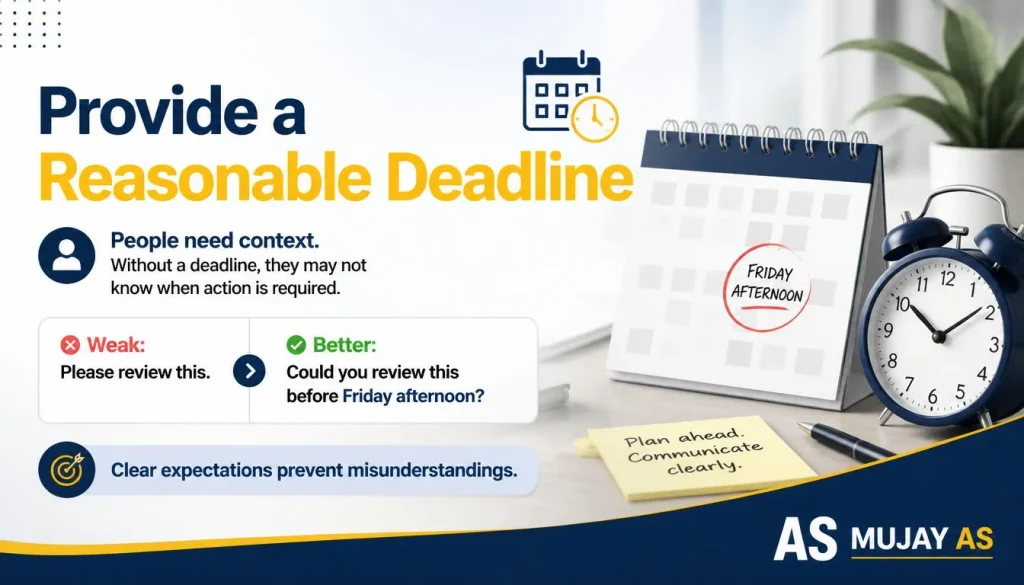
Provide a Reasonable Deadline
People need context.
Without a deadline, they may not know when action is required.
Examples:
Weak:
Please review this.
Better:
Could you review this before Friday afternoon?
Clear expectations prevent misunderstandings.
Common Mistakes When Asking for Help
Even polite phrases can lose effectiveness if used incorrectly.
Let’s examine the most common mistakes.
Sounding Too Demanding
Avoid language that assumes compliance.
Examples:
Less Effective
I need this done today.
Better
Would you be able to review this today if your schedule permits?
The second version sounds far more respectful.
Being Too Vague
Unclear requests often create delays.
Vague
Can you help?
Clear
Could you help me prepare the presentation slides for tomorrow’s meeting?
Specific requests generate faster responses.
Over-Apologizing
Many people weaken their requests by apologizing excessively.
Example:
Sorry to bother you. Sorry for asking. Sorry for the inconvenience.
This can reduce confidence.
A better approach:
I appreciate your time and would value your input.
Professional and confident.

Forgetting Gratitude
People like feeling appreciated.
Even a brief thank-you improves relationships.
Simple examples include:
- Thank you.
- Much appreciated.
- Thanks for your help.
- I appreciate your support.
Choosing the Right Phrase for Different Situations
Not every alternative fits every circumstance.
Here’s a practical guide.
| Situation | Recommended Phrase |
| Asking a coworker | Could You Help Me With This? |
| Contacting a manager | I’d Appreciate Your Assistance |
| Seeking mentorship | Could I Get Your Advice? |
| Requesting feedback | When You Have a Moment, Could You Take a Look? |
| Asking a favor | Would You Mind Helping Me? |
| Major request | I’d Be Grateful for Your Help |
Real-World Examples of Polite Help Requests
Understanding theory is helpful.
Seeing practical examples is even better.
Formal Email Example
Subject: Assistance With Project Documentation
Dear Ms. Roberts,
I’d appreciate your assistance in reviewing the attached project documentation before Friday. Your expertise would help ensure everything meets the required standards.
Thank you for your time and consideration.
Informal Email Example
Hi Mark,
Could you help me with the presentation slides this afternoon? I’d like a second opinion before sending them to the client.
Thanks!
Workplace Chat Example
When you have a moment, could you take a look at the sales report? I want to make sure the figures are accurate.
Student-to-Professor Example
Professor Adams,
Could I get your advice on narrowing my research topic? I’d like to focus my project more effectively.

Customer Service Example
I’d appreciate your assistance in resolving this billing issue. Please let me know if you require any additional information.
Quick Reference Guide: Which Alternative Should You Use?
For Formal Emails
I’d Appreciate Your Assistance
For Everyday Workplace Requests
Could You Help Me With This?
For Expert Guidance
Could I Get Your Advice?
For Feedback Requests
When You Have a Moment, Could You Take a Look?
For Respectful Favors
Would You Mind Helping Me?
For Important Assistance
I’d Be Grateful for Your Help
FAQs
1. Is “I need your help” a polite phrase?
Yes, “I need your help” is generally polite, especially when paired with words like “please” or “if you have a moment.” However, in professional settings, softer alternatives such as “Could you help me?” or “Would you mind assisting me?” often sound more courteous and respectful.
2. What are the best professional alternatives to “I need your help”?
Some of the most professional alternatives include:
- Could you help me with this?
- Would you mind assisting me?
- I’d appreciate your assistance.
- Could I ask for your support?
- Would you be able to help me?
- May I get your advice on this?
These expressions are ideal for business communication, emails, and formal writing.
3. When should I avoid saying “I need your help”?
Avoid using “I need your help” when you want to sound less demanding or more diplomatic. In situations involving clients, managers, or senior colleagues, a softer request often creates a more positive impression and encourages cooperation.
4. Which alternative works best in a business email?
For professional emails, phrases like “I’d appreciate your assistance,” “Could you please help me with this?”, or “Would you be able to assist me?” are excellent choices. They sound respectful while maintaining a professional tone.
5. Can I use “I need your help” in everyday conversations?
Absolutely. The phrase is common in casual conversations with friends, family, and coworkers. Depending on the situation, you can also use friendlier alternatives like “Can you give me a hand?” or “Could you help me out?”
6. Why is choosing the right way to ask for help important?
Using the right expression improves communication, demonstrates professionalism, and increases the likelihood of receiving a positive response. Selecting words that match the situation also strengthens your English usage, grammar, and overall communication skills.
Conclusion
Although “I need your help” is a perfectly acceptable expression, it isn’t always the most effective choice. The right alternative depends on your audience, the level of formality, and the situation. Whether you’re writing a professional email, speaking during a meeting, or asking a friend for assistance, using a more thoughtful and polite phrase can make your request sound more respectful and persufasive.
By understanding these six better ways to politely ask for help, you’ll communicate with greater confidence and professionalism. Choosing the appropriate wording not only improves your relationships but also helps you make a stronger impression in both personal and workplace conversations.

Mia Rose is an English language specialist and editorial writer at Phrase Finesse, where she helps readers master grammar, vocabulary, spelling, and effective communication. Passionate about making English simple and practical, she creates well-researched, reader-friendly content that explains complex language concepts in a clear and engaging way.
With extensive experience in English language education, content writing, and editorial review, Mia specializes in grammar, punctuation, word choice, idioms, confusing word pairs, and writing style. Her articles are carefully researched, fact-checked, and designed to help students, professionals, writers, and English learners build confidence in both written and spoken English.

[…] See More :“I Need Your Help” 6 Polite Ways to Ask for Help […]
[…] See More: “I Need Your Help” 6 Polite Ways to Ask for Help […]