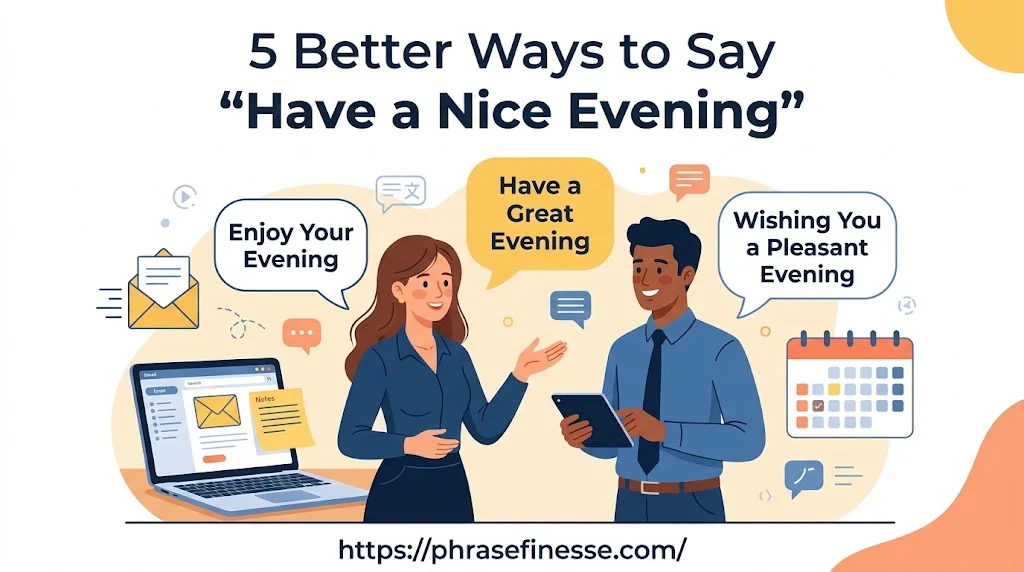
If you want to wish someone else a pleasant end of their day, Five Better Ways to Say “Have a Nice Evening”, and professional formal phrase.
However, your choice can adapt to different contexts and settings. The best time to say this phrase is usually when you’re ending a conversation during the evening. As a greeting, “good evening” differs from “good night,” which usually signals a later farewell. Understanding the difference helps you use the right expression and follow good communication etiquette in each context and setting.
There are dozens of ways to wish someone well at the end of day, but “have a nice evening” remains a nice option when you want a simple goodbye. Still, there are better ways in some situations, and this article will explore and highlight what makes each alternative more appropriate.
From my experience with everyday and professional communication, a usually formal goodbye phrase can sound warmer when you choose an expression that fits the person and situation. A few small wording changes can make your saying feel more natural without losing its polite tone.
Is “Have a Nice Evening” Correct?
Yes, “Have a nice evening” is grammatically correct and widely used in English.
The phrase works as a polite farewell that expresses good wishes for someone’s evening. People commonly use it after finishing a conversation, leaving a workplace, ending a customer interaction, or saying goodbye to someone they know.
For example:
“Thank you for your help with the project. Have a nice evening.”
This sentence sounds polite, respectful, and appropriate in most situations.
However, language is not only about correctness. It is also about tone.
The phrase “Have a nice evening” can sometimes feel:
- A little formal
- Slightly routine
- Less personal when repeated often
Think of it like wearing the same outfit every day. There is nothing wrong with it, but sometimes a small change creates a better impression.
Using alternatives allows you to match your words with the relationship and situation.
Why Use Alternatives to “Have a Nice Evening”?
Small changes in language can completely change how your message feels.
Compare these two examples:
Example 1:
“Thanks for meeting with me. Have a nice evening.”
Example 2:
“Thanks for meeting with me. I hope you have a relaxing evening.”
Both sentences are polite. However, the second one feels more thoughtful because it shows awareness of the other person’s experience.
Choosing the right phrase helps you communicate:
- Warmth — showing genuine kindness
- Professionalism — maintaining respectful communication
- Personality — sounding less robotic
- Confidence — using natural expressions instead of memorized phrases
In customer service, workplace communication, and personal conversations, these small differences matter.
5 Better Ways to Say “Have a Nice Evening”
1. Enjoy Your Evening
“Enjoy your evening” is one of the most natural alternatives to “Have a nice evening.”
It sounds friendly, relaxed, and slightly more personal. Instead of simply wishing someone a pleasant evening, you encourage them to make the most of their time.
This phrase works well because it feels conversational without becoming too casual.
When to Use “Enjoy Your Evening”
You can use this phrase with:
- Coworkers
- Friends
- Customers
- Neighbors
- Professional contacts you already know
It fits many situations because it balances friendliness and politeness.
Examples:
At work:
“Thanks for your help with the report. Enjoy your evening!”
After a meeting:
“I appreciate your time today. Enjoy your evening.”
With a friend:
“I’ll see you tomorrow. Enjoy your evening!”
Why “Enjoy Your Evening” Sounds More Natural
The word “enjoy” creates a more active feeling.
Compare:
- Have a nice evening → A general good wish
- Enjoy your evening → A personal encouragement
The difference is subtle, but it changes the emotional tone.
It is similar to saying:
- “Have a good meal.”
- “Enjoy your meal.”
The second option feels warmer because it invites someone to experience something pleasant.
2. Have a Great Evening
If you want something slightly more enthusiastic, “Have a great evening” is an excellent choice.
This phrase replaces “nice” with “great,” making the message sound more positive and energetic.
Difference Between “Nice” and “Great”
| Phrase | Tone | Feeling |
| Have a nice evening | Neutral and polite | Simple goodwill |
| Have a great evening | More enthusiastic | Stronger positivity |
Neither phrase is incorrect. The difference comes down to emotion.
For example:
“Thank you for visiting our office. Have a great evening!”
This sounds welcoming and upbeat.
When to Use “Have a Great Evening”
This phrase works especially well in:
- Customer service conversations
- Retail interactions
- Workplace discussions
- Friendly professional communication
Examples:
“It was wonderful speaking with you today. Have a great evening.”
“Thanks for your feedback. Have a great evening!”
Professional Example: Customer Communication
Imagine a customer support representative ending a conversation.
A basic closing:
“Your issue has been resolved. Have a nice evening.”
A warmer closing:
“Your issue has been resolved. Thank you for your patience. Have a great evening.”
The second version creates a stronger customer experience because it combines appreciation with a positive farewell.
3. Wishing You a Pleasant Evening
When you need a more formal alternative, “Wishing you a pleasant evening” works beautifully.
This phrase sounds polished and professional. It is especially useful in business writing, formal emails, and workplace communication.
Why This Phrase Works
The expression creates a respectful distance while still showing kindness.
You might use it when communicating with:
- Clients
- Business partners
- New professional contacts
- Customers
Examples:
“Thank you for your assistance with this matter. Wishing you a pleasant evening.”
“I appreciate your quick response. Wishing you a pleasant evening ahead.”
“Pleasant” vs. “Nice”
Both words express something positive, but they create different impressions.
| Word | Tone |
| Nice | Everyday, simple, casual |
| Pleasant | More polished, formal, professional |
For example:
Casual:
“Have a nice evening!”
Formal:
“Wishing you a pleasant evening.”
Both are correct. The better choice depends on your audience.
4. Hope You Have a Relaxing Evening
Sometimes people need more than a polite goodbye. They need a little encouragement after a busy day.
That is where “Hope you have a relaxing evening” becomes useful.
This phrase shows empathy because it recognizes that someone may need time to rest.
When to Use This Phrase
It works well after:
- A stressful workday
- A long meeting
- A difficult conversation
- A busy event
Examples:
“You handled a lot today. Hope you have a relaxing evening.”
“Thanks for taking care of everything. Hope you have a relaxing evening.”
Why This Phrase Feels More Thoughtful
A relaxing evening represents more than just time passing. It suggests:
- Rest
- Recovery
- Personal time
- Balance
This makes the phrase feel more human.
Instead of simply saying goodbye, you acknowledge the person behind the conversation.
5. Enjoy the Rest of Your Evening
The phrase “Enjoy the rest of your evening” is ideal when the evening has already started.
It recognizes that the person has already spent part of their evening working, traveling, meeting, or handling responsibilities.
When to Use It
This phrase works well:
- After evening meetings
- During late phone calls
- After dinner conversations
- When leaving someone at night
Examples:
“Thanks for joining the call. Enjoy the rest of your evening.”
“I appreciate your help today. Enjoy the rest of your evening.”
See More : “Both Of You” vs. “You Both” Difference Explained
Difference Between These Two Phrases
| Phrase | Best Used When |
| Have a nice evening | Before or at the start of the evening |
| Enjoy the rest of your evening | When part of the evening has already passed |
For example:
At 5:30 PM:
“Have a nice evening.”
At 8:30 PM:
“Enjoy the rest of your evening.”
Both sound natural when used at the right time.
Comparison Table: Alternatives to “Have a Nice Evening”
Choosing the right phrase depends on the situation, relationship, and tone you want to create. A phrase that works perfectly with a friend may sound too casual in a professional email.
The table below helps you quickly choose the best alternative.
| Alternative Phrase | Tone | Best Used For | Example |
| Enjoy your evening | Friendly and natural | Friends, coworkers, casual professional conversations | “Thanks for your help today. Enjoy your evening!” |
| Have a great evening | Positive and cheerful | Customers, colleagues, everyday conversations | “It was great speaking with you. Have a great evening!” |
| Wishing you a pleasant evening | Formal and polished | Business emails, clients, professional messages | “Thank you for your assistance. Wishing you a pleasant evening.” |
| Hope you have a relaxing evening | Caring and thoughtful | Busy coworkers, friends, supportive conversations | “You’ve had a long day. Hope you have a relaxing evening.” |
| Enjoy the rest of your evening | Warm and appropriate | Late-day conversations, meetings, phone calls | “Thanks for attending the meeting. Enjoy the rest of your evening.” |
Formal Ways to Say “Have a Nice Evening” in Professional Settings
Professional communication requires balance. You want to sound polite without becoming overly distant or robotic.
A good closing phrase should leave the other person with a positive impression while matching the formality of the conversation.
For example, ending a client email with:
“Bye, have a nice evening!”
may sound too casual.
A better option would be:
“Thank you for your time. I hope you have a pleasant evening.”
The second version sounds more professional because it combines appreciation with a respectful farewell.
I Hope You Have a Pleasant Evening
This is one of the safest professional alternatives to “Have a nice evening.”
It works well because it sounds courteous while still feeling natural.
Examples:
1.“Thank you for reviewing the proposal.
2.I hope you have a pleasant evening.”
3.“I appreciate your quick response.
3.I hope you have a pleasant evening.”
Best Situations:
Use this phrase when writing to:
- Clients
- Managers
- New business contacts
- Customers
- Professional partners
Wishing You a Wonderful Evening
This phrase adds a little more warmth than “pleasant evening.”
It works well when you already have a positive relationship with the person.
Examples:
“Thank you for your continued support. Wishing you a wonderful evening.”
“It was a pleasure speaking with you today. Wishing you a wonderful evening.”
Tone:
- Professional
- Friendly
- Appreciative
It feels slightly more personal than traditional business language.
Thank You for Your Time. Have a Pleasant Evening.
Combining gratitude with a farewell creates a stronger ending.
Instead of ending suddenly, you recognize the person’s effort.
This approach works especially well after:
- Meetings
- Interviews
- Consultations
- Customer calls
Example:
“Thank you for taking the time to discuss the project. I appreciate your insights. Have a pleasant evening.”
This type of closing feels complete and respectful.
Casual Ways to Say “Have a Nice Evening”
Not every situation requires formal language. When you’re talking with friends, family, or familiar coworkers, casual expressions often sound more natural.
Here are some relaxed alternatives.
Enjoy Your Night
“Enjoy your night” is a common casual alternative.
It works best when someone has plans, such as:
- Going out
- Meeting friends
- Attending an event
Examples:
“Have fun at the concert. Enjoy your night!”
“Thanks for hanging out. Enjoy your night!”
Note:
This phrase can sound more like a wish for entertainment rather than simple relaxation.
Have a Good One
“Have a good one” is a casual expression that can replace “Have a nice evening.”
It is common in everyday American English.
Examples:
“Thanks for stopping by. Have a good one!”
“See you tomorrow. Have a good one!”
Best Used With:
- Friends
- Coworkers you know well
- Store employees
- Casual interactions
Avoid using it in very formal emails because it may sound too relaxed.
Take Care
“Take care” is short, warm, and widely used.
Although it does not specifically mention the evening, it works well as a goodbye phrase.
Examples:
“Thanks for your help today. Take care!”
“It was nice catching up. Take care.”
This phrase communicates kindness and goodwill without sounding overly formal.
Relax and Enjoy Your Evening
This phrase adds a personal touch.
It works especially well when someone has finished a demanding day.
Examples:
“You’ve been working hard all week. Relax and enjoy your evening.”
“Everything is finished now. Relax and enjoy your evening!”
How to Choose the Right Alternative to “Have a Nice Evening”
The best phrase is not always the most impressive one. It is the one that fits naturally.
Before choosing an expression, consider three things:
Consider Your Relationship
Your relationship with the person affects your word choice.
With a Close Friend:
Better options:
- “Enjoy your evening!”
- “Have a great night!”
- “Relax and enjoy your evening!”
With a Client:
Better options:
- “I hope you have a pleasant evening.”
- “Wishing you a wonderful evening.”
With a Coworker:
Better options:
- “Enjoy your evening.”
- “Have a great evening.”
Match the Situation
Different moments call for different expressions.
| Situation | Recommended Phrase |
| Ending a business email | “Wishing you a pleasant evening” |
| Leaving work | “Enjoy your evening” |
| Ending a customer conversation | “Have a great evening” |
| Speaking after a stressful day | “Hope you have a relaxing evening” |
| Saying goodbye late at night | “Enjoy the rest of your evening” |
Keep Your Tone Natural
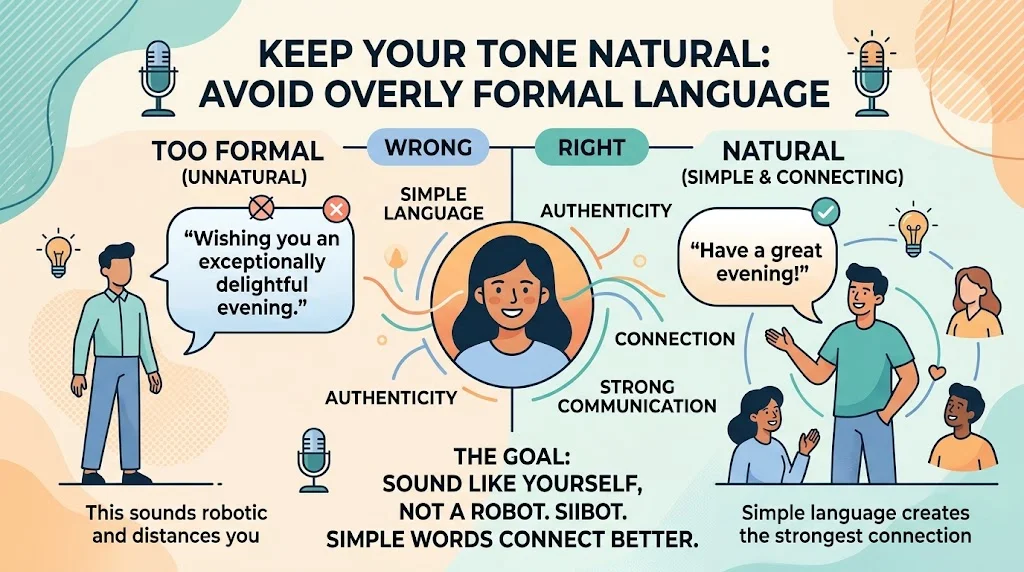
A common mistake is choosing words that do not sound like you.
For example:
“Wishing you an exceptionally delightful evening.”
This is grammatically correct, but it may sound unnatural in everyday communication.
Simple language often creates the strongest connection.
A natural:
“Enjoy your evening!”
usually sounds better than an overly complicated phrase.
Common Mistakes When Saying Evening Greetings
Even simple phrases can sound awkward when used in the wrong situation.
Understanding common mistakes helps you communicate more naturally.
Mistake: Using Formal Phrases in Casual Conversations
A formal phrase can create unnecessary distance.
For example:
“Wishing you a pleasant evening, my friend.”
This sounds unusual because the phrase does not match the relationship.
With friends, simpler options work better:
“Enjoy your evening!”
or
“Have a great night!”
Mistake: Repeating the Same Phrase Everywhere
Using “Have a nice evening” every time is not wrong. However, repeated expressions can make conversations feel automatic.
Imagine a customer receiving the same closing sentence from every employee:
“Thank you. Have a nice evening.”
After hearing it repeatedly, it may lose its warmth.
Small variations make communication feel more genuine.
Examples:
Instead of:
“Have a nice evening.”
Try:
- “Enjoy your evening.”
- “Have a great evening.”
- “Hope you have a relaxing evening.”
Mistake: Choosing a Phrase That Does Not Match the Time
Timing matters.
For example:
At 4 PM:
“Enjoy the rest of your evening.”
may feel slightly early.
At 10 PM:
“Have a nice evening.”
may sound a little unusual because the evening is almost over.
Choose a phrase that matches the moment.
Mistake: Using “Have Fun” in Professional Situations
“Have fun” sounds friendly, but it does not fit every setting.
For example:
“Thanks for reviewing the contract. Have fun!”
This sounds too casual.
A better option:
“Thank you for reviewing the contract. Have a pleasant evening.”
Real-Life Examples: Choosing the Right Evening Greeting
Example: Workplace Conversation
Situation:
A coworker helped complete an important task.
Less personal:
“Thanks. Have a nice evening.”
Better:
“Thanks for helping with that project. Enjoy your evening!”
Why it works:
- Shows appreciation
- Sounds warmer
- Maintains professionalism
Example: Customer Service
Situation:
A customer’s problem has been solved.
Basic:
“Your issue is fixed. Have a nice evening.”
Improved:
“Your issue has been resolved. Thank you for your patience. Have a great evening!”
Why it works:
- Recognizes the customer’s experience
- Creates a positive final impression
Example: Professional Email
Situation:
Sending a message to a business contact.
Basic:
“Let me know if you need anything else. Have a nice evening.”
Improved:
“Please let me know if you need any further assistance. Wishing you a pleasant evening.”
Why it works:
- Sounds polished
- Keeps professional boundaries
FAQs
1. Is “Have a Nice Evening” grammatically correct?
Yes. “Have a nice evening” is grammatically correct and commonly used as a polite goodbye.
2. Is “Have a Nice Evening” formal?
Yes, it can sound formal, especially in professional or polite conversations. However, it also works in everyday situations.
3. What is another way to say “Have a Nice Evening”?
You can say “Enjoy your evening,” “Have a good evening,” “Take care,” or “Enjoy the rest of your evening.”
4. When should you say “Have a Nice Evening”?
Use it when you’re ending a conversation during the evening and want to offer a friendly farewell.
5. Is “Have a Good Evening” better than “Have a Nice Evening”?
Neither is always better. Both are polite expressions, but “Have a good evening” may sound slightly more traditional or professional.
6. Can I say “Have a Nice Evening” in a professional setting?
Absolutely. It’s a safe and courteous expression for emails, customer service, meetings, workplace conversations, and other professional settings.
Conclusion
“Have a nice evening” is a polite and versatile way to end a conversation. Still, choosing an alternative can make your goodbye sound warmer, more natural, or better suited to the situation. The best expression depends on your relationship with the person, the setting, and the tone you want to create.

Emma Brooke is an English language specialist, editor, and content writer at Phrase Finesse, where she helps readers develop stronger writing and communication skills through clear, practical, and engaging content. With a passion for the English language, she specializes in simplifying grammar rules, vocabulary, spelling, punctuation, and word usage for learners at every level.
Emma has extensive experience creating educational content that is accurate, well-researched, and easy to understand. She is particularly skilled at explaining confusing word pairs, grammar concepts, idioms, sentence structure, and effective writing techniques, making complex topics approachable for students, professionals, educators, and English learners worldwide.