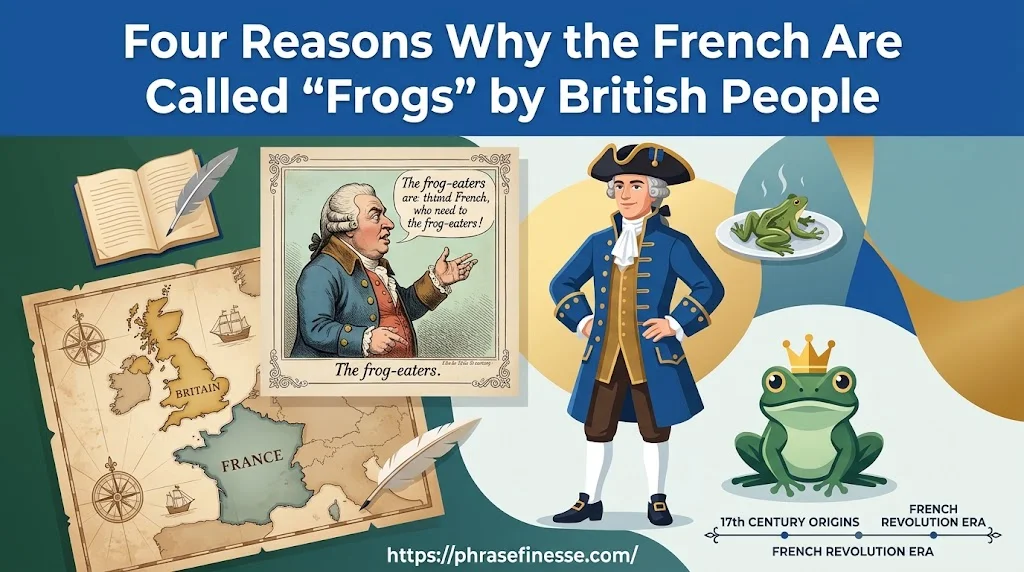
Have you ever wondered why the British sometimes call the French “frogs”? The phrase can sound strange, especially if you encounter it without knowing its history. This article explores Four Reasons Why the French Are Called “Frogs” by British People including the cultural associations, historical references, and language-related explanations behind the nickname.
Rather than treating the term as a simple insult, we’ll examine how British–French relations, food stereotypes, geography, and English usage helped shape this familiar expression.
The nickname has a complicated cultural history, and its meaning can change depending on the context, tone, and speaker. You may encounter “frog” or “frogs” in casual conversation, literature, comedy, broadcasting, or informal business communication, although it generally isn’t appropriate for formal writing.
Understanding the expression also helps you recognize how grammar, word choice, cultural references, and linguistic conventions influence everyday English. Even something as ordinary as scheduling meetings, managing a calendar, handling online booking, or discussing time management can involve language shaped by these broader cultural patterns.
In this guide, you’ll discover the four main explanations behind the nickname and learn how each connects to British perceptions of France and its people. We’ll separate historical evidence from popular assumptions, explain the role of French cuisine and geography, and clarify how the expression developed in English.
Whether you’re studying English usage, researching cultural language, or simply curious about an unusual British expression, this guide will give you a clear, balanced explanation. You’ll also see why consistency in language, project management, and everyday communication require more than knowing individual words—they require understanding the context behind them.
Quick Answer:
The French are called “frogs” in British and wider English usage mainly because of the long-standing stereotype that French people eat frogs’ legs. However, the history goes deeper than cuisine.
The word “frog” was already used for the Dutch in 17th-century English, apparently because the Netherlands was stereotyped as a low-lying, marshy country. At the same time, English writers associated frogs with French food. A documented example of “French Frogs” appears in William Davenant’s The First Days Entertainment at Rutland-House in 1657.
Later, especially around the French Revolution, political satire helped transform the frog into a recognizable symbol of revolutionary France. Historian David Bindman argues that British representations gradually shifted from portraying the French as frog-eaters to depicting them simply as frogs.
So the four main explanations are:
- French cuisine: frogs’ legs became a recognizable stereotype of French eating habits.
- An older Dutch connection: English speakers had already used “frog” for the Dutch.
- Political satire: revolutionary France gave the image a powerful new political meaning.
- Wordplay and national rivalry: “frog” was short, memorable, insulting, and easy to use in caricature.
The important point is that no single explanation accounts for the entire history.
What Does “Frog” Mean When Referring to a French Person?
When “frog” refers to a French person, it doesn’t mean the ordinary amphibian.
Modern English dictionaries identify this usage as offensive or derogatory slang. Cambridge defines it as an offensive word for a French person, while Collins describes Frog or Froggy as a derogatory term.
That distinction matters because people sometimes encounter the expression in British literature, historical writing, films, or discussions of Anglo-French stereotypes. The fact that the word has a long history doesn’t make it a neutral modern label.
Is “Frog” Still Used Today?
Yes, the term still appears in English, particularly in informal speech, historical references, and stereotypical portrayals of British-French relations.
However, dictionaries clearly flag the expression as offensive. “French person” or “French people” is the appropriate neutral wording in modern writing.
The same principle applies to historical insults generally. You can discuss a word’s history without treating the word itself as acceptable everyday language.
Why Are the French Called Frogs? The Four Main Explanations
The easiest explanation is also the one most people already know: frogs’ legs.
But historical nicknames rarely grow from one neat seed. They develop through repetition, humor, rivalry, politics, and cultural stereotypes. The French “frog” nickname is a good example.
Here’s how the four major explanations fit together.
| Explanation | Historical basis | Role in the nickname |
| Frogs’ legs | Frogs became associated with French cuisine | Strongest popular explanation |
| Dutch “frog” stereotype | English used “frog” for Dutch people in the 17th century | Shows the term had an older history |
| French Revolution | Political cartoons increasingly portrayed revolutionary France as frogs | Helped strengthen the national symbol |
| Wordplay and rivalry | “Frog” was short, vivid, and insulting | Helped the nickname survive |
Now let’s examine each one.
1. French Cuisine Created the “Frog-Eater” Stereotype
If you’ve ever heard the phrase “frog-eater,” you’ve already encountered the basic idea behind the nickname.
Frogs’ legs have been associated with French cuisine for centuries. That association is real. It isn’t simply a modern British invention designed to mock France.
French gastronomy still includes cuisses de grenouilles, or frogs’ legs. A French food producer describes frog legs as a symbol of French cuisine, while France continues to regulate the production and preparation of frogs’ legs for human consumption.
That doesn’t mean French people eat frogs every day. The stereotype has always been far broader than the actual eating habit.
National nicknames work through exaggeration. One distinctive food becomes a shorthand for an entire population.
Think of it this way: if one country becomes strongly associated with a particular dish, outsiders may eventually use that dish as a nickname for its people. The food becomes a cultural shortcut.
That appears to have happened with France and frogs.
Frogs’ Legs Were Associated With France Long Before the Modern Nickname
The culinary connection is older than the modern slang.
Etymological evidence notes that the stereotype of frogs as French cuisine appears in John Marston’s The Malcontent, dating from around 1603. The same source says that English had a term “French frog” for a French person by the 1650s.
That’s an important detail.
It means the food stereotype existed before the word frog became firmly established as the simple slang term for a French person.
In other words, the nickname wasn’t necessarily created from scratch. English speakers already had a cultural association between France and frogs.
“Frog-Eater” Helps Explain the Shortening
One traditional explanation says that frog developed as a shortened form of “frog-eater.”
Etymonline dates the British derogatory sense of frog meaning “Frenchman” to 1769, describing it as supposedly shortened from frog-eater. However, it also points out that “French frog” appears as early as the 1650s.
That creates an important historical distinction.
The simple explanation is:
frog-eater → frog
But the evidence suggests the story wasn’t quite that tidy.
The expression “French frog” existed before the 1769 date associated with the standalone derogatory meaning. Therefore, “frog-eater” may explain part of the development without explaining every early occurrence.
The Food Stereotype Was Strong Enough to Stick
Once a national stereotype becomes familiar, it doesn’t need to be literally accurate for everyone.
Most French people don’t eat frogs’ legs regularly. The same is true of many food-based national stereotypes. They’re caricatures, not demographic surveys.
The stereotype survives because it is:
- Easy to understand
- Visually memorable
- Connected to a real culinary tradition
- Simple to turn into a joke
- Useful for political cartoons and satire
That combination made the frog particularly effective.
2. The “Frog” Nickname Was Originally Used for the Dutch
Here’s where the story takes an unexpected turn.
The French weren’t the first Europeans English speakers called frogs.
During the 17th century, frog could also refer to the Dutch. Etymonline connects that usage with the expression “frog-land,” referring to the marshy or low-lying geography of the Netherlands.
This matters because it destroys one popular oversimplification:
The British didn’t simply look at French cuisine and invent the word “frog.”
The word already had a life of its own as a national insult.
Why Were the Dutch Associated With Frogs?
The geography of the Netherlands provided convenient material for mockery.
Large parts of the country lie at or near sea level, with extensive wetlands, waterways, drainage systems, and reclaimed land. To English satirists, this environment made frogs and marshes an easy metaphor.
Political writers took advantage of that imagery.
Research into Dutch political satire shows that 17th-century English writers explicitly portrayed the Dutch as frogs. In 1665, for example, John Ogilby produced an anti-Dutch satire titled Of the Frogs fearing the Sun would marry. The work connected political pamphleteering with the imagery of Aesop’s fables.
The frog, therefore, was already a political creature before it became a durable symbol of the French.
A National Insult Could Travel
Nicknames don’t always stay attached to their original target.
When neighboring countries compete, the language of insult can move from one rival to another. Words, symbols, jokes, and caricatures get recycled.
That appears to be part of what happened with frog.
Historian David Bindman’s research is especially useful here. He argues that the satirical frog symbol migrated from the Dutch to the French, with the French Revolution playing an important role in the transition.
That makes the history much more interesting than the standard “French people eat frogs” explanation.
3. The French Revolution Turned the Frog Into a Political Symbol
The French Revolution changed the meaning of countless political symbols.
Beginning in 1789, France entered a period of extraordinary political upheaval. The monarchy fell, revolutionary governments emerged, and European monarchies watched events across the Channel with considerable anxiety.
British satirists suddenly had a huge political target.
And frogs proved remarkably useful.
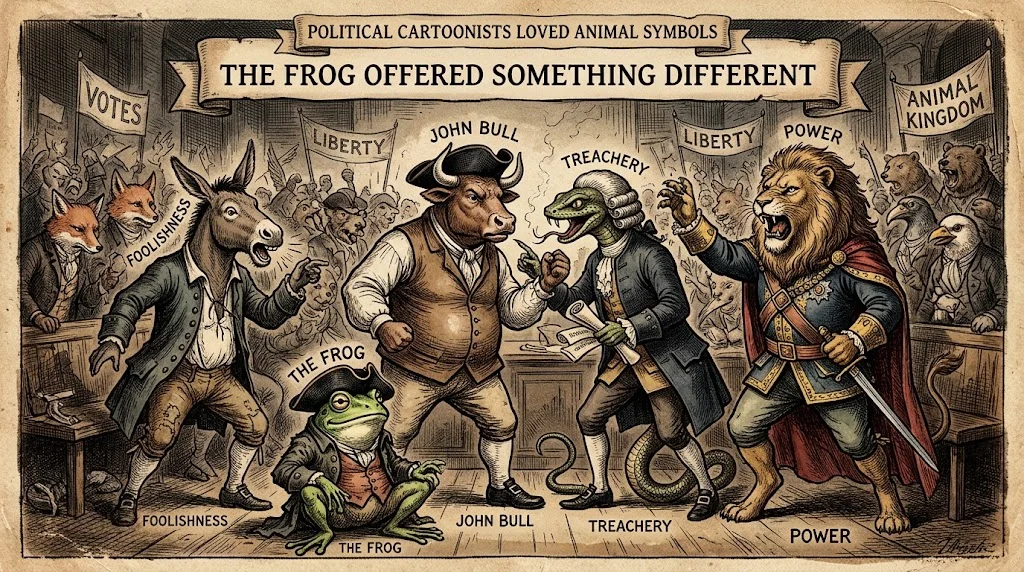
Political Cartoonists Loved Animal Symbols
Eighteenth-century political caricature often turned people into animals.
Animals could exaggerate a person’s supposed character without requiring a long explanation. A snake could suggest treachery. A lion could suggest power. A donkey could suggest foolishness.
The frog offered something different.
It could represent a whole population.
The Paris Musées collection preserves an English political caricature titled “The frogs who wanted a King.” The work is dated to the revolutionary era and depicts French revolutionary figures through frog imagery.
That’s powerful evidence that the frog had become more than a joke about French cuisine.
It was now part of political caricature.
Aesop’s Fables Added Another Layer
The connection between frogs and political rebellion wasn’t invented during the French Revolution.
European writers had long used Aesop’s fable about frogs wanting a king as political allegory. In the story, frogs ask for a ruler and receive one that brings them trouble.
That old literary tradition gave political cartoonists a ready-made symbolic language.
Bindman’s research argues that the transition from frog-eaters to frogs can be understood partly through the political use of Aesop’s fables.
This helps explain why the frog could move beyond food.
Instead of saying:
“The French eat frogs.”
A caricaturist could imply:
“These French people are the frogs.”
That’s a much stronger political image.
4. “Frog” Was Short, Memorable, and Perfect for National Rivalry
There was another reason the nickname worked so well: language likes memorable insults.
“French frog” is short. “Frog-eater” is vivid. “Froggy” is easy to turn into a mocking adjective or noun.
That kind of linguistic economy helps a nickname survive.
National rivalries also provide fertile ground for this sort of language. Britain and France spent centuries competing over territory, trade, military power, colonial influence, and political interests.
The relationship wasn’t simply hostile. It was complicated.
The two countries fought numerous wars, borrowed cultural ideas from each other, traded extensively, and constantly compared themselves with each other.
That combination creates an ideal environment for stereotypes.
The Nickname Worked Because It Combined Several Ideas
Consider what the word “frog” could evoke in British satire:
- A French culinary habit
- A wetland animal
- A foreigner
- An old political symbol
- A neighboring rival
- A ridiculous caricature
- A short and memorable insult
That’s a lot of cultural baggage packed into one syllable.
The nickname didn’t need one perfect origin because several associations reinforced each other.
Once people heard frog used for the French often enough, the explanation became almost unnecessary.
When Did British People First Call the French “Frogs”?
This question has a more precise answer than many people realize.
One important early example comes from William Davenant’s 1657 work The First Days Entertainment at Rutland-House.
The text contains the phrase “French Frogs.” A modern scholarly study identifies this as the earliest recorded use of frog connected with French nationality in the Oxford English Dictionary’s evidence.
That date is significant because it predates the French Revolution by more than a century.
A short quotation from the 1657 text reads:
“our poor French Frogs”
That tiny phrase carries considerable historical weight.
It demonstrates that the French-frog association wasn’t invented in 1789.
See More : Expectations Of vs. Expectations For: What’s the Difference?
Why Do Some Sources Give Later Dates?
This is where etymology becomes more complicated.
Different sources may date different stages of the word’s development.
For example:
| Date | Development |
| c. 1603 | French cuisine is associated with frogs in John Marston’s The Malcontent |
| 1657 | “French Frogs” appears in Davenant’s work |
| 17th century | “Frog” can also refer to Dutch people |
| 1769 | Etymonline gives a date for frog as a derogatory term for a Frenchman, linked to “frog-eater” |
| 1789 onward | Revolutionary France provides fertile ground for frog imagery |
| 1790s | Political caricatures increasingly use frogs to represent revolutionary French people |
These dates aren’t necessarily contradictory.
They can describe different stages of the nickname’s history.
The existence of an early phrase such as “French Frogs” doesn’t mean the standalone slang term had already achieved the same widespread meaning it later acquired.
That distinction is crucial.
Was the French Revolution the Original Source of the “Frog” Nickname?
No.
The documentary evidence rules out the simple claim that the French Revolution invented the nickname.
The 1657 reference to “French Frogs” came more than 130 years before the Revolution.
However, saying the Revolution had nothing to do with the nickname would also miss an important part of the story.
The Revolution appears to have helped transform and strengthen the frog as a political symbol.
David Bindman describes the historical movement as a shift from French people being viewed as frog-eaters toward the French themselves being represented as frogs. He places the decisive transformation in the context of the French Revolution and its aftermath.
So the most accurate formulation is:
The French Revolution didn’t invent the frog nickname. It helped turn an older stereotype into a powerful political symbol.
Why Were Frogs Associated With France in the First Place?
The culinary explanation remains important because it supplied the most recognizable connection.
French cooking has long been famous for incorporating ingredients that outsiders sometimes considered unusual. Frogs’ legs became one of those recognizable culinary markers.
Interestingly, the association is not entirely one-sided or imaginary.
Frogs’ legs remain part of French culinary culture today. Le Monde described them in 2023 as an emblematic part of French gastronomy, noting that chefs continue to serve the dish even as concerns about supply and environmental pressure affect the trade.
French government regulations also specifically address the production and preparation of frogs’ legs for human consumption.
That doesn’t make the stereotype fair.
It simply explains why British observers had a real cultural detail they could exaggerate.
The “Frog-Eater” Theory vs. the Dutch Theory
These explanations aren’t necessarily competing theories.
They can both be true.
The frog-eater theory explains why frogs became associated with French people.
The Dutch theory explains why the word frog already existed as a national insult before it settled on the French.
The political history then explains how the symbol became more deeply embedded.
Think of the nickname like a recipe.
The ingredients include:
French food + older national stereotypes + political satire + Anglo-French rivalry = the modern “frog” stereotype
No single ingredient tells the whole story.
A Historical Case Study: “The Frogs Who Wanted a King”
One of the clearest examples of the frog becoming political appears in an English caricature held by the Musée Carnavalet, part of the Paris Musées collection.
The print is titled “The frogs who wanted a King.” The museum identifies it as an English political caricature directed against Revolutionary France. It dates from the revolutionary period and draws on the imagery of frogs and Aesop’s fable.
This example is useful because it shows the stereotype operating in a completely different way.
There is no need to depict a French dinner table.
The frogs themselves stand in for the French political population.
That’s a major conceptual shift.
What the Caricature Shows
The symbolism works on several levels:
- The frogs represent French people.
- The political setting connects them to revolutionary events.
- Aesop’s fable supplies the narrative framework.
- The caricature mocks political change through animal imagery.
- The insult becomes political rather than purely culinary.
This is why the French Revolution matters even though it wasn’t the original source of the nickname.
Why National Nicknames Often Come From Food
Food makes an unusually effective source of national stereotypes.
It’s tangible.
Everyone eats. Everyone has recognizable dishes. Different cuisines often seem strange to outsiders, especially when people encounter unfamiliar ingredients.
That creates easy material for humor.
The French had frogs’ legs.
The British had roast beef.
And the rivalry practically wrote the jokes itself.
The French Had Their Own Nickname for the British
The French have historically called English people “les Rosbifs,” a Frenchified form of “roast beef.”
Collins defines rosbif as a French term for an English person and explains that it comes from English roast beef, regarded as typically English.
The Académie Française likewise records “les mangeurs de rosbif” and the shortened “les Rosbifs” as terms for the English, with a pejorative or popular sense.
So the culinary teasing runs in both directions.
The British stereotype:
French → frogs
The French stereotype:
English → roast beef
That symmetry tells us something important.
These names weren’t serious demographic descriptions. They were part of a long tradition of cross-Channel cultural mockery.
Is “Frog” a Neutral Name for French People?
No.
This point deserves a clear answer.
Modern dictionaries classify the term as offensive or derogatory when it refers to a French person. Cambridge labels it an offensive word, while Collins calls it a derogatory term.
Therefore, it shouldn’t be treated as a casual replacement for French person.
Historical discussion is different.
A historian might write about the term because the word itself is the subject of research. A novelist might use it to accurately portray a particular historical setting. A language article might explain its origin.
Those uses don’t make the insult neutral.
“Froggy” Has the Same Problem
“Froggy” is another form of the stereotype.
Collins specifically lists Froggy as an offensive or derogatory term for a French person.
So changing frog to Froggy doesn’t automatically make the expression friendly.
Context matters, but the dictionary classification remains important.
Common Myths About Why the French Are Called Frogs
The nickname has accumulated plenty of folklore. Here are the biggest misconceptions.
Myth: “The French Are Called Frogs Because All French People Eat Frogs”
That’s an exaggeration.
Frogs’ legs are genuinely associated with French cuisine, but that doesn’t mean frogs form a normal everyday staple for everyone in France.
The stereotype takes a real culinary tradition and stretches it across an entire population.
That’s how national caricature works.
Myth: “The French Revolution Invented the Term”
The historical evidence says otherwise.
A 1657 text already uses “French Frogs.”
The Revolution came in 1789.
Therefore, the nickname clearly existed beforehand.
What the Revolution did was give the frog a much stronger political and satirical role.
Myth: “There Is One Confirmed Origin”
There isn’t.
Some sources emphasize the frog-eating stereotype. Others document the earlier Dutch use. Scholarly research emphasizes the movement of the symbol between national groups and the importance of revolutionary politics.
The evidence points toward multiple overlapping influences.
That is more historically defensible than claiming one person invented the nickname on one particular day.
Myth: “British People Have Always Called the French Frogs”
Not exactly.
The word’s history is much messier.
English speakers used “frog” for the Dutch during the 17th century. The French association existed by the mid-17th century, while its later political meaning developed further around the French Revolution.
The nickname evolved.
It wasn’t handed down fully formed.
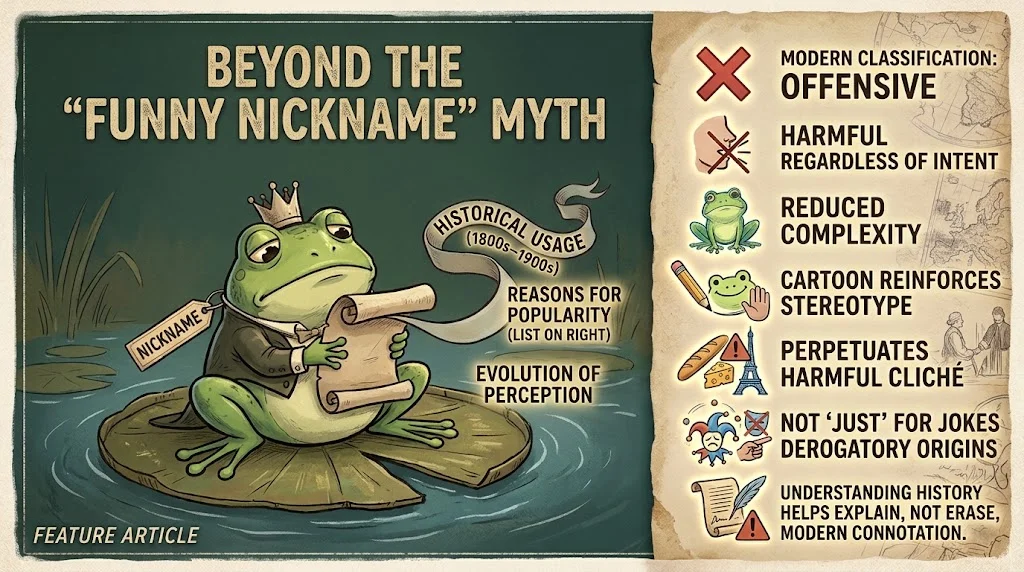
Myth: “Frog Is Just a Funny Nickname”
Today, dictionaries classify the expression as offensive.
That means calling a French person a “frog” can be insulting even when the speaker intends it as a joke.
Understanding the history helps explain the word. It doesn’t erase its modern connotation.
Why Did the Nickname Survive for So Long?
A good nickname has to be easy to remember.
“Frog” succeeds on every basic linguistic level.
It’s:
- One syllable
- Easy to pronounce
- Visually vivid
- Easy to turn into a cartoon
- Connected to a real cultural stereotype
- Flexible enough for jokes and insults
- Useful in political writing
It also benefited from Britain’s long relationship with France.
The two countries were close enough to know each other well, yet competitive enough to produce endless stereotypes.
That combination is linguistic kindling.
Every conflict, sporting rivalry, political dispute, or cultural disagreement could revive an old nickname.
The Real History of the French “Frog” Nickname
When all the evidence is placed together, the story becomes much clearer.
The timeline looks like this:
Around 1603
English literature already associates frogs with French culinary habits.
1657
William Davenant uses “French Frogs” in The First Days Entertainment at Rutland-House.
17th century
English also uses frog as a term for Dutch people, linked to the idea of a marshy “frog-land.”
1665
John Ogilby’s anti-Dutch satire uses frog imagery in political commentary.
1769
Etymonline records frog as a British derogatory term for a Frenchman, supposedly shortened from frog-eater.
1789 onward
The French Revolution creates a powerful new political context for frog imagery.
Revolutionary period
English political caricatures portray revolutionary French people as frogs, including the print “The frogs who wanted a King.”
This timeline shows why the origin can’t be reduced to one sentence.
So, What Is the Most Likely Explanation?
The strongest explanation combines the evidence rather than choosing one theory.
First, frogs were associated with French cuisine. That gave English speakers a ready-made stereotype.
Second, frog already had a history as a derogatory national label. English speakers had used it for the Dutch, so the word wasn’t linguistically tied to France from the beginning.
Third, the French Revolution gave the frog new political power. Satirists could use frogs to represent revolutionary France rather than merely making jokes about food.
Finally, the word itself was wonderfully compact. “Frog” was far easier to repeat, print, caricature, and remember than a longer phrase such as “frog-eater.”
That’s why the nickname endured.
Why the French Are Called Frogs: The Bottom Line
The French are called “frogs” in British English because frogs became strongly associated with French people through a mixture of culinary stereotypes, older national insults, political satire, and Anglo-French rivalry.
The frogs’ legs explanation is real, but it isn’t the complete story.
Historical evidence places “French Frogs” in English writing as early as 1657, long before the French Revolution. Meanwhile, the word frog had also been used for the Dutch during the 17th century.
The French Revolution then helped turn the frog from a food-based stereotype into a broader political symbol. British caricaturists used frogs to mock revolutionary France, drawing on older traditions of animal symbolism and Aesop’s fables.
So, if someone asks “Why are the French called frogs?”, the most accurate short answer is:
Because frogs’ legs became a long-standing stereotype of French cuisine, while older English uses of “frog” and later political satire helped turn that association into a lasting nickname.
It’s a much stranger story than the simple “French people eat frogs” joke suggests.
And that’s often the case with national nicknames. A single word can preserve centuries of food, rivalry, politics, humor, and cultural misunderstanding.
FAQs
1. Why are the French called “frogs” by British people?
The French are sometimes called “frogs” because of a long-standing British nickname connected to stereotypes about French culture, cuisine, and certain regional associations. The exact origin is debated, and several explanations have developed over time. Today, the term is generally considered informal and potentially offensive, depending on how it’s used.
2. Is “frog” a derogatory term for a French person?
Yes, “frog” can be derogatory when used to describe a French person. Its offensiveness depends on the speaker, context, and relationship between the people involved. In respectful or formal communication, it’s better to refer to someone as French rather than use the nickname.
3. Does the word “frog” refer to French food?
One popular explanation connects the nickname with frog legs, a food associated with French cuisine. However, this is only one theory about the expression’s history. The nickname has multiple possible cultural and historical explanations, so it shouldn’t be treated as having one universally accepted origin.
4. Where did the nickname “frogs” for the French originate?
The precise origin of “frogs” as a nickname for the French remains uncertain. Various theories connect it with French cuisine, geographical associations, and historical British attitudes toward France. The expression developed through repeated cultural usage rather than from one clearly documented event.
5. Do French people call British people a similar name?
French speakers have also used informal nicknames for the British, including terms such as “les Anglais” in ordinary contexts and more stereotypical expressions in informal speech. However, not every nickname carries the same level of offensiveness. Meaning depends heavily on historical context, tone, and English usage or French usage.
6. Is it appropriate to call French people “frogs” today?
Generally, you should avoid calling French people “frogs,” especially in professional or formal settings. The term can be perceived as a slur or ethnic stereotype. In business communication, meetings, formal writing, broadcasting, and professional correspondence, using neutral language is the safest and most respectful choice.
Conclusion
The nickname “frogs” has a surprisingly complicated history. Although people often associate it with French cuisine and frog legs, other historical and cultural explanations also contribute to its continued use in British English.
Understanding why the French are called frogs by British people requires looking beyond a single explanation. Language often preserves old stereotypes, rivalries, humor, and cultural perceptions long after their original context has faded.
Today, the expression is best understood as an informal and potentially offensive nickname, rather than a neutral term for French people. Knowing its background can help you recognize the phrase when you encounter it while also understanding when it’s inappropriate to use.

Alyan Ashraf is an English language writer and editor at Phrase Finesse, where he specializes in grammar, vocabulary, spelling, word usage, and clear communication. Passionate about the English language, he creates practical, research-backed content that helps readers avoid common mistakes and write with greater accuracy and confidence.
Known for his clear writing style and attention to detail, Alyan simplifies complex language topics into easy-to-understand guides filled with real-world examples and actionable insights. His work covers confusing word pairs, grammar rules, idioms, punctuation, and everyday English usage, making learning both accessible and engaging for students, professionals, writers, and non-native English speakers.
Every article Alyan writes is carefully researched, fact-checked, and designed to meet high editorial standards. His goal is to help readers strengthen their English skills, expand their vocabulary, and communicate more effectively in academic, professional, and everyday settings.
Through Phrase Finesse, Alyan is committed to publishing trusted language resources that make mastering English simpler, clearer, and more enjoyable for learners around the world