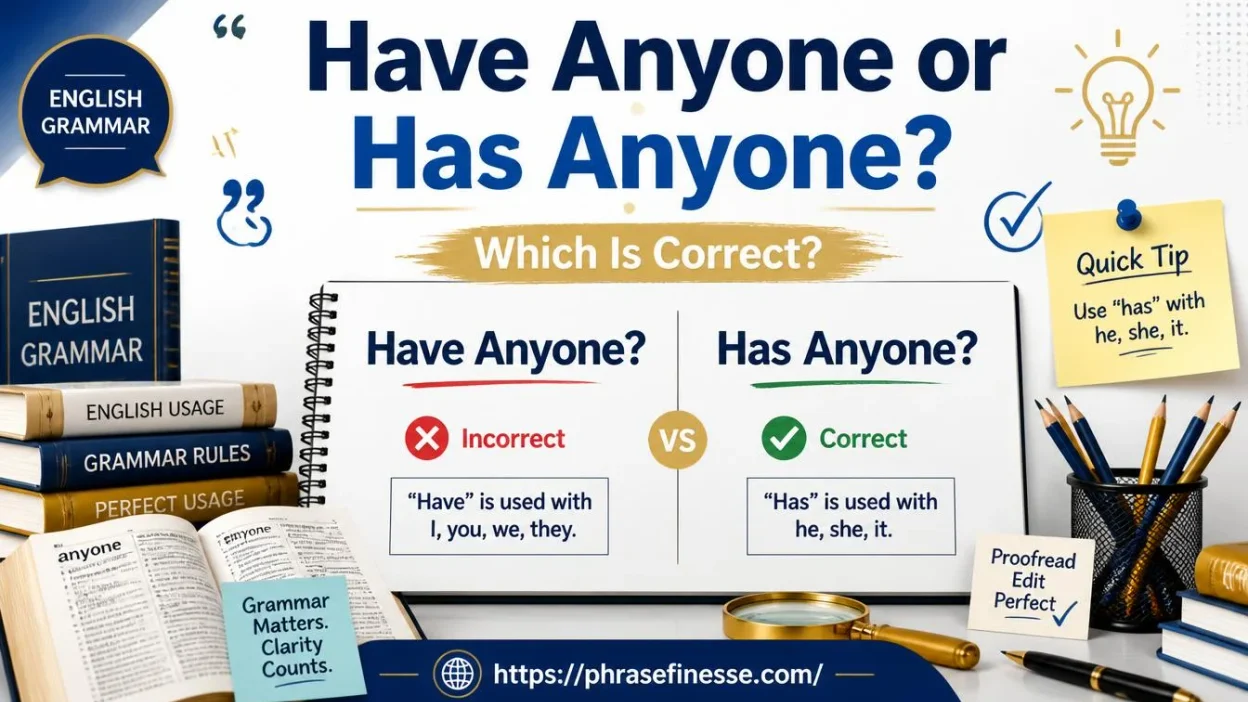
Have you ever paused while writing a message and wondered whether “Have Anyone” Or “Has Anyone”? Learn It Here! is the correct phrase to use? This common grammar question appears in emails, conversations, and professional documents more often than many people realize.
Understanding the correct structure is essential for accurate English usage, strong grammar, and clear communication.
Whether you’re sending a note about meetings, managing a calendar, coordinating scheduling, or discussing time management tasks, choosing the right verb form helps your writing sound natural and professional.
In areas such as business communication, formal writing, project management, online booking, and even broadcasting, grammatical accuracy improves readability and maintains consistency across all forms of communication.
In this guide, you’ll learn the key difference between “have anyone” and “has anyone,” why one form is usually correct, and how subject-verb agreement affects sentence structure.
We’ll also explore practical examples, common mistakes, and simple grammar rules to help you use these expressions confidently in both everyday conversations and professional contexts. By the end, you’ll know exactly which phrase to choose and when to use it correctly.
Quick Answer:
The correct phrase is usually “has anyone.”
Correct Examples
- Has anyone called me today?
- Has anyone seen my wallet?
- Has anyone completed the assignment?
- Has anyone spoken with the client?
Incorrect Examples
- Have anyone called me today?
- Have anyone seen my wallet?
- Have anyone completed the assignment?
The reason is straightforward:
Anyone is considered a singular indefinite pronoun, so it requires the singular helping verb has rather than have.
| Expression | Correct? | Reason |
| Has anyone called? | ✅ | Singular pronoun |
| Has anyone arrived? | ✅ | Correct agreement |
| Have anyone called? | ❌ | Incorrect agreement |
| Have anyone arrived? | ❌ | Incorrect agreement |
If you remember only one thing from this article, remember this:
Anyone is grammatically singular, so it takes “has,” not “have.”
Why “Has Anyone” Is Grammatically Correct
The answer comes from a basic grammar principle called subject-verb agreement.
Subject-verb agreement means the verb must match the subject in number.
- Singular subject → singular verb
- Plural subject → plural verb
Since anyone is singular, it pairs with has.
Understanding the Subject “Anyone”
The word anyone refers to an unspecified person.
Although it could theoretically refer to any individual in a group, English treats it as one person grammatically.
For example:
- Anyone can join.
- Anyone is welcome.
- Anyone has the right to ask questions.
In each sentence, anyone functions as a singular noun.
What Is an Indefinite Pronoun?
Anyone belongs to a category called indefinite pronouns.
These pronouns do not identify a specific individual.
Examples include:
- Anyone
- Anybody
- Someone
- Somebody
- Everyone
- Everybody
- No one
- Nobody
These words are all grammatically singular.
Subject-Verb Agreement in Action
Look at these examples:
| Subject | Correct Verb |
| Anyone | Has |
| Somebody | Has |
| Everyone | Has |
| Nobody | Has |
| People | Have |
| Employees | Have |
Notice that people and employees are plural, so they take have.
Meanwhile, anyone remains singular and takes has.
Understanding the Difference Between “Has” and “Have”
Many learners know that both words relate to possession and perfect tenses. The challenge is knowing when each should be used.
Use “Has” With Singular Subjects
Examples:
- He has arrived.
- She has completed the project.
- Anyone has access.
Use “Have” With Plural Subjects
Examples:
- They have arrived.
- Employees have completed the training.
- Students have submitted their work.
Quick Comparison Table
| Subject | Verb |
| He | Has |
| She | Has |
| It | Has |
| Anyone | Has |
| Someone | Has |
| They | Have |
| We | Have |
| You | Have |
This table explains why “Has anyone called?” is correct while “Have anyone called?” is not.
Examples of “Has Anyone” in Everyday English
One of the easiest ways to master grammar is through real-world examples.
Questions About Actions
These questions ask whether an action has occurred.
Examples:
- Has anyone opened the package?
- Has anyone checked the inventory?
- Has anyone submitted the report?
- Has anyone fixed the printer?
These sentences follow the same pattern:
Has + anyone + past participle
Questions About Experiences
The present perfect tense often asks about experiences.
Examples:
- Has anyone visited Japan?
- Has anyone climbed Mount Kilimanjaro?
- Has anyone tried this software?
- Has anyone read this novel?
These questions seek information about experiences at any time before now.
Questions in Professional Settings
Business environments frequently use this structure.
Examples:
- Has anyone contacted the supplier?
- Has anyone reviewed the proposal?
- Has anyone updated the schedule?
- Has anyone spoken with the customer?
Managers often use these questions during meetings because they efficiently determine task status.
Questions in Education
Teachers and students regularly use this form.
Examples:
- Has anyone finished the exam?
- Has anyone read Chapter Five?
- Has anyone solved the equation?
- Has anyone completed the project?
When “Have Anyone” May Appear in a Sentence
Here’s where things get interesting.
While “Have anyone?” is incorrect as a standalone question, “have anyone” can appear within larger grammatical structures.
The key difference is that have is no longer directly agreeing with anyone.
After Modal Verbs
Modal verbs include:
- Could
- Would
- Should
- Might
- May
- Must
- Can
After a modal verb, English uses the base form have.
Examples:
- Could anyone have predicted the outcome?
- Would anyone have believed it?
- Might anyone have noticed the mistake?
- Can anyone have forgotten that event?
Notice that have remains unchanged because modal verbs control the verb structure.
In Infinitive Structures
Examples:
- To have anyone attend the meeting would be beneficial.
- To have anyone question the results is unusual.
Here, have functions as an infinitive rather than a helping verb.
In Causative Constructions
Examples:
- We didn’t have anyone answer the phones.
- The company couldn’t have anyone access the database.
Again, have is performing a different grammatical job.
See More :6 Words for Someone Who Won’t Admit They’re Wrong
Comparing Similar Sentences
These examples help highlight the distinction.
| Sentence | Correct? | Explanation |
| Has anyone arrived? | ✅ | Subject-verb agreement |
| Have anyone arrived? | ❌ | Incorrect agreement |
| Could anyone have arrived earlier? | ✅ | Modal construction |
| Would anyone have guessed? | ✅ | Modal construction |
This is why grammar depends heavily on sentence structure rather than isolated words.
Similar Indefinite Pronouns That Follow the Same Rule
The rule doesn’t apply only to anyone.
Several other pronouns behave exactly the same way.
Has Anybody or Have Anybody?
Correct:
- Has anybody called?
- Has anybody responded?
Incorrect:
- Have anybody called?
- Have anybody responded?
Since anybody is singular, it requires has.
Has Someone or Have Someone?
Correct:
- Has someone left their umbrella?
- Has someone contacted support?
Incorrect:
- Have someone left their umbrella?
- Have someone contacted support?
Has Everyone or Have Everyone?
Correct:
- Has everyone arrived?
- Has everyone finished?
Incorrect:
- Have everyone arrived?
- Have everyone finished?
Has No One or Have No One?
Correct:
- Has no one noticed?
- Has no one volunteered?
Incorrect:
- Have no one noticed?
- Have no one volunteered?
Quick Reference Table
| Pronoun | Correct Form |
| Anyone | Has anyone |
| Anybody | Has anybody |
| Someone | Has someone |
| Somebody | Has somebody |
| Everyone | Has everyone |
| Everybody | Has everybody |
| No one | Has no one |
| Nobody | Has nobody |
Common Mistakes People Make With “Anyone”
Many mistakes happen because English grammar doesn’t always match intuition.
Let’s examine the most common errors.
Confusing Meaning With Grammar
People often think:
“Anyone means many possible people, so shouldn’t it be plural?”
That seems logical, but grammar doesn’t work that way.
Even though anyone may refer to multiple possible individuals conceptually, it remains singular grammatically.
Compare:
- Anyone is welcome.
- Anyone has a chance.
Both are singular constructions.
Copying Informal Speech
In casual conversation, people sometimes say things that aren’t grammatically standard.
For example:
- “Have anyone seen my phone?”
You might hear this occasionally in fast speech.
However, standard written English requires:
- “Has anyone seen my phone?”
Formal writing, academic papers, business communication, and professional emails should follow the standard rule.
Mixing Up Auxiliary Verbs
Writers often confuse:
- Has
- Have
- Do
- Does
- Did
Consider these examples:
| Correct | Incorrect |
| Has anyone called? | Have anyone called? |
| Does anyone know? | Do anyone know? |
| Did anyone respond? | Has anyone respond? |
Each auxiliary verb follows specific agreement rules.
as Anyone vs. Have Any People
Another common source of confusion involves plural nouns.
Compare these sentences:
Singular Indefinite Pronoun
- Has anyone volunteered?
Plural Noun Phrase
- Have any people volunteered?
The second sentence uses people, a plural noun.
Therefore, have becomes correct.
Side-by-Side Comparison
| Expression | Singular or Plural? | Correct Verb |
| Anyone | Singular | Has |
| Anybody | Singular | Has |
| Someone | Singular | Has |
| Any person | Singular | Has |
| Any people | Plural | Have |
| Several people | Plural | Have |
| Many employees | Plural | Have |
This distinction helps prevent many grammar errors.
How to Remember the Rule
Grammar becomes easier when you have a reliable shortcut.
The One-Person Test
Replace anyone with one person.
Example:
- Has anyone called?
Becomes:
- Has one person called?
That sounds correct.
Now try:
- Have anyone called?
Becomes:
- Have one person called?
Clearly incorrect.
This simple substitution reveals the correct answer almost instantly.
The Indefinite Pronoun Shortcut
Remember this group:
- Anyone
- Anybody
- Someone
- Somebody
- Everyone
- Everybody
- No one
- Nobody
Treat all of them as singular.
That means they typically use:
- Has
- Is
- Was
- Does
Examples:
- Has anybody arrived?
- Is everyone ready?
- Was someone waiting?
- Does anybody know?
A Simple Formula
Anyone = Singular
Singular Subject = Has
Therefore:
Has anyone…? ✓
Have anyone…? ✗
Keep this formula in mind whenever you’re unsure.
Real-World Examples From Professional Writing
Let’s look at practical situations where this grammar rule appears.
Business Communication
Managers often ask:
- Has anyone reviewed the contract?
- Has anyone updated the client database?
- Has anyone received the shipment?
These questions focus on completed actions.
Mini Case Study
A project manager begins a meeting by asking:
“Has anyone identified potential risks?”
The sentence immediately signals professional, grammatically correct communication.
If the manager asked:
“Have anyone identified potential risks?”
The sentence would sound incorrect to educated listeners.
Small grammar choices influence professionalism.
Academic Writing
Researchers frequently use this structure.
Examples:
- Has anyone investigated this phenomenon before?
- Has anyone published comparable findings?
- Has anyone proposed an alternative explanation?
Academic writing values precision. Correct subject-verb agreement helps maintain credibility.
Customer Support
Support teams commonly ask:
- Has anyone from our team contacted you?
- Has anyone resolved your issue?
- Has anyone followed up on your request?
These questions appear daily in customer service interactions.
Everyday Conversation
Friends and family use this pattern constantly.
Examples:
- Has anyone seen my keys?
- Has anyone fed the dog?
- Has anyone called Grandma?
- Has anyone watched the new episode?
The structure feels natural because it follows standard English grammar.
Has Anyone or Did Anyone?
This question deserves special attention.
Both phrases are correct, but they express different meanings.
Has Anyone
Focuses on an action connected to the present.
Example:
- Has anyone called today?
The time period remains relevant now.
Did Anyone
Focuses on a completed past event.
Example:
- Did anyone call yesterday?
The action occurred in a finished time period.
Comparison Table
| Sentence | Meaning |
| Has anyone called today? | Today is still ongoing |
| Did anyone call yesterday? | Yesterday is finished |
| Has anyone responded yet? | Present relevance |
| Did anyone respond last week? | Completed past time |
Understanding this distinction improves both grammar and precision.
Has Anyone Been or Have Anyone Been?
The correct form is:
✅ Has anyone been there before?
❌ Have anyone been there before?
The rule remains unchanged because anyone is still singular.
Additional examples:
- Has anyone been to Australia?
- Has anyone been informed?
- Has anyone been selected?
Has Anybody or Did Anybody?
Both forms can be correct depending on context.
Examples:
- Has anybody seen my wallet today?
- Did anybody see my wallet yesterday?
The difference lies in time reference, not subject agreement.
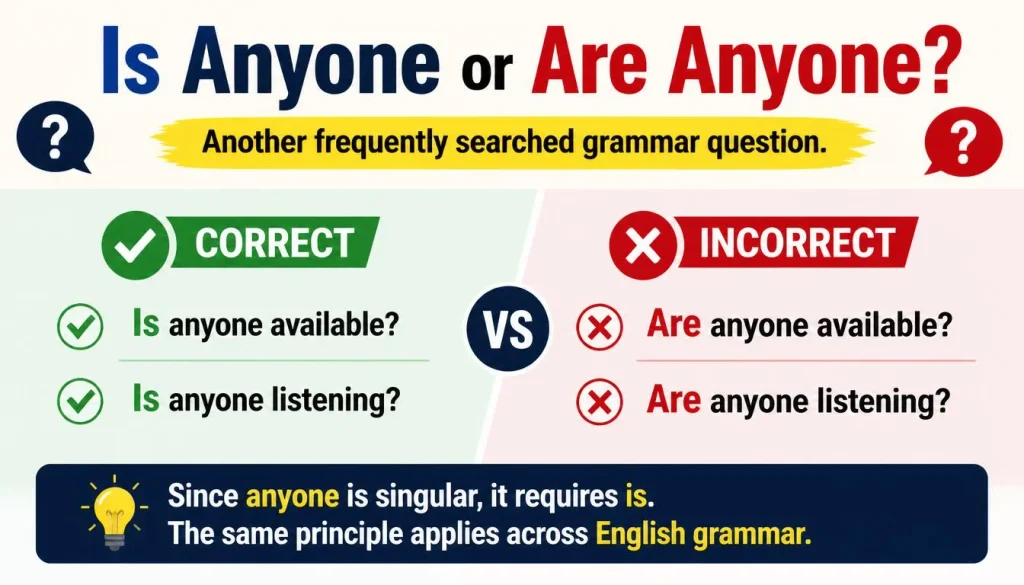
Is Anyone or Are Anyone?
Another frequently searched grammar question.
Correct:
- Is anyone available?
- Is anyone listening?
Incorrect:
- Are anyone available?
- Are anyone listening?
Since anyone is singular, it requires is.
The same principle applies across English grammar.
FAQs
Is “Has Anyone” grammatically correct?
Yes, “Has anyone” is grammatically correct in standard English. The pronoun “anyone” is treated as singular, so it takes the singular verb “has.” For example: “Has anyone seen my keys?”
Why is “Have Anyone” usually incorrect?
“Have anyone” is generally incorrect when used at the beginning of a question because “anyone” is singular. Standard subject-verb agreement requires “has anyone” instead of “have anyone.”
Can “Have Anyone” ever be used correctly?
Yes, but only in specific sentence structures. For example: “Do you have anyone who can help?” Here, “have” is linked to “you,” not “anyone,” making the sentence grammatically correct.
Is “Anyone” singular or plural?
In formal grammar, “anyone” is considered a singular indefinite pronoun. Therefore, it typically takes singular verbs such as “is,” “has,” and “does.”
Which phrase should I use in professional writing?
In professional emails, reports, and business communication, you should use “has anyone” when asking a question involving the pronoun “anyone.” This ensures grammatical accuracy and maintains a professional tone.
What is an example of “Has Anyone” in a sentence?
Here are a few examples:
- “Has anyone completed the project report?”
- “Has anyone updated the meeting schedule?”
- “Has anyone confirmed the online booking?”
These examples follow the correct rules of subject-verb agreement.
Conclusion
Choosing between “Have Anyone” and “Has Anyone” becomes simple once you understand the grammar rule behind it. Since “anyone” is a singular indefinite pronoun, the correct question form is usually “has anyone.”
While “have anyone” can appear in certain sentence constructions, it is generally not correct when directly paired with “anyone” as the subject of a question.
Mastering this distinction strengthens your English usage, improves formal writing, and helps maintain consistency in everyday and professional communication. Whether you’re writing emails, handling business communication, managing meetings, or coordinating project management tasks, using “has anyone” correctly will make your writing clearer, more polished, and grammatically accurate.

Alyan Ashraf is an English language writer and editor at Phrase Finesse, where he specializes in grammar, vocabulary, spelling, word usage, and clear communication. Passionate about the English language, he creates practical, research-backed content that helps readers avoid common mistakes and write with greater accuracy and confidence.
Known for his clear writing style and attention to detail, Alyan simplifies complex language topics into easy-to-understand guides filled with real-world examples and actionable insights. His work covers confusing word pairs, grammar rules, idioms, punctuation, and everyday English usage, making learning both accessible and engaging for students, professionals, writers, and non-native English speakers.
Every article Alyan writes is carefully researched, fact-checked, and designed to meet high editorial standards. His goal is to help readers strengthen their English skills, expand their vocabulary, and communicate more effectively in academic, professional, and everyday settings.
Through Phrase Finesse, Alyan is committed to publishing trusted language resources that make mastering English simpler, clearer, and more enjoyable for learners around the world