Have you ever received a message saying, “Can you check this on your end?” and wondered what it really means? In professional emails, support conversations, and team discussions, this phrase appears constantly, yet many writers and learners remain unsure about its exact usage.
This On Your End Meaning: How to Use It Correctly explains the phrase in clear, practical terms, helping you understand its role in modern English usage, grammar, and workplace communication.
The expression on your end commonly refers to a person’s side, responsibility, system, or situation in a particular context. You’ll often encounter it in business communication, meetings, project management, customer support, and collaborative tasks where teams need clarity and accountability.
Whether discussing scheduling, time management, online booking issues, calendar updates, or technical problems during broadcasting, understanding this phrase improves both accuracy and professionalism. Correct usage also supports stronger formal writing and promotes better consistency in everyday communication.
In this guide, you’ll learn the meaning of on your end, why the preposition on is used, and how the phrase differs from similar workplace expressions. We’ll explore real-world examples, common mistakes, grammar rules, and practical alternatives that fit different situations.
By the end, you’ll know how to use the phrase naturally and confidently in emails, conversations, and professional documents while maintaining clear and effective communication.
On Your End Meaning: What Does “On Your End” Mean?
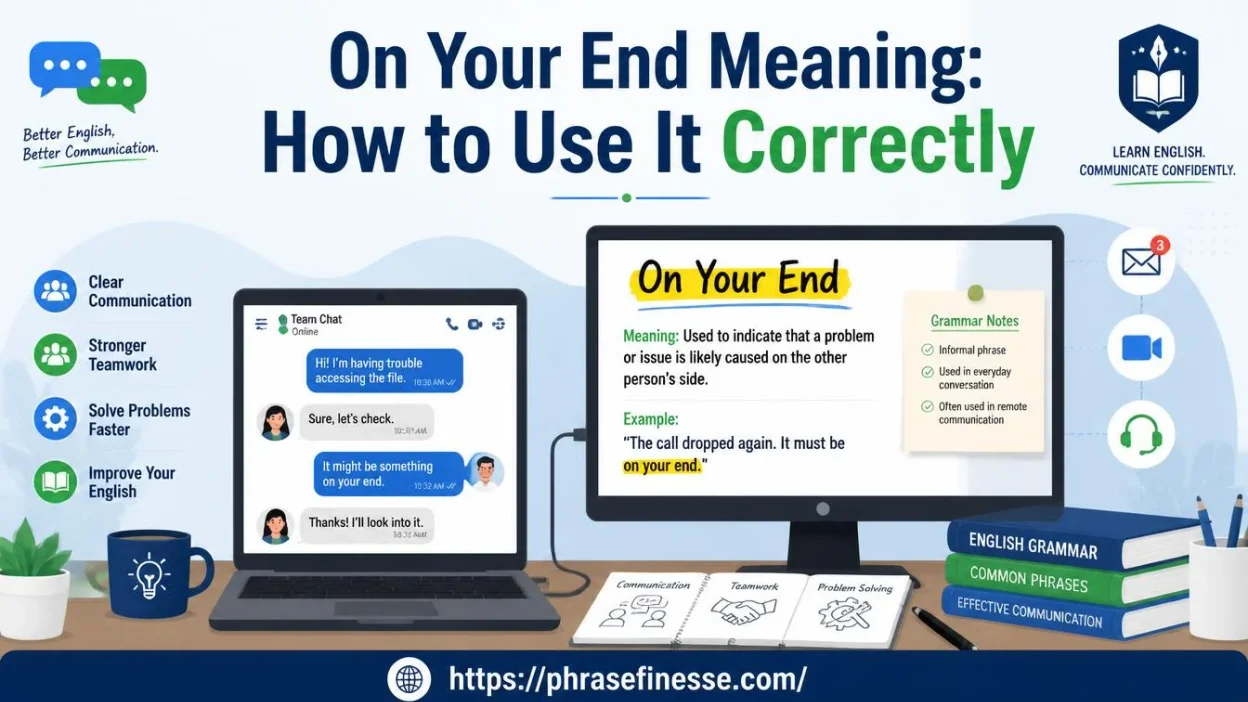
The phrase “on your end” means something related to your side, your responsibility, your location, your system, or your circumstances.
The word “end” does not refer to a physical ending. Instead, it represents a person’s part in a process or situation.
Think about a team project. Every person handles a different section. Your section represents your end of the project.
If someone says:
“Everything is complete on your end.”
They mean:
“Everything is complete from your side or within your responsibilities.”
The phrase is especially common when two or more people work together and each person controls a different part of the situation.
Simple Definition of “On Your End”
On your end = from your side or within your responsibility.
It can refer to:
- Your computer or device
- Your workplace tasks
- Your location
- Your personal situation
- Your organization
- Your decisions or actions
Examples of “On Your End”
| Sentence | Meaning |
| “Is the file opening correctly on your end?” | Is the file working on your device? |
| “I finished the report on my end.” | I completed my part of the work. |
| “Everything looks good on your end.” | Your side has no problems. |
| “Can you confirm the meeting time on your end?” | Can you verify it from your side? |
Breaking Down the Phrase “On Your End”
Understanding each word makes the phrase easier to remember.
The Meaning of “On”
The word “on” works as a preposition. It connects something to a specific position, situation, or area.
Examples:
- On my computer
- On your account
- On your side
- On your end
In “on your end,” the word “on” shows a connection to someone’s area of responsibility or experience.
The Meaning of “Your”
The word “your” shows ownership or connection.
It tells the listener that the phrase refers to their side.
Examples:
- Your device
- Your office
- Your account
- Your responsibility
The Meaning of “End”
The word “end” has a figurative meaning here.
It represents:
- A person’s part of a process
- A specific side of communication
- A responsibility area
- A particular situation
For example:
“There was an error on our end.”
This does not mean the error happened at the physical “end” of something. It means the error happened within the company’s responsibility.
Is “On Your End” Grammatically Correct?
Yes, “on your end” is grammatically correct and widely accepted in modern English.
Native speakers use this phrase frequently in:
- Workplace conversations
- Emails
- Customer support messages
- Technology discussions
- Online meetings
- Business communication
The phrase follows a common English pattern where “end” represents someone’s side of an activity or responsibility.
Similar expressions include:
- On my end
- On our end
- On their end
- On the company’s end
Examples:
“There seems to be a problem on your end.”
Meaning:
“The problem appears to be related to your side.”
“We have completed everything on our end.”
Meaning:
“We have completed everything we are responsible for.”
Why Do People Use “On Your End”?
The phrase helps people separate responsibilities.
Imagine two teams working on the same software project. One team manages the design while another handles the technical system.
If something goes wrong, asking:
“Is everything okay on your end?”
helps identify which side needs attention.
Instead of blaming someone, the phrase creates a neutral way to discuss problems.
Common Reasons People Use This Phrase
- To troubleshoot problems
- To confirm completed tasks
- To divide responsibilities
- To check information
- To coordinate projects
- To avoid confusion
“On Your End” vs. “At Your End”: Which One Is Correct?
Many English learners wonder whether they should say:
- On your end
- At your end
Both phrases can be correct. However, they have slightly different usage patterns.
| Phrase | Meaning | Common Usage |
| On your end | From your side or responsibility | Very common in American English |
| At your end | From your location or side | More common in British English |
Examples of “On Your End”
“The website works fine on my end.”
This focuses on the speaker’s experience or system.
“Can you check the settings on your end?”
This asks another person to review their side.
Examples of “At Your End”
“There seems to be a network issue at your end.”
This sounds slightly more location-focused.
In everyday American workplace communication, “on your end” usually sounds more natural.
How to Use “On Your End” in Different Situations
The phrase appears in many areas of modern communication.
Using “On Your End” in Technology and Troubleshooting
Technology is one of the most common places where people use this phrase.
When two people use different devices, accounts, or networks, they may experience different results.
For example:
“The application works perfectly on my end. Could you restart it on your end?”
The speaker means:
- My device works correctly.
- Your device may have a different issue.
Common Technology Examples
- Internet connection problems
- Software errors
- Website issues
- Login problems
- File-sharing problems
- Application bugs
Example:
“Are you still seeing the error message on your end?”
This asks whether the other person experiences the same problem.
Using “On Your End” in Workplace Communication
Modern workplaces rely heavily on collaboration. Teams often work across cities, countries, and time zones.
The phrase helps coworkers explain responsibilities clearly.
Example:
“I have completed the presentation on my end. Could you review the final slides?”
This means:
- The speaker finished their assigned work.
- Another person needs to complete their part.
Workplace Examples
| Situation | Example Sentence |
| Project update | “The research is finished on my end.” |
| Team collaboration | “Please check the numbers on your end.” |
| Deadline planning | “Are you ready on your end?” |
| Document review | “Everything looks correct on my end.” |
Using “On Your End” in Customer Service
Customer support teams use this phrase often because it creates a clear troubleshooting process.
Instead of saying:
“The problem is your fault.”
A support representative might say:
“We don’t see any issues on our end. Could you check your account settings?”
This sounds more professional and helpful.
Customer Support Examples
“The payment system is working on our end.”
Meaning:
The company’s system appears normal.
“Could you try clearing your browser cache on your end?”
Meaning:
The customer needs to perform an action.
Using “On Your End” in Everyday Conversations
Although the phrase sounds professional, people also use it casually.
Examples:
“Everything good on your end?”
Meaning:
“Is everything okay with you?”
“I’m ready on my end.”
Meaning:
“I’m prepared.”
“Let me know if anything changes on your end.”
Meaning:
“Tell me if your situation changes.”
Common Mistakes When Using “On Your End”
Even though the phrase is simple, people sometimes use it incorrectly.
Mistake: Using It for Physical Objects
The phrase usually describes a person’s side, responsibility, or situation.
Incorrect:
“The phone is on your end.”
This sounds confusing.
Better:
“The phone is on your side of the table.”
Mistake: Thinking It Means “The End”
Some learners misunderstand the phrase because of the word “end.”
Example:
“The project is complete on your end.”
This does not mean:
“The project is finished completely.”
It means:
“Your part of the project is complete.”
Read More: 3 Words for Someone Who Takes a Survey
Mistake: Using It Too Much in Formal Writing
The phrase works well in communication, but some formal documents require clearer wording.
Instead of:
“Please handle this on your end.”
A formal alternative could be:
“Please complete this task from your side.”
or:
“Please review this matter and take the necessary action.”
Synonyms and Alternatives for “On Your End”
Sometimes another phrase may fit better depending on the situation.
| Alternative | Best Used For |
| From your side | General communication |
| On your side | Casual conversations |
| Within your responsibility | Formal writing |
| From your perspective | Opinions |
| In your system | Technology issues |
| At your location | Physical situations |
Examples
Instead of:
“Can you check this on your end?”
You could say:
“Can you check this from your side?”
or:
“Can you review this in your system?”
“On Your End” vs. “On My End” vs. “On Our End”
Changing the pronoun changes the meaning.
On My End
Means:
From my side or within my responsibility.
Example:
“The document opens correctly on my end.”
On Your End
Means:
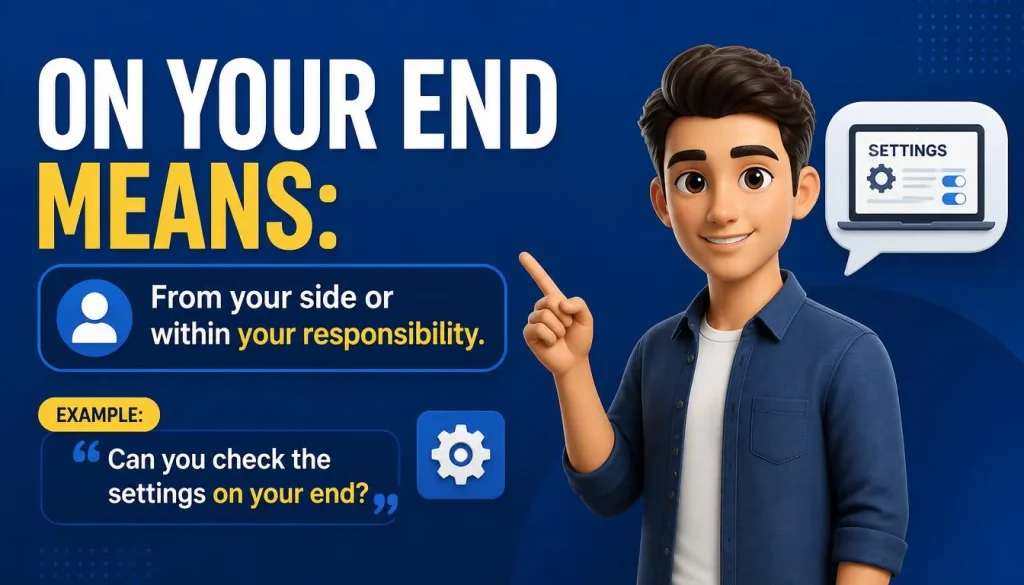
From your side or within your responsibility.
Example:
“Can you check the settings on your end?”
On Our End
Means:
From our group’s or organization’s side.
Example:
“We have fixed the issue on our end.”
Is “On Your End” Formal or Informal?
The phrase is neutral.
It works in:
✅ Professional emails
✅ Workplace chats
✅ Customer support
✅ Meetings
✅ Everyday conversations
However, extremely formal writing may require more specific language.
Professional Example
“Could you confirm whether the issue still appears on your end?”
Casual Example
“Everything okay on your end?”
Can You Start a Sentence With “On Your End”?
Yes, you can start a sentence with “on your end.”
Examples:
“On your end, please make sure all details are correct.”
“On your end, everything should be ready before the deadline.”
Starting with the phrase places emphasis on the other person’s responsibility.
Real-Life Case Studies Using “On Your End”
Case Study: Remote Team Collaboration
A marketing team works in three different countries. One employee cannot access a shared document.
The conversation:
“The file opens correctly on my end. Can you check on your end?”
The team member checks their account settings and discovers a permission issue.
Lesson:
The phrase helped the team identify where the problem existed without assigning blame.
Case Study: Customer Support Problem
A customer cannot complete an online purchase.
The support agent checks the company system.
The agent says:
“Everything looks normal on our end. Could you try updating your payment information on your end?”
Lesson:
The phrase separates company responsibilities from customer actions.
FAQs
1: What does “on your end” mean?
The phrase “on your end” refers to a person’s side, system, responsibility, location, or situation in a particular context. It is commonly used in business communication, customer support, and workplace discussions to identify where an issue, task, or action is occurring.
2: Is “on your end” grammatically correct?
Yes, “on your end” is grammatically correct and widely accepted in both spoken and written English. It is especially common in professional settings, although some formal documents may prefer more specific alternatives such as “from your side” or “within your department.”
3: Why is the preposition “on” used in “on your end”?
The preposition “on” is used idiomatically in this expression to indicate a particular side or point of responsibility. In English, certain phrases become standard through usage, and “on your end” has become a conventional way to refer to someone’s area of involvement or control.
4: Can I use “at your end” instead of “on your end”?
In some regions, particularly in British English, “at your end” may be used. However, “on your end” is generally more common in modern workplace communication, technical support, and American English.
5: Is “on your end” appropriate for formal writing?
It can be used in many professional emails and workplace documents. However, for highly formal writing, alternatives such as “from your side,” “within your team,” or “under your responsibility” may sound more precise and professional.
6: What are some alternatives to “on your end”?
Common alternatives include:
- From your side
- Within your team
- In your department
- On your side
- Under your responsibility
- At your location
The best choice depends on the context and level of formality.
Conclusion
Understanding “on your end” can make your communication clearer and more professional. The phrase is widely used to refer to another person’s side, responsibility, system, or situation, especially in business communication, project management, technical support, and everyday workplace conversations.
While it may seem simple, knowing why the preposition “on” is used and when suitable alternatives are appropriate helps improve both grammar accuracy and communication effectiveness.
By applying the examples and guidelines in this article, you can use “on your end” confidently in emails, meetings, and professional discussions while maintaining clarity, precision, and consistency.

Mia Rose is an English language specialist and editorial writer at Phrase Finesse, where she helps readers master grammar, vocabulary, spelling, and effective communication. Passionate about making English simple and practical, she creates well-researched, reader-friendly content that explains complex language concepts in a clear and engaging way.
With extensive experience in English language education, content writing, and editorial review, Mia specializes in grammar, punctuation, word choice, idioms, confusing word pairs, and writing style. Her articles are carefully researched, fact-checked, and designed to help students, professionals, writers, and English learners build confidence in both written and spoken English.