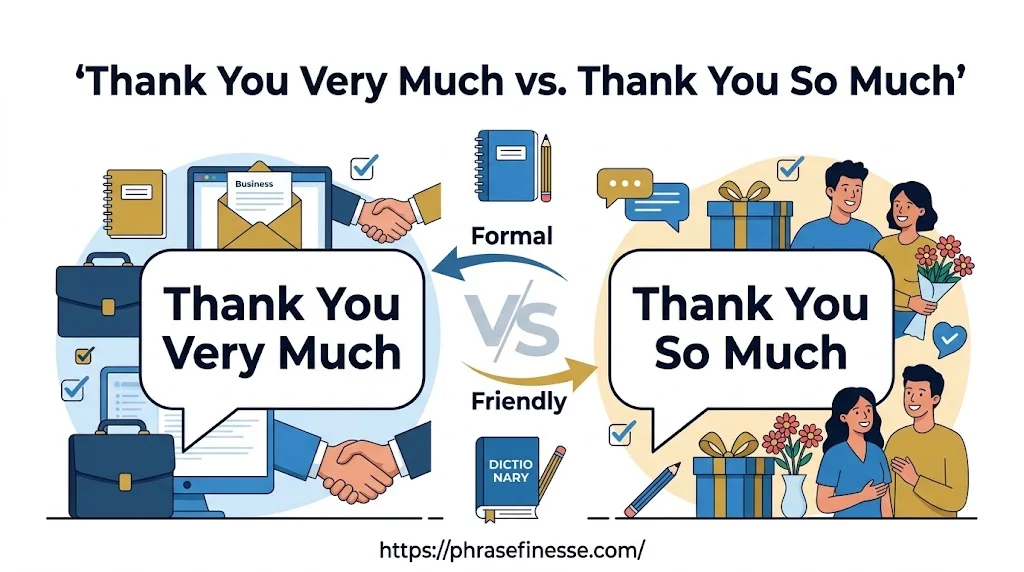
Have you ever wondered whether Thank You Very Much vs. Thank You So Much: comes down to more than just one word? Both expressions show gratitude, but they can create slightly different tones depending on the situation.
You might use them in business communication, casual conversations, emails, meetings, or everyday interactions. Understanding this subtle distinction can help you choose words that sound natural, sincere, and appropriate.
In this guide, you’ll learn how “thank you very much” and “thank you so much” differ in meaning, tone, emphasis, and English usage. We’ll also explore how each phrase works in formal writing, professional messages, scheduling, time management, online booking, broadcasting, and project management contexts.
You’ll see practical examples that show when each expression fits best, along with common grammar and usage considerations.
The goal isn’t to memorize a rigid rule. Instead, you’ll learn how context, tone, formality, and consistency influence your choice.
Whether you’re thanking someone for arranging a meeting, updating a calendar, helping with an online booking, or simply doing you a favor, this guide will help you express appreciation naturally. By the end, you’ll know exactly when to choose each phrase.
Quick Answer
“Thank you very much” and “thank you so much” are both correct ways to express gratitude. “Thank you very much” often sounds slightly more formal, polite, or measured, while “thank you so much” usually feels more warm, enthusiastic, and personal. However, the difference isn’t absolute. Your tone and context matter more than the words themselves.
Thank You Very Much vs. Thank You So Much: The Short Answer
If you’re looking for the quick answer, here it is:
- “Thank you very much” is generally more formal and reserved.
- “Thank you so much” is warmer, friendlier, and more emotional.
- Both are grammatically correct.
- Both express sincere appreciation.
- Neither phrase is inherently more polite. The best choice depends on the situation.
| Phrase | Meaning | Tone | Best Used For |
| Thank you very much | Strong appreciation | Formal, respectful | Business emails, interviews, customer service, speeches |
| Thank you so much | Strong appreciation | Friendly, heartfelt | Friends, family, coworkers, casual emails, text messages |
The real difference lies in how the listener or reader feels when they hear the phrase.
What Does “Thank You Very Much” Mean?
At its core, “thank you very much” simply means “I appreciate what you’ve done to a great degree.”
The phrase combines:
- Thank you (an expression of gratitude)
- Very much (an adverbial phrase that increases the level of appreciation)
Unlike casual alternatives, this expression often carries an air of professionalism and courtesy.
Why It Sounds More Formal
The phrase has been part of standard English for centuries. Because it appears frequently in business, customer service, speeches, and official communication, many people naturally associate it with polite professionalism.
For example:
- Thank you very much for your time.
- Thank you very much for considering my application.
- Thank you very much for your assistance.
Notice that these examples sound respectful without becoming overly emotional.
When Native Speakers Use It
Native speakers commonly use “thank you very much” in situations where they want to show appreciation while maintaining professional distance.
Typical examples include:
- Job interviews
- Academic settings
- Business correspondence
- Customer support interactions
- Public presentations
- Government offices
- Formal ceremonies
It communicates gratitude without sounding overly familiar.
Examples of “Thank You Very Much”
Professional Email
Thank you very much for reviewing my proposal. I appreciate your valuable feedback.
Interview
Thank you very much for taking the time to meet with me today.
Customer Service
Thank you very much for your patience while we resolved the issue.
Presentation
Thank you very much for attending today’s seminar.
Formal Letter
Thank you very much for your generous support throughout this project.
Each example sounds polished and appropriate in a professional environment.
What Does “Thank You So Much” Mean?
“Thank you so much” also expresses gratitude, but it carries a stronger emotional tone.
Instead of sounding reserved, it feels genuine, enthusiastic, and personal.
People often choose this phrase when someone has helped them in a meaningful way or when they want their appreciation to sound heartfelt.
For instance:
- Thank you so much for helping me move.
- Thank you so much for the thoughtful gift.
- Thank you so much for always being there.
The emotion becomes immediately noticeable.
Why “So Much” Feels More Emotional
In modern conversational English, the word “so” often functions as an emotional intensifier.
Consider these examples:
- I’m so happy.
- That’s so kind.
- You’re so helpful.
The same pattern appears in “thank you so much.”
Although both “very” and “so” intensify meaning, “so” usually feels more spontaneous and heartfelt in everyday speech.
That’s why native speakers often choose it when talking with people they know well.
Common Situations
You’ll hear “thank you so much” frequently in:
- Text messages
- Family conversations
- Social media comments
- Birthday messages
- Wedding speeches
- Thank-you notes
- Friendly emails
- Everyday conversations
Because the tone feels warm, it naturally fits personal relationships.
Examples of “Thank You So Much”
Friend
Thank you so much for driving me home yesterday.
Birthday Gift
Thank you so much for the beautiful present.
Teacher
Thank you so much for believing in me.
Coworker
Thank you so much for covering my shift.
Neighbor
Thank you so much for watering my plants while I was away.
Each example sounds sincere without becoming overly formal.
The Main Difference Between “Thank You Very Much” and “Thank You So Much”
Although both phrases mean essentially the same thing, they create different emotional effects.
Here’s a detailed comparison.
| Feature | Thank You Very Much | Thank You So Much |
| Formality | High | Medium |
| Emotional warmth | Moderate | High |
| Business communication | Excellent | Good |
| Personal conversations | Good | Excellent |
| Everyday speech | Common | Very common |
| Customer service | Extremely common | Less common |
| Text messages | Less common | Very common |
| Speeches | Common | Common |
| Professional emails | Preferred | Acceptable depending on relationship |
Think of it this way:
- Very much emphasizes respect.
- So much emphasizes emotion.
Neither is better than the other.
They simply serve different purposes.
Grammar Explained: Why Both Expressions Are Correct
Some learners assume one phrase must be grammatically superior.
That isn’t true.
Both expressions follow standard English grammar.
The only difference is the intensifier that follows the phrase “thank you.”
Let’s examine each one.
How “Very Much” Works
In grammar, very much functions as an adverbial intensifier.
It modifies the level of gratitude being expressed.
Structure:
Thank + You + Very Much
Examples:
- Thank you very much.
- We appreciate your support very much.
- I enjoyed the conference very much.
Notice that very much often appears after verbs in English.
Because of this long-standing usage, the phrase sounds conventional and polished.
How “So Much” Works
So much also functions as an intensifier.
However, instead of emphasizing degree in a neutral way, it often conveys emotion.
Structure:
Thank + You + So Much
Examples:
- Thank you so much.
- I appreciate it so much.
- We miss you so much.
The grammar remains completely correct.
The difference lies entirely in tone.
Why Neither Changes the Meaning
Whether you choose very much or so much, the basic message remains identical:
I sincerely appreciate what you’ve done.
What changes is how your appreciation feels to the other person.
That’s why understanding context matters more than memorizing grammar rules.
Which Sounds More Natural Today?
Language evolves.
Expressions that sounded formal fifty years ago may sound different today.
In modern American English, “thank you so much” has become increasingly common in everyday conversation.
People use it because it feels authentic and friendly.
Meanwhile, “thank you very much” remains widely used in professional communication and polite interactions.
Neither expression is outdated.
Instead, each has found its own place.
In Everyday Conversation
Most native speakers naturally say:
- Thanks so much!
- Thank you so much!
- Thanks!
These options sound relaxed and conversational.
In Professional Communication
Professionals often write:
- Thank you very much for your assistance.
- Thank you very much for your prompt response.
- Thank you very much for your consideration.
These phrases strike the right balance between gratitude and professionalism.
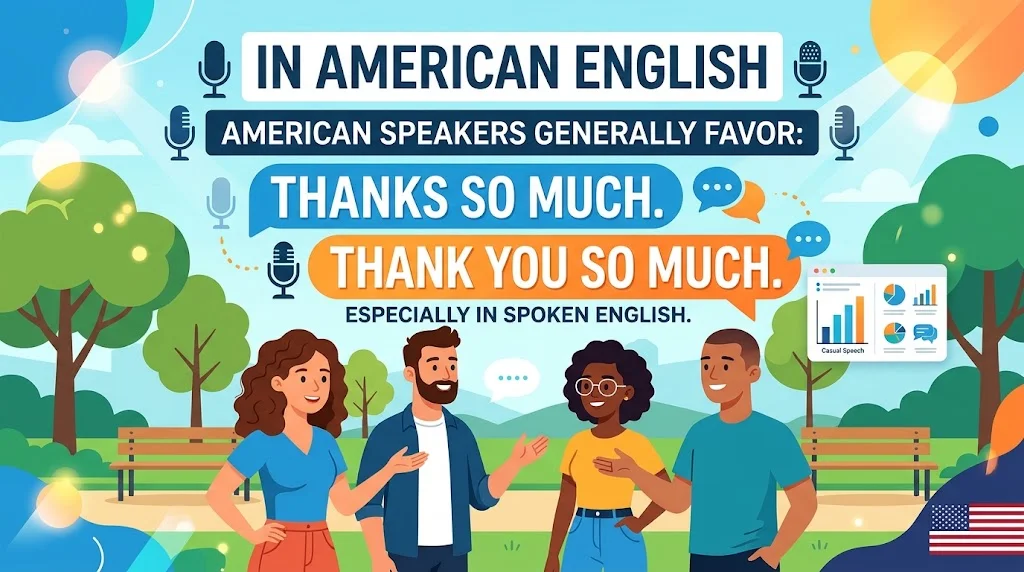
In American English
American speakers generally favor:
- Thanks so much.
- Thank you so much.
Especially in spoken English.
In British English
British English continues to use both expressions regularly.
However, professional settings still tend to lean toward:
- Thank you very much.
while informal conversations frequently use:
- Thanks so much.
- Thank you so much.
The distinction is subtle rather than absolute.
See More : Question Mark After “I Was Wondering…”
Formal vs. Informal Usage
Choosing the right phrase depends less on grammar and more on the relationship between you and the person you’re thanking.
Best Formal Situations for “Thank You Very Much”
Use this expression when speaking or writing to:
- Employers
- Hiring managers
- Professors
- Clients
- Customers
- Government officials
- Business partners
- Conference speakers
- Interviewers
- Service professionals
Example
Thank you very much for your prompt response. I look forward to hearing from you.
This wording sounds respectful and polished without feeling distant.
Best Informal Situations for “Thank You So Much”
Use this version with people you know well, including:
- Friends
- Family members
- Neighbors
- Close coworkers
- Classmates
- Mentors
- Social media followers
Example
Thank you so much for making my birthday so special.
The warmth of the phrase matches the personal relationship.
A Simple Rule to Remember
When you’re unsure, think about your relationship with the other person.
- Professional or unfamiliar? → Thank you very much
- Personal or friendly? → Thank you so much
That one guideline will help you choose naturally in most situations.
Business Email Examples: Choosing the Right Expression
Business writing isn’t just about grammar. It’s also about building relationships. The way you express gratitude can influence how professional, approachable, and sincere you appear.
In most formal business situations, “thank you very much” remains the safest choice. However, “thank you so much” works well when you already have a friendly relationship with the recipient.
Let’s look at common workplace scenarios.
After a Job Interview
A hiring manager expects professionalism. Keep your language respectful and concise.
Example
Dear Ms. Carter,
Thank you very much for taking the time to interview me today. I enjoyed learning more about your team and the role. I appreciate your consideration and look forward to hearing from you.
This version sounds polished and confident.
Thanking a Client
Showing appreciation strengthens business relationships.
Example
Thank you very much for choosing our services. We truly appreciate your trust and look forward to working with you again.
Thanking a Professor
Academic communication usually benefits from a more formal tone.
Example
Thank you very much for your detailed feedback on my research paper. Your suggestions will help me improve my work significantly.
Thanking a Friendly Coworker
A warmer tone often feels more natural.
Example
Thank you so much for helping me finish the presentation. I couldn’t have completed it on time without your support.
Thanking a Mentor
Mentorship is personal, making “thank you so much” an excellent choice.
Example
Thank you so much for your encouragement throughout my career. Your advice has made a lasting difference.
Conversation Examples
Native English speakers naturally adjust their expressions depending on the situation.
Below are realistic conversations you’ll hear in everyday life.
At a Restaurant
Customer: The meal was wonderful.
Server: I’m glad you enjoyed it.
Customer: Thank you very much.
This sounds polite and respectful.
Receiving a Gift
Friend: I hope you like it.
You: Thank you so much! It’s exactly what I wanted.
The excitement makes “so much” feel more natural.
At Work
Coworker: I fixed the spreadsheet for you.
You: Thank you so much. That saved me a lot of time.
At the Doctor’s Office
Doctor: Everything looks good.
Patient: Thank you very much, Doctor.
The formal tone matches the setting.
At School
Teacher: Excellent job on your project.
Student: Thank you very much.
Family Dinner
Mom: I baked your favorite dessert.
You: Thank you so much!
Warm, heartfelt, and completely natural.
Text Message
Friend: I picked up your package.
You: Thanks so much!
Notice that many people shorten the expression in casual writing.
Common Mistakes to Avoid
Although both expressions are correct, learners often make mistakes by using them in the wrong context.
Avoid these common errors.
Using an Overly Emotional Tone in Formal Emails
Imagine sending this after a job interview:
Thank you sooooo much!!
Although friendly, it doesn’t sound professional.
Instead, write:
Thank you very much for your time.
Sounding Too Formal with Close Friends
If your best friend helps you move, saying:
Thank you very much for your assistance.
sounds unusually distant.
Most native speakers would simply say:
Thank you so much!
or
Thanks so much!
Repeating “Thank You” Too Often
Avoid this:
1.Thank you so much.
2.Thank you very much.
3.Thank you again.
4. Thank you.
Instead, vary your wording.
For example:
Thank you so much for your help. I really appreciate everything you’ve done.
Mixing Formal and Casual Language
This combination feels awkward:
Thank you very much, buddy!
The two styles don’t match.
A better version would be either:
Thank you very much, Mr. Williams.
or
Thanks so much, buddy!
Consistency creates smoother communication.
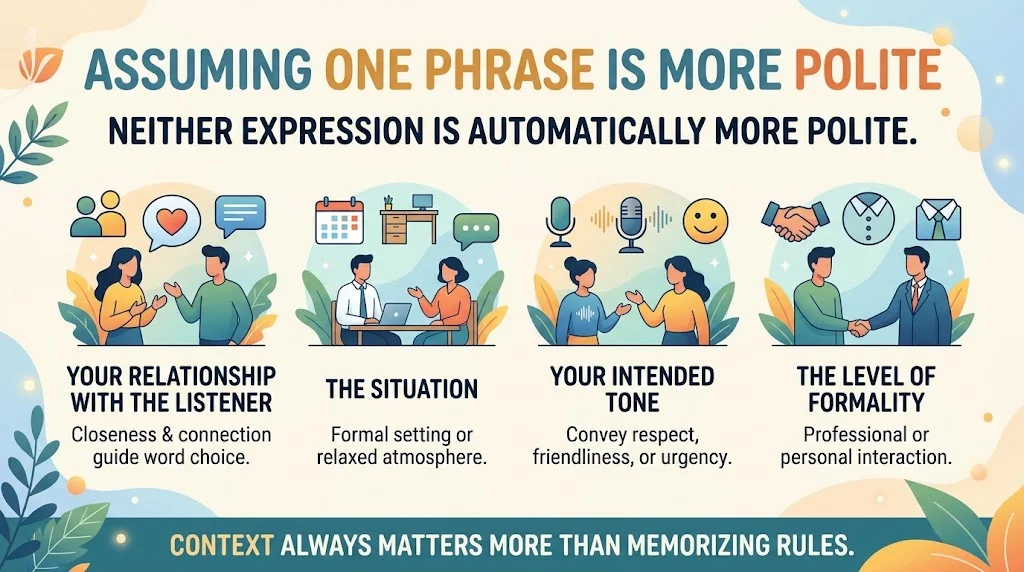
Assuming One Phrase Is More Polite
Neither expression is automatically more polite.
The right choice depends on:
- Your relationship with the listener
- The situation
- Your intended tone
- The level of formality
Context always matters more than memorizing rules.
Better Alternatives Depending on the Situation
English offers many ways to express appreciation.
Some sound formal, while others feel relaxed and conversational.
Professional Alternatives
| Expression | Best Situation |
| Thank you. | Universal |
| Thank you very much. | Business communication |
| Many thanks. | Professional emails |
| Much appreciated. | Workplace conversations |
| I sincerely appreciate your help. | Formal letters |
| Thank you for your assistance. | Customer service |
| Thank you for your time. | Interviews |
| I’m grateful for your support. | Professional relationships |
Casual Alternatives
| Expression | Tone |
| Thanks so much! | Warm |
| Thanks a lot! | Friendly |
| I really appreciate it. | Genuine |
| You’re amazing—thank you! | Enthusiastic |
| Thanks a ton! | Informal |
| I can’t thank you enough. | Deep appreciation |
| You’re the best! | Very casual |
| Thanks for everything. | Personal |
Each alternative carries a slightly different emotional weight.
Choosing the right one helps your gratitude sound authentic.
Which One Should You Use?
If you’re still unsure, this quick guide can help.
| Situation | Best Choice | Why |
| Job interview | Thank you very much | Professional |
| Business meeting | Thank you very much | Respectful |
| Customer support | Thank you very much | Polite |
| University professor | Thank you very much | Formal |
| Boss | Thank you very much | Professional |
| Close coworker | Thank you so much | Friendly |
| Best friend | Thank you so much | Personal |
| Family member | Thank you so much | Warm |
| Birthday gift | Thank you so much | Emotional |
| Wedding gift | Thank you so much | Heartfelt |
| Text message | Thanks so much | Natural |
| Social media comment | Thanks so much | Conversational |
Is One Phrase More Common Than the Other?
Language trends change over time.
Today, “thank you so much” appears more frequently in everyday spoken English because people generally prefer friendly, conversational language.
However, “thank you very much” continues to dominate in:
- Business communication
- Customer service
- Public announcements
- Professional speeches
- Academic writing
- Official correspondence
Neither expression is disappearing.
Instead, each serves a different purpose.
Real-World Case Studies
Case Study: Following Up After an Interview
Emily interviewed for a marketing position.
She ended her email with:
Thank you very much for taking the time to speak with me today.
The hiring manager later commented that her message sounded professional and thoughtful.
Case Study: Thanking a Friend
James received unexpected help while moving apartments.
His text read:
Thank you so much! I honestly couldn’t have done it without you.
The message sounded sincere because it matched the emotional situation.
Case Study: Customer Appreciation
A hotel manager responded to a guest review by writing:
Thank you very much for your wonderful feedback. We hope to welcome you again soon.
The professional wording reflected the hotel’s brand image.
What Native Speakers Usually Say
Here’s a quick overview.
| Situation | What Native Speakers Often Say |
| Texting | Thanks so much! |
| Business email | Thank you very much. |
| Gift | Thank you so much! |
| Interview | Thank you very much. |
| Family | Thanks so much! |
| Restaurant | Thank you very much. |
| Social media | Thanks so much! |
| Wedding card | Thank you so much. |
One interesting pattern stands out.
As communication becomes more personal, speakers tend to choose “so much.”
As communication becomes more professional, they often prefer “very much.”
FAQs
1. Is “Thank You Very Much” more formal than “Thank You So Much”?
Generally, yes. “Thank you very much” can sound slightly more formal, polished, or restrained. You can use it comfortably in professional emails, customer service, workplace conversations, and other formal situations. However, “thank you so much” is also perfectly acceptable in many professional settings when you want to sound warmer or more enthusiastic.
2. Is “Thank You So Much” more sincere than “Thank You Very Much”?
Not necessarily. Both expressions can communicate genuine gratitude. The difference usually comes from tone rather than sincerity. “Thank you so much” often adds emotional warmth or enthusiasm, while “thank you very much” can sound more measured and courteous.
3. Can I use “Thank You Very Much” in a professional email?
Absolutely. “Thank you very much” works well in business communication and formal writing. For example, you might write, “Thank you very much for your prompt response.” It sounds respectful without becoming overly emotional.
4. Can I say “Thank You So Much” in formal writing?
Yes. “Thank you so much” isn’t grammatically incorrect or inherently informal. It simply tends to sound more friendly and expressive. In a highly formal document, however, “thank you very much” or “I greatly appreciate your assistance” may fit the tone better.
5. Which is better: “Thank You Very Much” or “Thank You So Much”?
Neither phrase is universally better. Choose “thank you very much” when you want a more formal or composed tone. Choose “thank you so much” when you want to emphasize warmth and enthusiasm. Your relationship with the reader and the situation should guide your choice.
6. Do “Thank You Very Much” and “Thank You So Much” mean the same thing?
They have essentially the same basic meaning: you are expressing gratitude. The main distinction involves emphasis and tone. “Very much” can feel more measured, while “so much” often conveys stronger emotional enthusiasm. Both expressions are natural and widely understood in English.
Conclusion
So, which should you use: “thank you very much” or “thank you so much”? The answer depends mainly on the tone and context you want to create. Both phrases are grammatically correct and communicate appreciation, but they can leave slightly different impressions.
Use “thank you very much” when you prefer a polite, professional, or measured expression. It works particularly well in formal writing, business communication, emails, meetings, and workplace situations. Meanwhile, “thank you so much” works beautifully when you want your gratitude to sound warmer, more enthusiastic, or more personal.
Ultimately, effective English usage isn’t about following rigid rules. It’s about choosing language that matches your audience, purpose, and situation. Once you understand this subtle difference, you’ll be able to express gratitude with greater confidence, clarity, and consistency.

Emma Brooke is an English language specialist, editor, and content writer at Phrase Finesse, where she helps readers develop stronger writing and communication skills through clear, practical, and engaging content. With a passion for the English language, she specializes in simplifying grammar rules, vocabulary, spelling, punctuation, and word usage for learners at every level.
Emma has extensive experience creating educational content that is accurate, well-researched, and easy to understand. She is particularly skilled at explaining confusing word pairs, grammar concepts, idioms, sentence structure, and effective writing techniques, making complex topics approachable for students, professionals, educators, and English learners worldwide.