Have you ever paused while writing and wondered whether “Heroes or Hero’s or Heroes’” is correct? It is a common question, even for experienced writers. Small punctuation and pluralization mistakes can affect clarity, credibility, and professional communication. Understanding the difference between Heroes, Hero’s, and Heroes’ is essential for accurate English usage, polished grammar, and effective formal writing.
In today’s digital world, clear language matters more than ever. Whether you are creating content about scheduling, time management, online booking, business communication, broadcasting, meetings, or a calendar system, correct grammar helps your message stay professional and easy to understand. Consistent writing also supports better readability, improves user experience, and strengthens overall writing consistency across websites, emails, reports, and marketing materials.
This article breaks down the meaning and proper usage of Heroes, Hero’s, and Heroes’ with simple explanations and practical examples. You will learn when to use each form, how possessives and plurals work, and how to avoid common mistakes in project management documents, workplace communication, academic writing, and everyday content. By the end, you will have the confidence to use these terms correctly in any professional or personal writing situation.
Quick Answer
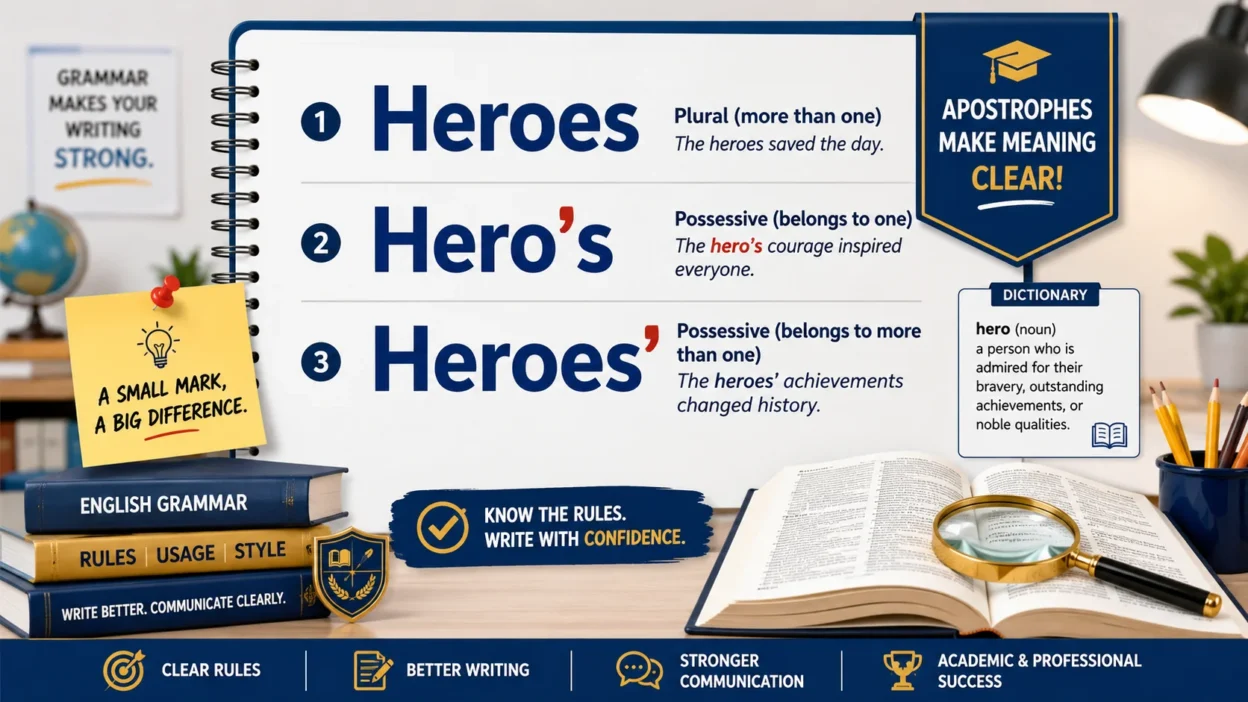
Heroes is the plural form of hero. Hero’s shows that something belongs to one hero, while Heroes’ shows that something belongs to multiple heroes. The easiest way to remember the difference is that apostrophes indicate possession, not plurality.
Meaning
Here’s the short version.
| Word | Meaning | Example |
| Heroes | More than one hero | The heroes saved the city. |
| Hero’s | Something belongs to one hero | The hero’s shield was damaged. |
| Heroes’ | Something belongs to multiple heroes | The heroes’ shields were damaged. |
If you’re in a hurry, remember this:
- Heroes = plural
- Hero’s = singular possessive
- Heroes’ = plural possessive
Everything else builds on these three simple rules.
Understanding Why These Words Cause Confusion
English has a habit of making simple things look complicated.
The problem begins because apostrophes perform several jobs. They show possession. They also appear in contractions. Meanwhile, plural nouns usually don’t need apostrophes at all.
As a result, many people incorrectly assume that adding an apostrophe automatically creates a plural form.
Consider these examples:
❌ Hero’s are important role models.
✅ Heroes are important role models.
In the incorrect sentence, the apostrophe mistakenly turns the word into a possessive noun. The writer intended to indicate multiple heroes, not ownership.
A useful principle to remember is this:
Apostrophes generally show ownership, not plurality.
That single rule eliminates many common mistakes.
Read More: Universities or University’s or Universities’? Use Correct One!
What Does “Heroes” Mean?
The word heroes is simply the plural form of hero.
Use it whenever you’re talking about more than one hero.
Definition of Heroes
A hero is someone admired for courage, achievement, or noble qualities.
When discussing two or more heroes, the word becomes heroes.
Examples
- The heroes rescued dozens of people.
- Many heroes emerged during the crisis.
- The superheroes became modern cultural heroes.
- History remembers heroes who changed the world.
Notice that none of these examples contain an apostrophe.
That’s because no ownership exists.
The sentences merely refer to multiple heroes.
Why Does Hero Become Heroes?
Many English learners wonder why the word changes from hero to heroes rather than simply becoming heros.
English spelling follows certain pluralization patterns.
Words ending in -o sometimes form their plurals by adding -es.
Examples include:
| Singular | Plural |
| Hero | Heroes |
| Potato | Potatoes |
| Tomato | Tomatoes |
| Echo | Echoes |
| Torpedo | Torpedoes |
Because hero follows this pattern, the correct plural form is heroes.
Writing heros is considered incorrect in standard English.
Quick Fact
Not every word ending in -o follows this rule.
For example:
- Piano → Pianos
- Photo → Photos
- Radio → Radios
English occasionally likes to keep writers on their toes.
Examples of Heroes Used Correctly
Let’s look at several examples in different contexts.
In Everyday Writing
- The heroes received awards for their bravery.
- Those firefighters became local heroes overnight.
- The story focuses on unlikely heroes.
In Literature
- Ancient myths often feature heroes who face impossible challenges.
- Greek heroes frequently battled monsters and gods.
In Sports
- Championship-winning players often become heroes in their hometowns.
- Fans celebrated the team’s heroes after the final whistle.
In Business
- Some entrepreneurs become heroes to aspiring founders.
- Industry heroes often inspire innovation.
In every example above, heroes simply means more than one hero.
Nothing belongs to anyone.
No apostrophe is needed.
What Does “Hero’s” Mean?
Now let’s add ownership.
The form hero’s is the singular possessive version of hero.
This means one hero owns, controls, possesses, or is associated with something.
The Basic Formula
Hero + ‘s = Hero’s
Think of it this way:
Something belongs to one hero.
Examples
- The hero’s cape fluttered in the wind.
- The hero’s determination inspired the crowd.
- The hero’s sword gleamed under the moonlight.
- Everyone admired the hero’s courage.
In each sentence, something belongs to a single hero.
That’s why the apostrophe comes before the letter s.
How to Know When Hero’s Is Correct
A simple question can help.
Ask yourself:
“Does something belong to one hero?”
If the answer is yes, use hero’s.
Example Analysis
Sentence:
“The hero’s helmet was cracked.”
Who owns the helmet?
One hero.
Therefore, hero’s is correct.
Another example:
“The hero’s reputation grew after the battle.”
Who has the reputation?
One hero.
Again, hero’s is the correct choice.
Common Mistakes With Hero’s
Many writers misuse apostrophes when creating plural nouns.
Consider these examples.
Incorrect
- Hero’s save lives.
- Several hero’s arrived.
- The comic featured many hero’s.
Correct
- Heroes save lives.
- Several heroes arrived.
- The comic featured many heroes.
The apostrophe should disappear because ownership isn’t involved.
What Does “Heroes'” Mean?
Now let’s move to the third form.
Heroes’ is the plural possessive version.
This form shows that multiple heroes own or share something.
The Basic Formula
Heroes + ‘ = Heroes’
The apostrophe appears after the existing s because the noun is already plural.
Examples
- The heroes’ mission lasted several months.
- The heroes’ equipment required repairs.
- The heroes’ headquarters stood on a hill.
- The heroes’ sacrifices were remembered for generations.
Each example involves multiple heroes possessing something.
How to Identify Heroes’ Correctly
Ask this question:
“Does something belong to more than one hero?”
If yes, use heroes’.
Example
Sentence:
“The heroes’ uniforms were displayed in the museum.”
Who owns the uniforms?
Multiple heroes.
Therefore, heroes’ is correct.
Another example:
“The heroes’ teamwork saved the city.”
The teamwork belongs collectively to multiple heroes.
Again, the plural possessive form works perfectly.
Hero’s vs Heroes vs Heroes’: Side-by-Side Comparison
Here’s where many writers finally experience the “aha” moment.
| Word | Singular or Plural | Possessive? | Example |
| Hero | Singular | No | The hero arrived. |
| Heroes | Plural | No | The heroes arrived. |
| Hero’s | Singular | Yes | The hero’s shield broke. |
| Heroes’ | Plural | Yes | The heroes’ shields broke. |
Notice the progression.
- Hero = one hero
- Heroes = multiple heroes
- Hero’s = one hero owns something
- Heroes’ = multiple heroes own something
Once you understand this sequence, the confusion largely disappears.
The Grammar Rule Behind Possessives
English possessives follow a predictable system.
Singular Possessive Rule
For most singular nouns:
Add apostrophe + s.
Examples:
- Hero’s
- Teacher’s
- Doctor’s
- Writer’s
- Student’s
Examples
- The teacher’s lesson was engaging.
- The doctor’s advice proved valuable.
- The student’s essay received praise.
The same rule creates hero’s.
The Plural Possessive Rule
When a plural noun already ends in s, add only an apostrophe.
Examples:
| Plural Noun | Possessive Form |
| Heroes | Heroes’ |
| Teachers | Teachers’ |
| Doctors | Doctors’ |
| Writers | Writers’ |
| Students | Students’ |
Examples in sentences:
- The teachers’ lounge was renovated.
- The doctors’ conference lasted three days.
- The heroes’ achievements became legendary.
Irregular Plural Possessives
Some plural nouns don’t end in s.
These require apostrophe + s.
Examples include:
| Singular | Plural | Possessive |
| Child | Children | Children’s |
| Man | Men | Men’s |
| Woman | Women | Women’s |
| Person | People | People’s |
Examples:
- Children’s books filled the shelves.
- Men’s clothing occupied the second floor.
- Women’s achievements deserve recognition.
This rule differs from heroes’ because heroes already ends with s.
Real-World Examples You Can Learn From
Let’s examine practical examples.
Correct Use of Heroes
“The heroes rushed into the burning building.”
Meaning:
Several heroes performed an action.
No ownership exists.
Correct Use of Hero’s
“The hero’s badge reflected the sunlight.”
Meaning:
One hero owns the badge.
Correct Use of Heroes’
“The heroes’ badges reflected the sunlight.”
Meaning:
Several heroes own several badges.
A tiny apostrophe placement creates a major difference in meaning.
A Quick Case Study
Imagine a newspaper covering a rescue operation.
Version A
“The heroes received medals.”
Meaning:
Several rescuers received medals.
Version B
“The hero’s medal was displayed.”
Meaning:
One rescuer owns one medal.
Version C
“The heroes’ medals were displayed.”
Meaning:
Several rescuers own multiple medals.
The same root word communicates three distinct ideas.
That’s why proper apostrophe placement matters
Similar Words That Follow the Same Pattern
The hero example isn’t unique.
Many nouns follow identical grammatical rules.
| Singular | Plural | Singular Possessive | Plural Possessive |
| Hero | Heroes | Hero’s | Heroes’ |
| Echo | Echoes | Echo’s | Echoes’ |
| Tomato | Tomatoes | Tomato’s | Tomatoes’ |
| Potato | Potatoes | Potato’s | Potatoes’ |
| Torpedo | Torpedoes | Torpedo’s | Torpedoes’ |
Once you master hero, you automatically understand dozens of similar words.
A Simple Memory Trick That Actually Works
Many grammar rules feel abstract.
This memory trick keeps things simple.
Remember This Phrase
Before the S means one owner. After the S means many owners.
Examples:
- Hero’s = apostrophe before S = one hero owns something
- Heroes’ = apostrophe after S = multiple heroes own something
Another useful shortcut:
No Apostrophe = Just More Than One
- Heroes = multiple heroes
Apostrophe Before S = One Owner
- Hero’s shield
Apostrophe After S = Multiple Owners
- Heroes’ shields
This quick framework solves most apostrophe questions in seconds.
Mini Quiz: Test Your Understanding
Choose the correct word.
Question One
The _____ courage inspired everyone.
A. Heroes
B. Hero’s
C. Heroes’
Answer: Hero’s
One hero owns the courage.
Question Two
Several _____ arrived during the emergency.
A. Heroes
B. Hero’s
C. Heroes’
Answer: Heroes
Simple plural noun.
Question Three
The _____ uniforms were cleaned after the ceremony.
A. Heroes
B. Hero’s
C. Heroes’
Answer: Heroes’
Multiple heroes own the uniforms.
Question Four
The _____ cape billowed dramatically.
A. Heroes
B. Hero’s
C. Heroes’
Answer: Hero’s
One hero owns the cape.
Question Five
The comic featured dozens of _____.
A. Heroes
B. Hero’s
C. Heroes’
Answer: Heroes
Plural form only.
The Most Common Apostrophe Mistake Writers Make
Many grammar experts call it the greengrocer’s apostrophe.
This mistake occurs when writers add apostrophes to ordinary plurals.
Examples:
❌ Apple’s for sale
❌ Banana’s available
❌ Hero’s save lives
Correct versions:
✅ Apples for sale
✅ Bananas available
✅ Heroes save lives
The lesson remains consistent:
Plural nouns rarely require apostrophes.
Ownership requires apostrophes.
Simple quantity does not.
Quick Reference Chart
Save this chart whenever you need a fast answer.
| If You Mean… | Use |
| One hero | Hero |
| More than one hero | Heroes |
| Something belongs to one hero | Hero’s |
| Something belongs to multiple heroes | Heroes’ |
This table solves nearly every hero-related grammar question.
My Personal Experience as an English Language Specialist
As an English language specialist, I have noticed that apostrophe errors are among the most common grammar mistakes writers make. The confusion between “Heroes,” “Hero’s,” and “Heroes'” appears frequently in blog posts, academic papers, business emails, and even professional marketing content. Many writers mistakenly add an apostrophe when they simply want to create a plural noun, which can unintentionally change the meaning of an entire sentence.
Over the years, I have taught students, content creators, and professionals that the key to mastering these forms is understanding ownership. Whenever I encounter a word like “Hero’s” or “Heroes’,” I immediately ask a simple question: “Who owns what?” If nothing belongs to anyone, the correct choice is usually the plural form “Heroes.” This straightforward approach has helped countless writers improve their grammar accuracy and confidence.
In my experience, the most effective way to avoid apostrophe mistakes is to focus on meaning before punctuation. Once writers understand whether they are referring to one hero, many heroes, or ownership, choosing between “Heroes,” “Hero’s,” and “Heroes'” becomes surprisingly simple. Mastering this small grammar rule can significantly improve clarity, professionalism, and credibility in any form of writing.
FAQs
1. What is the difference between Heroes, Hero’s, and Heroes’?
Heroes is the plural form of hero and refers to more than one hero. Hero’s is the singular possessive form and shows that something belongs to one hero. Heroes’ is the plural possessive form and indicates that something belongs to multiple heroes.
2. Is Hero’s grammatically correct?
Yes, Hero’s is grammatically correct when showing possession. For example, “The hero’s courage inspired everyone.” However, it should not be used as a plural form of hero.
3. When should I use Heroes’ with an apostrophe after the “s”?
Use Heroes’ when something belongs to more than one hero. For example, “The heroes’ achievements were celebrated across the country.”
4. Why do people confuse Heroes and Hero’s?
Many writers mistakenly add an apostrophe when creating a plural noun. In English grammar, most plural nouns do not require an apostrophe. Heroes is simply the plural form, while Hero’s shows possession.
5. Can I use Heroes in professional and formal writing?
Absolutely. Heroes is the correct plural form and is widely used in formal writing, business communication, academic content, and everyday English. Using the correct form improves grammar accuracy and writing consistency.
6. How can I remember the difference between Heroes, Hero’s, and Heroes’?
A simple rule is to look for ownership. If there is no ownership, use Heroes. If one hero owns something, use Hero’s. If multiple heroes own something, use Heroes’. This rule helps prevent common grammar mistakes.
Conclusion
Understanding the difference between Heroes, Hero’s, and Heroes’ is an important part of mastering English grammar and improving writing accuracy. While these words may look similar, each serves a distinct purpose. Heroes refers to more than one hero, Hero’s shows possession by a single hero, and Heroes’ indicates possession by multiple heroes.
Using the correct form strengthens formal writing, enhances business communication, and ensures greater consistency in professional, academic, and everyday content. Whether you are drafting reports, creating website content, managing project management documents, or writing emails related to scheduling, meetings, and time management, proper grammar helps your message remain clear and credible. By applying the simple rules explained in this guide, you can confidently choose the correct form every time and avoid one of the most common punctuation mistakes in English.

Mia Rose is an English language specialist and editorial writer at Phrase Finesse, where she helps readers master grammar, vocabulary, spelling, and effective communication. Passionate about making English simple and practical, she creates well-researched, reader-friendly content that explains complex language concepts in a clear and engaging way.
With extensive experience in English language education, content writing, and editorial review, Mia specializes in grammar, punctuation, word choice, idioms, confusing word pairs, and writing style. Her articles are carefully researched, fact-checked, and designed to help students, professionals, writers, and English learners build confidence in both written and spoken English.