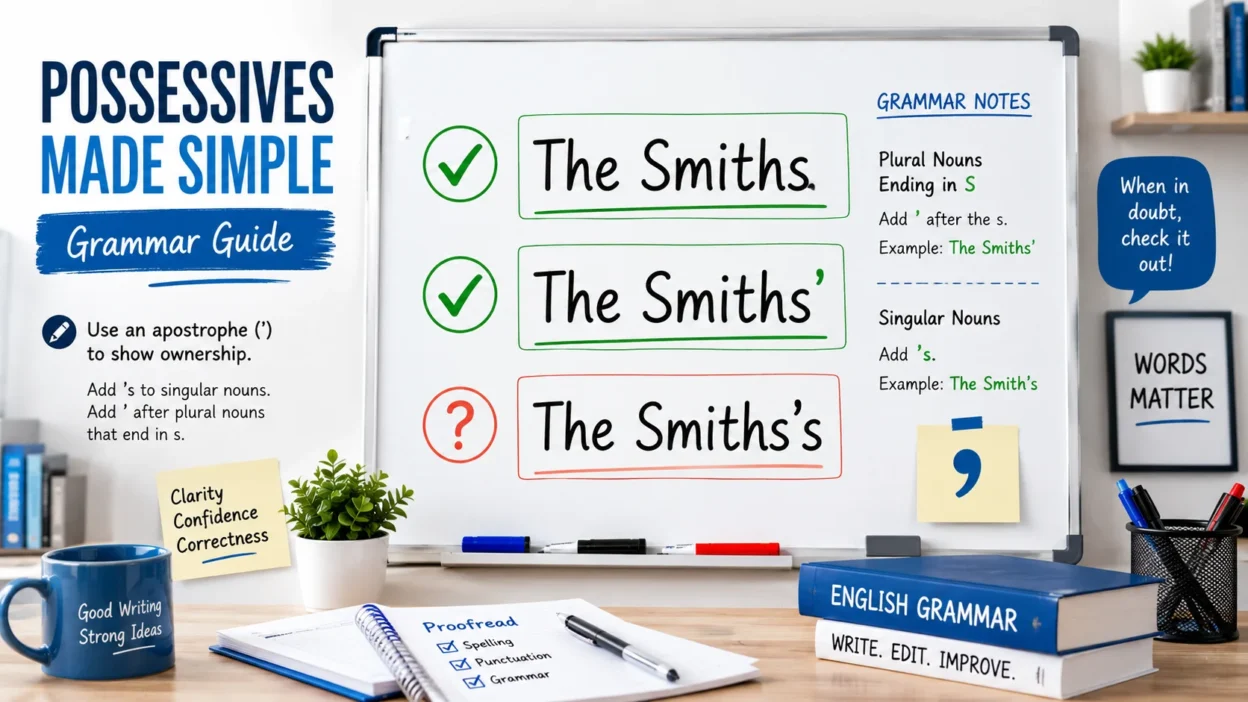
Have you ever paused while writing a family name and wondered, “The Smiths Or The Smiths’ Or The Smiths’s?” It is a surprisingly common question in English usage, especially when writing holiday cards, invitations, social media posts, or official documents. Understanding the difference between these forms is essential for accurate grammar, clear communication, and maintaining consistency in both personal and professional writing.
Many writers struggle to determine when a family name should be plural, possessive, or both. The confusion often appears in formal writing, business communication, emails, announcements, and everyday correspondence. A small punctuation mark can completely change the meaning of a sentence, making it important to know the correct rules for plural nouns and possessive forms. Mastering these distinctions helps you write with confidence and avoid common grammatical mistakes.
In this guide, we will break down the differences between The Smiths, The Smiths’, and The Smiths’s using simple explanations, practical examples, and easy-to-follow grammar rules. Whether you are improving your English usage, creating professional content, or striving for greater consistency in your writing, this article will help you choose the correct form every time. By the end, you will understand exactly when each version is appropriate and how to apply it correctly in real-world situations.
Quick Answer: The Smiths, The Smiths’, or The Smiths’s?
Here’s the short version:
| Form | Meaning | Example |
| The Smiths | More than one member of the Smith family | The Smiths live next door. |
| The Smiths’ | Something belongs to the Smith family | The Smiths’ house is beautiful. |
| The Smiths’s | Usually incorrect when referring to the whole Smith family | Rarely appropriate in this context. |
Most of the confusion comes from mixing up plural forms and possessive forms.
Before deciding which version to use, ask yourself a simple question:
Are you talking about the family itself or something that belongs to the family?
The answer determines the correct spelling.
Understanding the Difference Between Plural and Possessive Nouns
Many grammar mistakes happen because plural and possessive nouns look similar.
However, they serve completely different functions.
A Plural Noun
A plural noun refers to more than one person, place, thing, or idea.
Examples:
- Dog → Dogs
- Teacher → Teachers
- Smith → Smiths
When talking about the entire Smith family, Smiths is simply the plural form.
Example:
The Smiths are hosting a barbecue this weekend.
Nothing belongs to anyone here. You’re merely referring to multiple members of the Smith family.
A Possessive Noun
A possessive noun shows ownership.
Examples:
- The dog’s leash
- The teacher’s classroom
- The Smiths’ backyard
The apostrophe indicates that something belongs to someone.
This distinction forms the foundation of every rule discussed below.
When to Use “The Smiths”
The Smiths is the correct form when you’re referring to the family as a group.
Think of it as the plural version of Smith.
Examples
- The Smiths moved to Texas last year.
- The Smiths enjoy traveling together.
- We had dinner with the Smiths.
- The Smiths are celebrating their anniversary.
Notice something important.
There is no apostrophe.
You’re not showing ownership. You’re simply naming a family consisting of multiple people who share the surname Smith.
Common Uses
You typically use The Smiths in:
- Family introductions
- Holiday cards
- Wedding invitations
- Address labels
- Neighborhood conversations
Examples:
- Merry Christmas from the Smiths!
- Welcome, The Smiths!
- We visited the Smiths over the weekend.
Whenever you’re talking about the family itself, use The Smiths.
When to Use “The Smiths’”
The Smiths’ is the possessive form of the plural noun Smiths.
This means something belongs to the Smith family collectively.
The Rule
First make the noun plural:
- Smith → Smiths
Then add an apostrophe:
- Smiths → Smiths’
Because the word already ends in s, you place the apostrophe after the final s.
Examples
- The Smiths’ home was recently renovated.
- The Smiths’ vacation photos looked amazing.
- The Smiths’ dog loves visitors.
- The Smiths’ garden won first place.
In each sentence, something belongs to the entire Smith family.
Visual Breakdown
| Family | Ownership |
| The Smiths | The Smiths’ house |
| The Johnsons | The Johnsons’ car |
| The Williamses | The Williamses’ boat |
This pattern remains consistent regardless of the family name.
Why “The Smiths’s” Is Usually Incorrect
Many people assume that every possessive noun requires an apostrophe followed by s.
That isn’t always true.
When a plural noun already ends in s, standard grammar rules typically require only an apostrophe.
Incorrect
- The Smiths’s house
- The Smiths’s dog
- The Smiths’s vacation
Correct
- The Smiths’ house
- The Smiths’ dog
- The Smiths’ vacation
The reason is simple.
The word Smiths already ends with an s because it’s plural.
Adding another s after the apostrophe creates an awkward and unnecessary construction.
The One Situation Where “Smith’s” Is Correct
A different rule applies when referring to a single person named Smith.
Examples
- Mr. Smith’s office
- John Smith’s car
- Sarah Smith’s laptop
- Smith’s presentation
Here, only one individual owns the object.
The possessive form becomes:
Smith + ’s = Smith’s
Comparison Table
| Meaning | Correct Form |
| One person named Smith | Smith’s |
| Entire Smith family | Smiths |
| Something owned by the Smith family | Smiths’ |
This distinction eliminates much of the confusion.
Real-World Examples of Correct Usage
Let’s examine situations people encounter every day.
Holiday Cards
Correct:
Happy Holidays from the Smiths!
Incorrect:
Happy Holidays from the Smith’s!
Why?
You’re identifying the family, not showing ownership.
Family Mailbox Signs
Correct:
The Smiths
Incorrect:
The Smith’s
A mailbox displays the family’s name.
Ownership isn’t the focus.
Family Property
Correct:
The Smiths’ lake house
Correct:
The Smiths’ driveway
Correct:
The Smiths’ vacation cabin
These items belong to the family collectively.
Neighborhood Conversation
Correct:
The Smiths moved in last month.
Correct:
The Smiths’ new fence looks great.
The first sentence refers to the family.
The second refers to something they own.
Read More: Heroes or Hero’s or Heroes’? Correct Possessive Explained!
The Grammar Rule Behind Family Names
English follows a straightforward process when creating possessives from family names.
Step 1: Make the Name Plural
Smith → Smiths
Jones → Joneses
Williams → Williamses
Brown → Browns
Step 2: Add Possession If Needed
Smiths → Smiths’
Joneses → Joneses’
Williamses → Williamses’
Browns → Browns’
That’s it.
The process remains consistent across most surnames.
Family Names That End in S
Names ending in s often create the most confusion.
Consider these examples:
- Jones
- Williams
- Harris
- Adams
- Brooks
Many writers aren’t sure whether they should add an apostrophe, apostrophe-s, or something else entirely.
Correct Plural Forms
| Singular Name | Plural Family Name |
| Jones | Joneses |
| Williams | Williamses |
| Harris | Harrises |
| Adams | Adamses |
| Brooks | Brookses |
Correct Possessive Forms
| Family Name | Possessive Form |
| Joneses | Joneses’ |
| Williamses | Williamses’ |
| Harrises | Harrises’ |
| Adamses | Adamses’ |
| Brookses | Brookses’ |
The same principle used for The Smiths’ applies here.
AP Style vs Chicago Style: Is There a Difference?
Different style guides occasionally approach possessives differently.
Fortunately, family possessives remain largely consistent.
AP Style
AP Style generally recommends:
- Singular noun: add ’s
- Plural noun ending in s: add apostrophe only
Examples:
- Smith’s report
- The Smiths’ house
Chicago Manual of Style
Chicago reaches the same conclusion for plural possessives.
Examples:
- The Smiths’ property
- The Joneses’ car
As a result, you rarely encounter disagreement when writing about family ownership.
Common Mistakes People Make
Certain errors appear repeatedly in emails, invitations, social media posts, and signage.
Mistake #1: Using an Apostrophe for Plurals
Incorrect:
The Smith’s are coming over tonight.
Correct:
The Smiths are coming over tonight.
An apostrophe never creates a plural noun.
Mistake #2: Adding Extra Letters
Incorrect:
The Smiths’s dog escaped.
Correct:
The Smiths’ dog escaped.
The plural already ends in s.
No additional s is needed.
Mistake #3: Mislabeling Holiday Cards
Incorrect:
Merry Christmas from the Smith’s
Correct:
Merry Christmas from the Smiths
This is one of the most common grammar mistakes seen every holiday season.
Mistake #4: Mixing Singular and Plural Possession
Incorrect:
The Smith’s house
when referring to the entire family.
Correct:
The Smiths’ house
The family owns the house collectively.
Easy Memory Trick
When you’re unsure which form to use, apply this simple test.
Ask Yourself:
Does something belong to the family?
If the answer is no:
Use:
The Smiths
Example:
The Smiths are visiting us.
If the answer is yes:
Use:
The Smiths’
Example:
The Smiths’ car is parked outside.
This quick check solves most possessive problems instantly.
Examples in Complete Sentences
The following examples demonstrate proper usage in natural writing.
Using “The Smiths”
- The Smiths hosted a graduation party.
- The Smiths adopted a rescue dog.
- Everyone enjoys spending time with the Smiths.
- The Smiths recently renovated their kitchen.
Using “The Smiths’”
- The Smiths’ backyard includes a swimming pool.
- The Smiths’ children attend the local school.
- The Smiths’ family business has operated for decades.
- The Smiths’ vacation plans changed unexpectedly.
Using “Smith’s”
- Mr. Smith’s briefcase remained in the office.
- John Smith’s proposal received approval.
- Smith’s report impressed the board members.
A Practical Case Study
Imagine a family named Smith ordering a custom wooden sign.
The sign company asks what wording should appear.
Option A
The Smith’s
Incorrect.
This creates a possessive meaning rather than identifying the family.
Option B
The Smiths
Correct.
The sign identifies the household.
Option C
The Smiths’ Home
Also correct.
Here, the sign indicates ownership of the home.
Understanding this distinction helps avoid costly engraving and printing mistakes.
FAQs
1. What is the difference between The Smiths, The Smiths’, and The Smiths’s?
The Smiths is the plural form and refers to the entire Smith family. The Smiths’ is the plural possessive form and shows that something belongs to the Smith family. The Smiths’s is generally considered incorrect in standard English because the plural possessive of Smiths is formed by adding only an apostrophe after the final s.
2. When should I use The Smiths?
Use The Smiths when you are simply referring to more than one member of the Smith family. For example, “The Smiths are hosting a dinner party this weekend.” No ownership or possession is implied in this form.
3. Is The Smiths’ house grammatically correct?
Yes. The Smiths’ house is correct because the house belongs to the entire Smith family. The apostrophe placed after the final s indicates plural possession.
4. Why do people write The Smiths’s?
Many people assume that every possessive noun requires ’s. However, since Smiths is already a plural noun ending in s, standard grammar rules require only an apostrophe at the end. Therefore, The Smiths’ is the correct plural possessive form.
5. How do I address a card to the Smith family?
If you are addressing a card to the family, write The Smiths. For example, “Happy Holidays from The Smiths.” If you are referring to something that belongs to them, use The Smiths’, such as “Welcome to The Smiths’ home.”
6. Does the rule apply to other family names?
Yes. The same rule applies to other surnames. For example, The Johnsons becomes The Johnsons’, The Williamses becomes The Williamses’, and The Harrises becomes The Harrises’ when showing possession.
Conclusion
Understanding the difference between The Smiths, The Smiths’, and The Smiths’s can eliminate one of the most common punctuation mistakes in English usage. The Smiths refers to the family as a group, while The Smiths’ shows that something belongs to that group. In standard grammar and formal writing, The Smiths’s is generally not the correct form when referring to the possessions of the entire Smith family.
By learning these simple rules and applying them consistently, you can improve clarity, maintain writing consistency, and communicate more professionally. Whether you are writing invitations, family announcements, emails, or official documents, choosing the correct form ensures your writing remains polished, accurate, and easy to understand.

Alyan Ashraf is an English language writer and editor at Phrase Finesse, where he specializes in grammar, vocabulary, spelling, word usage, and clear communication. Passionate about the English language, he creates practical, research-backed content that helps readers avoid common mistakes and write with greater accuracy and confidence.
Known for his clear writing style and attention to detail, Alyan simplifies complex language topics into easy-to-understand guides filled with real-world examples and actionable insights. His work covers confusing word pairs, grammar rules, idioms, punctuation, and everyday English usage, making learning both accessible and engaging for students, professionals, writers, and non-native English speakers.
Every article Alyan writes is carefully researched, fact-checked, and designed to meet high editorial standards. His goal is to help readers strengthen their English skills, expand their vocabulary, and communicate more effectively in academic, professional, and everyday settings.
Through Phrase Finesse, Alyan is committed to publishing trusted language resources that make mastering English simpler, clearer, and more enjoyable for learners around the world