Have you ever paused while writing an email, report, or presentation and wondered whether “By Contrast” or “In Contrast” is the better choice? The distinction may seem minor, but understanding By Contrast vs. In Contrast: Difference Explained can improve your grammar, strengthen your English usage, and make your writing sound more natural.
These expressions often appear in formal writing, academic work, and professional communication, where clarity and consistency matter.
Many writers use these phrases interchangeably, yet they serve slightly different purposes depending on the sentence structure and intended emphasis. Whether you are preparing documents for business communication, managing updates in project management, discussing deadlines in scheduling and time management, or explaining differences in meetings, choosing the right expression helps convey your message more effectively.
Even industries such as broadcasting, online booking, and calendar management rely on precise language to avoid confusion.
In this guide, you’ll learn the exact difference between “by contrast” and “in contrast,” when each phrase should be used, and the common mistakes to avoid. We’ll break down the grammar rules, explore real-world examples, compare their usage in different contexts, and provide practical tips that will help you write with greater confidence, accuracy, and professionalism.
Quick Answer:
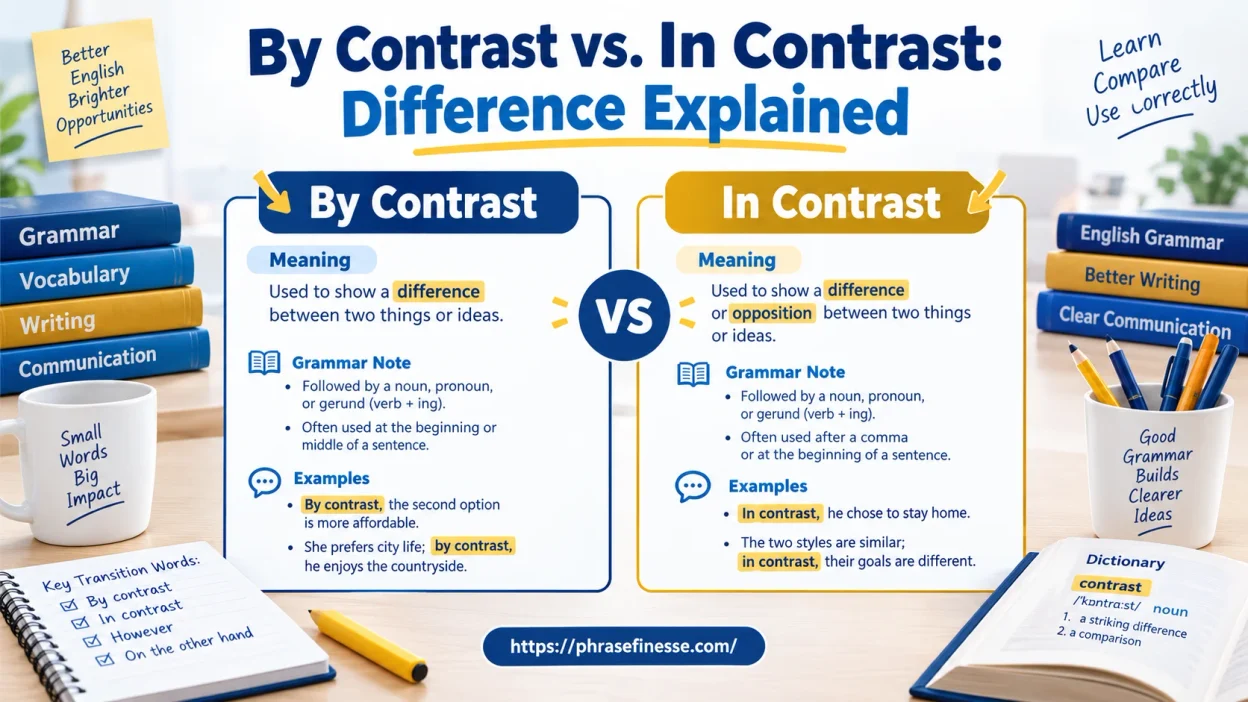
Both by contrast and in contrast are transitional expressions used to highlight differences between two ideas, situations, people, or results.
However, there is a subtle distinction:
| Phrase | Primary Function | Typical Use |
| By Contrast | Emphasizes a direct comparison between two statements | Highlights a specific difference |
| In Contrast | Introduces a contrasting idea or viewpoint | Connects contrasting information smoothly |
| In Contrast To | Compares something directly with a noun or noun phrase | Followed by nouns rather than complete clauses |
Quick Rule
- Use by contrast when emphasizing a specific difference.
- Use in contrast when introducing a contrasting statement.
- Use in contrast to before a noun or noun phrase.
For example:
The first software package requires extensive training. By contrast, the second package can be learned in a few hours.
The first software package requires extensive training. In contrast, the second package is user-friendly.
In contrast to older software systems, the new platform is cloud-based.
All three are correct, but each serves a slightly different purpose.
What Does “By Contrast” Mean?
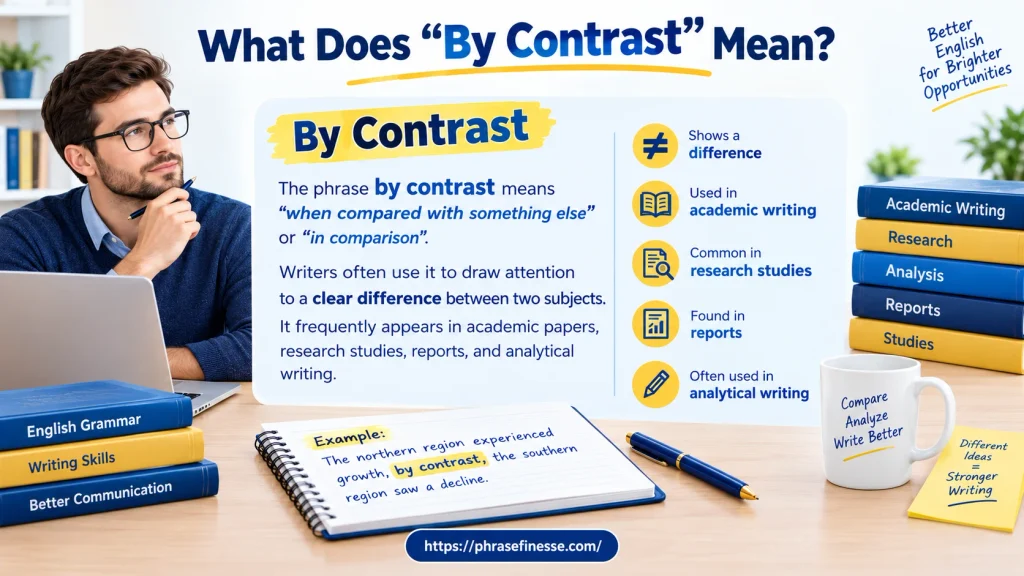
The phrase by contrast means when compared with something else or in comparison.
Writers often use it to draw attention to a clear difference between two subjects. It frequently appears in academic papers, research studies, reports, and analytical writing.
Why Writers Use “By Contrast”
The phrase helps readers focus on differences that might otherwise be overlooked.
It acts almost like a spotlight.
Instead of merely stating two facts, it encourages readers to compare them.
Common Sentence Structures
By contrast, + clause
Sales increased by 18% in the first quarter. By contrast, revenue declined during the same period last year.
Statement. By contrast, statement.
Traditional newspapers rely heavily on subscriptions. By contrast, many online publications depend on advertising revenue.
Subject A vs. Subject B
The luxury model includes advanced safety features. By contrast, the budget model offers only basic protection.
Examples of “By Contrast”
Business
The startup generated profits within six months. By contrast, its competitors needed several years.
Technology
Earlier smartphones had limited storage capacity. By contrast, modern devices can store hundreds of gigabytes.
Education
Public universities often receive government funding. By contrast, private institutions rely heavily on tuition and donations.
Healthcare
The new treatment reduced symptoms significantly. By contrast, the traditional therapy produced only modest improvements.
Notice that by contrast often emphasizes a measurable or observable difference.
What Does “In Contrast” Mean?
The phrase in contrast introduces an opposing or different idea.
Although similar to by contrast, it usually functions more as a transition between thoughts rather than a direct comparison tool.
Because of this flexibility, many writers prefer in contrast in general writing.
Common Sentence Structures
In contrast, + clause
The northern region experienced severe drought. In contrast, the southern region received above-average rainfall.
Statement. In contrast, statement.
The first proposal focuses on rapid growth. In contrast, the second emphasizes long-term stability.
Examples of “In Contrast”
Workplace Communication
The previous management team prioritized cost reduction. In contrast, the current leadership focuses on innovation.
Marketing
Traditional advertising reaches a broad audience. In contrast, digital marketing allows precise targeting.
Travel
Urban destinations offer convenience and entertainment. In contrast, rural areas provide peace and natural beauty.
Finance
Some investors seek aggressive growth. In contrast, others prioritize steady income.
In each example, in contrast introduces a different perspective or situation.
The Main Difference Between “By Contrast” and “In Contrast”
The distinction between these phrases is often more about emphasis than grammar.
Comparison Table
| Feature | By Contrast | In Contrast |
| Focus | Direct comparison | General contrast |
| Tone | Analytical | Neutral |
| Academic Writing | Very common | Very common |
| Business Writing | Common | Common |
| Everyday Conversation | Less common | More common |
| Emphasis | Stronger | Slightly softer |
Think of It This Way
Imagine you’re showing two photographs.
By contrast says:
“Look specifically at how these photos differ.”
In contrast says:
“Here’s another photo that presents a different picture.”
The difference is subtle but noticeable in formal writing.
Example Pair
Company A expanded into ten new markets. By contrast, Company B reduced international operations.
This emphasizes a direct comparison.
Company A expanded into ten new markets. In contrast, Company B focused on domestic growth.
This introduces a differing approach.
Both work, but the first feels more analytical.
In Contrast To vs. By Contrast
This is where many English learners make mistakes.
“In Contrast To” Is Followed by a Noun
Examples:
In contrast to last year’s results, profits increased significantly.
In contrast to traditional classrooms, online learning offers greater flexibility.
In contrast to his brother, James enjoys public speaking.
Notice that a noun or noun phrase follows the expression.
Why “By Contrast To” Sounds Wrong
Native speakers rarely use by contrast to.
For example:
❌ By contrast to previous studies…
❌ By contrast to older systems…
These constructions are generally considered unnatural.
Instead write:
✅ In contrast to previous studies…
✅ In contrast to older systems…
Or:
✅ Previous studies produced different findings. By contrast, the current research reached a new conclusion.
Rule to Remember
| Structure | Correct? |
| In contrast to + noun | Yes |
| By contrast + clause | Yes |
| In contrast + clause | Yes |
| By contrast to + noun | No |
This single rule eliminates one of the most common grammar mistakes involving these expressions.
Examples of “By Contrast” in Different Contexts
Understanding usage becomes easier when you see real examples.
Business Examples
Small businesses often operate with limited resources. By contrast, large corporations have access to substantial capital.
The first marketing campaign generated thousands of leads. By contrast, the second campaign produced only a few hundred.
Academic Examples
Students who reviewed weekly achieved higher scores. By contrast, those who studied only before exams performed worse.
Quantitative methods focus on numerical data. By contrast, qualitative research examines experiences and perceptions.
Technology Examples
Earlier processors required significant power consumption. By contrast, modern chips deliver greater performance while using less energy.
Desktop computers prioritize power and expandability. By contrast, tablets focus on portability.
Workplace Examples
Remote employees enjoy flexible schedules. By contrast, office workers benefit from face-to-face collaboration.
Some organizations emphasize efficiency. By contrast, others prioritize creativity.
Everyday Examples
My older car averages 20 miles per gallon. By contrast, my new vehicle exceeds 40 miles per gallon.
Summer temperatures can exceed 100°F in some regions. By contrast, coastal areas remain relatively cool.
Examples of “In Contrast” in Different Contexts
Education
Traditional lectures are instructor-centered. In contrast, modern classrooms encourage active participation.
Healthcare
Some patients recover quickly after surgery. In contrast, others require extended rehabilitation.
Economics
Developed economies often experience slower population growth. In contrast, developing nations frequently grow more rapidly.
Journalism
Local officials supported the proposal. In contrast, national leaders expressed concerns.
Everyday English
Cats tend to be independent. In contrast, dogs often seek more social interaction.
Winter days are short and cold. In contrast, summer days are longer and warmer.
These examples show how naturally in contrast fits into both formal and informal writing.
Can “By Contrast” and “In Contrast” Be Used Interchangeably?
Often, yes.
In many sentences, replacing one with the other changes little beyond style and emphasis.
Example
The first apartment costs $800 per month. By contrast, the second costs $1,500.
The first apartment costs $800 per month. In contrast, the second costs $1,500.
Both are correct.
Both sound natural.
Most readers would interpret them identically.
When Either Works
- Essays
- Reports
- Articles
- News writing
- Business communication
- Academic discussions
When “By Contrast” Works Better
Use it when emphasizing a direct comparison.
Renewable energy usage increased dramatically. By contrast, fossil fuel consumption declined.
The comparison itself is the focus.
When “In Contrast” Works Better
Use it when introducing a broader opposing idea.
Some experts predict rapid growth. In contrast, others expect a recession.
The differing viewpoint is the focus.
Common Mistakes and How to Avoid Them
Even advanced English speakers occasionally misuse these phrases.
Using “By Contrast To”
This is the most frequent mistake.
Incorrect
By contrast to previous reports…
Correct
In contrast to previous reports…
Or
Previous reports suggested otherwise. By contrast, recent findings indicate a different trend.
Read More :Can You End a Sentence With “For”? Grammar Rules Explained
Forgetting the Comma
When these expressions begin a sentence, they are typically followed by a comma.
Correct
By contrast, the newer model weighs less.
In contrast, the newer model weighs less.
Incorrect
By contrast the newer model weighs less.
Using Contrast When No Difference Exists
Contrast requires opposing or differing information.
Weak Example
The room is large. In contrast, the building is large.
There is no meaningful contrast.
Better Example
The room is large. In contrast, the building’s offices are surprisingly small.
Overusing Transitional Phrases
Too many transitions make writing feel repetitive.
Repetitive
In contrast, this happened. In contrast, that happened. In contrast, another thing happened.
Better
Mix alternatives:
- However
- Conversely
- On the other hand
- Whereas
- Yet
- Nevertheless
Alternative Expressions for Showing Contrast
English offers many ways to highlight differences.
Formal Alternatives
| Expression | Typical Use |
| Conversely | Opposite result |
| However | Contradicting statement |
| Nevertheless | Unexpected continuation |
| By Comparison | Direct comparison |
| Whereas | Compare two clauses |
Informal Alternatives
| Expression | Typical Use |
| But | Simple contrast |
| Yet | Mild contradiction |
| While | Comparing ideas |
| On the Other Hand | Alternative perspective |
Examples
Conversely
Demand increased in Asia. Conversely, demand fell in Europe.
Whereas
John prefers working remotely, whereas Sarah enjoys office environments.
However
The product is expensive. However, it offers excellent value.
On the Other Hand
Buying saves money long term. On the other hand, renting requires less commitment.
Tips for Using Contrast Phrases Naturally
The best writers use transitions strategically.
Match the Phrase to the Structure
If you’re comparing complete ideas:
By contrast, profits fell.
If you’re comparing with a noun:
In contrast to last year, profits increased.
Avoid Repetition
Readers notice repeated transitions.
Instead of using in contrast five times, vary your wording.
Consider Formality
By contrast often sounds more analytical.
In contrast sounds slightly more conversational.
Prioritize Clarity
Choose whichever expression helps readers understand your point immediately.
The goal isn’t complexity.
The goal is communication.
Quick Grammar Rules Summary
| Rule | Example |
| Use “by contrast” before a contrasting statement | By contrast, the second option costs less. |
| Use “in contrast” to introduce a differing idea | In contrast, the newer model performs better. |
| Use “in contrast to” before a noun phrase | In contrast to last year, sales increased. |
| Avoid “by contrast to” | Generally incorrect. |
| Use commas after introductory phrases | In contrast, profits rose. |
Real-World Case Study: How Contrast Improves Professional Writing
Consider these two report excerpts.
Version One
Sales increased in North America. Sales declined in Europe. The company expanded into Asia. Profit margins improved.
The information is clear but disconnected.
Version Two
Sales increased in North America. By contrast, sales declined in Europe. The company expanded into Asia. In contrast, competitors reduced their international presence. As a result, profit margins improved.
The second version is easier to follow.
The relationships between ideas become obvious.
This is why professional writers, journalists, researchers, and business analysts rely heavily on contrast markers.
Expert Writing Principle
“Transitions don’t merely connect sentences; they reveal relationships between ideas.”
That principle explains why mastering phrases like by contrast and in contrast can significantly improve your writing quality.
FAQs
1. Is “by contrast” the same as “in contrast”?
Not exactly. Both phrases highlight differences, but “by contrast” is often used to compare two ideas directly, while “in contrast” introduces a contrasting statement or viewpoint. In many situations, they can be used interchangeably, but sentence structure may influence which sounds more natural.
2. Which is more common in formal writing: “by contrast” or “in contrast”?
Both are widely accepted in formal writing. However, “in contrast” tends to appear more frequently in academic papers, reports, and professional documents because it transitions smoothly between ideas and paragraphs.
3. Can I start a sentence with “by contrast”?
Yes. “By contrast” can appear at the beginning of a sentence to introduce a comparison.
Example:
- The first proposal required significant funding. By contrast, the second proposal was relatively inexpensive.
4. Do I need a comma after “in contrast”?
Usually, yes, when “in contrast” appears at the beginning of a sentence.
Example:
- In contrast, the new system reduced processing time by half.
When it appears in the middle of a sentence, punctuation depends on the sentence structure and style guide being followed.
5. Can “by contrast” and “in contrast” be used in business communication?
Absolutely. These phrases are valuable in business communication, project management, meetings, and reports because they clearly distinguish between options, results, strategies, or outcomes.
Example:
- Sales increased in the first quarter. In contrast, customer support requests declined.
6. What are some alternatives to “by contrast” and “in contrast”?
Several alternatives can express a similar meaning, including:
- On the other hand
- Conversely
- However
- Unlike
- Whereas
- Nevertheless (depending on context)
The best choice depends on the tone, formality, and relationship between the ideas being compared.
Conclusion
Understanding the difference between “by contrast” and “in contrast” can make your writing clearer, more precise, and more professional. While both expressions emphasize differences, “by contrast” typically highlights a direct comparison, whereas “in contrast” often introduces a contrasting idea or statement.
The distinction is subtle, but using the right phrase strengthens grammar, improves English usage, and enhances overall consistency.
Whether you’re writing academic papers, business reports, emails, or everyday content, mastering these contrast expressions helps you communicate ideas more effectively.
By applying the examples and guidelines discussed in this article, you can choose the most appropriate phrase with confidence and create writing that feels polished, natural, and easy to understand.

Emma Brooke is an English language specialist, editor, and content writer at Phrase Finesse, where she helps readers develop stronger writing and communication skills through clear, practical, and engaging content. With a passion for the English language, she specializes in simplifying grammar rules, vocabulary, spelling, punctuation, and word usage for learners at every level.
Emma has extensive experience creating educational content that is accurate, well-researched, and easy to understand. She is particularly skilled at explaining confusing word pairs, grammar concepts, idioms, sentence structure, and effective writing techniques, making complex topics approachable for students, professionals, educators, and English learners worldwide.