Have you ever come across the term “First Pass” Meaning & Usage (Helpful Examples) and wondered what it actually means in different contexts? The phrase appears in everything from project management and business communication to broadcasting, editing, and everyday English usage. While it may seem straightforward, its meaning can vary depending on the situation. Understanding how and when to use first pass correctly can improve clarity, strengthen communication, and help you write with greater precision.
In professional environments, the term often refers to an initial review, draft, evaluation, or attempt before further refinement. Whether you are discussing scheduling, time management, meetings, calendar planning, online booking, or workflow processes, the phrase carries a practical meaning that supports efficiency and organization. It is also widely used in formal writing, content creation, technical fields, and collaborative projects where multiple revisions are expected.
This guide explores the complete meaning, correct usage, and real-world applications of first pass, along with helpful examples that demonstrate how the phrase functions in different settings. You will learn the grammatical role of the expression, common usage patterns, and best practices for maintaining consistency in professional and academic communication. By the end, you will have a clear understanding of how to use first pass naturally and confidently in both spoken and written English.
What Does “First Pass” Mean?
At its core, first pass refers to the first review, examination, attempt, or evaluation of something.
It is rarely the final version.
Instead, it serves as an early stage in a larger process.
Simple Definition of First Pass
First Pass Definition:
A first pass is an initial review, attempt, inspection, or analysis conducted before additional revisions, improvements, or evaluations occur.
The phrase implies that more work will follow.
For example:
- A writer completes a first pass of a manuscript.
- A manager performs a first pass review of a proposal.
- A software engineer conducts a first pass analysis of code.
In every case, the task has begun but isn’t finished.
The Core Idea Behind First Pass
The concept is surprisingly simple.
Most successful work goes through multiple stages.
Rarely does anyone create something perfect on the first try.
A first pass helps people:
- Identify major problems
- Spot opportunities for improvement
- Evaluate overall quality
- Establish priorities
- Create a roadmap for future revisions
Think about painting a room.
The first coat covers the wall, but imperfections often remain visible.
The second coat improves the appearance.
The final coat creates the finished result.
A first pass works much the same way.
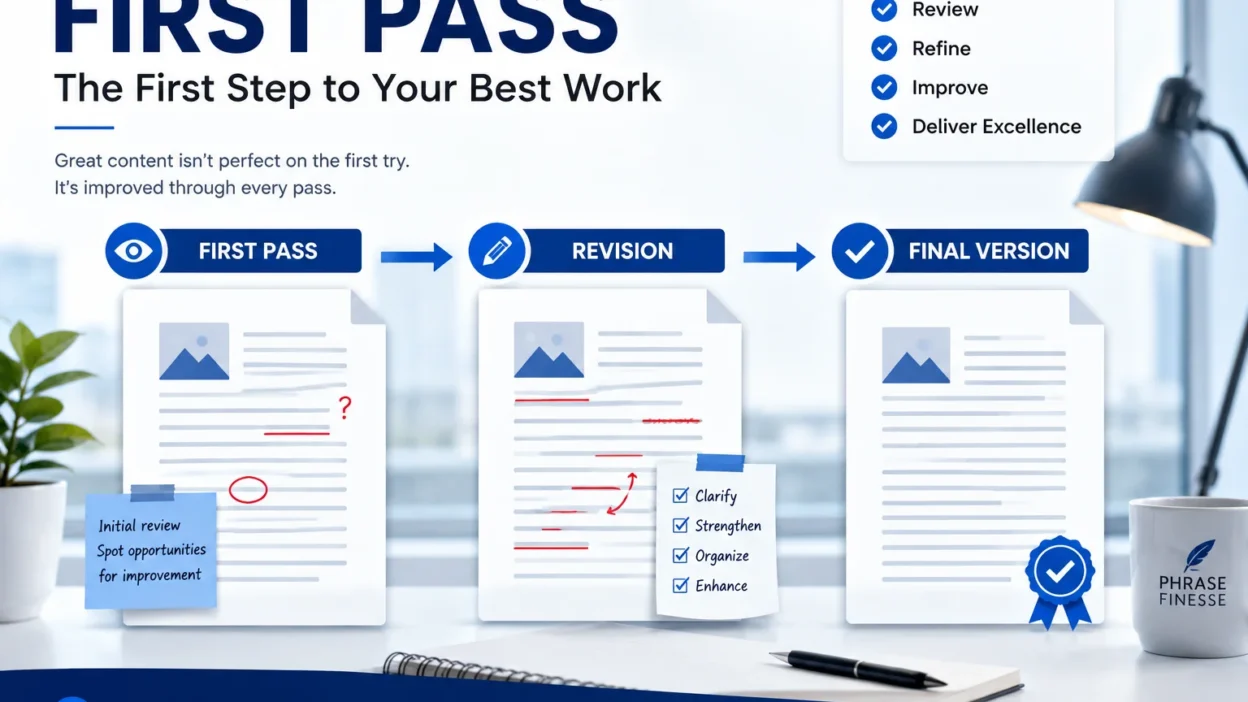
First Pass Workflow
| Stage | Purpose |
| First Pass | Initial review or attempt |
| Second Pass | Refinement and corrections |
| Third Pass | Detailed improvements |
| Final Pass | Final approval or completion |
Origin and Development of the Phrase “First Pass”
The phrase didn’t originate in writing or business.
Its roots trace back to inspection processes, engineering procedures, and manufacturing workflows.
Historically, inspectors would make a “pass” through products, machinery, or production lines to identify defects.
The first inspection became known as the first pass.
Additional inspections followed until quality standards were met.
Over time, the phrase spread into:
- Publishing
- Film production
- Software development
- Data science
- Marketing
- Education
- Project management
Today, it has become a universal business and productivity term.
Why the Phrase Became So Popular
Modern work rarely happens in a single step.
Most projects involve:
- Drafting
- Reviewing
- Revising
- Testing
- Refining
The phrase “first pass” captures this reality perfectly.
Instead of expecting perfection immediately, professionals recognize that quality emerges through iteration.
As the famous saying goes:
“Done is better than perfect.”
The first pass gets work moving.
Improvement comes afterward.
Read More: The Smiths or The Smiths’ or The Smiths’s? Correct Possessive Form
First Pass Meaning in Everyday English
Outside professional settings, people use the phrase regularly.
Everyday Conversation Examples
You might hear someone say:
- “I made a first pass through the garage and threw out the obvious junk.”
- “This is only my first pass at the budget.”
- “After my first pass through the textbook, I’ll review the difficult chapters.”
In these examples, the speaker isn’t claiming completion.
They’re describing an initial effort.
Why People Use the Expression
The phrase communicates two important ideas:
- Progress has been made.
- More work remains.
That balance makes it extremely useful.
First Pass Meaning in Writing and Editing
One of the most common uses of first pass appears in writing.
Writers rarely produce polished content on the first attempt.
Instead, they move through several editing stages.
What Happens During a First Pass Edit?
During the first pass, editors focus on big-picture issues.
They often evaluate:
- Structure
- Organization
- Flow
- Clarity
- Missing information
- Redundant sections
They usually ignore minor grammar mistakes at this stage.
Why?
Because fixing punctuation before solving structural issues wastes time.
Editing Workflow Example
| Editing Stage | Primary Focus |
| First Pass | Structure and organization |
| Second Pass | Clarity and readability |
| Third Pass | Grammar and style |
| Final Pass | Proofreading |
Example
Imagine a 5,000-word article.
A first pass editor may ask:
- Does the introduction make sense?
- Are sections organized logically?
- Is any information missing?
- Does the article answer the reader’s questions?
Only later do they worry about commas and spelling.
First Pass in Publishing
Publishing professionals rely heavily on first-pass reviews.
When editors receive manuscripts, they often perform a first pass before committing significant resources.
What Editors Look For
During a first pass review, publishers evaluate:
- Overall quality
- Market potential
- Writing style
- Reader appeal
- Subject matter expertise
Many manuscripts never move beyond this stage.
A strong first pass can determine whether a project continues.
Example
An editor might write:
“The manuscript passed the first review and shows strong commercial potential.”
That means the book survived the initial evaluation.
First Pass in Film and Video Production
Film editors use the term constantly.
Raw footage often contains hundreds of hours of recordings.
Before creating a polished film, editors perform a first pass.
What Happens During a First Pass Review?
Editors:
- Watch footage
- Identify usable scenes
- Mark technical issues
- Remove unusable clips
- Create rough sequences
This process helps organize massive amounts of content.
Example
A documentary team may spend weeks completing the first pass before beginning serious editing.
Without this step, later stages become chaotic.
Why It Matters
Film production is expensive.
A thorough first pass saves time, money, and creative energy.
First Pass Meaning in Software Development
Software teams frequently use the term during code reviews.
First Pass Code Review
A first pass review focuses on obvious issues such as:
- Syntax errors
- Logic mistakes
- Security concerns
- Structural problems
Reviewers look for major concerns before conducting deeper analysis.
Typical Software Workflow
Write Code
↓
First Pass Review
↓
Testing
↓
Bug Fixes
↓
Final Review
↓
Deployment
Benefits
A first pass helps developers:
- Catch errors early
- Reduce debugging costs
- Improve software quality
- Accelerate project timelines
First Pass Meaning in Data Analysis
Data analysts often conduct a first pass before performing advanced statistical work.
What Analysts Examine
During an initial review, analysts look for:
- Missing values
- Duplicate entries
- Outliers
- Obvious trends
- Data quality issues
This preliminary evaluation prevents larger problems later.
Example
A researcher reviewing survey data may discover:
- Missing responses
- Incorrect entries
- Formatting inconsistencies
Finding these issues early saves hours of work.
First Pass in Manufacturing and Quality Control
Manufacturing may be the industry most closely associated with first-pass evaluations.
Initial Inspection Process
Products often undergo a first pass inspection immediately after production.
Inspectors check:
- Dimensions
- Functionality
- Appearance
- Safety standards
Items that pass move forward.
Items that fail require rework.
Understanding First Pass Yield (FPY)
Manufacturers track an important metric called First Pass Yield.
FPY measures the percentage of products that pass inspection without requiring rework.
Formula
FPY = Good Units ÷ Total Units Produced
Example
| Units Produced | Units Passed | FPY |
| 1,000 | 950 | 95% |
A 95% first pass yield means 95% of products met standards immediately.
Why FPY Matters
Higher FPY results in:
- Lower costs
- Faster production
- Less waste
- Higher customer satisfaction
First Pass Meaning in Sports
Sports organizations use first-pass evaluations to improve performance.
Game Film Analysis
Coaches often conduct a first pass review shortly after games.
They identify:
- Tactical mistakes
- Strong performances
- Strategic opportunities
- Areas requiring training
Example
A soccer coach might review match footage and create notes before deeper analysis begins.
The first pass provides a broad overview.
Detailed evaluation comes later.
First Pass vs First Draft
Many people confuse these terms.
However, they describe different stages.
Comparison Table
| Feature | First Pass | First Draft |
| Purpose | Review | Creation |
| Focus | Evaluation | Production |
| Occurs After Work Exists | Yes | No |
| Requires Existing Content | Yes | Usually |
Key Difference
A first draft creates something.
A first pass reviews something.
That’s the easiest way to remember the distinction.
First Pass vs Initial Review
These terms often overlap.
However, they aren’t always identical.
Similarities
Both involve:
- Early evaluation
- Preliminary assessment
- Quality checks
Differences
A first pass often implies future rounds of review.
An initial review may stand alone.
For that reason, first pass usually suggests an ongoing process.
First Pass vs Rough Draft
Another common misunderstanding involves rough drafts.
Rough Draft
A rough draft is an unfinished version of content.
First Pass
A first pass evaluates existing content.
Example
A writer may:
- Create a rough draft.
- Perform a first pass edit.
- Conduct additional revisions.
- Complete a final version.
The two terms describe different stages.
Common Situations Where People Use “First Pass”
The phrase appears in countless professional environments.
Business
- Budget reviews
- Proposal evaluations
- Strategic planning
Education
- Essay grading
- Research reviews
- Curriculum development
Marketing
- Campaign audits
- Content reviews
- Performance analysis
Product Development
- Prototype inspections
- Feature evaluations
- User testing
Legal Work
- Contract reviews
- Compliance checks
- Document analysis
The versatility of the phrase explains its popularity.
How to Use “First Pass” Correctly in a Sentence
Here are examples from different contexts.
Professional Examples
- The finance team completed a first pass of the annual budget.
- Management conducted a first pass review of the proposal.
Writing Examples
- I finished a first pass edit of the article.
- The editor provided feedback after the first pass.
Technical Examples
- Engineers performed a first pass inspection of the prototype.
- Developers completed a first pass code review.
Academic Examples
- Researchers conducted a first pass analysis of the survey data.
- The professor completed a first pass evaluation of the essays.
Casual Examples
- This is only my first pass through the closet.
- I’ll make another pass tomorrow.
Helpful First Pass Example Sentences
Below are additional examples.
Workplace
- The report looks promising after the first pass.
- Our first pass uncovered several inconsistencies.
Writing
- The manuscript improved significantly after the first pass.
- Major revisions emerged during the first pass review.
Technology
- The first pass testing revealed performance issues.
- Engineers documented findings during the first pass.
Education
- Students completed a first pass review before submitting assignments.
- Teachers used a first pass assessment to identify learning gaps.
Daily Life
- My first pass through the attic removed three boxes of clutter.
- The first pass helped me identify what needed attention.
Synonyms for First Pass
Depending on context, several alternatives may work.
General Synonyms
- Initial review
- Preliminary review
- Early assessment
- Initial examination
- First review
- Preliminary inspection
Industry-Specific Alternatives
| Industry | Alternative Term |
| Writing | First edit |
| Manufacturing | Initial inspection |
| Research | Preliminary analysis |
| Software | Initial code review |
| Film | Rough review |
Using the right synonym depends on the situation.
When Not to Use “First Pass”
The phrase isn’t appropriate everywhere.
Finalized Work
Avoid using first pass for completed projects.
Incorrect:
This finalized contract is the first pass.
Correct:
This finalized contract has completed all review stages.
Certified Results
Official findings generally require stronger language.
Legal Conclusions
Final legal determinations are not first-pass evaluations.
The phrase implies ongoing work.
Common Mistakes When Using “First Pass”
Treating It as a Final Version
A first pass rarely represents completion.
Confusing It with First Draft
Remember:
- Draft = creation
- Pass = review
Assuming Every Industry Uses It the Same Way
Different professions apply the phrase differently.
Context matters.
Ignoring Follow-Up Steps
A first pass usually signals additional work ahead.
Without future review, the phrase loses much of its meaning.
Why Multiple Passes Produce Better Results
Human beings rarely achieve perfection instantly.
Research in productivity and quality management consistently shows that iterative review improves outcomes.
Benefits of Multiple Passes
- Fewer errors
- Better clarity
- Stronger quality control
- Improved consistency
- Greater accuracy
Real-World Examples
| Industry | Multiple-Pass Benefit |
| Publishing | Better readability |
| Software | Fewer bugs |
| Manufacturing | Higher quality |
| Film | Stronger storytelling |
| Research | More reliable findings |
The Iteration Principle
Every additional review provides an opportunity to improve.
That is why successful organizations embrace revision rather than avoid it.
Frequently Asked Questions
1. What does “first pass” mean?
First pass refers to an initial review, attempt, draft, or examination of something before additional revisions or improvements are made. It is commonly used in project management, editing, production, and professional workflows.
2. Is “first pass” a formal expression?
Yes, first pass is widely accepted in both professional and technical contexts. It frequently appears in business communication, formal writing, software development, broadcasting, and content creation to describe an early stage of work.
3. How is “first pass” used in a sentence?
Here is a simple example: “After the first pass of the report, the team identified several areas that needed improvement.” In this sentence, the phrase refers to the initial review of the report.
4. What is the difference between a first pass and a final review?
A first pass is the preliminary stage where major issues, ideas, or opportunities for improvement are identified. A final review occurs after revisions have been completed and focuses on ensuring accuracy, quality, and consistency.
5. Can “first pass” be used outside of business settings?
Absolutely. The term is used in many fields, including broadcasting, education, publishing, software testing, and everyday English usage. Any process involving multiple stages or revisions may include a first pass.
6. Why is understanding “first pass” important?
Understanding the term helps improve business communication, project management, and formal writing. It allows you to communicate workflow stages clearly and use professional language more effectively in both spoken and written English.
Conclusion
The term first pass is a practical and widely used expression that describes an initial review, attempt, or stage in a larger process. Whether you encounter it in project management, business communication, broadcasting, editing, or everyday English usage, understanding its meaning can help you communicate more accurately and professionally.
As we have explored, a first pass is rarely the final version of anything. Instead, it serves as the foundation for refinement, improvement, and better decision-making. By learning its correct meaning, usage patterns, and real-world applications, you can use the phrase with confidence while maintaining clarity and consistency in your writing and conversations.

Alyan Ashraf is an English language writer and editor at Phrase Finesse, where he specializes in grammar, vocabulary, spelling, word usage, and clear communication. Passionate about the English language, he creates practical, research-backed content that helps readers avoid common mistakes and write with greater accuracy and confidence.
Known for his clear writing style and attention to detail, Alyan simplifies complex language topics into easy-to-understand guides filled with real-world examples and actionable insights. His work covers confusing word pairs, grammar rules, idioms, punctuation, and everyday English usage, making learning both accessible and engaging for students, professionals, writers, and non-native English speakers.
Every article Alyan writes is carefully researched, fact-checked, and designed to meet high editorial standards. His goal is to help readers strengthen their English skills, expand their vocabulary, and communicate more effectively in academic, professional, and everyday settings.
Through Phrase Finesse, Alyan is committed to publishing trusted language resources that make mastering English simpler, clearer, and more enjoyable for learners around the world