Have you ever paused while writing an email and wondered whether Yours or Your’s or Yours’ is correct? It’s a surprisingly common question, especially in business communication, formal writing, and everyday messages. A misplaced apostrophe can change how your writing is perceived, making it essential to understand the correct form for clear and professional English usage.
Whether you’re drafting reports, responding to clients, managing online booking requests, or coordinating meetings, correct grammar helps build credibility. In areas like scheduling, time management, project management, and maintaining a shared calendar, small language mistakes can create confusion. Understanding the difference between yours, your’s, and yours’ improves accuracy, strengthens consistency, and supports effective communication across personal and professional settings.
In this guide, you’ll learn the grammatical rules behind each form, discover which versions are correct, and see practical examples in real-world contexts. We’ll also explore common mistakes, usage tips, and simple memory tricks to help you write with confidence. By the end, you’ll have a clear understanding of this often-confusing grammar topic and know exactly when to use Yours or Your’s or Yours’ correctly.
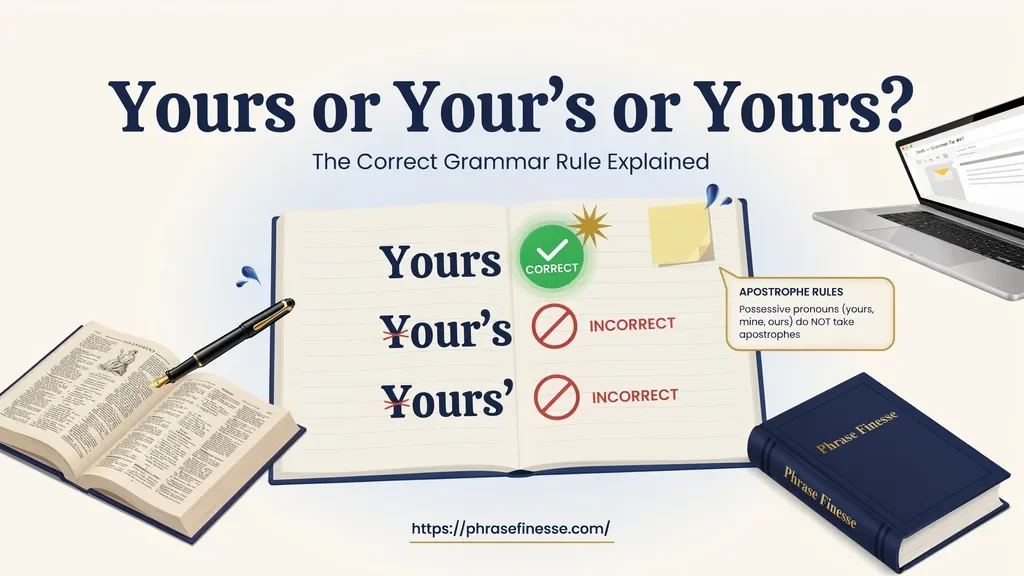
Yours or Your’s or Yours? The Quick Answer
Let’s clear up the confusion immediately.
| Word | Correct? | Meaning |
| Yours | ✅ Yes | Belonging to you |
| Your | ✅ Yes | Shows possession before a noun |
| Your’s | ❌ No | Not a correct English word |
Quick Examples
Correct:
- This book is yours.
- Is this your backpack?
- The decision is yours.
Incorrect:
- This book is your’s.
- The choice is your’s.
- That seat is your’s.
If you remember only one thing from this article, remember this:
Possessive pronouns do not use apostrophes.
Since yours is a possessive pronoun, it never needs an apostrophe.
What Does “Yours” Mean?
The word yours is a possessive pronoun.
A possessive pronoun shows ownership or possession. It replaces a noun rather than modifying one.
For example:
- This phone is yours.
- The responsibility is yours.
- The final decision is yours.
In each sentence, yours indicates ownership.
Instead of repeating the noun, English allows you to replace it with a possessive pronoun.
Consider this example:
Without a possessive pronoun:
- This laptop is your laptop.
With a possessive pronoun:
- This laptop is yours.
The second sentence sounds more natural because it avoids repetition.
Definition of “Yours”
Yours means:
Something that belongs to or is associated with you.
It functions as a stand-alone possessive form.
Examples:
- The red car is yours.
- This opportunity is yours.
- The victory is yours.
- The keys are yours.
Notice that a noun never follows yours.
This point becomes important when comparing it with your.
When to Use “Yours”
Use yours when the noun has already been mentioned or is understood from context.
Examples
- My coat is black. Yours is blue.
- Their office is larger than yours.
- The choice is yours.
- The credit belongs to you. It is yours.
In each example, yours replaces a noun phrase.
This makes writing cleaner and more efficient.
Examples of “Yours” in Everyday Sentences
Casual Conversation
- Is this pen yours?
- The last slice of pizza is yours.
- That parking spot isn’t yours.
Workplace Communication
- The report is yours to review.
- This project is yours now.
- The client account is yours.
Academic Writing
- Your interpretation differs from ours.
- The final argument is yours to develop.
- The research findings are yours to analyze.
Why “Your’s” Is Incorrect
Now let’s address the version that causes the most trouble.
Your’s is not a word in standard English grammar.
You won’t find it accepted in professional writing, academic writing, journalism, or major dictionaries.
Yet people use it frequently.
Why?
Because English apostrophes can be confusing.
The Apostrophe Mistake Explained
Many writers assume possession always requires an apostrophe.
Examples include:
- John’s book
- Sarah’s car
- The company’s office
Because these words use apostrophes to show possession, some writers incorrectly apply the same rule to your.
That leads to:
- Your’s book
- The choice is your’s
Both examples are wrong.
The rule changes when you’re dealing with possessive pronouns.
Why Possessive Pronouns Do Not Use Apostrophes
Possessive pronouns already indicate ownership.
They don’t need an apostrophe to perform that job.
Consider these examples:
| Possessive Pronoun | Correct Form |
| Mine | ✅ Mine |
| Yours | ✅ Yours |
| His | ✅ His |
| Hers | ✅ Hers |
| Ours | ✅ Ours |
| Theirs | ✅ Theirs |
| Its | ✅ Its |
Notice a pattern?
None of them contain apostrophes.
Because yours belongs to this group, it follows the same rule.
Examples of Incorrect Usage
Incorrect
- This house is your’s.
- The decision is your’s.
- That jacket is your’s.
Correct
- This house is yours.
- The decision is yours.
- That jacket is yours.
A simple apostrophe creates a grammatical error.
Understanding Your vs. Yours
One reason people struggle with this topic is that your and yours are closely related.
They both show possession.
However, they perform different jobs.
What Is “Your”?
Your is a possessive adjective.
It describes a noun.
Examples:
- Your car
- Your house
- Your idea
- Your laptop
Notice that a noun always follows your.
Think of your as a helper word.
It cannot stand alone.
Examples
- Your phone is ringing.
- Your meeting starts at noon.
- Your package has arrived.
What Is “Yours”?
Yours is a possessive pronoun.
It replaces a noun.
Examples:
- The phone is yours.
- The meeting room is yours.
- The package is yours.
Unlike your, it can stand alone.
Your vs. Yours Comparison Table
| Feature | Your | Yours |
| Part of Speech | Possessive Adjective | Possessive Pronoun |
| Requires a Noun After It | Yes | No |
| Shows Ownership | Yes | Yes |
| Can Stand Alone | No | Yes |
| Example | Your car is new. | The car is yours. |
This distinction explains almost every correct use of these words.
Grammar Rule: Why “Yours” Has No Apostrophe
Grammar often appears full of exceptions.
Fortunately, this rule is straightforward.
Possessive pronouns never use apostrophes.
That includes:
- Mine
- Yours
- His
- Hers
- Ours
- Theirs
- Its
Many grammar experts teach this as one of the easiest punctuation rules to remember.
Simple Formula
Possessive Pronoun = No Apostrophe
If the word functions as a possessive pronoun, leave the apostrophe out.
Easy Memory Trick
Try this quick test.
Ask yourself:
“Would I write mine’s, ours’s, or theirs’?”
The answer is no.
Since those forms are obviously wrong, your’s must also be wrong.
Remember:
- Mine → correct
- Yours → correct
- Ours → correct
- Theirs → correct
No apostrophes anywhere.
Examples of “Yours” Used Correctly
Learning through examples helps grammar rules become second nature.
In Everyday Conversation
- The remote is yours.
- This seat is yours.
- The last cookie is yours.
- The decision is yours.
These examples sound natural because yours replaces the noun phrase.
In Professional Emails
Professional communication frequently uses yours.
Examples:
- The final approval is yours.
- The account is now yours to manage.
- This opportunity is yours if you want it.
Business writing favors concise language.
Using yours helps avoid repetition.
In Academic Writing
Students and researchers also use possessive pronouns regularly.
Examples:
- Your conclusion differs from ours.
- The interpretation is yours.
- The findings are yours to evaluate.
Academic writing values precision and clarity.
Possessive pronouns contribute to both.
At the End of Letters
Many traditional letter closings contain yours.
Examples include:
- Yours sincerely
- Yours faithfully
- Truly yours
- Respectfully yours
These expressions have existed for centuries and remain standard in formal correspondence.
Example
Yours sincerely,
John Smith
The word remains correct because it functions as a possessive pronoun rather than a noun modifier.
Common Mistakes People Make
Understanding common errors helps prevent them.
Let’s examine the mistakes that appear most often.
Writing “Your’s” Instead of “Yours”
This is the most frequent error.
Incorrect:
- This phone is your’s.
Correct:
- This phone is yours.
The apostrophe serves no purpose.
Remove it.
Confusing “You’re” and “Yours”
Another common issue involves you’re.
Difference
| Word | Meaning |
| You’re | You are |
| Yours | Belonging to you |
Examples:
- You’re doing great.
- The success is yours.
One refers to a person.
The other refers to ownership.
Mixing Up “Your” and “Yours”
Many writers accidentally swap these forms.
Incorrect:
- Yours car is outside.
Correct:
- Your car is outside.
Why?
Because a noun follows the word.
Remember:
- Use your before nouns.
- Use yours by itself.
Overusing Apostrophes
English learners often add apostrophes unnecessarily.
Examples:
Incorrect:
- Her’s
- Their’s
- Our’s
- Your’s
Correct:
- Hers
- Theirs
- Ours
- Yours
This mistake appears so frequently that grammar teachers address it worldwide.
Yours vs. Other Similar Words
Looking at related words helps clarify the differences.
Yours vs. You’re
Yours
Shows ownership.
Example:
- The trophy is yours.
You’re
Means “you are.”
Example:
- You’re the winner.
Quick Test
Replace you’re with you are.
If the sentence still works, use you’re.
Example:
- You’re welcome.
- You are welcome.
The sentence still makes sense.
Therefore, you’re is correct.
Yours vs. Your
Your
Requires a noun.
- Your bike
- Your desk
- Your phone
Yours
Replaces the noun.
- The bike is yours.
- The desk is yours.
- The phone is yours.
Yours vs. Mine
Both are possessive pronouns.
Examples:
- That notebook is mine.
- This notebook is yours.
Neither word uses an apostrophe.
Yours vs. Theirs
Both indicate ownership.
Examples:
- The blue house is theirs.
- The white house is yours.
Again, no apostrophes appear.
Practice Quiz: Can You Spot the Correct Word?
Test your understanding.
Choose the correct option.
Question 1
Is this jacket your / yours?
Answer:
Yours
Correct sentence:
- Is this jacket yours?
Question 2
Your / Yours laptop needs updating.
Answer:
Your
Correct sentence:
- Your laptop needs updating.
Question 3
The final decision is your’s / yours.
Answer:
Yours
Correct sentence:
- The final decision is yours.
Question 4
You’re / Yours welcome.
Answer:
You’re
Correct sentence:
- You’re welcome.
Question 5
The responsibility is your’s / yours.
Answer:
Yours
Correct sentence:
- The responsibility is yours.
Real-World Case Study: The Email Mistake That Hurts Credibility
Imagine a job applicant sends this message:
“The attached portfolio is your’s to review.”
Most hiring managers immediately notice the error.
Although the mistake seems small, grammar influences credibility.
Professional communication often creates first impressions.
A misplaced apostrophe can distract readers from the message itself.
Now compare:
“The attached portfolio is yours to review.”
The second sentence looks polished, professional, and grammatically correct.
This example demonstrates why understanding possessive pronouns matters in real life.
Read More: Great Minds Think Alike: Meaning, Origin, and How to Use!
FAQs
1. Is your’s a correct word in English?
No, your’s is not a correct word in standard English grammar. The possessive pronoun yours already shows ownership and does not require an apostrophe.
2. What is the difference between your and yours?
Your is a possessive adjective that comes before a noun, such as “your book.” Yours is a possessive pronoun that replaces the noun, such as “The book is yours.”
3. Is yours’ ever correct?
In modern English, yours’ is generally considered incorrect. Since yours is already a possessive pronoun, adding an apostrophe after it is unnecessary.
4. Why doesn’t yours need an apostrophe?
Possessive pronouns like yours, his, hers, ours, and theirs show ownership without apostrophes. The apostrophe rule used for possessive nouns does not apply to these pronouns.
5. How is yours used in letters and emails?
Yours commonly appears in complimentary closes such as “Yours sincerely” and “Yours faithfully.” These expressions are widely used in formal writing and business communication.
6. How can I remember the correct form?
A simple trick is to compare yours with hers and theirs. Since those words do not use apostrophes, yours should not use one either.
Conclusion
Understanding the difference between Yours or Your’s or Yours’? is easier once you know the basic grammar rule. Yours is the only correct possessive pronoun, while your’s and yours’ are incorrect in standard English. Whether you’re writing emails, handling business communication, managing online booking requests, organizing meetings, or creating professional documents, using the correct form improves clarity and demonstrates strong English usage. By remembering that possessive pronouns do not take apostrophes, you can write with greater confidence, accuracy, and consistency in every situation.

Emma Brooke is an English language specialist, editor, and content writer at Phrase Finesse, where she helps readers develop stronger writing and communication skills through clear, practical, and engaging content. With a passion for the English language, she specializes in simplifying grammar rules, vocabulary, spelling, punctuation, and word usage for learners at every level.
Emma has extensive experience creating educational content that is accurate, well-researched, and easy to understand. She is particularly skilled at explaining confusing word pairs, grammar concepts, idioms, sentence structure, and effective writing techniques, making complex topics approachable for students, professionals, educators, and English learners worldwide.