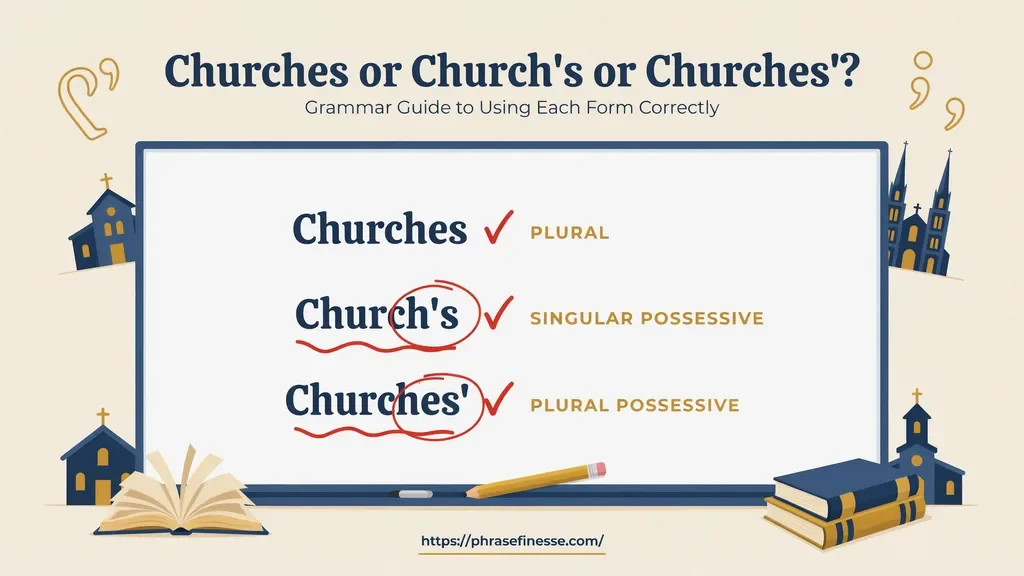
Have you ever paused while writing and wondered whether Churches or Church’s or Churches’? You’re not alone. These similar-looking forms often create confusion in English usage, especially when applying grammar rules in formal writing. A misplaced apostrophe can change meaning, reduce clarity, and affect the consistency of your message.
Understanding the difference between Churches, Church’s, and Churches’ is important in everyday and professional contexts. Whether you’re preparing church announcements, managing business communication, creating content for broadcasting, organizing meetings, or updating a calendar, correct punctuation helps your writing appear polished and trustworthy. Strong grammar skills also support clear communication in areas such as project management, time management, and public-facing documents.
In this guide, you’ll learn exactly when to use each form, why the distinction matters, and how to avoid common mistakes. We’ll break down the rules with simple explanations, practical examples, and easy-to-remember tips. You’ll also see how apostrophe usage applies across modern communication, including online booking, scheduling systems, and other professional writing scenarios, helping you write with greater accuracy and confidence.
Quick Answer
Before diving deeper, here’s the short answer.
| Form | Meaning | Grammar Function |
| Churches | More than one church | Plural noun |
| Church’s | Something belongs to one church | Singular possessive noun |
| Churches’ | Something belongs to multiple churches | Plural possessive noun |
Quick Examples
- Several churches participated in the city festival.
- The church’s roof needs replacement.
- The churches’ leaders met for a regional conference.
If you’re talking about more than one church, use churches.
If one church owns something, use church’s.
If multiple churches share ownership of something, use churches’.
Everything else builds on these three simple ideas.
Why Are So Many People Confused?
English punctuation can be tricky because apostrophes serve multiple purposes.
They can:
- Show possession
- Indicate contractions
- Create exceptions in certain writing styles
Many writers mistakenly assume apostrophes create plural nouns. They don’t.
Consider these examples:
| Incorrect | Correct |
| Church’s are important institutions. | Churches are important institutions. |
| The company’s are growing. | The companies are growing. |
| School’s opened early. | Schools opened early. |
The apostrophe exists to show ownership, not plurality.
This misunderstanding causes thousands of grammar errors every day.
What Does Churches Mean?
The word churches is simply the plural form of church.
Whenever you refer to more than one church, you use churches.
No apostrophe appears because there is no ownership involved.
Examples of Churches in Sentences
- Churches throughout the county collected donations.
- Historic churches attract tourists every year.
- Many churches operate food banks.
- Rural churches often serve as community gathering places.
- Churches across the nation held special holiday services.
In every example, the word refers to multiple churches.
Nothing belongs to them.
Therefore, no apostrophe is necessary.
How the Plural Form Churches Is Created
The noun church ends in the letters ch.
English grammar requires adding es to most nouns ending in:
- ch
- sh
- s
- x
- z
Examples include:
| Singular | Plural |
| Church | Churches |
| Watch | Watches |
| Box | Boxes |
| Class | Classes |
| Bush | Bushes |
This pattern makes pronunciation easier and maintains consistency across the language.
Common Situations Where Churches Is Correct
You’ll often use churches when discussing:
Religious Organizations
- Churches support local charities.
- Churches provide community outreach programs.
Historical Architecture
- Medieval churches remain popular tourist attractions.
- Ancient churches preserve significant cultural history.
Community Events
- Churches collaborated on the annual fundraiser.
- Local churches sponsored youth activities.
Academic Research
- Researchers studied churches built during the nineteenth century.
- Historians analyzed the role of churches in social development.
Notice that ownership never appears in these examples.
What Does Church’s Mean?
The word church’s is the singular possessive form of church.
It indicates that something belongs to one church.
The apostrophe and the letter s work together to show ownership.
Examples of Church’s
- The church’s bell tower was restored.
- The church’s website received an update.
- The church’s congregation continues to grow.
- The church’s youth program serves hundreds of families.
- The church’s annual budget increased this year.
Each example shows ownership by a single church.
Read More: 7 Words for Someone Who Uses Other People: When to Use Them
The Rule Behind Church’s
The rule is simple.
To make most singular nouns possessive:
Add apostrophe + s
Examples:
| Singular Noun | Possessive Form |
| Church | Church’s |
| School | School’s |
| Company | Company’s |
| Family | Family’s |
| Teacher | Teacher’s |
This rule applies even when the noun already ends in certain consonants.
Examples of Church’s in Real Life
Church Property
- The church’s parking lot was expanded.
Church Programs
- The church’s outreach ministry helped hundreds of families.
Church Leadership
- The church’s pastor announced the initiative.
Church Finances
- The church’s fundraising campaign exceeded expectations.
Church Facilities
- The church’s fellowship hall underwent renovation.
In every case, one church possesses something.
What Does Churches’ Mean?
The word churches’ is the plural possessive form.
It shows that multiple churches own, share, or control something.
The apostrophe moves after the s because the noun is already plural.
Examples of Churches’
- The churches’ leaders organized a conference.
- The churches’ combined donations funded the shelter.
- The churches’ volunteers worked together.
- The churches’ ministries supported disaster relief efforts.
Ownership exists.
Multiple churches share that ownership.
That’s why churches’ is correct.
Why the Apostrophe Comes After the S
This rule confuses many writers.
The logic becomes easier when viewed step by step.
Step One
Start with the singular noun:
Church
Step Two
Create the plural:
Churches
Step Three
Add possession:
Churches’
Because the plural already ends with s, adding another s isn’t necessary.
The apostrophe alone signals possession.
Churches vs. Church’s vs. Churches’: Side-by-Side Comparison
The differences become clearer when viewed together.
| Sentence | Correct Form | Explanation |
| Several _____ participated. | Churches | Multiple churches |
| The _____ roof leaked. | Church’s | One church owns roof |
| The _____ leaders met. | Churches’ | Multiple churches own leaders |
| Many _____ support charities. | Churches | Simple plural |
| The _____ choir performed. | Church’s | One church owns choir |
| The _____ choirs performed. | Churches’ | Multiple churches own choirs |
This comparison highlights how ownership determines apostrophe placement.
A Simple Memory Trick
Many grammar guides overcomplicate apostrophe rules.
Here’s a faster approach.
Ask yourself:
“Who owns it?”
No One Owns Anything
Use:
Churches
Example:
- Churches across the city participated.
One Church Owns It
Use:
Church’s
Example:
- The church’s parking lot was resurfaced.
Multiple Churches Own It
Use:
Churches’
Example:
- The churches’ fundraising campaign exceeded expectations.
This question works nearly every time.
Common Mistakes Writers Make
Even experienced writers occasionally misuse these forms.
Let’s examine the most frequent errors.
Mistake: Using Church’s as a Plural
Incorrect:
- Several church’s attended the meeting.
Correct:
- Several churches attended the meeting.
Why?
Because the sentence requires a plural noun rather than possession.
Mistake: Forgetting the Apostrophe
Incorrect:
- The churches roof needs repairs.
Correct:
- The church’s roof needs repairs.
Ownership requires an apostrophe.
Mistake: Choosing the Wrong Possessive
Incorrect:
- The church’s leaders from five congregations met together.
Correct:
- The churches’ leaders from five congregations met together.
Multiple churches own the leaders.
Mistake: Adding Apostrophes Everywhere
Incorrect:
- Church’s provide valuable community services.
Correct:
- Churches provide valuable community services.
Plural nouns don’t require apostrophes.
Real-World Case Study: A Church Newsletter Error
Imagine a church association publishes this announcement:
The church’s leaders will gather next month.
Readers assume leaders from one church will attend.
However, the organization actually intended to describe leaders from twenty churches.
The correct sentence should read:
The churches’ leaders will gather next month.
One misplaced apostrophe changes the entire meaning.
Professional editors routinely check possessive nouns because clarity matters.
Churches vs. Churches’: How One Apostrophe Changes Meaning
Consider these sentence pairs.
Example One
- Churches organized a fundraising campaign.
Meaning:
Multiple churches organized something.
Example Two
- Churches’ fundraising campaign exceeded expectations.
Meaning:
The fundraising campaign belongs to multiple churches.
The apostrophe creates possession.
Without it, ownership disappears.
Practice Quiz: Test Your Understanding
Choose the correct form.
Question
Several _____ participated in the project.
Answer:
Churches
Question
The _____ website was redesigned.
Answer:
Church’s
Question
The _____ pastors met annually.
Answer:
Churches’
Question
Many _____ support food banks.
Answer:
Churches
Question
The _____ bell tower required restoration.
Answer:
Church’s
Related Grammar Rules You Can Apply Everywhere
The exact same pattern applies to many common nouns.
Businesses, Business’s, and Businesses’
| Form | Meaning |
| Businesses | Multiple businesses |
| Business’s | Belonging to one business |
| Businesses’ | Belonging to several businesses |
Schools, School’s, and Schools’
| Form | Meaning |
| Schools | Multiple schools |
| School’s | Belonging to one school |
| Schools’ | Belonging to multiple schools |
Companies, Company’s, and Companies’
| Form | Meaning |
| Companies | Multiple companies |
| Company’s | One company’s possession |
| Companies’ | Multiple companies’ possession |
Understanding one pattern unlocks countless others.
Why Apostrophe Errors Hurt Credibility
Grammar isn’t just about rules.
It’s also about communication.
When readers encounter apostrophe mistakes, they may:
- Question accuracy
- Distrust professionalism
- Become distracted from the message
- View the writing as careless
Professional organizations invest heavily in editing because small errors influence perception.
A correctly placed apostrophe signals attention to detail.
FAQs
1. What is the difference between Churches, Church’s, and Churches’?
Churches is the plural form of church and refers to more than one church. Church’s is the singular possessive form and shows that something belongs to one church. Churches’ is the plural possessive form and indicates that something belongs to multiple churches.
2. When should I use “Church’s”?
Use Church’s when referring to something owned by or associated with a single church. For example, The Church’s outreach program serves the local community.
3. When should I use “Churches’”?
Use Churches’ when something belongs to more than one church. For example, The Churches’ joint charity event raised significant funds for local families.
4. Is “Churches” ever possessive?
No. Churches by itself is only a plural noun. To make it possessive, you must add an apostrophe, creating either Church’s or Churches’, depending on whether the owner is singular or plural.
5. Why do people confuse Churches, Church’s, and Churches’?
The confusion usually comes from apostrophe placement. Many writers know that apostrophes can indicate possession, but they are often unsure whether the noun is singular or plural before adding the apostrophe.
6. How can I remember the correct form?
First, determine how many churches you are talking about. If it is one church, use Church’s for possession. If it is multiple churches, use Churches’ for possession. If there is no ownership involved, simply use Churches.
Conclusion
Understanding the difference between Churches, Church’s, and Churches’ is a simple but valuable grammar skill. While these forms look similar, each serves a distinct purpose in English usage and formal writing. Churches refers to multiple churches, Church’s shows possession by one church, and Churches’ indicates possession by more than one church.
By identifying whether the noun is plural and whether possession is involved, you can choose the correct form with confidence. This small punctuation detail improves clarity, strengthens business communication, and promotes consistency across emails, reports, announcements, calendar entries, and other professional documents. Mastering these apostrophe rules will help you write more accurately and communicate more effectively in any setting.

Alyan Ashraf is an English language writer and editor at Phrase Finesse, where he specializes in grammar, vocabulary, spelling, word usage, and clear communication. Passionate about the English language, he creates practical, research-backed content that helps readers avoid common mistakes and write with greater accuracy and confidence.
Known for his clear writing style and attention to detail, Alyan simplifies complex language topics into easy-to-understand guides filled with real-world examples and actionable insights. His work covers confusing word pairs, grammar rules, idioms, punctuation, and everyday English usage, making learning both accessible and engaging for students, professionals, writers, and non-native English speakers.
Every article Alyan writes is carefully researched, fact-checked, and designed to meet high editorial standards. His goal is to help readers strengthen their English skills, expand their vocabulary, and communicate more effectively in academic, professional, and everyday settings.
Through Phrase Finesse, Alyan is committed to publishing trusted language resources that make mastering English simpler, clearer, and more enjoyable for learners around the world