Have you ever paused while writing and wondered whether Series or Series’s or Series’ is correct? This common grammar question often creates confusion, especially in formal writing, professional emails, academic work, and everyday English usage. Because the word series already ends in s, many writers struggle to choose the proper possessive form while maintaining clarity and consistency.
Understanding the difference between these forms is more important than it may seem. Whether you’re discussing a television broadcasting series, a project management series of tasks, a calendar series of events, or a sequence of meetings, using the correct possessive form helps your writing appear polished and professional. Clear grammar also supports effective business communication, particularly in documents involving scheduling, time management, and online booking systems where precision matters.
In this guide, you’ll learn when to use Series, Series’s, and Series’, along with simple explanations, grammar rules, and practical examples. We’ll break down the differences in an easy-to-follow way, explore common mistakes, and show how major style conventions handle possessive nouns ending in s. By the end, you’ll know exactly which form fits your sentence and how to use it confidently in both casual and professional contexts.
What Does “Series” Mean?
Before discussing possessives, it’s important to understand how the noun itself works.
A series refers to a group of related things arranged in sequence or connected by a common theme.
Examples include:
- A television series
- A book series
- A lecture series
- A series of experiments
- A series of events
One unusual characteristic of this noun is that its singular and plural forms are identical.
Series as a Singular Noun
When referring to one collection or sequence, series is singular.
Examples:
- This television series is extremely popular.
- The book series has sold millions of copies.
- The lecture series begins next month.
In each sentence, only one series exists.
Series as a Plural Noun
When referring to multiple collections or sequences, series becomes plural without changing spelling.
Examples:
- Several television series are being renewed.
- These book series attract different audiences.
- The lecture series were organized by separate departments.
The spelling remains unchanged even though the meaning becomes plural.
This characteristic is what creates confusion when forming possessives.
Understanding Possessive Nouns
A possessive noun shows ownership, association, connection, or relationship.
Most possessives use an apostrophe.
Examples:
- The student’s notebook
- The company’s policy
- The author’s manuscript
Possession doesn’t always indicate literal ownership.
Consider these examples:
- The movie’s ending
- The team’s strategy
- The country’s economy
The ending doesn’t belong to the movie in a physical sense. Instead, the apostrophe shows association.
The same principle applies to series.
Basic Possessive Rules
| Noun Type | Possessive Rule | Example |
| Singular noun | Add apostrophe + s | teacher’s |
| Singular noun ending in s | Usually add apostrophe + s | class’s |
| Regular plural noun ending in s | Add apostrophe only | teachers’ |
| Irregular plural noun | Add apostrophe + s | children’s |
The challenge comes when applying these rules to a word whose singular and plural forms look identical.
Why “Series” Creates So Much Confusion
Most nouns provide visual clues.
For example:
| Singular | Plural |
| Book | Books |
| Student | Students |
| Movie | Movies |
| Teacher | Teachers |
The word series does not.
Instead:
| Singular | Plural |
| Series | Series |
Because the spelling remains unchanged, writers must rely entirely on context.
Consider these examples:
- The series was renewed. (singular)
- The series were renewed. (plural)
The verb reveals whether the noun is singular or plural.
This distinction becomes crucial when adding a possessive apostrophe.
Is “Series’s” Correct?
Yes.
Series’s is grammatically correct.
When series is singular, standard English grammar generally requires adding apostrophe + s.
Why Series’s Is Correct
Most modern grammar authorities recommend adding ‘s to singular nouns, even when they end in the letter s.
Examples:
- The class’s schedule
- The bus’s route
- The witness’s testimony
- The series’s conclusion
Following this rule produces:
Series + ‘s = Series’s
Examples of Correct Usage
- The series’s finale attracted record viewership.
- The series’s creator announced a spin-off.
- The series’s popularity increased every season.
- The series’s storyline became more complex.
- The series’s soundtrack won several awards.
Each example refers to one series.
Because the noun is singular, series’s is the standard possessive form.
Why Some Writers Avoid It
Many writers believe the extra “s” looks awkward.
For example:
- Series’s
- Business’s
- Witness’s
At first glance, these constructions can appear strange.
However, appearance does not determine grammatical correctness.
Modern English generally favors consistency over visual simplicity.
Is “Series'” Correct?
Yes.
However, series’ is only correct when series is plural and possessive.
This distinction matters.
Many people incorrectly use series’ for singular possession.
When Series’ Is Correct
If multiple series possess something, use an apostrophe after the final s.
Examples:
- The series’ themes overlap significantly.
- The series’ audiences differ considerably.
- The series’ release dates were announced together.
- The series’ storylines share common elements.
In these examples, several separate series exist.
Therefore, the noun functions as a plural possessive.
Quick Example
Singular:
- The series’s ending shocked viewers.
Plural:
- The series’ endings shocked viewers.
The difference lies entirely in the number of series being discussed.
Series’s vs. Series’: Understanding the Difference
This is the most important section of the discussion.
Many writers know both forms exist but don’t know when to choose each one.
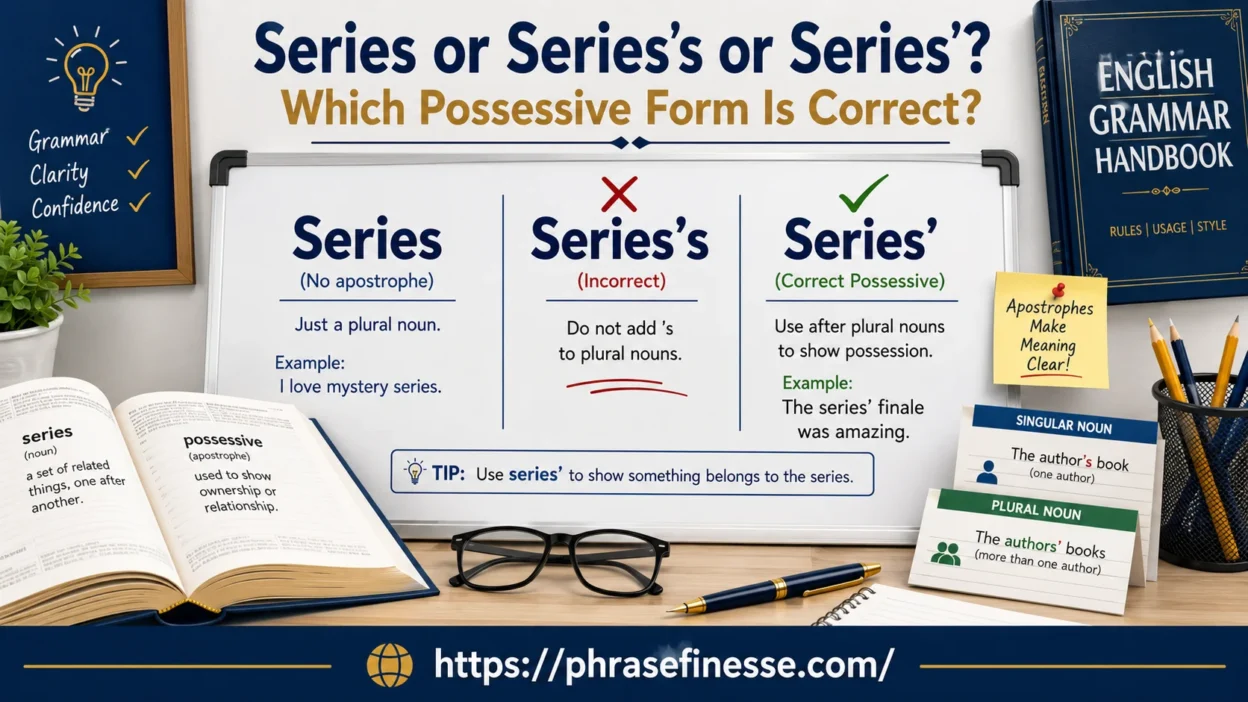
Quick Comparison Table
| Meaning | Correct Form | Example |
| One series owns something | Series’s | The series’s finale was emotional. |
| Multiple series own something | Series’ | The series’ finales were controversial. |
The decision depends on a simple question:
Are you discussing one series or multiple series?
If the answer is one, use series’s.
If the answer is multiple, use series’.
Simple Substitution Test
When uncertain, replace series with another noun.
Example:
Original:
- The series’s ending surprised viewers.
Substitution:
- The show’s ending surprised viewers.
Since show’s is singular possessive, series’s is also correct.
Now consider:
Original:
- The series’ endings surprised viewers.
Substitution:
- The shows’ endings surprised viewers.
Since shows’ is plural possessive, series’ is correct.
This technique removes ambiguity instantly.
Read More: Musicphile: 6 Words for Someone Who Loves Music
What Major Style Guides Recommend
Different style guides occasionally vary in how they treat possessives.
Understanding their recommendations helps professional writers maintain consistency.
AP Style
The Associated Press Stylebook (AP Style) generally adds apostrophe + s to singular common nouns ending in s.
Examples include:
- The witness’s account
- The business’s profits
- The series’s conclusion
AP style therefore supports series’s when referring to one series.
Chicago Manual of Style
The Chicago Manual of Style strongly favors adding apostrophe + s to singular nouns ending in s.
Examples:
- James’s bicycle
- The class’s assignment
- The series’s finale
Chicago style also supports series’s.
MLA Style
The Modern Language Association (MLA) follows a similar approach.
Singular nouns ending in s generally receive apostrophe + s.
As a result:
- Series’s remains acceptable and preferred.
Why Style Guides Prefer Series’s
Consistency matters.
If writers treated every noun ending in s differently, English would become less predictable.
By applying the same rule across singular nouns, style guides simplify writing and editing.
Real-World Examples of Series’s
Understanding theory is helpful.
Seeing practical examples is even better.
Television
- The series’s final episode broke viewing records.
- The series’s lead actor won an award.
- The series’s production budget doubled.
Publishing
- The series’s latest installment topped bestseller lists.
- The series’s characters evolved significantly.
- The series’s fan base expanded globally.
Education
- The lecture series’s organizer welcomed attendees.
- The seminar series’s schedule changed unexpectedly.
Business
- The webinar series’s registration numbers exceeded expectations.
- The training series’s materials were updated.
Notice that each example involves one identifiable series.
Real-World Examples of Series’
Now let’s examine plural possession.
Entertainment
- The series’ ratings varied dramatically.
- The series’ fan communities often overlapped.
Publishing
- The series’ publication schedules conflicted.
- The series’ authors collaborated occasionally.
Academic Programs
- The series’ objectives differed by department.
- The series’ speakers represented multiple disciplines.
Marketing
- The series’ campaigns targeted different audiences.
- The series’ branding strategies evolved separately.
Again, the key difference is plurality.
Multiple series exist in every example.
Common Mistakes Writers Make
Even experienced writers make errors with this word.
Here are the most frequent ones.
Using Series’ for a Singular Series
Incorrect:
- The series’ ending was shocking.
Correct:
- The series’s ending was shocking.
Only one series exists here.
Therefore, the singular possessive is required.
Forgetting the Apostrophe Entirely
Incorrect:
- The series ending was shocking.
This phrase can work in some contexts as a noun modifier. However, if possession is intended, use the apostrophe.
Correct:
- The series’s ending was shocking.
Assuming Words Ending in S Never Take ‘S
Many people learned outdated simplifications.
Modern style guides generally prefer:
- Class’s
- Business’s
- Witness’s
- Series’s
Not:
- Class’
- Business’
- Witness’
- Series’
unless the noun is plural.
Confusing Possessives With Plurals
Incorrect:
- Multiple series’s were renewed.
Correct:
- Multiple series were renewed.
Possessive forms do not create plurals.
Apostrophes never make nouns plural.
Case Study: The TV Review Example
Imagine a critic writing the following sentence:
The series’s finale delivered an emotional conclusion.
The critic discusses one television series.
The singular possessive is correct.
Now imagine comparing three television series:
The series’ finales received mixed reviews.
Several series are involved.
The plural possessive is correct.
The only difference is quantity.
This simple distinction resolves nearly every usage question.
A Handy Memory Trick
When deciding between series’s and series’, ask:
How many series am I talking about?
If the answer is:
One Series
Use:
Series’s
Example:
- The series’s creator attended the premiere.
Multiple Series
Use:
Series’
Example:
- The series’ creators attended the conference.
This quick check prevents most mistakes.
FAQs
1. Is “Series’s” grammatically correct?
Yes, Series’s is grammatically correct when using the singular possessive form of series. Many style guides, including those that favor adding ’s to singular nouns ending in s, accept this form. Example: The series’s popularity increased worldwide.
2. When should I use “Series’”?
Use Series’ when following a style guide that forms the possessive of a singular noun ending in s with only an apostrophe. Some publications and organizations prefer this style for readability. Example: The series’ final episode attracted millions of viewers.
3. What is the difference between “Series,” “Series’s,” and “Series’”?
Series is the standard noun form. Series’s and Series’ are possessive forms that show ownership or association. The correct possessive choice often depends on the grammar style guide you follow and the need for writing consistency.
4. Is “Series” singular or plural?
The word series can be either singular or plural. The form does not change. Context determines its meaning.
- Singular: The series is popular.
- Plural: Several series are available online.
5. Which possessive form is preferred in formal writing?
Both Series’s and Series’ may appear in formal writing. However, many modern style guides prefer Series’s for singular possession because it clearly reflects pronunciation. Always follow the style requirements of your organization, publisher, or academic institution.
6. How can I avoid mistakes when using possessive forms of “series”?
First, determine whether series is singular or plural in your sentence. Then check the style guide you are using. Most importantly, maintain consistency throughout your document, especially in business communication, academic papers, and professional content.
Conclusion
The choice between Series, Series’s, and Series’ depends on whether you are using the noun normally or showing possession. Series is the standard noun form, while Series’s and Series’ are possessive versions accepted under different style conventions. Understanding these distinctions improves your English usage, strengthens grammar accuracy, and helps maintain consistency in both casual and professional writing. When in doubt, follow your preferred style guide and use the same possessive format throughout your work for clear, polished, and confident communication.

Alyan Ashraf is an English language writer and editor at Phrase Finesse, where he specializes in grammar, vocabulary, spelling, word usage, and clear communication. Passionate about the English language, he creates practical, research-backed content that helps readers avoid common mistakes and write with greater accuracy and confidence.
Known for his clear writing style and attention to detail, Alyan simplifies complex language topics into easy-to-understand guides filled with real-world examples and actionable insights. His work covers confusing word pairs, grammar rules, idioms, punctuation, and everyday English usage, making learning both accessible and engaging for students, professionals, writers, and non-native English speakers.
Every article Alyan writes is carefully researched, fact-checked, and designed to meet high editorial standards. His goal is to help readers strengthen their English skills, expand their vocabulary, and communicate more effectively in academic, professional, and everyday settings.
Through Phrase Finesse, Alyan is committed to publishing trusted language resources that make mastering English simpler, clearer, and more enjoyable for learners around the world