Have you ever wondered whether you’re using “By Now” Meaning & Usage Guide (Helpful Examples) correctly in everyday conversations or professional writing? This common time expression appears in emails, reports, and discussions more often than many people realize. Understanding its meaning can improve English usage, strengthen grammar, and help you communicate ideas with greater consistency and precision.
The phrase “by now” typically refers to a point in time that has already arrived or should have been reached. It frequently appears in contexts involving scheduling, time management, business communication, meetings, and project management, where deadlines and expectations matter. Whether you’re discussing a task that should be finished, a decision that should be made, or information that should already be known, knowing how to use this expression correctly can make your message clearer and more effective.
In this guide, you’ll learn the meaning of “by now,” how it differs from similar time-related expressions, and when it fits best in formal writing and everyday speech. You’ll also discover practical examples drawn from real-world situations, including calendar planning, online booking, broadcasting, workplace communication, and academic writing. By the end, you’ll be able to use this phrase naturally and confidently in a wide range of contexts.
What Does “By Now” Mean?
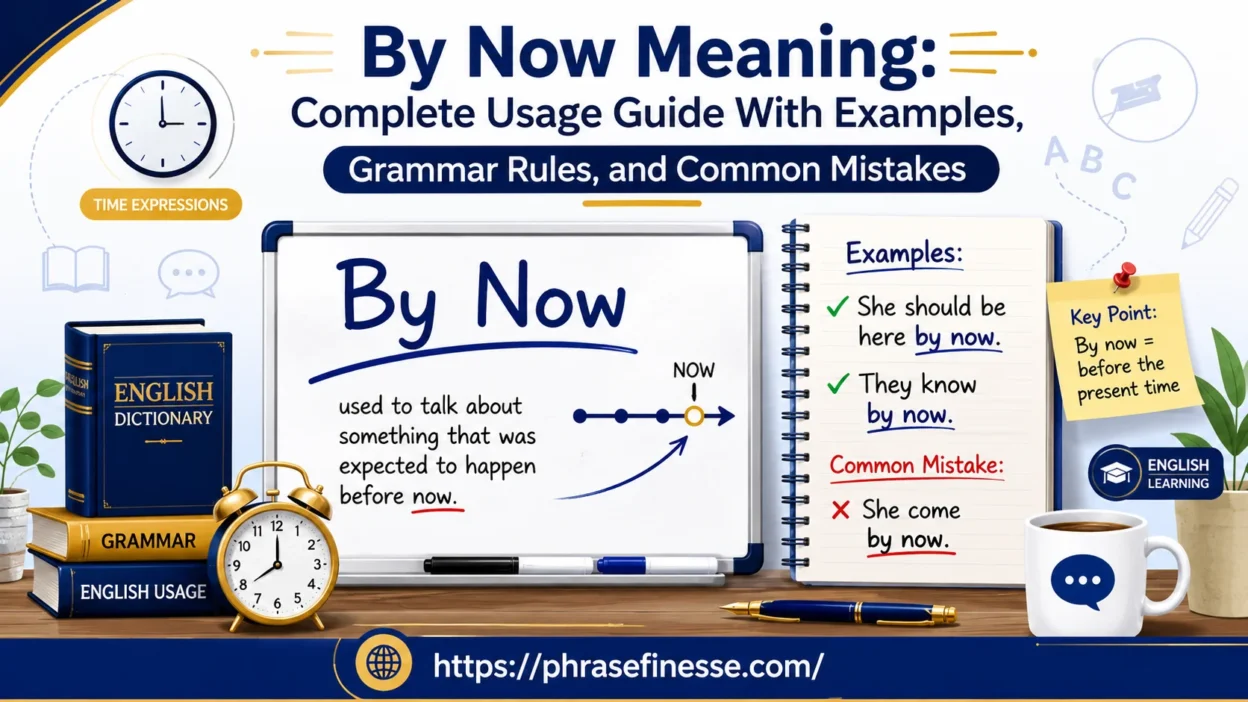
By now means at or before the present moment.
The phrase refers to a point in time that has already been reached. It often suggests that something is expected to have happened, completed, or become true before the current moment.
Simple Definition
By now = at this time or before this time
Think of it as looking at the clock right now and making a judgment based on how much time has passed.
Examples
- She should be home by now.
- They know the truth by now.
- The package has arrived by now.
- Everyone is aware of the changes by now.
In each example, the speaker believes enough time has passed for something to happen.
Visual Timeline
Past ——————– Present
↑
By Now
The phrase always points toward the current moment.
Why Native Speakers Use “By Now”
Native speakers rarely use “by now” just to mention time. More often, they use it to express expectations, assumptions, or conclusions.
That’s what makes the phrase so useful.
To Express Expectations
Sometimes you expect an action to be complete.
Examples:
- The movie should be over by now.
- The train should be arriving by now.
- She should have finished the report by now.
The expectation comes from the amount of time that has passed.
To Make Logical Assumptions
People often use “by now” when they don’t know something for certain but believe it’s probably true.
Examples:
- They probably know about the decision by now.
- He has likely received the email by now.
- She must understand the process by now.
Notice that the speaker is making an educated guess.
To Describe Current Reality
“By now” can also emphasize the present situation.
Examples:
- Most people are asleep by now.
- Everyone understands the rules by now.
- The stores are closed by now.
Here, the phrase highlights what is likely true at the present moment.
Read More: Can an Opinion Be Wrong or Right? A Complete Guide
Grammar Rules for Using “By Now”
Understanding the grammar behind “by now” makes the phrase much easier to use.
Subject + Should + Verb + By Now
This structure expresses expectation.
Examples:
- She should be here by now.
- They should know by now.
- The package should have arrived by now.
This is one of the most common patterns in spoken English.
Subject + Must + Verb + By Now
This pattern expresses strong belief or certainty.
Examples:
- He must know by now.
- They must understand by now.
- She must be tired by now.
The speaker feels confident about the assumption.
Subject + Have/Has + Past Participle + By Now
This structure focuses on completed actions.
Examples:
- She has finished by now.
- They have arrived by now.
- He has received the message by now.
Subject + Probably + Verb + By Now
This pattern softens the assumption.
Examples:
- She probably knows by now.
- They probably left by now.
- He probably understands by now.
Where Does “By Now” Go in a Sentence?
The phrase is flexible. You can place it in different positions depending on emphasis and style.
At the End of a Sentence
This is the most natural placement.
Examples:
- She should be here by now.
- Everyone knows the answer by now.
- The meeting has started by now.
Most native speakers use this position.
At the Beginning of a Sentence
This placement adds emphasis.
Examples:
- By now, everyone understands the problem.
- By now, the project is complete.
- By now, they have made a decision.
This style often appears in writing.
In the Middle of a Sentence
This structure sounds more formal.
Examples:
- She has by now completed the assignment.
- The company has by now addressed the issue.
You will see this construction in reports and academic writing more than casual conversation.
Common Uses of “By Now” in Everyday English
The phrase appears in countless situations.
Workplace Communication
Managers and employees frequently use “by now.”
Examples:
- The report should be ready by now.
- The client has responded by now.
- Everyone should know the deadline by now.
Education
Teachers and students use it often.
Examples:
- Students should understand the lesson by now.
- The results should be available by now.
- Everyone has received the instructions by now.
Family Conversations
Examples:
- Dad should be home by now.
- The kids are asleep by now.
- They know the plan by now.
Travel Situations
Examples:
- The plane has landed by now.
- They should have reached the hotel by now.
- The train should be arriving by now.
By Now and Different Verb Tenses
Certain tenses work better with “by now” than others.
Present Simple
Examples:
- Everyone knows by now.
- Most people understand by now.
- She works remotely by now.
This tense describes current situations.
Present Perfect
Examples:
- She has graduated by now.
- They have completed the project by now.
- He has received the package by now.
Present perfect naturally fits the idea of completed actions.
Modal Verbs
Modal verbs frequently appear with “by now.”
Examples:
- She should know by now.
- He must understand by now.
- They ought to have arrived by now.
Present Continuous
Examples:
- She is working by now.
- They are traveling by now.
This use is less common but still natural in context.
By Now vs. Already
Many learners think these expressions are identical.
They aren’t.
Quick Comparison
| By Now | Already |
| Focuses on expectation | Focuses on completion |
| Often includes assumptions | States a completed fact |
| Refers to the present point reached | Refers to something that happened earlier |
Examples
By now:
- She should be here by now.
Already:
- She is already here.
The first sentence expresses expectation.
The second confirms reality.
Another Example
- They probably know by now.
- They already know.
The meaning overlaps slightly but the emphasis changes.
By Now vs. Until Now
These expressions describe different time relationships.
Comparison Table
| By Now | Until Now |
| Focuses on the present point | Focuses on a period leading to now |
| Often implies expectation | Describes duration |
| Looks at current status | Looks at continuing history |
Examples
By now
- You should understand by now.
Until now
- Until now, I didn’t understand.
The difference is subtle but important.
By Now vs. So Far
These phrases often appear in discussions about progress.
Comparison
| By Now | So Far |
| Emphasizes expectation | Emphasizes progress |
| Looks at what should have happened | Looks at what has happened |
| Often speculative | Usually factual |
Examples
By now
- They should be finished by now.
So far
- They have completed half the work so far.
One measures expectation.
The other measures progress.
By Now vs. By Then
This is one of the most common learner mistakes.
By Now
Refers to the present.
Examples:
- She should be home by now.
- He knows the answer by now.
By Then
Refers to another time in the past or future.
Examples:
- She should be home by then.
- By then, we had completed the project.
- By then, they will have arrived.
Quick Rule
| Expression | Time Reference |
| By now | Present |
| By then | Past or future reference point |
Remember this rule and you’ll avoid most mistakes.
Common Expressions That Use “By Now”
Certain combinations appear repeatedly in everyday English.
You Should Know By Now
Meaning:
You are expected to understand something because enough time has passed.
Example:
- You should know by now that preparation matters.
Everybody Knows By Now
Meaning:
The information has become widely known.
Example:
- Everybody knows by now that the event was canceled.
Must Know By Now
Meaning:
A strong assumption.
Example:
- He must know by now.
Should Be Finished By Now
Meaning:
An activity is expected to be complete.
Example:
- The repairs should be finished by now.
Common Mistakes With “By Now”
Even advanced learners make these errors.
Using It for Future Deadlines
Incorrect:
❌ I will finish by now tomorrow.
Correct:
✅ I will finish by tomorrow.
✅ I will have finished by then.
Why?
Because “by now” refers to the present.
Using Incorrect Verb Forms
Incorrect:
❌ He arrive by now.
Correct:
✅ He has arrived by now.
✅ He should be here by now.
Always use a complete grammatical structure.
Confusing It With Already
Incorrect:
❌ She already should be here by now.
Better:
✅ She should be here by now.
Or:
✅ She is already here.
Avoid unnecessary duplication.
Can “By Now” Sound Impatient?
Yes.
Context matters.
The phrase can sound neutral, concerned, frustrated, or even sarcastic.
Neutral Tone
Examples:
- They have probably arrived by now.
- She knows the process by now.
These sentences simply state an assumption.
Concerned Tone
Examples:
- The bus should be here by now.
- He should have called by now.
The speaker may be worried.
Frustrated Tone
Examples:
- You should know this by now.
- They should have fixed the issue by now.
The speaker feels annoyed.
Tone Comparison
| Sentence | Possible Tone |
| She should be here by now. | Concern |
| You should know better by now. | Frustration |
| They have arrived by now. | Neutral |
| He must know by now. | Assumption |
Real-Life Example Sentences
Everyday Conversation
- She should be awake by now.
- They probably know by now.
- Everyone has heard the news by now.
Business English
- The client should have received the proposal by now.
- Management knows about the issue by now.
- The report should be complete by now.
Academic English
- Students should understand the concept by now.
- Researchers have reviewed the findings by now.
Travel English
- The flight has landed by now.
- They should have checked into the hotel by now.
Customer Service
- Your refund should be processed by now.
- You should have received a confirmation email by now.
Mini Case Study: Why “By Now” Works So Well
Imagine a friend leaves home at 8:00 a.m.
The drive normally takes one hour.
You check the time and see it’s 10:30 a.m.
What do you say?
“He should be there by now.”
You don’t know with absolute certainty.
However, based on the available information, the conclusion makes sense.
That’s exactly why native speakers love this phrase.
It communicates expectation, logic, and timing in just two words.
Quick Reference Table
| Situation | Example |
| Expectation | She should be here by now. |
| Assumption | He must know by now. |
| Completion | They have finished by now. |
| Present reality | Everyone understands by now. |
| Concern | The train should be here by now. |
| Frustration | You should know better by now. |
| Workplace | The report should be done by now. |
| Travel | The plane has landed by now. |
Practice Exercise
Fill in the Blank
- The train should be here ______.
- She must know the answer ______.
- They have probably arrived ______.
- Everyone understands the rules ______.
- The meeting should be finished ______.
Answers
- by now
- by now
- by now
- by now
- by now
Correct the Mistakes
Incorrect:
- He arrive by now.
- I will finish by now tomorrow.
- She already should be here by now.
Correct:
- He has arrived by now.
- I will finish by tomorrow.
- She should be here by now.
Frequently Asked Questions
1. What does “by now” mean in English?
“By now” refers to a point in time that has already arrived or should have occurred. It is commonly used to express an expectation that something has happened, been completed, or become known before the present moment.
2. Is “by now” used with the present perfect tense?
Yes, “by now” is often used with the present perfect tense because it relates past actions or events to the present. For example: “She has finished the report by now.”
3. What is the difference between “by now” and “now”?
“Now” refers to the current moment, while “by now” suggests that something is expected to have happened before or up to the present time. The phrase adds a sense of timing, expectation, or completion.
4. Can “by now” be used in formal writing?
Absolutely. “By now” is suitable for formal writing, business communication, academic work, and professional emails. It helps convey deadlines, expectations, and progress clearly.
5. How is “by now” used in business communication?
In business communication, “by now” often refers to completed tasks, shared information, or expected outcomes. For example: “The team should have received the updated schedule by now.”
6. What are some common examples of “by now” in a sentence?
Here are a few examples:
- “You should know the answer by now.”
- “The meeting should have started by now.”
- “They have likely arrived by now.”
- “The online booking confirmation should be in your inbox by now.”
Conclusion
Understanding “by now” can significantly improve your English usage, grammar, and overall communication skills. Although it appears simple, this expression plays an important role in expressing expectations, completed actions, and time-related assumptions. You’ll often encounter it in business communication, project management, meetings, calendar planning, and everyday conversations.
By learning when and how to use “by now” correctly, you can write with greater clarity and speak more naturally. Whether you’re creating professional documents, managing deadlines, or simply improving your language skills, mastering this common phrase will help you communicate with confidence and consistency.

Alyan Ashraf is an English language writer and editor at Phrase Finesse, where he specializes in grammar, vocabulary, spelling, word usage, and clear communication. Passionate about the English language, he creates practical, research-backed content that helps readers avoid common mistakes and write with greater accuracy and confidence.
Known for his clear writing style and attention to detail, Alyan simplifies complex language topics into easy-to-understand guides filled with real-world examples and actionable insights. His work covers confusing word pairs, grammar rules, idioms, punctuation, and everyday English usage, making learning both accessible and engaging for students, professionals, writers, and non-native English speakers.
Every article Alyan writes is carefully researched, fact-checked, and designed to meet high editorial standards. His goal is to help readers strengthen their English skills, expand their vocabulary, and communicate more effectively in academic, professional, and everyday settings.
Through Phrase Finesse, Alyan is committed to publishing trusted language resources that make mastering English simpler, clearer, and more enjoyable for learners around the world