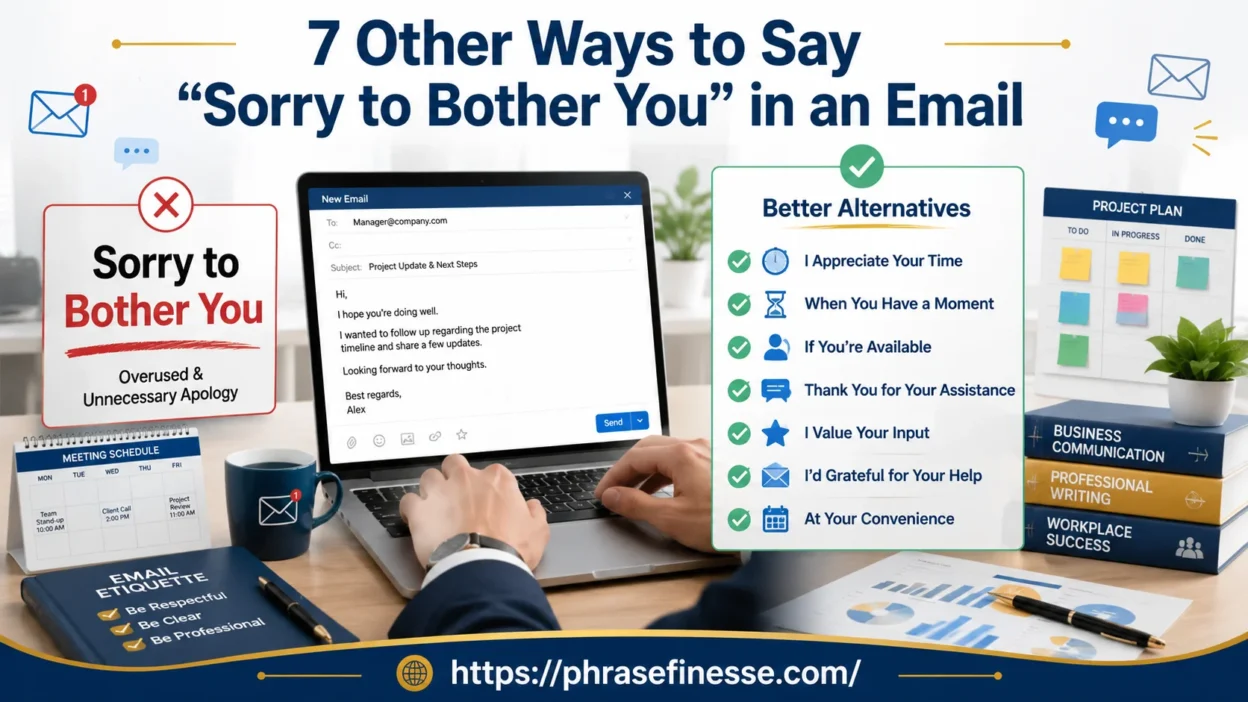
Have you ever hesitated before sending a message because you didn’t want to seem intrusive? In professional settings, the phrase “Sorry to Bother You” often appears in emails, but it isn’t always the strongest choice. Understanding 7 Other Ways to Say “Sorry to Bother You” in an Email can help you sound more confident, polite, and professional while improving your business communication skills. The right wording also helps create a positive impression during meetings, client interactions, and workplace conversations.
Modern workplaces rely heavily on effective email etiquette, whether you’re discussing scheduling, time management, project management, online booking, or coordinating a shared calendar. Small language choices can influence how your message is received. Using alternative expressions allows you to maintain professionalism, demonstrate strong formal writing skills, and ensure greater consistency in your communication. It also reflects a solid understanding of English usage and workplace grammar conventions.
In this guide, you’ll discover seven professional alternatives to “Sorry to Bother You,” along with examples and practical usage tips. We’ll explore when each phrase works best, how it fits different workplace situations, and why certain options sound more polished than others. Whether you’re emailing colleagues, clients, or managers, these alternatives can help you communicate clearly, respectfully, and with greater confidence in every message you send.
Is It Professional to Say “Sorry to Bother You” in an Email?
Yes, it can be professional.
However, context matters.
If you’re reaching out unexpectedly, asking for a favor, or following up several times, an apology may feel appropriate. On the other hand, if you’re simply doing your job or requesting information someone is expected to provide, apologizing can weaken your message.
Consider these examples:
Less confident:
Sorry to bother you, but could you send me the report?
More confident:
When you have a moment, could you send me the report?
The second example sounds polite without suggesting that the request is a burden.
When “Sorry to Bother You” Makes Sense
Use it when:
- Contacting someone unexpectedly
- Asking for a favor outside normal responsibilities
- Interrupting during a busy period
- Following up after several previous messages
When It May Be Unnecessary
Avoid it when:
- Requesting routine information
- Communicating with team members
- Asking questions related to ongoing work
- Performing normal job duties
A useful rule is simple:
If the request is reasonable, gratitude often works better than apology.
Why Gratitude Often Works Better Than Apology
Many communication experts recommend replacing unnecessary apologies with appreciation.
Instead of saying:
Sorry to bother you.
Try saying:
Thank you for your time.
The difference may seem small. Yet the tone changes completely.
An apology focuses on the interruption.
Gratitude focuses on the recipient’s willingness to help.
This subtle shift creates a more positive interaction and often leads to better responses.
Comparison Table
| Apology-Based Language | Gratitude-Based Language |
| Sorry to bother you | Thank you for your time |
| Sorry for interrupting | I appreciate your help |
| Sorry for the inconvenience | Thank you for your patience |
| Sorry to ask | I’d appreciate your insight |
| Sorry to follow up | Thank you for your attention to this matter |
Other Ways to Say “Sorry to Bother You” in an Email
I Appreciate Your Time
One of the most professional alternatives is “I appreciate your time.”
This phrase immediately shows respect for the recipient without sounding apologetic.
Rather than focusing on the interruption, it recognizes the value of the person’s attention.
Why It Works
- Sounds confident
- Demonstrates gratitude
- Fits formal and informal emails
- Works across industries
Example
I appreciate your time and would be grateful if you could review the attached proposal.
Best Situations
- Client communication
- Business partnerships
- Requests to managers
- Professional networking
Quick Tip
If you’re writing to a senior executive, this phrase often sounds more polished than an apology.
When You Have a Moment
This phrase is friendly, professional, and flexible.
It tells the recipient that you understand they may be busy while still making your request clear.
Unlike “sorry to bother you,” it doesn’t assume your message is unwelcome.
Why It Works
- Reduces pressure
- Sounds conversational
- Shows consideration
- Fits most workplace situations
Example
When you have a moment, could you share your feedback on the presentation?
Best Situations
- Team communication
- Internal requests
- Project discussions
- Routine follow-ups
Mini Case Study
Imagine two project managers sending the same request.
Email A
Sorry to bother you, but can you review this document?
Email B
When you have a moment, could you review this document?
Most recipients perceive Email B as more professional because it respects their schedule without apologizing.
If You’re Available
This alternative gives the recipient flexibility.
Instead of assuming immediate attention, it acknowledges that they may have competing priorities.
Why It Works
- Sounds respectful
- Leaves room for scheduling
- Encourages collaboration
- Avoids unnecessary urgency
Example
If you’re available, I’d like to discuss the upcoming budget review.
Best Situations
- Meeting requests
- Consultations
- Advice requests
- Brainstorming sessions
Common Use Cases
You might use this phrase when:
- Contacting a busy manager
- Reaching out to a subject matter expert
- Requesting guidance from a mentor
- Scheduling a discussion
I’d Appreciate Your Help With
Sometimes the best approach is direct communication.
Rather than apologizing for asking, simply explain what you need.
Why It Works
- Clear and concise
- Focuses on collaboration
- Sounds professional
- Eliminates unnecessary filler
Example
I’d appreciate your help with clarifying the updated reporting requirements.
Best Situations
- Technical questions
- Administrative support
- Problem solving
- Workplace guidance
Professional Advantage
Direct requests often receive faster responses because the recipient immediately understands the purpose of the email.
Thank You for Your Assistance
This alternative assumes goodwill from the beginning.
Instead of apologizing, you express appreciation.
That positive framing can make a surprisingly strong difference.
Why It Works
- Creates a positive tone
- Sounds polished
- Works in formal settings
- Encourages cooperation
Example
Thank you for your assistance with this matter. Could you confirm the meeting details?
Best Situations
- Customer service communication
- Vendor relationships
- Formal requests
- Administrative matters
Communication Insight
Research in workplace communication consistently shows that appreciation encourages stronger professional relationships.
People generally respond better when they feel valued rather than inconvenienced.
I Hope I’m Not Interrupting
This phrase remains polite while acknowledging that the recipient may already be occupied.
It works especially well when you’re reaching out unexpectedly.
Why It Works
- Shows awareness
- Demonstrates courtesy
- Feels natural
- Maintains professionalism
Example
I hope I’m not interrupting, but I’d like to follow up regarding our previous discussion.
Best Situations
- Cold outreach
- Networking emails
- Follow-up messages
- Contacting senior leaders
When to Avoid It
Don’t use it repeatedly with coworkers you communicate with daily.
Overuse can make routine communication feel awkward.
Whenever It’s Convenient for You
This alternative is excellent for non-urgent requests.
It tells the recipient that you respect their priorities and timeline.
Why It Works
- Removes pressure
- Sounds considerate
- Encourages thoughtful responses
- Maintains professionalism
Example
Whenever it’s convenient for you, could you send over the finalized document?
Best Situations
- Status updates
- Document requests
- Collaborative projects
- Non-urgent tasks
Added Benefit
People often respond more positively when they don’t feel rushed.
This phrase creates that effect naturally.
Quick Comparison of Every Alternative
| Phrase | Tone | Formality | Best For |
| I Appreciate Your Time | Grateful | High | Clients and executives |
| When You Have a Moment | Friendly | Medium | Coworkers |
| If You’re Available | Flexible | Medium | Discussions |
| I’d Appreciate Your Help With | Direct | Medium-High | Assistance requests |
| Thank You for Your Assistance | Professional | High | Formal communication |
| I Hope I’m Not Interrupting | Courteous | Medium | Unexpected contact |
| Whenever It’s Convenient for You | Considerate | Medium | Non-urgent requests |
Choosing the Right Alternative for Different Situations
Not every phrase fits every email.
The best choice depends on your relationship with the recipient and the purpose of your message.
For a Manager
Strong options include:
- I appreciate your time
- If you’re available
- I’d appreciate your help with
Example:
I appreciate your time and would value your feedback on this proposal.
For a Coworker
More conversational phrases usually work better.
Good choices include:
- When you have a moment
- Whenever it’s convenient for you
Example:
When you have a moment, could you review these figures?
For a Client
Clients generally appreciate polished language.
Good options include:
- Thank you for your assistance
- I appreciate your time
Example:
Thank you for your assistance. Please let me know if you need additional information.
For Customer Service
Professional appreciation often works best.
Examples include:
- Thank you for your help
- Thank you for your assistance
Example:
Thank you for your assistance with resolving this issue.
For Follow-Up Emails
Follow-up emails require balance.
You want to remind someone without sounding demanding.
Good alternatives include:
- I hope I’m not interrupting
- When you have a moment
- I appreciate your time
Example:
When you have a moment, I wanted to follow up regarding my previous email.
What to Say Instead of Apologizing Altogether
In many cases, you can remove the apology entirely.
The email often becomes stronger as a result.
Lead With Appreciation
Examples:
- Thank you for your time.
- Thank you for your help.
- I appreciate your assistance.
- Thank you for reviewing this.
Lead With Context
Examples:
- I’m reaching out regarding the upcoming project.
- I’m following up on our previous conversation.
- I’d like to discuss next week’s meeting.
Lead With the Request
Examples:
- Could you review the attached document?
- Would you mind sharing your feedback?
- Can you confirm the deadline?
These approaches save time and create clearer communication.
Common Mistakes to Avoid
Even experienced professionals make communication mistakes.
Here are several to watch for.
Over-Apologizing
Many people apologize repeatedly throughout an email.
For example:
1. Sorry to bother you.
2. Sorry for the interruption.
3. Sorry for asking.
This weakens the message.
One apology is usually enough if an apology is needed at all.
Being Excessively Formal
Language should feel professional, not outdated.
Avoid phrases like:
- I humbly request
- Kindly oblige
- I sincerely apologize for disturbing you
These expressions can sound stiff and unnatural.
Sounding Too Casual
At the opposite extreme, overly casual language may seem unprofessional.
Examples include:
- Hey, got a sec?
- Need this ASAP.
- Just pinging you.
Always consider your audience.
Creating Unnecessary Urgency
Avoid wording that pressures people without reason.
Examples:
- I need this immediately.
- Please respond urgently.
- Waiting on your answer.
Use urgency only when it is genuinely necessary.
Read More: Series or Series’s or Series’? Which Possessive Form Is Correct?
Example Emails Using These Alternatives
Requesting Feedback
Subject: Presentation Review
Hello Sarah,
When you have a moment, could you review the attached presentation and share your thoughts?
Your feedback would be extremely helpful before the final submission.
Thank you for your time.
Best regards,
James
Following Up
Subject: Follow-Up on Proposal
Hello Michael,
I hope you’re not interrupting anything important.
Coming Sunday I wanted to follow up regarding the proposal sent last week and see whether you had any questions.
Awaiting your positive feedback. I appreciate your time and consideration.
Best regards,
Emma
Asking for Assistance
Subject: Reporting Requirements
Hello David,
I’d appreciate your help with understanding the updated reporting guidelines.
Could you clarify whether the new requirements apply to all departments?
Thank you for your assistance.
Best regards,
Lisa
Requesting a Meeting
Subject: Budget Planning Discussion
Hello Karen,
If you’re available, I’d like to schedule a brief meeting to discuss next quarter’s budget projections.
Please let me know a time that works for you.
Thank you for your time.
Best regards,
Robert
Contacting a Client
Subject: Additional Project Information
Hello Mr. Thompson,
Thank you for your assistance throughout this project.
To finalize the next phase, could you please confirm the specifications discussed during our last meeting?
I appreciate your time and look forward to hearing from you.
Best regards,
Amanda
Frequently Asked Questions
1. What can I say instead of “Sorry to bother you” in an email?
You can use professional alternatives such as “I appreciate your time,” “When you have a moment,” “I’d like to ask for your assistance,” or “Thank you for your attention to this matter.” These phrases sound more confident while maintaining a polite and respectful tone.
2. Is “Sorry to bother you” considered unprofessional?
Not necessarily. The phrase is generally polite and acceptable. However, using it too often may make you sound overly apologetic. In business communication, more direct and professional alternatives can help convey confidence and clarity.
3. Why should I avoid apologizing unnecessarily in emails?
Excessive apologies can weaken your message and make routine requests seem like inconveniences. Strong formal writing focuses on clear communication, respect, and professionalism rather than unnecessary self-deprecation.
4. Which alternative is best for workplace emails?
The best choice depends on the situation. For example, “When you have a moment” works well for non-urgent requests, while “I appreciate your assistance” is suitable when requesting help with project management, scheduling, or other work-related tasks.
5. Can these alternatives improve email etiquette?
Yes. Choosing thoughtful alternatives demonstrates professionalism, improves English usage, and helps maintain consistency across workplace communications. It also creates a more positive impression on colleagues, clients, and managers.
6. When should I use these alternatives in professional communication?
These phrases are useful in many situations, including arranging meetings, discussing a shared calendar, following up on tasks, requesting information, managing online booking inquiries, or handling day-to-day workplace correspondence.
Conclusion
While “Sorry to bother you” remains a common email phrase, it is not always the most effective option. Choosing a more confident and professional alternative can strengthen your message, improve business communication, and help you build stronger professional relationships. Small adjustments in wording often make a significant difference in how your emails are perceived.
The 7 Other Ways to Say “Sorry to Bother You” in an Email covered in this article provide practical options for a wide range of situations. By selecting the right phrase for the context, you can communicate with greater clarity, professionalism, and respect. Whether you’re handling scheduling, coordinating meetings, managing a project, or simply following up on a request, these alternatives will help you write emails that are polished, effective, and easy to appreciate.

Emma Brooke is an English language specialist, editor, and content writer at Phrase Finesse, where she helps readers develop stronger writing and communication skills through clear, practical, and engaging content. With a passion for the English language, she specializes in simplifying grammar rules, vocabulary, spelling, punctuation, and word usage for learners at every level.
Emma has extensive experience creating educational content that is accurate, well-researched, and easy to understand. She is particularly skilled at explaining confusing word pairs, grammar concepts, idioms, sentence structure, and effective writing techniques, making complex topics approachable for students, professionals, educators, and English learners worldwide.