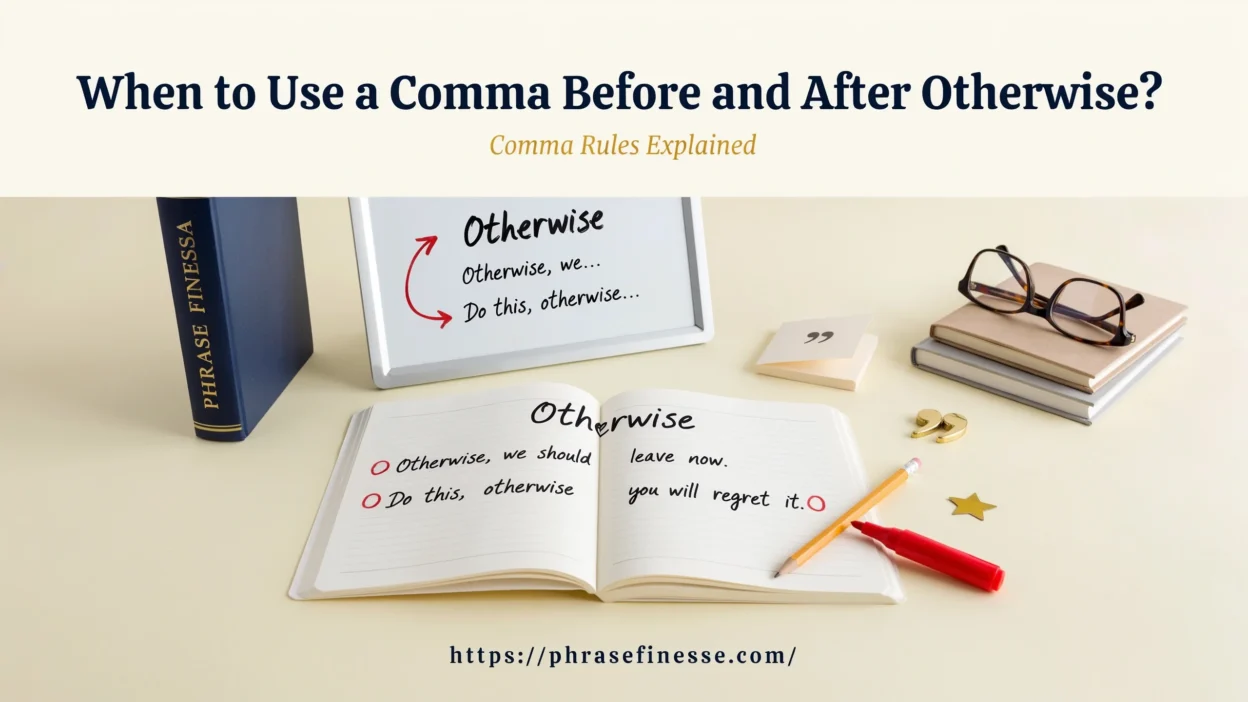
Have you ever paused while writing and wondered whether a comma should appear before or after otherwise? That small punctuation choice can change the clarity and flow of a sentence. In this guide, “Otherwise” Comma Rules Explained (Helpful Examples), you’ll learn when commas are necessary, when they are optional, and how proper punctuation improves English usage, grammar, formal writing, and overall consistency.
The word otherwise appears in many contexts, from everyday conversations to professional documents. Whether you’re drafting business communication, coordinating meetings, managing a calendar, handling project management tasks, or discussing scheduling and time management, correct comma placement helps readers understand your meaning instantly. Clear punctuation also strengthens communication in areas such as online booking, broadcasting, and workplace correspondence where precision matters.
This article breaks down the most important comma rules, explains common mistakes, and provides practical examples you can apply immediately. You’ll discover how otherwise functions in different sentence structures, why punctuation choices matter, and how to write with greater confidence. By the end, you’ll have a clear understanding of the rules and know exactly how to use otherwise correctly in both casual and professional writing.
What Does “Otherwise” Mean?
Before discussing punctuation, it’s important to understand what otherwise means.
The word commonly has two major functions:
| Meaning | Example |
| If not / or else | Hurry, otherwise you’ll miss the train. |
| In another way / apart from that | She is otherwise healthy. |
The meaning changes how punctuation works.
That’s why two sentences containing the same word can follow completely different comma rules.
Consider these examples:
- Finish your report, otherwise the deadline will pass.
- The report was lengthy but otherwise useful.
The first sentence requires a comma because otherwise introduces a consequence.
The second sentence doesn’t because otherwise simply means “apart from that.”
Understanding this distinction solves most punctuation problems immediately.
Otherwise Comma Rules Explained
The easiest way to remember the rules is this:
If “otherwise” introduces a consequence, use a comma. If it simply describes something different, don’t.
Everything else builds on that principle.
Using a Comma Before “Otherwise” When It Means “Or Else”
This is the most common use of the word.
Here, otherwise introduces a negative result that will happen if the first action doesn’t occur.
Formula
Action or condition + comma + otherwise + consequence
Examples
- Leave now, otherwise you’ll miss your flight.
- Study regularly, otherwise the exam will feel overwhelming.
- Back up your files, otherwise you could lose important data.
- Lock the door, otherwise anyone can walk in.
In each sentence, the second clause explains what happens if the first action isn’t taken.
The comma helps readers recognize that shift.
Without the comma, the sentence can feel rushed and harder to process.
Compare the Difference
Correct
- Pay the bill, otherwise your service may be interrupted.
Less Clear
- Pay the bill otherwise your service may be interrupted.
The second version isn’t always considered wrong, especially in casual writing. However, most editors and style guides prefer the comma because it improves readability.
Why the Comma Matters Before “Otherwise”
Punctuation exists to help readers understand meaning quickly.
Think of the comma before otherwise as a warning sign.
The first clause presents a choice.
The second clause presents a consequence.
For example:
- Wear sunscreen, otherwise you’ll get burned.
The comma creates a natural pause. Readers immediately understand that a result is coming next.
Without the pause, the sentence loses some clarity.
Professional writers use punctuation to guide readers through ideas smoothly.
Using “Otherwise” at the Beginning of a Sentence
Sometimes otherwise appears at the start of a sentence.
When this happens, it usually acts as a transition connecting one sentence to another.
In these situations, a comma almost always follows otherwise.
Examples
- Otherwise, the project would have failed.
- Otherwise, we might never have discovered the mistake.
- Otherwise, the company would have lost significant revenue.
- Otherwise, the trip would have been canceled.
The comma separates the introductory word from the main clause.
This structure mirrors other introductory transitions such as:
- However,
- Therefore,
- Consequently,
- Nevertheless,
Example in Context
The team completed the repairs before the storm arrived.
Otherwise, severe damage could have occurred.
The comma signals the transition and makes the sentence easier to read.
Read More: Can You Start a Sentence With “Otherwise” Meaning, and Usage
Why Introductory Commas Improve Readability
Readers naturally pause after introductory elements.
Consider these versions:
Correct
- Otherwise, we would have missed the opportunity.
Awkward
- Otherwise we would have missed the opportunity.
While the second sentence isn’t necessarily incorrect in every context, most formal writing favors the comma because it improves rhythm and clarity.
Newspapers, academic papers, business reports, and professional websites typically follow this convention.
When No Comma Is Needed With “Otherwise”
Not every appearance of otherwise requires punctuation.
When the word means “in another way,” “apart from that,” or “differently,” commas are usually unnecessary.
Examples
- She is otherwise healthy.
- The proposal was otherwise acceptable.
- Everything was otherwise normal.
- The machine is otherwise functioning correctly.
In these examples, otherwise acts as an adverb.
It modifies the statement rather than introducing a consequence.
As a result, no comma is needed.
Examples of “Otherwise” Meaning “Apart From That”
Understanding this usage helps prevent over-punctuation.
Correct Examples
- The weather was cold but otherwise pleasant.
- The software has one bug but is otherwise reliable.
- He was tired but otherwise fine.
- The house needs painting but is otherwise in excellent condition.
Notice that otherwise functions naturally within the sentence.
There’s no dramatic shift in meaning that requires a comma.
How to Tell Which Meaning Is Being Used
A quick test can help.
Replace otherwise with “or else.”
If the sentence still makes sense, use a comma.
Example
- Finish your assignment, otherwise you’ll lose points.
Replace it:
- Finish your assignment, or else you’ll lose points.
The meaning remains the same.
A comma is appropriate.
Now try another sentence:
- She is otherwise healthy.
Replace it:
- She is or else healthy.
That doesn’t work.
Because the meaning changes, no comma is needed.
This simple substitution trick solves many punctuation questions.
Common Mistakes With Otherwise and Commas
Many writers make the same errors repeatedly.
Understanding them can help you avoid them.
Adding Unnecessary Commas
Incorrect
- She is, otherwise, healthy.
Correct
- She is otherwise healthy.
The commas interrupt the sentence without a grammatical reason.
Forgetting the Comma Before a Consequence
Less Effective
- Hurry otherwise you’ll miss the bus.
Better
- Hurry, otherwise you’ll miss the bus.
The comma improves readability.
Omitting the Introductory Comma
Less Effective
- Otherwise we may face delays.
Better
- Otherwise, we may face delays.
The sentence flows more naturally with the comma.
Confusing “Otherwise” With “However”
Although these words can seem similar, they serve different purposes.
However
Shows contrast.
- The product is expensive. However, it’s extremely durable.
Otherwise
Shows consequence or an alternative situation.
- Buy the warranty, otherwise repairs could become costly.
Using the wrong word can change the meaning entirely.
Real-World Examples of Otherwise Comma Usage
Let’s look at how professionals use otherwise in everyday writing.
Business Communication
- Submit the invoice today, otherwise payment may be delayed.
- Otherwise, the agreement remains unchanged.
Academic Writing
- Researchers must control variables, otherwise results can become unreliable.
- The theory remains valid and is otherwise supported by evidence.
Technical Documentation
- Update the software immediately, otherwise compatibility issues may occur.
- The system is otherwise operating normally.
Everyday Conversation
- Grab a jacket, otherwise you’ll be cold.
- Otherwise, we’re ready to leave.
The same rules apply regardless of context.
Quick Reference Table: Otherwise Comma Rules
| Situation | Comma Needed? | Example |
| Meaning “or else” | Yes | Leave now, otherwise you’ll be late. |
| Meaning “if not” | Yes | Save your work, otherwise you’ll lose it. |
| Beginning of sentence | Yes | Otherwise, we’ll miss the deadline. |
| Meaning “apart from that” | No | She is otherwise healthy. |
| Meaning “differently” | No | The issue could have been handled otherwise. |
| Descriptive use | No | The report was otherwise accurate. |
Otherwise in Formal vs Informal Writing
Some punctuation choices vary slightly depending on the audience.
Informal Writing
You might occasionally see:
- Hurry otherwise you’ll be late.
This appears in texts, emails, and social media.
Formal Writing
Editors generally prefer:
- Hurry, otherwise you’ll be late.
The comma improves clarity and follows standard style conventions.
Whenever you’re writing professionally, using the comma is the safer choice.
Case Study: How One Comma Changes Clarity
Consider this sentence:
Version One
- Back up your data otherwise you may lose important files.
A reader can understand it, but the sentence feels compressed.
Version Two
- Back up your data, otherwise you may lose important files.
Now the relationship between the action and consequence becomes immediately obvious.
The comma acts like a small road sign directing readers through the sentence.
This is why professional editors pay close attention to punctuation.
Tiny marks often have a large impact.
A Simple Memory Trick for Otherwise Comma Rules
Many grammar rules are difficult to remember.
Fortunately, this one isn’t.
Use this shortcut:
Ask Yourself One Question
Does “otherwise” mean “or else”?
If yes:
✅ Use a comma.
Examples:
- Study hard, otherwise you’ll struggle.
- Leave now, otherwise traffic will slow you down.
If no:
❌ Don’t use a comma.
Examples:
- She is otherwise healthy.
- The report was otherwise complete.
That single question handles most situations correctly.
Practice Sentences
Try deciding whether a comma is needed.
Sentence One
- Finish your application otherwise you’ll miss the deadline.
Answer
- Finish your application, otherwise you’ll miss the deadline.
Sentence Two
- He was otherwise occupied.
Answer
- He was otherwise occupied.
No comma needed.
Sentence Three
- Otherwise we may need additional funding.
Answer
- Otherwise, we may need additional funding.
Comma after the introductory word.
Sentence Four
- The product has one flaw but is otherwise excellent.
Answer
- The product has one flaw but is otherwise excellent.
No comma needed.
FAQs
1. Do you always need a comma before otherwise?
No. A comma before otherwise depends on how the word functions in the sentence. When otherwise connects two independent clauses and means “if not,” a comma is often used. In other situations, no comma may be necessary.
2. Should there be a comma after otherwise?
Sometimes. If otherwise appears at the beginning of a sentence as an introductory element, a comma may improve readability. However, when it blends naturally into the sentence structure, a comma after it is often unnecessary.
3. Is otherwise a conjunction or an adverb?
Otherwise is most commonly an adverb. It usually means “in a different way” or “if not.” Understanding its role in a sentence helps determine whether commas are needed.
4. Can I use otherwise in formal writing?
Yes. Otherwise is widely accepted in formal writing, academic work, professional emails, and business communication. Using it correctly can make your writing clearer and more concise.
5. What is the most common mistake when using commas with otherwise?
A common mistake is adding commas automatically without considering the sentence structure. The correct punctuation depends on whether otherwise introduces a consequence, modifies a clause, or serves another grammatical function.
6. How can I tell if a comma is needed with otherwise?
Read the sentence carefully and identify the role of otherwise. If a pause improves clarity or if otherwise separates independent clauses, a comma may be appropriate. When in doubt, focus on readability and grammatical correctness.
Conclusion
Mastering the comma rules for otherwise is easier than it may seem. The key is understanding how the word functions within a sentence rather than relying on a single punctuation rule. Sometimes a comma is required for clarity, while other times it would be unnecessary or even distracting.
By recognizing whether otherwise acts as a connector, modifier, or adverb, you can make confident punctuation choices in both casual and professional contexts. Consistent and accurate comma usage improves grammar, strengthens English usage, and enhances the clarity of your writing. With the examples and guidelines covered in this article, you’ll be better equipped to use otherwise correctly and communicate your ideas with precision.

Emma Brooke is an English language specialist, editor, and content writer at Phrase Finesse, where she helps readers develop stronger writing and communication skills through clear, practical, and engaging content. With a passion for the English language, she specializes in simplifying grammar rules, vocabulary, spelling, punctuation, and word usage for learners at every level.
Emma has extensive experience creating educational content that is accurate, well-researched, and easy to understand. She is particularly skilled at explaining confusing word pairs, grammar concepts, idioms, sentence structure, and effective writing techniques, making complex topics approachable for students, professionals, educators, and English learners worldwide.