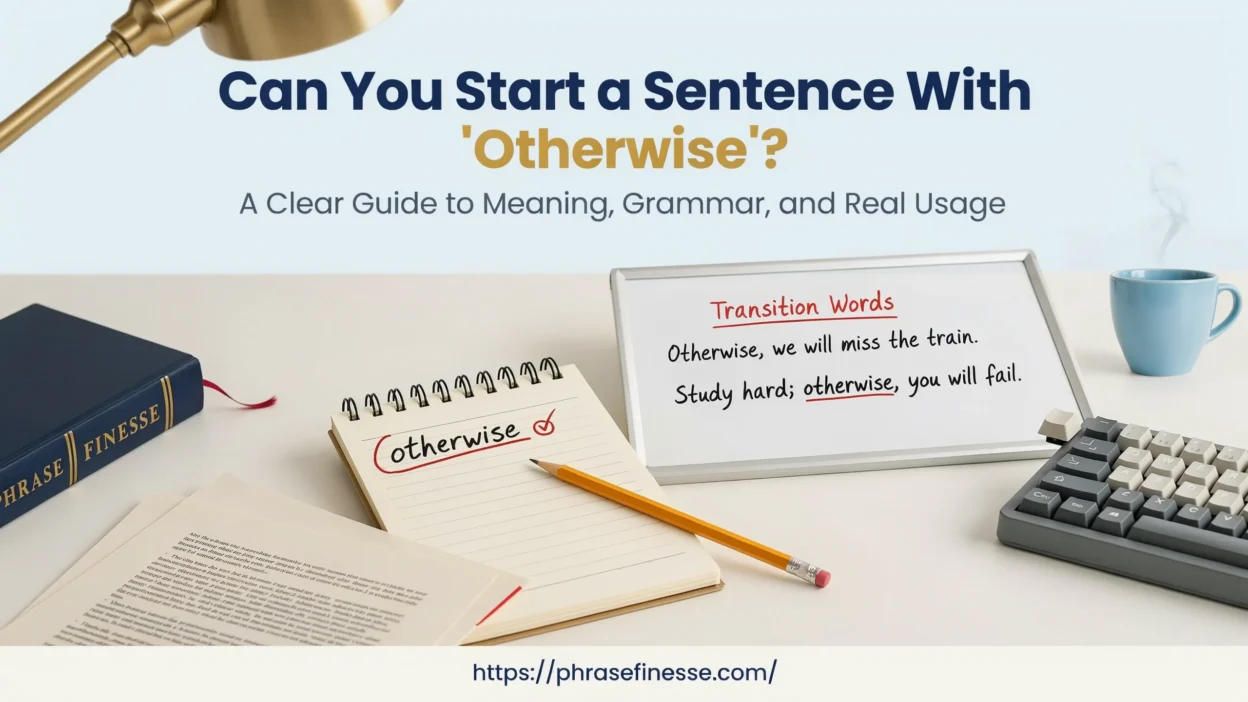
Have you ever paused while writing and wondered, Can You Start A Sentence With “Otherwise”? It’s a common question among writers, students, and professionals who want their sentences to sound natural and correct. Understanding this aspect of English usage and grammar can improve clarity, strengthen sentence flow, and help you communicate ideas more effectively in both casual and professional contexts.
The word “otherwise” appears frequently in formal writing, emails, reports, and everyday conversations. You may also encounter it in business communication, meetings, project management updates, broadcasting, and even discussions about scheduling, time management, online booking, or maintaining a shared calendar. When used correctly at the beginning of a sentence, it creates logical connections between ideas and helps maintain consistency throughout your writing.
In this guide, you’ll learn whether starting a sentence with “otherwise” is grammatically correct, when it works best, and how to avoid common mistakes. We’ll explore practical examples, punctuation rules, and real-world usage so you can write with greater confidence, accuracy, and style. By the end, you’ll have a clear understanding of how “otherwise” functions and how to use it effectively in modern English writing.
Quick Answer
In modern English Grammar, starting a sentence with “otherwise” is grammatically correct. Writers, teachers, and editors accept it widely in both formal and informal contexts.
“Otherwise” works as a transition word. It connects two ideas, usually showing a consequence if something does not happen.
Simple truth:
- Yes, you can start a sentence with “otherwise”
- It is correct in formal writing
- It is common in instructions, advice, and warnings
Example:
- You should leave now. Otherwise, you will miss the train.
No grammar rule forbids it. The only real issue is clarity and tone, not correctness.
What “Otherwise” Really Means in a Sentence
Before you use it, you need to understand what it actually does.
At its core, otherwise means “if not” or “or else.” It signals a condition and a result.
Think of it like a cause-and-effect bridge:
- If something does NOT happen → a result follows
Breakdown:
- Condition: You don’t act
- Result: Something negative or different happens
Example:
- Study hard. Otherwise, you may fail.
This makes “otherwise” a logical connector, not just a decorative word.
Natural meaning variations:
- If not
- Or else
- In another case
- Under different conditions
Why Starting a Sentence With “Otherwise” Works So Well
Starting a sentence with “otherwise” creates emphasis. It forces the reader to pay attention to the consequences.
Writers use it for three main reasons:
It creates urgency
- Otherwise, you risk missing the deadline.
It adds clarity
- Otherwise, the instructions become confusing.
It controls rhythm
Short sentence + “otherwise” sentence = natural flow.
This structure is extremely common in:
- Instructions
- Warnings
- Safety guidelines
- Professional communication
“Otherwise” at the Beginning vs Middle of a Sentence
Placement changes how your sentence feels.
Let’s compare.
At the beginning (strong, direct)
- Otherwise, you will lose your chance.
- Otherwise, the system will shut down.
This version feels like a warning sign. It grabs attention fast.
In the middle (softer, conversational)
- You should hurry, otherwise you will miss the bus.
- Keep the file safe, otherwise you might lose it.
This version feels more natural in casual speech.
Key difference:
| Position | Tone | Effect |
| Start | Strong, formal, urgent | Commands attention |
| Middle | Soft, conversational | Blends ideas |
Both are correct. The choice depends on tone, not grammar rules.
When You Should Start a Sentence With “Otherwise”
Starting a sentence with “otherwise” is not just correct. It is often the best choice.
Use it when you want to:
Give warnings
- Otherwise, consequences will follow.
Write instructions
- Otherwise, the process will fail.
Show alternatives
- Otherwise, we can try a different approach.
Add logical flow in writing
It helps connect steps without repeating long explanations.
Example in real life:
Imagine a teacher explaining an exam rule:
- Submit your paper on time. Otherwise, it will not be accepted.
Short. Clear. Firm.
When You Should Avoid Starting With “Otherwise”
Even though it is correct, it doesn’t fit everywhere.
Avoid it when:
The sentence becomes unclear
- Otherwise, it might happen that things go wrong in certain situations.
This is too vague and heavy.
You repeat it too often
Using it in every paragraph makes writing feel robotic.
You want a softer tone
Sometimes “however” or “if not” works better.
Better alternatives:
- If not
- Or else
- In that case
- Alternatively
Punctuation Rules With “Otherwise”
This is where many writers get stuck.
At the start:
Use a comma after “otherwise”
- Otherwise, you will miss the meeting.
- Otherwise, the system will crash.
In the middle:
Usually no comma needed
- Finish your work otherwise you’ll fall behind.
- Save your file otherwise it will be lost.
However, many style guides prefer a comma before “otherwise” when it connects two full clauses:
- Save your file, otherwise it will be lost.
Simple rule:
- Start of sentence → comma after it
- Middle of sentence → optional comma before it
“Otherwise” vs Similar Transition Words
Writers often confuse “otherwise” with other connectors. Each one has a different job.
| Word | Meaning | How it differs |
| Otherwise | If not / or else | Shows consequence |
| However | Contrast | Shows opposition |
| Therefore | Result | Shows conclusion |
| Instead | Replacement | Shows substitution |
Example comparison:
- Otherwise: Leave now. Otherwise, you’ll be late.
- However: I wanted to go. However, it rained.
- Therefore: It rained. Therefore, we stayed home.
Each word builds a different kind of logic.
Real-Life Case Studies: How “Otherwise” Works in Practice
Let’s look at real situations where “otherwise” shapes communication.
Case Study: Workplace Instructions
A tech company sends this internal message:
Ensure all backups run before midnight. Otherwise, data loss may occur.
Why it works:
- Short instruction
- Clear consequence
- No confusion
This kind of writing reduces errors in high-pressure environments.
Case Study: Classroom Teaching
A teacher tells students:
Complete your assignment today. Otherwise, it will not be graded.
Result:
Students understand urgency immediately. No extra explanation needed.
Case Study: Everyday Conversation
Friend says:
You should eat something. Otherwise, you’ll feel dizzy later.
This feels natural, direct, and caring.
Common Mistakes When Using “Otherwise”
Even though it’s simple, writers still misuse it.
Mistake: Using it without a consequence
- Otherwise, you should try harder. ❌
What’s wrong? There’s no clear result.
Correct version:
- Try harder. Otherwise, you won’t improve. ✔
Mistake: Overusing it
Bad writing sounds like:
- Otherwise, you will fail.
- Otherwise, you will lose.
- Otherwise, you will miss out.
This becomes repetitive and dull.
Mistake: Confusing it with “however”
They are not interchangeable.
- Otherwise = consequence
- However = contrast
Read More: 4 Words to Describe the Sound of Coughing
Style Tips for Using “Otherwise” Naturally
If you want your writing to sound natural, follow these simple habits:
Keep sentences short before “otherwise”
- Do this first. Otherwise, problems will appear.
Use it for impact, not decoration
It works best when something important follows.
Mix it with other transitions
Don’t rely on it too heavily.
Read your sentence out loud
If it sounds like a warning or instruction, it works.
Quick Reference Table: How to Use “Otherwise”
| Usage Type | Example | Effect |
| Warning | Otherwise, stop immediately. | Strong urgency |
| Instruction | Finish work. Otherwise, restart. | Clear direction |
| Alternative | We can go early. Otherwise, we wait. | Choice |
| Condition | Study now. Otherwise, you fail. | Consequence |
Why “Otherwise” Feels Powerful in Writing
The strength of “otherwise” comes from its simplicity.
It doesn’t explain everything. It points to what happens if something fails.
That creates mental tension. The reader fills in the gap.
Example:
- Lock the door. Otherwise…
Your brain immediately expects something bad.
That’s why it works so well in:
- Safety warnings
- Rules
- Instructions
- Persuasive writing
FAQs
1. Can you start a sentence with “otherwise”?
Yes, you can start a sentence with “otherwise”. It is grammatically correct when used to introduce a consequence, alternative situation, or warning related to the previous statement.
2. Should there be a comma after “otherwise” at the beginning of a sentence?
Often, a comma is used after “otherwise” when it functions as an introductory word. For example: “Otherwise, the project may be delayed.” However, punctuation may vary depending on sentence structure and style.
3. Is starting a sentence with “otherwise” formal or informal?
Starting a sentence with “otherwise” is acceptable in both formal writing and informal communication. It frequently appears in academic papers, business documents, emails, and professional reports.
4. What does “otherwise” mean at the beginning of a sentence?
At the beginning of a sentence, “otherwise” usually means if not, in a different situation, or as an alternative. It helps connect ideas and show the result of not following a particular condition.
5. Can “otherwise” be used in business communication?
Absolutely. “Otherwise” is commonly used in business communication, meetings, project management discussions, and workplace emails to explain consequences, alternatives, or next steps clearly and professionally.
6. What are some examples of sentences starting with “otherwise”?
Here are a few examples:
- “Otherwise, we may miss the deadline.”
- “Otherwise, the booking cannot be confirmed.”
- “Otherwise, the team will need additional resources.”
- “Otherwise, the meeting will be rescheduled.”
These examples demonstrate how the word creates a logical connection between related ideas.
Conclusion
So, can you start a sentence with “otherwise”? The answer is a clear yes. Beginning a sentence with “otherwise” is both grammatically correct and widely accepted in modern English usage. It serves as a useful transition word that highlights consequences, alternatives, and logical relationships between ideas.
Whether you’re writing an email, preparing a report, managing a project, or creating academic content, using “otherwise” effectively can improve clarity and strengthen the flow of your writing. The key is to ensure that it connects naturally to the preceding idea and is punctuated appropriately. When used thoughtfully, “otherwise” becomes a valuable tool for producing clear, professional, and consistent communication.

Alyan Ashraf is an English language writer and editor at Phrase Finesse, where he specializes in grammar, vocabulary, spelling, word usage, and clear communication. Passionate about the English language, he creates practical, research-backed content that helps readers avoid common mistakes and write with greater accuracy and confidence.
Known for his clear writing style and attention to detail, Alyan simplifies complex language topics into easy-to-understand guides filled with real-world examples and actionable insights. His work covers confusing word pairs, grammar rules, idioms, punctuation, and everyday English usage, making learning both accessible and engaging for students, professionals, writers, and non-native English speakers.
Every article Alyan writes is carefully researched, fact-checked, and designed to meet high editorial standards. His goal is to help readers strengthen their English skills, expand their vocabulary, and communicate more effectively in academic, professional, and everyday settings.
Through Phrase Finesse, Alyan is committed to publishing trusted language resources that make mastering English simpler, clearer, and more enjoyable for learners around the world