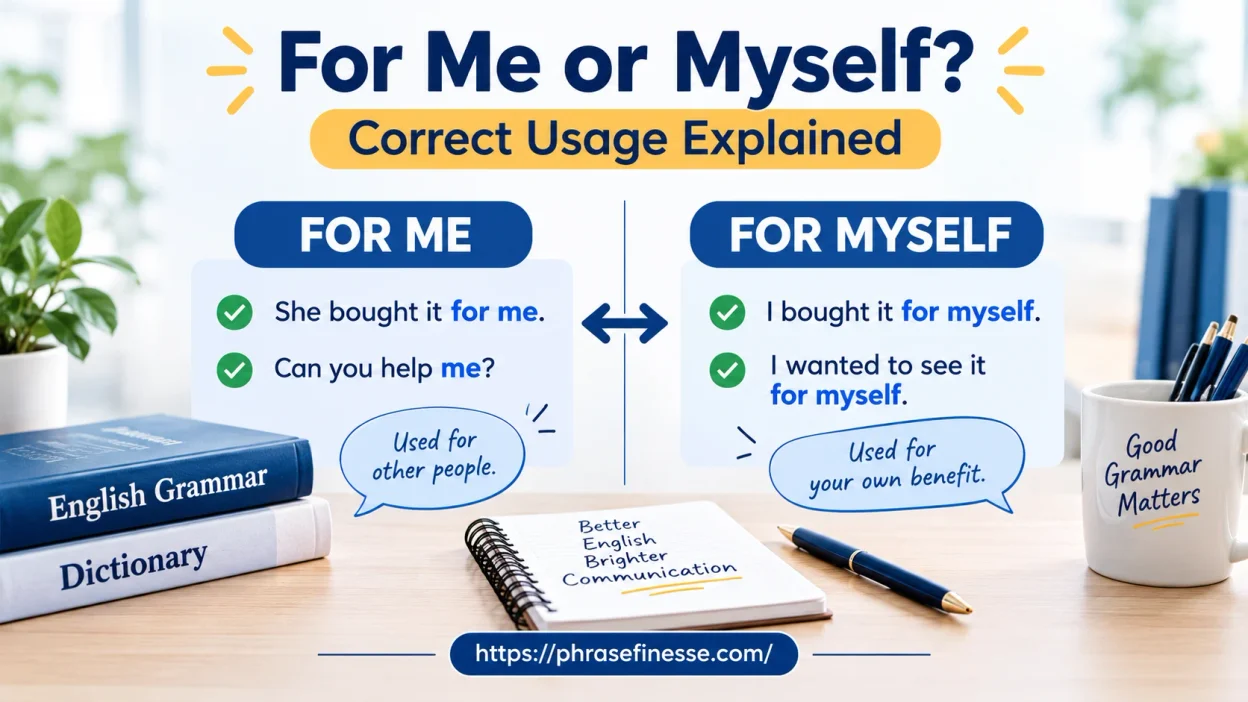
Have you ever paused while writing an email and wondered whether “for me” or “for myself” is the correct choice? Many English learners and native speakers face this same challenge. In this guide, For Me or Myself? Correct Usage Explained you’ll discover when each expression is appropriate, why the difference matters, and how to avoid common mistakes that can affect your English usage, grammar, and overall communication.
Choosing the right phrase is more important than many people realize. Whether you’re handling business communication, participating in meetings, managing a project management update, organizing a calendar, discussing scheduling, or sending messages related to online booking, the words you choose influence clarity and professionalism.
Understanding the distinction between “for me” and “for myself” helps improve formal writing, strengthens consistency, and ensures your message sounds natural in both professional and everyday contexts.
In the sections below, we’ll break down the grammar rules, explain the role of reflexive pronouns, and provide practical examples from real-life situations, including time management, workplace correspondence, and even broadcasting scenarios.
By the end of this article, you’ll know exactly when to use each phrase, recognize common errors instantly, and communicate with greater confidence and precision..
Quick Answer
If you’re looking for the fastest answer, here it is:
- Use for me in most situations.
- Use for myself only when the action refers back to you or when you want to add emphasis.
Examples
✅ 1. Could you save a seat for me?
✅ 2. She bought a gift for me.
✅ 3. I bought a gift for myself.
✅ 4. I wanted to see the results for myself.
❌ 5. She bought a gift for myself.
❌ 6. Please contact John or myself.
In everyday English, for me is far more common than for myself.
What Does “For Me” Mean?
The phrase for me uses the pronoun me, which functions as an object pronoun.
An object pronoun receives the action in a sentence.
Think of it this way:
Someone does something.
That action affects you.
Therefore, me becomes the object.
Examples
- She prepared dinner for me.
- They reserved a room for me.
- Can you carry this bag for me?
- He printed the report for me.
In each example, another person performs the action. You simply receive the benefit of that action.
Why “For Me” Is So Common
Most situations involve actions done by one person that benefit another.
That’s why English speakers naturally use for me much more often than for myself.
For example:
- My friend bought tickets for me.
- My boss scheduled a meeting for me.
- My teacher wrote a recommendation letter for me.
The speaker isn’t performing the action on themselves. Someone else is.
Common Uses of “For Me”
Expressing Benefit
When someone helps you, supports you, or provides something to you, for me is usually correct.
Examples:
- Can you hold the door for me?
- She translated the document for me.
- They arranged transportation for me.
Expressing Preference or Opinion
Another common use appears when sharing personal opinions.
Examples:
- For me, summer is the best season.
- For me, this restaurant serves the best pizza.
- For me, remote work improves productivity.
In these cases, for me means:
“In my opinion” or “from my perspective.”
Expressing Suitability
Examples:
- This schedule works for me.
- The price is reasonable for me.
- That solution isn’t practical for me.
Here, the phrase describes what fits your needs or circumstances.
What Does “For Myself” Mean?
The phrase for myself contains a reflexive pronoun.
A reflexive pronoun refers back to the subject of the sentence.
Reflexive Pronouns in English
| Subject Pronoun | Reflexive Pronoun |
| I | Myself |
| You | Yourself |
| He | Himself |
| She | Herself |
| We | Ourselves |
| They | Themselves |
A reflexive pronoun becomes necessary when the person performing the action and receiving the action is the same person.
Examples
- I bought a laptop for myself.
- I prepared dinner for myself.
- I booked a vacation for myself.
- I saved a copy for myself.
Notice something important.
The word I performs the action.
The word myself receives the action.
Both refer to the same person.
Understanding Reflexive Pronouns
Many grammar mistakes disappear once you understand this simple principle.
Basic Formula
Subject = Object
If the person doing the action and receiving the action are identical, a reflexive pronoun is often required.
Example
Sentence:
I bought a gift for myself.
Analysis:
| Element | Word |
| Subject | I |
| Action | bought |
| Recipient | myself |
Because the subject and recipient are the same person, myself is correct.
Now compare:
She bought a gift for me.
The subject and recipient are different people.
Therefore, me is correct.
When “For Myself” Is Correct
There are two major situations where for myself works perfectly.
Reflexive Actions
This is the most important use.
Examples:
- I purchased a new phone for myself.
- I made breakfast for myself.
- I built a website for myself.
- I created a savings account for myself.
In every sentence, the speaker both performs and receives the action.
Emphasis
Sometimes reflexive pronouns add emphasis rather than serving a grammatical necessity.
Examples:
- I wanted to see it for myself.
- I heard the news for myself.
- I checked the results for myself.
In these situations, for myself highlights personal experience.
The speaker wants to stress direct involvement.
When “For Myself” Is Wrong
Here’s where many professionals make mistakes.
People often assume myself sounds smarter or more formal.
Unfortunately, grammar doesn’t work that way.
Incorrect Examples
❌ 1. Please contact John or myself.
❌ 2. Sarah sent the report to David and myself.
❌ 3. The manager spoke with Karen and myself.
Correct Versions
✅ 1. Please contact John or me.
✅ 2. Sarah sent the report to David and me.
✅ 3. The manager spoke with Karen and me.
The reflexive pronoun rule isn’t satisfied.
The subject isn’t “I.”
Therefore, myself has no grammatical reason to exist.
Why People Overuse “Myself”
This phenomenon has a name:
Hypercorrection.
Hypercorrection occurs when someone tries so hard to sound correct that they accidentally become incorrect.
Workplace Example
Many professionals feel uncomfortable saying:
Contact me.
Instead, they write:
Contact myself.
The second version sounds more formal.
Yet it is grammatically wrong.
Ironically, using me demonstrates a stronger command of English grammar.
For Me vs. For Myself: Side-by-Side Comparison
| Feature | For Me | For Myself |
| Grammar Type | Object Pronoun | Reflexive Pronoun |
| Everyday Usage | Extremely Common | Less Common |
| Requires Same Subject and Object | No | Yes |
| Used for Emphasis | Rarely | Frequently |
| Common in Business Writing | Yes | Sometimes Misused |
| Sounds Natural in Most Cases | Yes | Only When Appropriate |
Simple Rule to Remember
If another person does something that benefits you:
Use for me.
If you do something that benefits yourself:
Use for myself.
Real-Life Examples in Everyday English
Grammar becomes easier when you see it in action.
At Home
✅ She cooked dinner for me.
✅ I cooked dinner for myself.
While Shopping
✅ Can you pick this up for me?
✅ I bought this jacket for myself.
During Travel
✅ The hotel arranged transportation for me.
✅ I planned the entire trip for myself.
At School
✅ My teacher wrote a recommendation letter for me.
✅ I created a study guide for myself.
In Friendships
✅ My friend saved a seat for me.
✅ I saved some money for myself.
Business Writing Examples
Business communication is where these mistakes appear most frequently.
Correct Professional Usage
- Please send the invoice to me.
- The client prepared a proposal for me.
- The assistant scheduled a meeting for me.
- Could you forward the document to me?
Incorrect Professional Usage
- Please send the invoice to myself.
- Contact John or myself.
- Forward the report to Sarah and myself.
These errors are surprisingly common in corporate environments.
Better Alternatives
| Incorrect | Correct |
| Contact myself | Contact me |
| Email myself | Email me |
| Send to John and myself | Send to John and me |
| Reach out to myself | Reach out to me |
Case Study: The Executive Email Mistake
Consider this email:
If you have any questions, please contact Sarah or myself.
Many people assume this sounds professional.
However, grammar experts would rewrite it as:
If you have any questions, please contact Sarah or me.
Why?
Remove Sarah from the sentence:
Please contact myself.
That sounds wrong.
Now try:
Please contact me.
That sounds natural.
The answer becomes obvious.
See More :What Does It Mean When Someone Calls You Sunshine?
The Removal Test: A Quick Grammar Trick
One of the easiest ways to determine whether you need me or myself is the removal test.
Step One
Remove the other person from the sentence.
Example
Original:
Please contact John or me.
Remove John:
Please contact me.
Correct.
Example
Original:
Please contact John or myself.
Remove John:
Please contact myself.
Incorrect.
Why This Trick Works
The test isolates the pronoun and reveals whether it functions naturally.
Professional editors use this technique every day.
Similar Pronoun Mistakes People Make
The confusion surrounding for me and for myself often overlaps with other pronoun errors.
I vs. Me
Incorrect:
John and me went shopping.
Correct:
John and I went shopping.
Me vs. Mine
Incorrect:
The car is me.
Correct:
The car is mine.
Me vs. Myself
Incorrect:
Please email myself.
Correct:
Please email me.
Himself vs. Him
Incorrect:
The award went to himself.
Correct:
The award went to him.
Understanding one pronoun rule often helps you master several others.
Grammar Quiz: Can You Choose the Correct Word?
Question One
She bought flowers for ______.
- Me
- Myself
Answer: Me
Question Two
I purchased a gift for ______.
- Me
- Myself
Answer: Myself
Question Three
Please send the contract to Sarah and ______.
- Me
- Myself
Answer: Me
Question Four
I wanted to experience the event for ______.
- Me
- Myself
Answer: Myself
Question Five
Can you save a seat for ______?
- Me
- Myself
Answer: Me
Common Phrases Using “For Me”
Many English expressions naturally use for me.
Examples include:
- That’s fine for me.
- It works for me.
- Wait for me.
- Speak for me.
- Vote for me.
- Save some for me.
These phrases appear constantly in spoken English.
Replacing me with myself would sound unnatural.
Common Phrases Using “For Myself”
Likewise, several expressions commonly use for myself.
Examples include:
- I decided for myself.
- I wanted to see it for myself.
- I learned it for myself.
- I experienced it for myself.
- I discovered it for myself.
These phrases emphasize personal experience and individual action.
Expert Grammar Insight
A useful rule from traditional English grammar states:
Reflexive pronouns should only appear when they refer back to the sentence’s subject or add emphasis.
This principle has remained consistent across modern style guides, educational materials, and professional editing standards.
Whenever you feel tempted to replace me with myself, pause and ask:
Am I referring back to the subject?
If the answer is no, me is probably the correct choice.
FAQs
1. Is “for me” or “for myself” more common in everyday English?
“For me” is far more common in everyday conversation and writing. It is the standard choice when referring to something intended for you or benefiting you. “For myself” is typically used only in specific grammatical situations involving reflexive or emphatic meaning.
2. When should I use “for myself” instead of “for me”?
Use “for myself” when the subject and object of the sentence refer to the same person or when you want to add emphasis. For example, “I baked a cake for myself” is correct because the action returns to the speaker.
3. Is it wrong to say “Please send it to myself”?
In most cases, yes. The correct phrase is “Please send it to me.” Many people use “myself” in formal settings because it sounds professional, but grammatically, “me” is usually the correct choice.
4. Can “for myself” be used for emphasis?
Yes. “For myself” can emphasize personal involvement or opinion. For example, “I wanted to see the results for myself.” Here, the phrase highlights that the speaker personally verified the results.
5. Are “for me” and “for myself” interchangeable?
No. While they may occasionally appear similar, they serve different grammatical purposes. “For me” functions as an object pronoun phrase, whereas “for myself” uses a reflexive pronoun and follows specific grammar rules.
6. Which phrase is better for professional and business writing?
In most professional contexts, “for me” is the correct and clearer option. Whether you’re writing emails, handling business communication, managing scheduling, or participating in meetings, using the grammatically accurate form improves clarity and professionalism.
Conclusion
Understanding the difference between “for me” and “for myself” is essential for accurate English usage and effective communication. Although these phrases may seem interchangeable at first glance, they serve distinct grammatical functions.
“For me” is the standard choice when referring to something intended for or affecting you, while “for myself” is reserved for reflexive or emphatic situations.
By learning when each phrase is appropriate, you can avoid common mistakes and write with greater confidence. Whether you’re focused on formal writing, business communication, project management, time management, or everyday conversations, choosing the correct expression improves clarity, professionalism, and consistency. Keep the examples from this guide in mind, and you’ll be able to use both phrases naturally and correctly in any context.

Alyan Ashraf is an English language writer and editor at Phrase Finesse, where he specializes in grammar, vocabulary, spelling, word usage, and clear communication. Passionate about the English language, he creates practical, research-backed content that helps readers avoid common mistakes and write with greater accuracy and confidence.
Known for his clear writing style and attention to detail, Alyan simplifies complex language topics into easy-to-understand guides filled with real-world examples and actionable insights. His work covers confusing word pairs, grammar rules, idioms, punctuation, and everyday English usage, making learning both accessible and engaging for students, professionals, writers, and non-native English speakers.
Every article Alyan writes is carefully researched, fact-checked, and designed to meet high editorial standards. His goal is to help readers strengthen their English skills, expand their vocabulary, and communicate more effectively in academic, professional, and everyday settings.
Through Phrase Finesse, Alyan is committed to publishing trusted language resources that make mastering English simpler, clearer, and more enjoyable for learners around the world


[…] See More :For Me or Myself? Correct Usage Explained […]
[…] See More :For Me or Myself? Correct Usage Explained […]