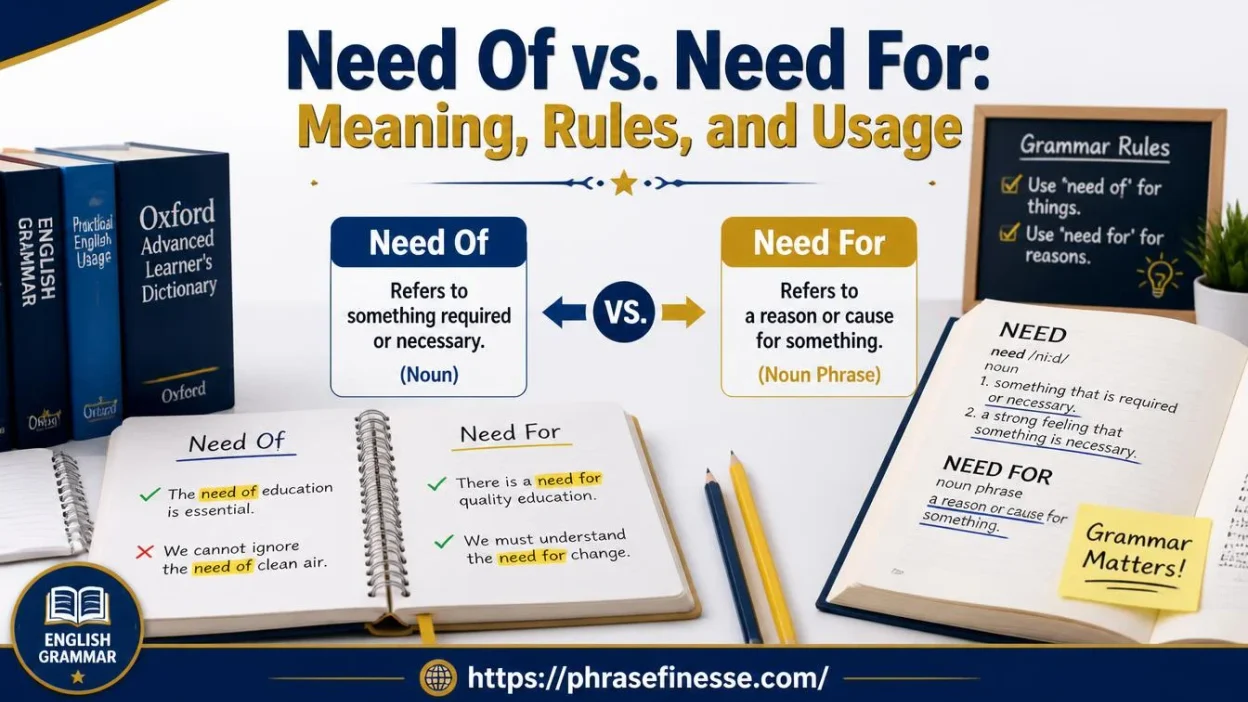
Here’s a polished three-paragraph introduction designed for strong search intent alignment, semantic relevance, readability, and natural keyword usage:Have you ever hesitated over whether to say “need of” or “need for”? You’re not alone. Choosing the right expression can make a noticeable difference in clear English usage, especially when writing professionally.
In this Need Of vs. Need For: Meaning, Rules, and Usage you’ll learn when to use each phrase, why they differ, and which structure sounds natural in modern English.
Although “need for” appears frequently in everyday and formal communication, “need of” has specific grammatical uses that can change the meaning of a sentence. Understanding this distinction helps you write with greater grammar accuracy, consistency, and precision.
Whether you’re preparing formal writing, workplace messages, reports, or everyday sentences, knowing which preposition fits the context can prevent awkward phrasing and confusion.
In this guide, we’ll break down the difference between need of and need for with clear explanations and practical examples. You’ll also see how these phrases work in contexts such as business communication, scheduling, time management, online booking, broadcasting, meetings, calendar planning, and project management.
By the end, you’ll have a simple framework for choosing the right expression confidently and using it naturally in your writing.
Quick Answer:
The short answer is simple:
“Need for” is the correct and commonly used phrase in modern English when you are talking about a requirement or necessity.
Examples:
- There is a need for better communication.
- The company has a need for skilled workers.
- We understand the need for change.
On the other hand, “need of” is rarely used by itself. You will mostly see it inside the fixed phrase:
- in need of
Examples:
- The house is in need of repairs.
- Many families are in need of support.
Here is a quick comparison:
| Phrase | Correct Usage | Example |
| Need for | Shows a requirement or necessity | There is a need for more research. |
| Need of | Rare when used alone | The phrase sounds outdated. |
| In need of | Shows someone or something requires help or attention | The patient is in need of care. |
A simple rule can help:
Use “need for” when something is required. Use “in need of” when someone or something lacks something important.
What Does “Need For” Mean?
The phrase “need for” describes a requirement, necessity, or reason something is important.
When you say there is a need for something, you mean that something is missing, required, or necessary to achieve a goal.
Think of it like a puzzle. If one piece is missing, there is a need for that piece before the picture becomes complete.
For example:
- A business may have a need for experienced employees.
- A student may have a need for extra study time.
- A community may have a need for clean drinking water.
In each sentence, something is required.
Need For Grammar Structure
The most common structure is:
Need for + noun
Examples:
- The need for education continues to grow.
- There is a need for patience when learning a new language.
- The need for technology has increased worldwide.
The word after for usually names the thing that is required.
| Sentence | What Is Required? |
| There is a need for training. | Training |
| We have a need for better tools. | Better tools |
| Scientists see a need for new solutions. | New solutions |
Examples of “Need For” in Different Situations
The phrase appears everywhere, from everyday conversations to professional writing.
1. Everyday English
In normal conversations, people use need for when discussing necessities.
Examples:
- There is no need for worry.
- I understand the need for rest after a long day.
- We have a need for more space in this room.
Notice how the phrase focuses on the requirement itself.
2. Business and Workplace Writing
Businesses frequently use need for when discussing goals, resources, and improvements.
Examples:
- The company recognized the need for better customer service.
- Managers discussed the need for stronger communication.
- The project created a need for additional employees.
In professional writing, need for sounds natural and clear.
3. Academic Writing
Researchers often use this phrase when explaining why a study or investigation matters.
Examples:
- This research highlights the need for further investigation.
- Scientists identified a need for new methods.
- The study shows the need for improved healthcare systems.
Academic writers use need for because it clearly expresses necessity.
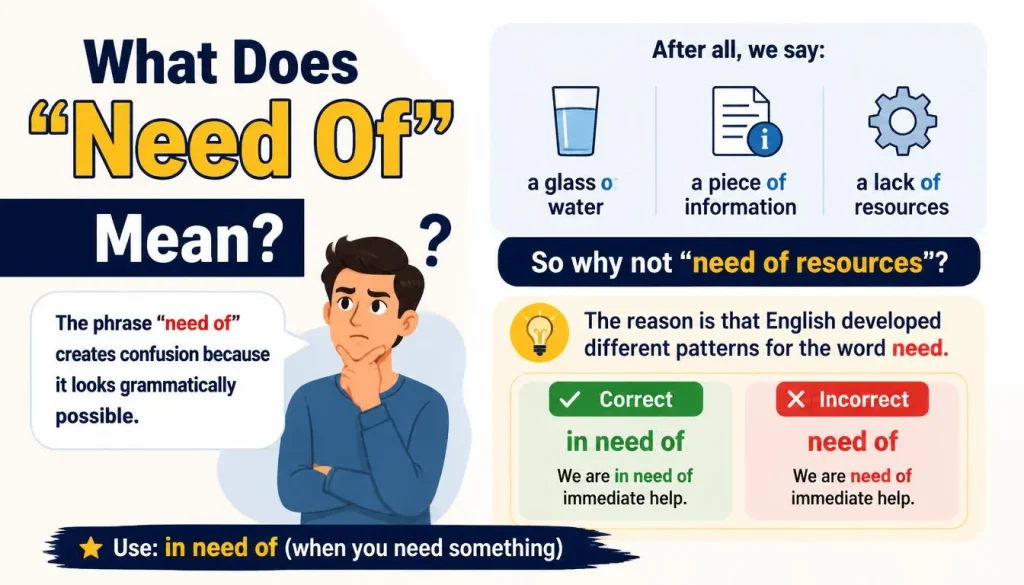
What Does “Need Of” Mean?
The phrase “need of” creates confusion because it looks grammatically possible. After all, we say:
- a glass of water
- a piece of information
- a lack of resources
So why not “need of resources”?
The reason is that English developed different patterns for the word need.
Modern English usually uses:
- need for + noun
- in need of + noun
- need + noun (when need works as a verb)
Using need of alone often sounds old-fashioned or unnatural.
For example:
❌ There is a need of more workers.
Most modern speakers would say:
✅ There is a need for more workers.
When Is “Need Of” Correct?
Although need of is uncommon, it is not completely impossible.
You may find it in older or highly formal writing.
For example:
- The organization has need of additional funding.
This sentence is grammatically possible, but it sounds formal and unusual today.
A more natural modern version would be:
- The organization needs additional funding.
- The organization has a need for additional funding.
English changes over time. Some expressions remain in books or legal documents while everyday speakers choose simpler alternatives.
Why “In Need Of” Is Correct
Many learners wonder:
“If need of is wrong, why is in need of correct?”
The answer lies in the complete phrase.
“In need of” is a fixed expression. It works as one unit.
The word in changes the structure and creates a phrase that means:
needing something because it is missing, damaged, unavailable, or necessary.
Examples:
- The car is in need of repair.
- The child is in need of medical attention.
- The building is in need of renovation.
You should not remove in from this expression.
Compare:
| Incorrect | Correct |
| The car is need of repair. | The car is in need of repair. |
| She is need of help. | She is in need of help. |
| The house needs of painting. | The house is in need of painting. |
The phrase works because “in need of” has its own meaning and grammatical role.
Need For vs In Need Of: Key Difference
Although these phrases look similar, they focus on different ideas.
| Phrase | Meaning | Example |
| Need for | Something is required | There is a need for more teachers. |
| In need of | Someone or something requires help or improvement | The school is in need of repairs. |
Here is another way to remember it:
Need for = demand
In need of = condition
Example:
- The city has a need for more hospitals.
(The city requires more hospitals.) - The old hospital is in need of repairs.
(The hospital needs fixing.)
The first sentence discusses a missing resource. The second describes a problem with something that already exists.
Common Real-Life Examples of “Need For”
Understanding phrases becomes easier when you see them in realistic situations.
Example 1: Education
A school notices that students struggle with technology.
The principal says:
“There is a need for better computer equipment.”
The phrase explains what the school requires.
Example 2: Healthcare
A hospital experiences more patients than expected.
A report states:
“The region has a growing need for healthcare professionals.”
Again, need for identifies a requirement.
Example 3: Technology
A company wants to protect customer information.
The manager explains:
“There is a need for stronger cybersecurity systems.”
The phrase shows the reason behind an action.
Common Mistakes With Need Of and Need For
Many mistakes happen because people translate directly from their first language.
Here are the most common errors:
| Wrong Sentence | Better Sentence | Reason |
| There is a need of change. | There is a need for change. | Requirement uses “for.” |
| We have need of help. | We need help. | Modern English uses the verb form. |
| The machine is need of repair. | The machine is in need of repair. | Fixed phrase requires “in.” |
| They discussed the need of improvement. | They discussed the need for improvement. | Noun “need” takes “for.” |
Need Of vs Need For Grammar Rules Explained
Understanding the grammar behind need of vs need for becomes much easier when you first understand how the word need functions in a sentence.
The word need can act as:
- A verb (an action or requirement)
- A noun (a thing that is required)
The correct phrase depends on which role need plays.
When “Need” Works as a Verb
When need acts as a verb, you usually do not add for or of after it.
The basic structure is:
Subject + need + object
Examples:
- I need help.
- She needs more time.
- They need information.
- We need better solutions.
In these examples, need directly connects with the thing required.
You do not say:
❌ I need of help.
❌ She needs for more time.
The correct versions are:
✅ I need help.
✅ She needs more time.
See More : Become or Became? Difference With Examples
Need as a Verb With “To”
When you need to describe an action, use:
Need + to + verb
Examples:
- I need to study tonight.
- You need to complete the form.
- They need to improve their communication skills.
- The machine needs to be repaired.
Here, the word after need describes an action.
| Incorrect | Correct |
| I need to of study. | I need to study. |
| She needs for to leave. | She needs to leave. |
| They need of improving. | They need to improve. |
When “Need” Works as a Noun
When need becomes a noun, English usually follows it with for.
The structure is:
Need + for + noun
Examples:
- The need for education is increasing.
- The need for safety is important.
- The need for communication has never been greater.
- The need for reliable information continues to grow.
Here, need represents a requirement or necessity.

Need For in Formal and Professional Writing
The phrase need for appears frequently in:
- Business reports
- Academic papers
- Research articles
- Government documents
- Professional emails
Why?
Because it clearly explains a reason or requirement.
For example:
“The project revealed a need for additional funding.”
This sentence sounds professional because it identifies a specific requirement.
Compare it with:
“The project revealed a need of additional funding.”
The second sentence feels unnatural because modern English speakers do not normally use that structure.
Need For vs Need Of Comparison Table
| Point | Need For | Need Of |
| Modern English usage | Very common | Rare |
| Used in everyday speech | Yes | Almost never |
| Used in business writing | Yes | Uncommon |
| Shows a requirement | Yes | Usually no |
| Works in fixed expressions | Sometimes | Mainly in “in need of” |
| Recommended for learners | Yes | Avoid unless part of a fixed phrase |
Real-Life Examples of Need For
1. Workplace Example
Imagine a company notices employees struggle with new software.
A manager might say:
“There is a need for additional training.”
The phrase explains what employees require.
2. Student Example
A student preparing for exams may say:
“I understand the need for better time management.”
The student recognizes that improved organization is necessary.
3. Community Example
A town experiencing water shortages may report:
“There is an urgent need for clean drinking water.”
The phrase highlights an important requirement.
Need Of vs Need For: Common Confusing Examples
Some sentences look correct because they follow patterns from other English expressions. However, they do not match standard usage.
Let’s examine them.
Example 1
❌ There is a need of more employees.
Why does it sound wrong?
Because need is acting as a noun, and nouns usually take for when showing a requirement.
Better:
✅ There is a need for more employees.
Example 2
❌ The company has need of new equipment.
This sentence is technically understandable, but it sounds old-fashioned.
Better:
✅ The company needs new equipment.
or
✅ The company has a need for new equipment.
Example 3
❌ The building is need of repairs.
The problem is the missing word in.
Correct:
✅ The building is in need of repairs.
Case Study: How Small Grammar Choices Change Professional Writing
Consider these two workplace emails.
Version One
“There is a need of improving our customer service process.”
The meaning is understandable, but the phrase sounds unnatural.
Version Two
“There is a need for improving our customer service process.”
This version sounds more natural because need for correctly introduces the requirement.
An even smoother option would be:
“We need to improve our customer service process.”
The best choice often depends on your writing style.
- Formal report: There is a need for improvement.
- Direct communication: We need to improve.
Need For vs Need To: What Is the Difference?
Many learners confuse need for with need to.
They have different grammar structures.
Need For
Used with a noun.
Examples:
- The need for exercise is well known.
- There is a need for better planning.
Meaning:
Something is required.
Need To
Used with a verb.
Examples:
- You need to exercise.
- We need to plan better.
Meaning:
Someone must perform an action.
Comparison Table
| Phrase | Structure | Example |
| Need for | Need + for + noun | The need for preparation |
| Need to | Need + to + verb | Need to prepare |
| Need | Need + noun | Need preparation |
Common Mistakes English Learners Make
Mistake 1: Adding “Of” After Need
Incorrect:
I have need of assistance.
Correct:
I need assistance.
or
I have a need for assistance.
Mistake 2: Forgetting “In” Before Need Of
Incorrect:
The car is need of repair.
Correct:
The car is in need of repair.
Mistake 3: Using “Need For” With a Verb
Incorrect:
There is a need for improve communication.
Correct:
There is a need for improved communication.
or
There is a need to improve communication.
Why?
Because for normally introduces a noun, not a base verb.
Need For or Need To: Quick Decision Guide
Ask yourself:
Are you naming something required?
Use:
✅ Need for
Examples:
- A need for change
- A need for support
- A need for improvement
Are you describing an action someone must take?
Use:
✅ Need to
Examples:
- Need to change
- Need to support
- Need to improve
Synonyms for “Need For”
Depending on the context, you can replace need for with other expressions.
| Synonym | Meaning | Example |
| Requirement for | Something necessary | A requirement for approval |
| Necessity for | Something essential | The necessity for safety |
| Demand for | A strong requirement or market desire | Increased demand for housing |
| Reason for | A cause or explanation | The reason for the change |
| Call for | A situation requiring action | The issue calls for attention |
However, these words do not always mean exactly the same thing.
For example:
- Need for = something required
- Demand for = something wanted or requested strongly
- Reason for = explanation behind something
Memory Trick: How to Remember Need Of vs Need For
A simple trick can prevent most mistakes:
Needs create requirements, so use “for.”
Examples:
- Need for food
- Need for education
- Need for improvement
However:
Problems create conditions, so use “in need of.”
Examples:
- A house in need of repair
- A person in need of help
- A system in need of updates
Think of it this way:
Need for = something you want to get.
In need of = something that needs fixing or receiving.
Need Of vs Need For in Different Types of Writing
Casual Conversation
Natural:
- I need help.
- We need more time.
- There is a need for change.
Avoid:
- I have need of help.
Business Communication
Recommended:
- The report highlights the need for improvement.
- We identified a need for additional resources.
Avoid:
- The report highlights the need of improvement.
Academic Writing
Recommended:
- This research demonstrates the need for further study.
- The findings show a need for better strategies.
Creative Writing
Both may appear depending on style.
For example:
“The old village stood in need of protection.”
This sounds literary because in need of creates a more descriptive tone.
FAQs
1. Is it “need for” or “need of”?
“Need for” is generally the more common and natural choice when you mean that something is required or necessary. For example, “There is a need for better communication” means better communication is necessary.
“Need of” has more specific uses. It commonly appears in the expression “in need of,” as in “The office is in need of repairs.” It can also occur in formal or older constructions.
2. What is the difference between “need for” and “need of”?
The main difference lies in meaning and grammatical structure. “Need for” usually introduces something that is necessary, while “in need of” describes someone or something that requires help, attention, or a particular thing.
For example:
- There is a need for more staff.
- The department is in need of more staff.
Both sentences communicate necessity, but they use different grammatical patterns.
3. Is “need of” grammatically correct?
Yes, “need of” can be grammatically correct, but it usually appears within a specific construction. The most common example is “in need of.”
For instance:
The project is in need of additional funding.
Using “need of” without the appropriate structure can sound unnatural in modern English. When you’re expressing a general requirement, “need for” is often the better choice.
4. Can I use “need for” in formal writing?
Yes. “Need for” works well in formal writing, academic contexts, reports, and professional communication. For example:
The company identified a need for improved project management.
You can also use it when discussing business communication, scheduling, meetings, time management, and workplace planning. The key is to make sure the phrase accurately expresses necessity.
5. Which is more common: “need for” or “need of”?
“Need for” is generally more common when expressing the requirement or necessity of something. For example, you might write about the need for consistency, the need for better scheduling, or the need for effective communication.
However, “in need of” remains a standard and widely used expression. The choice depends on the sentence structure and intended meaning rather than frequency alone.
6. How can I remember when to use “need for” and “need of”?
A simple way to remember the distinction is to associate “need for” with necessity and “in need of” with requiring something.
- Need for: There is a need for better time management.
- In need of: The team is in need of better time management.
When you’re unsure, read the complete sentence aloud. If “need for” clearly expresses that something is necessary, it will usually be the natural choice. For “need of,” check whether the sentence properly uses the established phrase “in need of.”
Conclusion
Understanding need of vs. need for becomes much easier once you recognize their different grammatical patterns. In most situations, use “need for” when you want to describe a requirement or necessity. Use “in need of” when you want to explain that someone or something requires a particular thing.
This small distinction can improve your English usage, formal writing, and business communication. Whether you’re writing about meetings, scheduling, online booking, broadcasting, calendar planning, or project management, choosing the right preposition makes your message clearer and more professional. When in doubt, focus on the meaning and structure of the complete sentence rather than relying on the words in isolation.

Emma Brooke is an English language specialist, editor, and content writer at Phrase Finesse, where she helps readers develop stronger writing and communication skills through clear, practical, and engaging content. With a passion for the English language, she specializes in simplifying grammar rules, vocabulary, spelling, punctuation, and word usage for learners at every level.
Emma has extensive experience creating educational content that is accurate, well-researched, and easy to understand. She is particularly skilled at explaining confusing word pairs, grammar concepts, idioms, sentence structure, and effective writing techniques, making complex topics approachable for students, professionals, educators, and English learners worldwide.