
Have you ever wondered whether “Hundred Thousands” or “Hundreds Of Thousands” is the correct expression in English? Many writers and speakers confuse these phrases because both seem similar, but they follow different grammar rules, number expressions, and English usage patterns.
In this guide, “Hundred Thousands” Or “Hundreds Of Thousands”? Learn It Here!” will help you understand the correct form, common mistakes, and practical examples for clearer formal writing and everyday communication.
Understanding the difference between hundred, hundreds, and thousands improves your grammar accuracy and helps you communicate numbers more naturally. Whether you are writing reports, managing business communication, preparing meetings, creating schedules through calendar tools, or handling project management documents, choosing the right numerical expression ensures clarity and consistency.
Correct number usage also matters in areas like online booking, broadcasting, and professional content where precise information builds trust.
This article will explain when to use “hundred thousands” and when to use “hundreds of thousands” with simple explanations and real-world examples.
You’ll learn the difference between exact numbers and approximate quantities, improve your English usage, and avoid common mistakes in spoken and written English. By the end, you’ll have a clear understanding of these expressions and feel more confident using them in both casual conversations and professional formal writing.
Quick Answer
The short answer is simple:
✅ Hundreds of thousands is the correct and natural expression in standard English.
❌ Hundred thousands is generally considered incorrect in modern English usage.
For example:
- Hundreds of thousands of people attended the festival.
- The video received hundreds of thousands of views.
- Hundreds of thousands of dollars were donated.
These examples sound natural because English uses the structure:
Plural number word + of + noun
When discussing an approximate large quantity.
By contrast:
- Hundred thousands of people attended. ❌
This construction sounds awkward and ungrammatical to most native speakers.
Understanding the Difference at a Glance
| Expression | Correct? | Meaning |
| Hundred thousands | ❌ Usually incorrect | Nonstandard construction |
| Hundreds of thousands | ✅ Correct | A large but unspecified number between roughly 200,000 and 999,999 |
| One hundred thousand | ✅ Correct | Exactly 100,000 |
| Five hundred thousand | ✅ Correct | Exactly 500,000 |
The key difference is whether you’re expressing an exact quantity or an approximate quantity.
What Does “Hundreds of Thousands” Mean?
The phrase hundreds of thousands refers to a very large number, usually somewhere between 200,000 and 999,999.
It doesn’t specify an exact figure. Instead, it communicates scale.
For example:
- Hundreds of thousands of visitors travel to the park annually.
- Hundreds of thousands of books were sold.
- Hundreds of thousands of fans watched the livestream.
In each sentence, the exact number isn’t important. The emphasis is on the fact that the amount is very large.
Why Writers Use It
Sometimes exact numbers aren’t available.
Other times, the precise figure doesn’t matter.
Imagine saying:
487,263 people attended.
That’s accurate.
However, in casual conversation or general writing, you might simply say:
Hundreds of thousands attended.
The message remains clear while sounding more natural.
Why “Hundred Thousands” Is Usually Incorrect
To understand why hundred thousands sounds wrong, you need to understand how English forms large numbers.
English treats large-number words differently depending on whether the quantity is exact or approximate.
Consider these examples:
- One hundred thousand
- Two hundred thousand
- Three hundred thousand
These are exact numbers.
Notice that hundred remains singular.
The same rule applies to:
- One hundred
- Two hundred
- Five hundred
English does not usually pluralize “hundred” after a specific number.
You wouldn’t write:
- Two hundreds ❌
- Five hundreds ❌
Instead:
- Two hundred ✓
- Five hundred ✓
The same pattern extends to larger numbers.
Therefore:
- Three hundred thousand ✓
- Three hundred thousands ❌
The Missing Word That Changes Everything
When expressing an approximate quantity, English introduces a different structure.
Instead of:
Hundred thousands
English uses:
Hundreds of thousands
The word of creates a grammatical bridge between the pluralized quantity and the larger unit.
Compare:
| Incorrect | Correct |
| Hundred thousands | Hundreds of thousands |
| Thousand millions | Thousands of millions |
| Million billions | Millions of billions |
The preposition of is essential.
Without it, the phrase sounds incomplete.
The Grammar Rule Behind Large Number Expressions
Once you understand this rule, you’ll rarely make mistakes with large numbers again.
The pattern works like this:
Exact Quantities
When a specific number comes first, use the singular form.
Formula
Number + hundred/thousand/million/billion
Examples
- One hundred thousand
- Four hundred thousand
- Seven hundred thousand
- Ten million
- Fifty billion
Notice something interesting:
Even though the quantity is plural, the word itself remains singular.
You say:
- Five hundred
- Six thousand
- Eight million
Not:
- Five hundreds ❌
- Six thousands ❌
- Eight millions ❌
Approximate Quantities
When discussing a large but uncertain amount, pluralize the number word and add of.
Formula
Plural number word + of + noun
Examples
- Hundreds of thousands
- Thousands of people
- Millions of dollars
- Billions of stars
This structure signals approximation rather than precision.
Hundreds of Thousands vs. Hundred Thousand
Many learners confuse these expressions because both involve similar words.
Let’s compare them directly.
| Phrase | Type | Meaning |
| Hundred thousand | Exact | Precisely 100,000 |
| Hundreds of thousands | Approximate | Somewhere between roughly 200,000 and 999,999 |
Example of Exact Usage
- The city has a population of one hundred thousand.
Here, the number is precise.
Example of Approximate Usage
- Hundreds of thousands of tourists visit annually.
The exact figure isn’t specified.
When to Use “Hundred Thousand”
Use this expression after a specific number.
Examples:
- One hundred thousand dollars
- Three hundred thousand residents
- Six hundred thousand subscribers
- Nine hundred thousand users
These are exact quantities.
No “of” is needed.
No plural form is needed.
When to Use “Hundreds of Thousands”
Use this phrase when the number is large but not exact.
Examples:
- Hundreds of thousands of people attended.
- Hundreds of thousands of homes lost power.
- Hundreds of thousands of viewers watched live.
This construction emphasizes magnitude rather than accuracy.
Similar Expressions That Follow the Same Rule
The rule isn’t limited to hundreds of thousands.
English uses the same pattern for many numerical expressions.
| Exact Quantity | Approximate Quantity |
| One thousand | Thousands of |
| Two million | Millions of |
| Three billion | Billions of |
| Four hundred thousand | Hundreds of thousands |
Understanding one pattern helps you master all of them.
Examples Across Different Contexts
Travel
- Thousands of tourists visit the island every year.
- Hundreds of thousands of passengers use the airport annually.
Technology
- Millions of users download the app.
- Hundreds of thousands of accounts are created monthly.
Finance
- Billions of dollars move through stock markets daily.
- Hundreds of thousands of dollars were raised.
Science
- Millions of stars exist within a galaxy.
- Hundreds of thousands of species inhabit tropical rainforests.
The structure remains consistent regardless of topic.
Real-World Examples of “Hundreds of Thousands”
One of the best ways to understand a phrase is to see it used in authentic situations.
Population and Migration
Governments often report that hundreds of thousands of people move between regions every year.
For example:
- Hundreds of thousands relocate for work.
- Hundreds of thousands apply for visas annually.
The exact number changes each year, making approximation practical.
Social Media Growth
Content creators frequently use the phrase when discussing audience size.
Examples:
- The post received hundreds of thousands of likes.
- Hundreds of thousands of users shared the video.
- Hundreds of thousands of comments were posted.
This wording feels more natural than citing exact statistics every time.
Natural Disasters
News organizations commonly report:
- Hundreds of thousands of residents evacuated.
- Hundreds of thousands lost electricity.
- Hundreds of thousands required assistance.
Again, the focus is on scale.
Business and Sales
Companies often announce:
- Hundreds of thousands of units sold.
- Hundreds of thousands of customers served.
- Hundreds of thousands of orders processed.
These statements highlight success without overwhelming readers with exact figures.
A Simple Case Study: Why Approximate Numbers Matter
Imagine two headlines:
Headline A
468,294 People Attend Annual Festival
Headline B
Hundreds of Thousands Attend Annual Festival
Both communicate essentially the same idea.
However, the second headline is:
- Easier to read
- Easier to remember
- Faster to understand
This is why journalists, marketers, and professional writers frequently use approximate numerical expressions.
They communicate impact instantly.
Common Mistakes and How to Avoid Them
Even experienced writers occasionally make errors with large-number expressions.
Let’s examine the most common ones.
Mistake: Writing “Hundred Thousands”
Incorrect:
Hundred thousands of people attended.
Correct:
Hundreds of thousands of people attended.
Why?
English requires both:
- The plural form (hundreds)
- The preposition (of)
Without them, the phrase sounds unnatural.
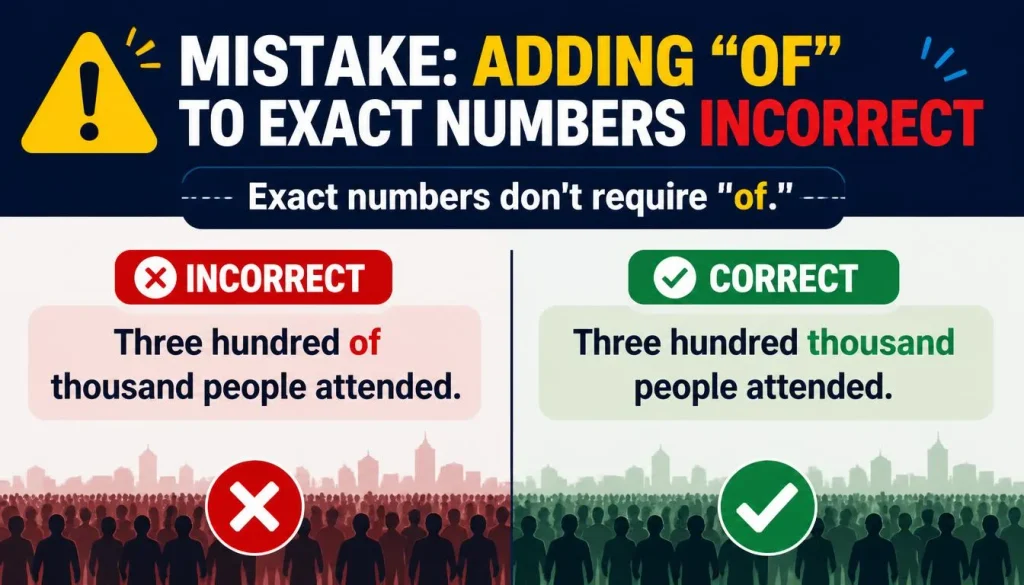
Mistake: Adding “Of” to Exact Numbers
Incorrect:
Three hundred of thousand people attended.
Correct:
Three hundred thousand people attended.
Exact numbers don’t require “of.”
Mistake: Pluralizing Exact Numbers
Incorrect:
Five hundreds thousand dollars
Correct:
Five hundred thousand dollars
After a specific number, “hundred” remains singular.
See More :For Me or Myself? Correct Usage Explained
Mistake: Mixing Exact and Approximate Structures
Incorrect:
Five hundreds of thousands
Correct:
Five hundred thousand
or
Hundreds of thousands
Choose one structure.
Don’t combine them.
How Native Speakers Actually Use These Expressions
Native English speakers overwhelmingly prefer:
- Hundreds of thousands
- Thousands of
- Millions of
- Billions of
These forms appear regularly in:
- Newspapers
- Academic writing
- Business reports
- Books
- Government publications
- Everyday conversation
The phrase hundred thousands rarely appears in modern English outside translation errors, learner mistakes, or unusual historical texts.
Can “Hundred Thousands” Ever Be Correct?
Technically, you may occasionally encounter the phrase in specialized contexts.
Examples include:
- Literal translations
- Historical documents
- Non-native writing
- Certain technical datasets
However, these instances are uncommon.
Modern style guides and standard English usage overwhelmingly favor:
Hundreds of thousands
If your goal is natural English, use that form.
A Helpful Comparison Table
| Purpose | Correct Expression | Example |
| Exact 100,000 | One hundred thousand | One hundred thousand tickets sold |
| Exact 500,000 | Five hundred thousand | Five hundred thousand subscribers |
| Approximate 200,000–999,999 | Hundreds of thousands | Hundreds of thousands attended |
| Approximate millions | Millions of | Millions of users joined |
| Approximate billions | Billions of | Billions of stars exist |
Memory Trick for Never Getting It Wrong
Here’s a simple shortcut.
Exact Number?
Use:
Hundred thousand
Examples:
- Two hundred thousand
- Seven hundred thousand
Large Unknown Number?
Use:
Hundreds of thousands
Examples:
- Hundreds of thousands of readers
- Hundreds of thousands of customers
Think of it this way:
Specific number = No “of”
Approximate number = Plural + “of”
This single rule works for:
- Hundreds of
- Thousands of
- Millions of
- Billions of
Examples You Can Copy and Use
1. In Business
- The company generated hundreds of thousands of dollars in revenue.
- Hundreds of thousands of products were shipped worldwide.
2. In Education
- Hundreds of thousands of students take standardized tests annually.
- Hundreds of thousands of books are distributed to schools.
3. In Technology
- Hundreds of thousands of users downloaded the update.
- Hundreds of thousands of devices remain active.
4. In Entertainment
- Hundreds of thousands of fans attended the concert.
- Hundreds of thousands watched the premiere online.
5. In Government
- Hundreds of thousands of applications were submitted.
- Hundreds of thousands of households benefited from the program.
Quick Reference Guide
| If You Mean… | Use This Form |
| Exactly 100,000 | One hundred thousand |
| Exactly 300,000 | Three hundred thousand |
| Roughly 200,000–999,999 | Hundreds of thousands |
| Roughly several thousand | Thousands of |
| Roughly several million | Millions of |
Bookmark this rule and you’ll avoid one of the most common large-number grammar mistakes in English.
FAQs
1. Which one is correct: “hundred thousands” or “hundreds of thousands”?
The correct choice depends on the meaning you want to express. Use “hundred thousand” when you mention an exact number, such as one hundred thousand or five hundred thousand. Use “hundreds of thousands” when you describe a large amount without giving a specific figure.
Examples:
- The company received two hundred thousand applications.
- The website attracted hundreds of thousands of visitors.
2. Why do we say “hundreds of thousands”?
We use “hundreds of thousands” to talk about an approximate quantity. It shows that the number is very large, but the exact amount is not important or not known.
Examples:
- Hundreds of thousands of people attended the festival.
- The video gained hundreds of thousands of views.
This expression is common in business communication, news reports, and everyday English usage.
3. Can I write “three hundreds thousand”?
No, “three hundreds thousand” is incorrect. When a specific number comes before hundred, the word hundred stays singular.
Correct:
- The project cost three hundred thousand dollars.
Incorrect:
- The project cost three hundreds thousand dollars.
This rule helps maintain accuracy in formal writing and professional documents.
4. Is “hundreds of thousands” used in professional writing?
Yes, “hundreds of thousands” is widely used in professional contexts when an exact figure is unnecessary. It appears in reports, project management updates, financial discussions, and official announcements.
Examples:
- The campaign reached hundreds of thousands of users.
- The organization helped hundreds of thousands of families.
Using the right expression improves clarity and consistency.
5. Can “hundred thousand” be plural?
No, “hundred thousand” does not become plural after a specific number. The words hundred and thousand remain singular when they follow an exact number.
Examples:
- One hundred thousand dollars
- Four hundred thousand customers
- Six hundred thousand records
However, when speaking generally, use hundreds of thousands.
6. How do I avoid mistakes with these number expressions?
Remember the difference between exact and approximate quantities:
- Exact amount: Use a number + hundred thousand.
- Estimated amount: Use hundreds of thousands.
Practicing these patterns will improve your grammar skills, strengthen your formal writing, and help you communicate numbers more effectively.
Conclusion
Knowing when to use “hundred thousand” and “hundreds of thousands” helps you express numbers clearly and correctly. The key difference is whether you are referring to a specific figure or a general large quantity.
Correct number expressions play an important role in English usage, professional communication, and accurate writing. Whether you are creating reports, preparing meetings, managing a calendar, or writing online content, choosing the right phrase makes your message easier to understand and more polished.