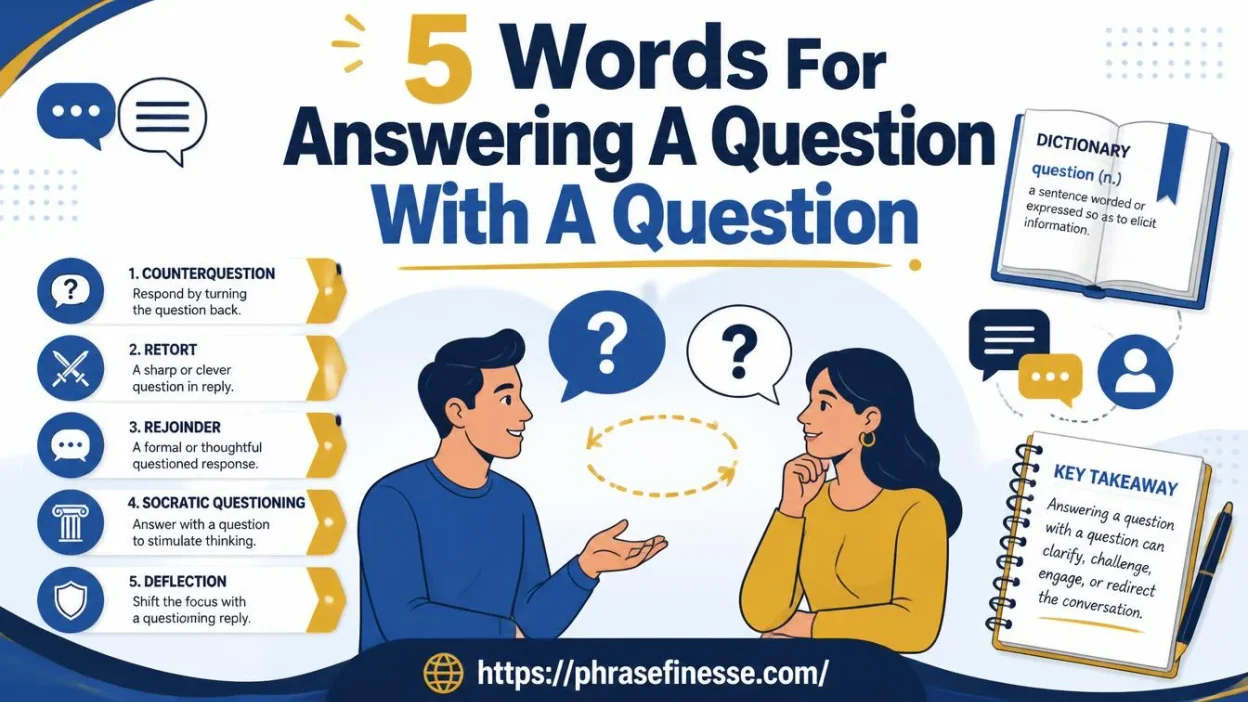
Have you ever asked someone a question only to receive another question in return? This common conversation technique appears in everyday discussions, debates, interviews, and professional settings.
Understanding the 5 Words For Answering A Question With A Question can help you describe this communication style more accurately while improving your knowledge of English usage, grammar, and effective conversation strategies.
Whether used to seek clarification, challenge an assumption, redirect a discussion, or encourage deeper thinking, answering a question with another question serves many purposes. You may encounter it in business communication, formal writing, broadcasting, workplace meetings, and even customer interactions involving online booking, scheduling, calendar management, time management, and project management discussions.
Choosing the right word for this rhetorical approach can make your communication more precise and professional.
In this guide, you’ll discover five useful words that describe the act of answering a question with a question, along with their meanings, examples, and practical usage. We’ll also explore subtle differences between these terms, common contexts where they appear, and tips for maintaining clarity and consistency in both spoken and written communication.
By the end, you’ll know exactly which word fits each situation and how to use it confidently.
What Does It Mean To Answer A Question With A Question?
Answering a question with a question occurs when someone responds to an inquiry by asking another question instead of providing a direct answer.
For example:
Person A: “Why were you late?”
Person B: “Have you ever been stuck in traffic during rush hour?”
Rather than answering immediately, Person B introduces another question.
This technique serves many purposes, including:
- Clarifying unclear information
- Challenging assumptions
- Encouraging critical thinking
- Gathering context
- Redirecting the conversation
- Avoiding uncomfortable topics
The intention behind the response often determines which specific term best describes it.
A Quick Example
Consider this conversation:
Manager: “Why did sales decline this quarter?”
Analyst: “Have we considered the impact of the new pricing strategy?”
The analyst isn’t avoiding the issue. Instead, they’re encouraging a deeper examination of the problem.
This type of response differs significantly from someone who asks a question merely to dodge accountability.
Counterquestion
Meaning
A counterquestion is the most direct and accurate word for answering a question with another question.
The term literally describes a question asked in response to a previous question.
Many dictionaries and linguistic references recognize counterquestion as the standard label for this communication pattern.
When To Use It
A counterquestion works well when:
- You need clarification
- More context is required
- The original question contains assumptions
- Additional information would improve the discussion
Examples
“Can you finish this project today?”
“Which part of the project needs priority?”
“Why do you think the proposal failed?”
“Did the client approve the final version?”
Advantages
| Benefit | Explanation |
| Clarifies information | Prevents misunderstandings |
| Improves discussion quality | Encourages deeper analysis |
| Identifies assumptions | Reveals hidden issues |
| Saves time | Gets relevant details quickly |
Drawbacks
- May frustrate impatient listeners
- Can appear evasive if overused
- Sometimes delays direct answers
Real-World Example
Lawyers frequently use counterquestions during cross-examinations. Instead of immediately answering, they ask targeted questions to uncover facts and expose inconsistencies.
Retort
Meaning
A retort is a sharp, quick, and often witty response. It may take the form of a question.
Retorts frequently appear during disagreements, debates, and humorous exchanges.
When To Use It
Retorts commonly appear in:
- Friendly banter
- Comedy
- Arguments
- Competitive discussions
Examples
“Do you really think that’s a good idea?”
“Do you really think it’s not?”
“Who made you the expert?”
“Who says expertise requires your approval?”
Advantages
- Creates memorable responses
- Adds humor
- Challenges criticism
- Demonstrates confidence
Drawbacks
- Can sound sarcastic
- May escalate conflict
- Often appears confrontational
Case Study: Political Debates
Politicians frequently employ retorts during televised debates.
When challenged, a candidate might respond:
“Why did your administration fail to solve the problem?”
Instead of answering directly, they return the challenge.
This technique can energize supporters but may frustrate audiences seeking clear answers.
Rejoinder
Meaning
A rejoinder is a reply to an argument, statement, or question.
Unlike a retort, a rejoinder often sounds more formal and reasoned.
It is common in legal discussions, academic debates, and professional conversations.
When To Use It
You’ll often see rejoinders in:
- Courtrooms
- Academic journals
- Public debates
- Formal discussions
Examples
“Why should we trust this data?”
“What evidence suggests the data is unreliable?”
“Is this policy effective?”
“Compared to which alternative?”
Advantages
- Encourages evidence-based discussion
- Keeps conversations focused
- Promotes logical thinking
Drawbacks
- May sound overly formal
- Can seem argumentative
- Not ideal for casual conversations
Expert Insight
Many debate coaches encourage students to use rejoinders because they shift discussions from emotion to evidence.
A well-crafted rejoinder often reveals weaknesses in an opponent’s reasoning.
Socratic Questioning
Meaning
Socratic questioning is a method of teaching and critical thinking that uses questions to stimulate deeper understanding.
The technique originates from the ancient Greek philosopher Socrates. Socrates
Instead of providing answers, the speaker guides others toward discovering answers themselves.
When To Use It
Socratic questioning works best in:
- Education
- Coaching
- Leadership
- Therapy
- Mentorship
Examples
Student: “What’s the correct solution?”
Teacher: “What pattern do you notice in the previous examples?”
Employee: “How should we solve this problem?”
Manager: “What options have you already considered?”
Why It Works
Research in education consistently shows that active learning improves understanding and retention.
When people discover answers independently, they often remember them longer.
Benefits
| Benefit | Result |
| Encourages critical thinking | Better decision-making |
| Develops independence | Less reliance on others |
| Improves learning | Stronger retention |
| Promotes reflection | Deeper understanding |
Drawbacks
- Can feel frustrating
- Requires patience
- Not suitable for urgent situations
Famous Socratic Question
“What evidence supports that belief?”
This simple question encourages reflection without imposing a conclusion.
Deflection
Meaning
Deflection occurs when someone answers a question with another question to avoid addressing the original issue.
Unlike counterquestions or Socratic questioning, deflection often aims to redirect attention.
When To Use It
While often criticized, deflection can be useful when:
- Protecting privacy
- Handling intrusive questions
- Managing sensitive topics
- Avoiding speculation
Examples
“How much money do you make?”
“Why do you ask?”
“Did you make that mistake?”
“Doesn’t everyone make mistakes occasionally?”
Advantages
- Protects personal boundaries
- Prevents disclosure of sensitive information
- Buys time to think
Drawbacks
- Damages trust
- Creates suspicion
- Often frustrates listeners
Case Study: Media Interviews
Journalists frequently encounter deflection during interviews.
Reporter:
“Will taxes increase next year?”
Politician:
“Shouldn’t we focus on economic growth first?”
The response redirects attention rather than addressing the original question.
Comparison Table Of The 5 Words
| Term | Purpose | Tone | Direct Answer Given? | Typical Setting |
| Counterquestion | Clarification | Neutral | Usually No | Business, interviews |
| Retort | Challenge or wit | Sharp | Rarely | Informal discussions |
| Rejoinder | Logical response | Formal | Sometimes | Debates, legal settings |
| Socratic Questioning | Encourage thinking | Educational | No | Teaching, coaching |
| Deflection | Avoid answering | Evasive | No | Sensitive conversations |
Why Do People Answer Questions With Questions?
Human communication rarely follows a straight line.
People often respond with questions because conversations involve more than exchanging information.
To Clarify Information
Sometimes the original question lacks important details.
Example:
“Can you finish it today?”
“Which task are you referring to?”
The second question prevents misunderstanding.
To Challenge Assumptions
Questions sometimes contain hidden assumptions.
For example:
“Why are you always late?”
A response might be:
“Am I always late?”
The speaker challenges the premise itself.
Read More :Hundred Thousands or Hundreds of Thousands? Which Is Correct?
To Encourage Critical Thinking
Teachers frequently use questions to promote learning.
Instead of handing students answers, they encourage exploration.
This approach develops stronger reasoning skills.
To Gain More Context
Professionals often need additional information before answering.
Doctors, consultants, lawyers, and analysts routinely ask follow-up questions before offering recommendations.
To Avoid Giving An Answer
Not every question deserves a direct response.
Some inquiries invade privacy or seek information that shouldn’t be shared.
In those situations, a question-based response can create appropriate boundaries.
Is Answering A Question With A Question Rude?
Not necessarily.
Context determines whether the behavior feels helpful or disrespectful.
Situations Where It Is Acceptable
- Clarifying unclear requests
- Teaching concepts
- Coaching employees
- Gathering facts
- Encouraging reflection
Example:
“What should I do?”
“What outcome are you hoping for?”
Most people view this as helpful.
Situations Where It Can Feel Rude
- Avoiding accountability
- Dodging simple questions
- Displaying sarcasm
- Showing disrespect
Example:
“Did you complete the report?”
“Why does everyone keep asking me that?”
This response often feels defensive.
Cultural Considerations
Different cultures interpret questioning styles differently.
Some cultures appreciate indirect communication.
Others prefer direct answers.
Understanding audience expectations helps prevent misunderstandings.
How To Tell Whether Someone Is Clarifying Or Deflecting
Recognizing intent is critical.
The same question can either improve communication or undermine it.
Signs Of Genuine Clarification
Look for these indicators:
- The follow-up question seeks relevant details
- The person eventually answers
- The conversation becomes clearer
- Information gathering appears genuine
Example:
“Which deadline are we discussing?”
The speaker seeks useful context.
Signs Of Deflection
Watch for these warning signs:
- Topic changes abruptly
- No answer follows
- The person repeatedly redirects discussion
- Accountability disappears
Example:
“Did you miss the deadline?”
“Why is everyone obsessed with deadlines?”
The response shifts attention away from the issue.
A Simple Test
Ask yourself:
Does the new question move the conversation closer to an answer or farther away?
If it moves closer, it’s likely clarification.
If it moves farther, it’s probably deflection.
Better Alternatives To Answering A Question With A Question
While counterquestions have value, direct communication often works better.
Give A Direct Answer First
Instead of:
“When will it be finished?”
“Why do you need it?”
Try:
“It’ll be finished tomorrow. Why do you need it?”
This approach feels more cooperative.
Ask For Clarification After Answering
Providing some information before requesting details builds trust.
Example:
“Yes, I can help. Which part do you need assistance with?”
Combine An Answer With A Follow-Up Question
This technique balances responsiveness and curiosity.
Formula
Answer
↓
Follow-Up Question
↓
Better Conversation
Example:
“The meeting starts at 10 a.m. Would you like the agenda as well?”
Common Mistakes When Using Counterquestions
Even useful communication techniques can backfire.
Sounding Defensive
People often interpret defensive counterquestions negatively.
Example:
“Why are you asking me that?”
The tone may feel confrontational.
Appearing Evasive
Repeatedly asking questions without answering creates frustration.
Eventually, listeners lose trust.
Overusing The Technique
A conversation shouldn’t feel like a tennis match where every question gets returned.
Balance matters.
Ignoring The Original Question
Always remember the initial inquiry.
Otherwise, the conversation becomes circular.
Creating Unnecessary Tension
A simple answer often solves problems faster than a clever counterquestion.
Choose the approach that serves the conversation rather than your ego.
Real-World Examples Of Questions Answered With Questions
Workplace Example
Manager:
“Can we launch next week?”
Project Lead:
“Have all compliance reviews been completed?”
This is a counterquestion.
The response seeks necessary information.
Interview Example
Interviewer:
“Why do you want this job?”
Candidate:
“What qualities are most important for success in this role?”
The candidate gathers useful context before answering.
Parent-Child Example
Child:
“Why do I need homework?”
Parent:
“How else would teachers know what you’ve learned?”
This illustrates Socratic questioning.
Sales Conversation Example
Customer:
“Why should I choose your product?”
Salesperson:
“What’s the biggest challenge you’re trying to solve?”
The salesperson seeks context.
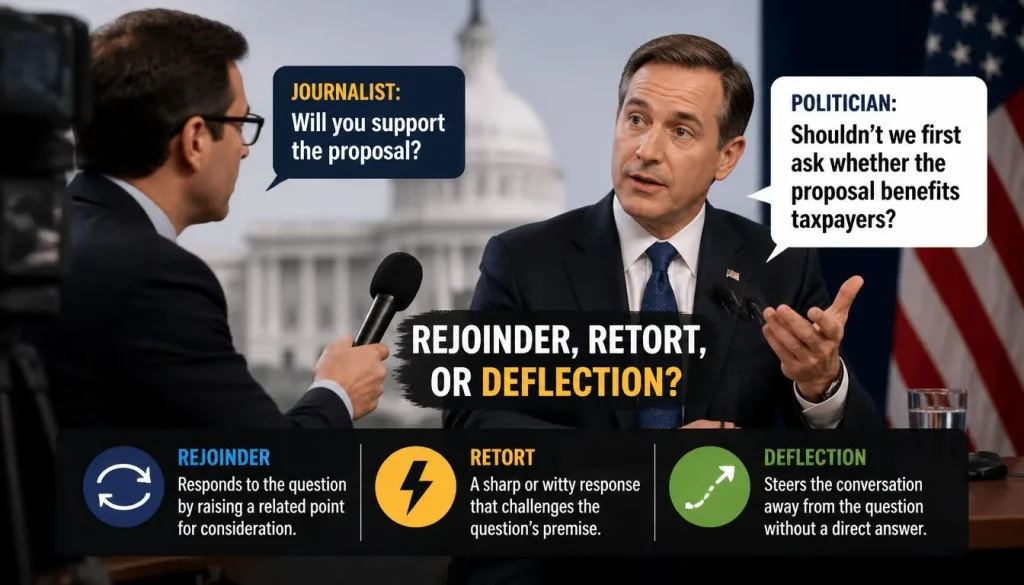
Political Interview Example
Journalist:
“Will you support the proposal?”
Politician:
“Shouldn’t we first ask whether the proposal benefits taxpayers?”
This may function as a rejoinder, retort, or deflection depending on intent.
FAQs
What does it mean to answer a question with a question?
Answering a question with a question means responding to someone’s inquiry by asking another question instead of providing a direct answer. People often use this technique to seek clarification, encourage deeper thinking, or redirect the conversation.
What is the most common word for answering a question with a question?
One of the most common terms is counterquestion. It refers to a question asked in response to another question and is frequently used in discussions, interviews, negotiations, and everyday conversations.
Is answering a question with a question considered rude?
Not necessarily. The tone and context matter. In many situations, a counterquestion can help clarify information or uncover assumptions. However, if used to avoid answering or dismiss someone’s concern, it may come across as rude or evasive.
Why do people answer questions with questions?
People use this communication technique for several reasons, including:
- Clarifying unclear questions
- Encouraging critical thinking
- Gathering more information
- Challenging assumptions
- Steering discussions toward a specific topic
Is answering a question with a question a rhetorical device?
Yes, it can be. In rhetoric, this technique is often associated with hypophora, Socratic questioning, or other forms of strategic questioning. It is commonly used in education, debates, interviews, and persuasive communication.
Can answering a question with a question improve communication?
When used appropriately, it can improve communication by promoting understanding and engagement. It is particularly useful in business communication, meetings, project management, and problem-solving discussions where additional context is needed before providing an answer.
Conclusion
Understanding the 5 Words For Answering A Question With A Question can help you communicate with greater precision and confidence. While answering a question with another question may seem simple, it serves many purposes, from clarifying information and encouraging critical thinking to guiding conversations in a productive direction.
Whether the term is counterquestion, retort, rejoinder, or another related expression, each word carries its own meaning and context. Knowing these distinctions can improve your English usage, strengthen your communication skills, and help you navigate conversations more effectively in both personal and professional settings.
The next time someone responds to your question with another question, you’ll not only recognize the technique but also understand the most accurate word to describe it. That deeper understanding can make your speaking and writing more precise, professional, and impactful.

Mia Rose is an English language specialist and editorial writer at Phrase Finesse, where she helps readers master grammar, vocabulary, spelling, and effective communication. Passionate about making English simple and practical, she creates well-researched, reader-friendly content that explains complex language concepts in a clear and engaging way.
With extensive experience in English language education, content writing, and editorial review, Mia specializes in grammar, punctuation, word choice, idioms, confusing word pairs, and writing style. Her articles are carefully researched, fact-checked, and designed to help students, professionals, writers, and English learners build confidence in both written and spoken English.