Have you ever wondered whether you should write “is equal to” or “equals” when explaining a mathematical idea, comparison, or relationship? The difference may seem small, but choosing the right expression improves clarity and accuracy.
In this guide, Is Equal To vs. Equals: Which Is Correct? explains the meaning, usage, and grammar rules behind these commonly confused terms. You’ll learn how each phrase works in different contexts, from English usage and formal writing to everyday communication.
Understanding the correct use of “is equal to” and “equals” helps you create clearer sentences and avoid common grammar mistakes. These expressions appear frequently in mathematics, business communication, technical writing, and educational content where precision matters.
Whether you are discussing scheduling, time management, online booking, meetings, or project management, using accurate language ensures better consistency and understanding.
This article will explore the key differences between “is equal to” and “equals” with simple examples, practical explanations, and helpful grammar insights. You’ll discover when each expression sounds natural and how to use them correctly in formal writing, reports, presentations, and daily conversations.
By the end, you’ll have a clear understanding of these terms and feel more confident applying them in any situation, including calendar planning, broadcasting, and professional communication.
Quick Answer
The short answer is simple:
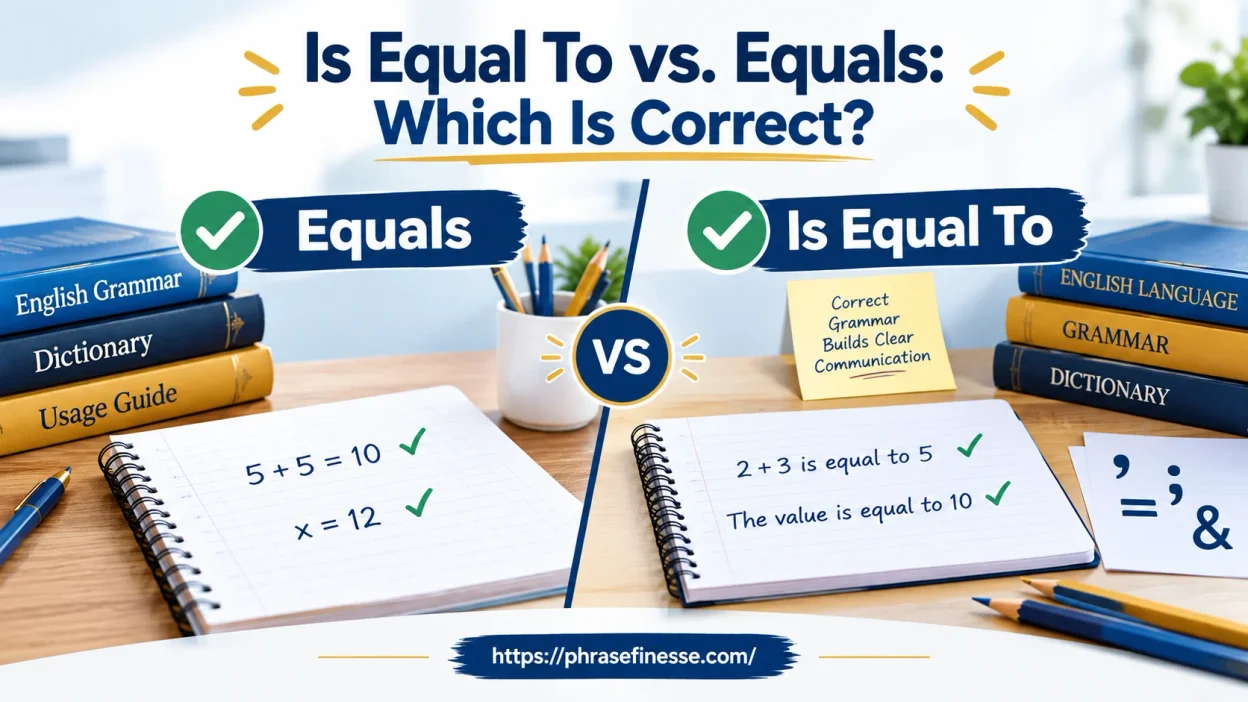
Both “equals” and “is equal to” are correct.
The difference lies in their grammatical roles.
| Expression | Correct? | Function |
| Equals | Yes | Verb |
| Is equal to | Yes | Adjective phrase |
| Equals to | No | Grammatically incorrect |
Examples
✅ Five plus five equals ten.
✅ Five plus five is equal to ten.
❌ Five plus five equals to ten.
The first two sentences are correct because they follow proper grammatical structures. The third sentence incorrectly combines two different patterns.
What Does “Equals” Mean?
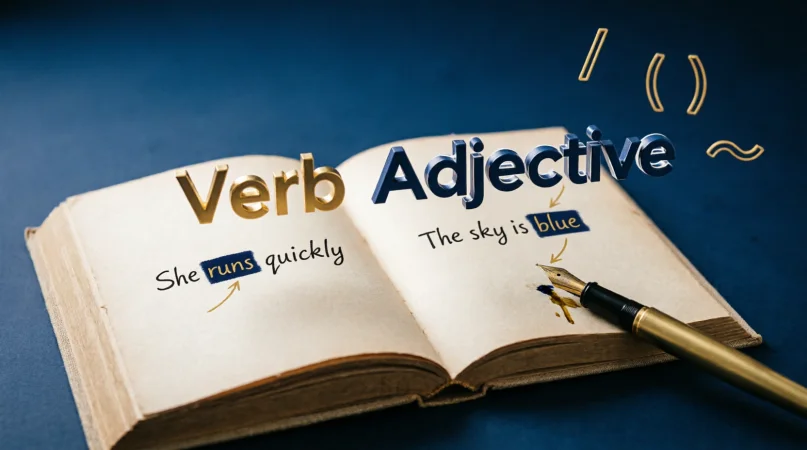
The word equals functions as a verb.
It means:
- Is the same as
- Amounts to
- Results in
- Corresponds to
When you use equals, it acts as the main action of the sentence.
Basic Structure
Subject + equals + object
Examples:
- Two plus two equals four.
- Knowledge equals power.
- Revenue equals income minus expenses.
- One kilometer equals one thousand meters.
In every example, equals performs the work of the verb.
Why Writers Like “Equals”
Many writers prefer equals because it is:
- Shorter
- More direct
- Easier to read
- Common in formulas and equations
Consider these examples:
- Practice equals improvement.
- Consistency equals success.
- Preparation equals confidence.
The sentences are concise and impactful.
What Does “Is Equal To” Mean?
The phrase is equal to works differently.
Here, equal is an adjective rather than a verb.
Because adjectives cannot act as verbs by themselves, they require a linking verb such as:
- is
- are
- was
- were
Structure
Subject + linking verb + equal to + object
Examples:
- Two plus two is equal to four.
- The payment is equal to the agreed amount.
- One gallon is equal to approximately 3.785 liters.
- Her contribution is equal to his contribution.
In these examples, equal describes a relationship rather than performing an action.
Why Writers Use “Is Equal To”
Writers often choose this structure when they want:
- Greater formality
- More emphasis on equivalence
- Technical precision
- Academic tone
For example:
The measured value is equal to the theoretical value.
This sounds more formal than:
The measured value equals the theoretical value.
Both are correct. The tone simply changes.
The Grammar Behind Is Equal To vs. Equals
Understanding the grammar makes the distinction much easier.
Equals Is a Verb
In grammar, a verb expresses an action, occurrence, or state.
Examples:
- Three times four equals twelve.
- The total equals fifty dollars.
- One foot equals twelve inches.
The verb is doing the work.
Equal Is an Adjective
An adjective describes a noun or pronoun.
Examples:
- The scores are equal.
- Their responsibilities are equal.
- The values are equal.
When you add to, you create a comparison.
Examples:
- The score is equal to the previous record.
- The amount is equal to the balance due.
Comparison Table
| Feature | Equals | Is Equal To |
| Part of Speech | Verb | Adjective phrase |
| Length | Shorter | Longer |
| Formality | Neutral | More formal |
| Common in Math | Yes | Yes |
| Common in Technical Writing | Sometimes | Frequently |
| Conversational Use | Very common | Less common |
This distinction explains why both versions are grammatically correct.
Why “Equals To” Is Incorrect
One of the most common mistakes English learners make is writing:
❌ Equals to
This error happens because people combine two separate grammatical structures.
Incorrect Example
❌ Five plus five equals to ten.
Correct Versions
✅ Five plus five equals ten.
✅ Five plus five is equal to ten.
The reason is straightforward.
The verb equals does not require to.
Once you choose the verb equals, the sentence is already complete.
Think of it this way:
- Equals = complete verb
- Equal = adjective requiring “to”
Mixing them creates a grammatical mismatch.
Is Equal To vs. Equals in Mathematics
Mathematics is where most people encounter these expressions first.
Mathematical Equations
Consider the equation:
4 + 4 = 8
You can read it in two ways:
- Four plus four equals eight.
- Four plus four is equal to eight.
Both are accepted by teachers, mathematicians, and educational publishers.
Comparison Table
| Equation | Equals Version | Is Equal To Version |
| 2 + 2 = 4 | Two plus two equals four | Two plus two is equal to four |
| 5 × 6 = 30 | Five times six equals thirty | Five times six is equal to thirty |
| 12 ÷ 3 = 4 | Twelve divided by three equals four | Twelve divided by three is equal to four |
| 9 − 4 = 5 | Nine minus four equals five | Nine minus four is equal to five |
Which Do Math Teachers Prefer?
In spoken math lessons, teachers often use equals because it is quicker.
For example:
Seven plus three equals ten.
In written explanations, textbooks sometimes prefer:
Seven plus three is equal to ten.
The choice often depends on style rather than correctness.
Is Equal To vs. Equals in Science
Scientific writing values precision.
As a result, researchers frequently use is equal to.
Examples
- One joule is equal to one newton meter.
- The observed value is equal to the predicted value.
- The concentration is equal to five milligrams per liter.
Scientific documents often prioritize clarity over brevity.
However, formulas commonly use equals.
Example:
Force equals mass multiplied by acceleration.
Both forms remain acceptable.
Is Equal To vs. Equals in Business Writing
Business communication uses both structures extensively.
Examples Using Equals
- Profit equals revenue minus expenses.
- Total assets equal total liabilities plus equity.
- Customer retention equals long-term growth.
Examples Using Is Equal To
- The refund is equal to the purchase price.
- The bonus is equal to ten percent of annual salary.
- The compensation is equal to the agreed amount.
Which Sounds Better?
For concise reports:
- Revenue equals expenses.
For formal agreements:
- Compensation is equal to the amount specified in the contract.
The context determines the better choice.
Is Equal To vs. Equals in Everyday English
Outside technical fields, both expressions still appear frequently.
Everyday Examples
- Hard work equals results.
- More practice equals better performance.
- One hour of preparation equals several hours of correction later.
These examples sound natural because equals creates a concise statement.
More Formal Alternatives
- Her effort is equal to mine.
- The quality is equal to premium brands.
- The final score is equal to the previous record.
These sound more formal and deliberate.
When Should You Use Equals?
Certain situations naturally favor equals.
Choose Equals When You Want Brevity
Examples:
- Time equals money.
- Experience equals confidence.
- Consistency equals progress.
The message becomes stronger and more memorable.
Choose Equals for Formulas
Examples:
- Profit equals revenue minus expenses.
- Density equals mass divided by volume.
- Speed equals distance divided by time.
Choose Equals in Conversation
People often say:
- One plus one equals two.
- More effort equals better results.
The structure feels natural and efficient.
When Should You Use Is Equal To?
Other situations favor is equal to.
Academic Writing
Universities and research institutions frequently use this structure.
Example:
The experimental value is equal to the theoretical value.
Technical Documentation
Engineers often write:
One megabyte is equal to 1,024 kilobytes.
Legal Documents
Contracts frequently contain statements such as:
The reimbursement is equal to the amount paid.
Formal Comparisons
Examples:
- Her contribution is equal to his contribution.
- Their responsibilities are equal to ours.
Real-World Case Study: How Major Publications Use These Expressions
A review of academic journals, educational textbooks, and business reports reveals a consistent pattern.
Academic Publications
Most academic papers favor is equal to when explaining relationships.
Example:
The calculated value is equal to the measured value.
Mathematics Textbooks
Math books often switch between both forms.
When teaching calculations:
Six plus six equals twelve.
When explaining concepts:
The area is equal to length multiplied by width.
Business Reports
Financial documents frequently use equals in formulas and is equal to in explanatory sections.
This approach improves readability while maintaining professionalism.
Read More :7 Words To Describe Someone Who Is Able To See The Big Picture
Common Mistakes Writers Make
Using Equals To
Incorrect:
❌ The total equals to one hundred dollars.
Correct:
✅ The total equals one hundred dollars.
✅ The total is equal to one hundred dollars.
Mixing Structures
Incorrect:
❌ The amount equals equal to fifty.
Correct:
✅ The amount equals fifty.
✅ The amount is equal to fifty.
Being Needlessly Wordy
Sometimes writers choose longer phrasing when shorter wording works better.
Wordy:
The total amount is equal to fifty dollars.
Concise:
The total equals fifty dollars.
Good writing often favors clarity.
Treating Equal as a Verb
Incorrect:
❌ The numbers equal to each other.
Correct:
✅ The numbers are equal to each other.
Remember:
Equal is an adjective.
It needs a linking verb.
Style Considerations for Professional Writers
Professional writers often choose between these structures based on tone.
If You Want Direct Writing
Use:
- Equals
Example:
Productivity equals output divided by input.
If You Want Formal Writing
Use:
- Is equal to
Example:
The compensation is equal to the amount outlined in the agreement.
If You Want Maximum Readability
Use whichever sounds more natural in the sentence.
Good writing values clarity above rigid preferences.
Quick Memory Trick
Many learners struggle to remember the difference.
Try this simple shortcut.
Use Equals If You Can Replace It With “Amounts To”
Example:
- Preparation equals success.
Replacement:
- Preparation amounts to success.
The sentence still works.
Use Is Equal To When Describing Equivalence
Example:
- The refund is equal to the purchase price.
You are describing a relationship rather than expressing an action.
Side-by-Side Examples
| Context | Equals | Is Equal To |
| Math | Five plus five equals ten | Five plus five is equal to ten |
| Science | Force equals mass × acceleration | Force is equal to mass × acceleration |
| Finance | Profit equals revenue minus costs | Profit is equal to revenue minus costs |
| Education | One semester equals fifteen weeks | One semester is equal to fifteen weeks |
| Law | Compensation equals damages awarded | Compensation is equal to damages awarded |
Both columns contain grammatically correct English.
Expert Grammar Insight
“Equals functions as a verb, while equal functions as an adjective. Understanding that distinction immediately eliminates most usage mistakes.”
This single rule explains nearly every confusion surrounding these expressions.
Once you recognize the grammatical role, choosing the correct form becomes straightforward.
FAQs
1. Is “is equal to” grammatically correct?
Yes, “is equal to” is grammatically correct and commonly used when describing that two values, quantities, or things have the same meaning, size, or importance. It usually appears in explanatory sentences, such as “Five dollars is equal to 500 cents.”
2. Is “equals” the same as “is equal to”?
Yes, both expressions show equality, but they work differently in sentences. “Equals” is often used in mathematical equations, such as “2 + 3 equals 5,” while “is equal to” works better in descriptive or explanatory writing.
3. Should I use “equals” in formal writing?
You can use “equals” in formal writing when discussing calculations, formulas, or numerical relationships. However, “is equal to” may sound clearer in academic explanations, reports, and professional documents where complete sentence structure matters.
4. Can “equals” be used outside mathematics?
Yes, “equals” can be used outside mathematics to show that two ideas or situations have the same value or effect. For example, “Hard work equals success” means that hard work leads to or represents success.
5. Which phrase is better for everyday English usage: “is equal to” or “equals”?
The better choice depends on the context. Use “is equal to” for explanations and comparisons, while “equals” is more natural for calculations, formulas, and direct statements of results.
6. Why is understanding the difference between “is equal to” and “equals” important?
Knowing the difference improves your grammar, English usage, and communication skills. Correct word choice creates clearer messages in education, business communication, formal writing, and professional environments where accuracy and consistency matter.
Conclusion
Understanding the difference between “is equal to” and “equals” helps you communicate ideas with greater accuracy and confidence. Although both expressions describe equality and similar relationships, they serve different purposes depending on the sentence structure and context.
Use “is equal to” when you are explaining a comparison or describing a relationship between two things. Choose “equals” when presenting calculations, formulas, or direct results. Recognizing these small grammar differences can improve your writing quality and make your communication more precise.
Whether you are writing for school, professional documents, business communication, or everyday conversations, choosing the correct expression strengthens your English usage skills. By applying these simple rules, you can avoid confusion and create clearer, more effective sentences in any situation.

Alyan Ashraf is an English language writer and editor at Phrase Finesse, where he specializes in grammar, vocabulary, spelling, word usage, and clear communication. Passionate about the English language, he creates practical, research-backed content that helps readers avoid common mistakes and write with greater accuracy and confidence.
Known for his clear writing style and attention to detail, Alyan simplifies complex language topics into easy-to-understand guides filled with real-world examples and actionable insights. His work covers confusing word pairs, grammar rules, idioms, punctuation, and everyday English usage, making learning both accessible and engaging for students, professionals, writers, and non-native English speakers.
Every article Alyan writes is carefully researched, fact-checked, and designed to meet high editorial standards. His goal is to help readers strengthen their English skills, expand their vocabulary, and communicate more effectively in academic, professional, and everyday settings.
Through Phrase Finesse, Alyan is committed to publishing trusted language resources that make mastering English simpler, clearer, and more enjoyable for learners around the world