Have you ever wondered whether “fair” and “just” mean exactly the same thing? While these words often appear interchangeable, they carry subtle differences in meaning, context, and English usage.
This Fair vs. Just: Understanding the Real Difference guide will help you understand how fairness, justice, and equality work in everyday conversations, professional settings, and formal writing.
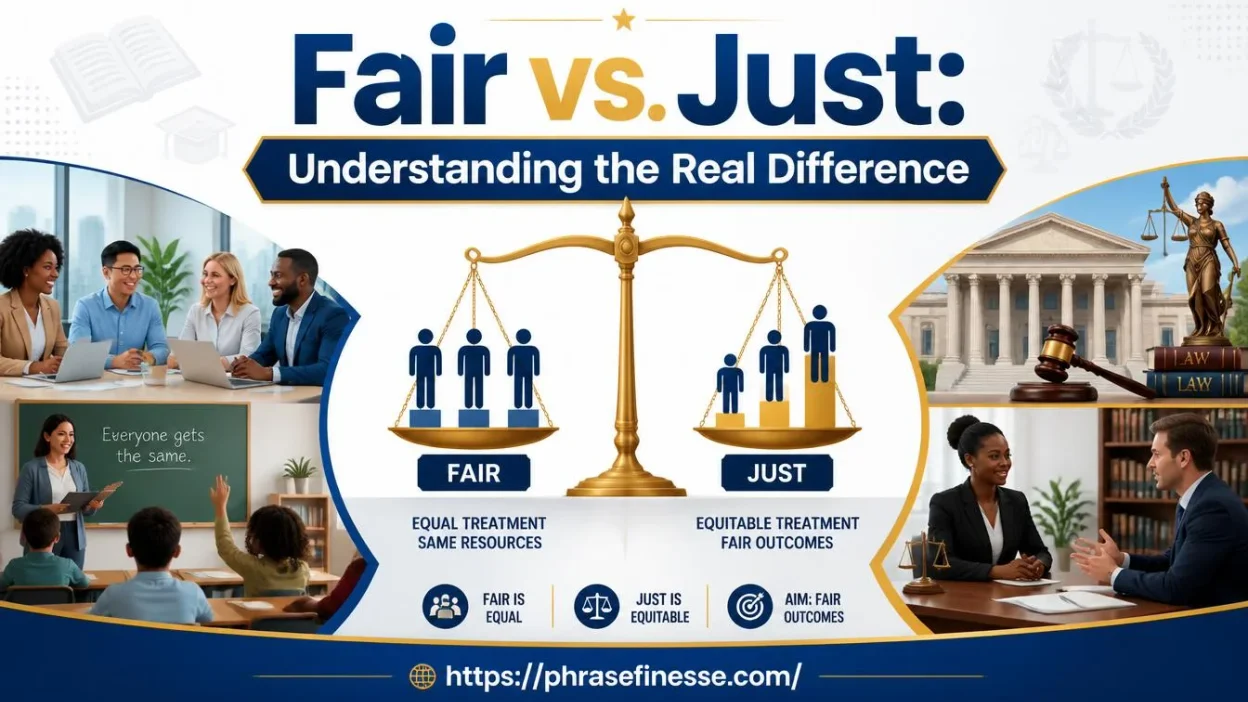
The word fair usually focuses on equal treatment, reasonable decisions, and balanced outcomes, while just connects more strongly with morality, laws, and what is right or deserved.
Understanding this distinction improves your grammar, strengthens business communication, and helps you maintain consistency when writing emails, reports, policies, or professional documents. Clear word choices also support effective communication in areas like meetings, project management, and workplace discussions.
In this article, you’ll explore the key differences between fair and just with simple examples, practical explanations, and common usage rules.
Whether you’re improving your writing skills, managing time management tasks, organizing a calendar, handling scheduling, or creating content for online booking, broadcasting, or professional platforms, knowing when to use these terms correctly can make your message more accurate, natural, and impactful.
Quick Answer:
The word fair generally refers to treating people equally and without favoritism.
When something is fair:
- The same rules apply to everyone.
- No one receives special treatment.
- Decisions are impartial.
- Opportunities are distributed equally.
For example, if a teacher gives every student the same amount of time to complete an exam, most people would consider that fair.
Fairness often focuses on the process rather than the outcome.
Examples of Fair
- A referee applies the same rules to both teams.
- Every employee receives the same company handbook.
- Students take the same test under the same conditions.
What Does “Just” Mean?
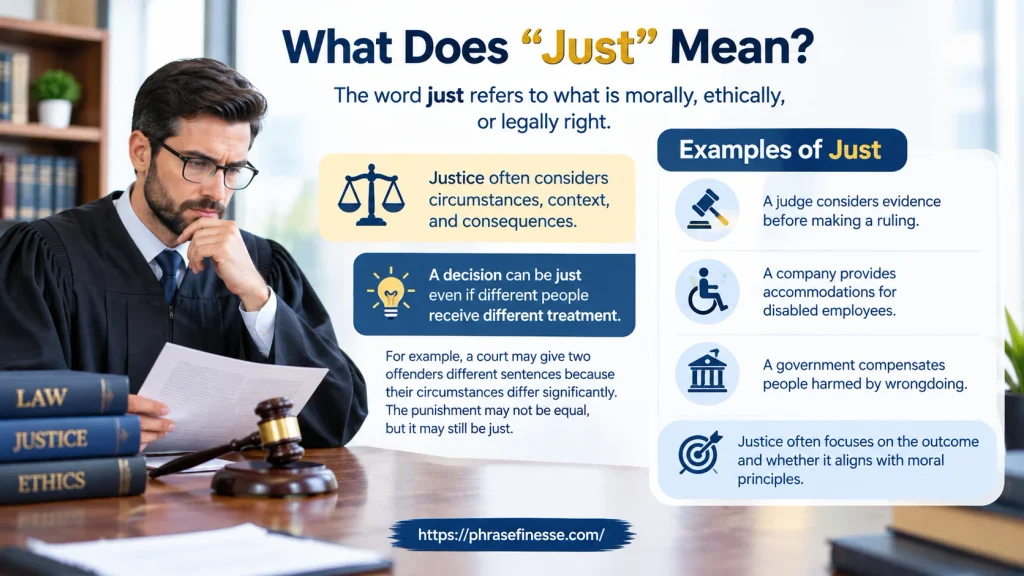
The word just refers to what is morally, ethically, or legally right.
Justice often considers circumstances, context, and consequences.
A decision can be just even if different people receive different treatment.
For example, a court may give two offenders different sentences because their circumstances differ significantly. The punishment may not be equal, but it may still be just.
Examples of Just
- A judge considers evidence before making a ruling.
- A company provides accommodations for disabled employees.
- A government compensates people harmed by wrongdoing.
Justice often focuses on the outcome and whether it aligns with moral principles.
Fair vs. Just at a Glance
| Aspect | Fair | Just |
| Primary Focus | Equal treatment | Right treatment |
| Goal | Consistency | Justice |
| Based On | Equality and impartiality | Morality, ethics, and law |
| Considers Individual Circumstances | Usually less | Usually more |
| Outcome | Equal process | Correct result |
| Context | Everyday situations | Ethical and legal situations |
The Core Difference Between Fair and Just
The easiest way to remember the difference is this:
Fair means treating people equally.
Just means treating people appropriately.
Those ideas often overlap, but not always.
Fairness Focuses on Equal Treatment
Fairness aims to ensure everyone plays by the same rules.
Imagine a marathon.
Every runner starts at the same line and Every runner follows the same route. Every runner faces the same finish line.
That setup is fair because everyone receives equal treatment.
Fairness values:
- Neutrality
- Consistency
- Equal opportunity
- Lack of favoritism
Without fairness, trust breaks down quickly.
People want to know the rules apply equally to everyone.
Justice Focuses on What Is Right
Justice asks a different question:
What outcome is morally correct?
Sometimes equal treatment does not produce a fair result.
Consider a student with a visual impairment.
Giving every student the exact same exam format might be fair according to the rules.
However, providing accommodations may be more just because it ensures the student has a genuine opportunity to demonstrate knowledge.
Justice often accounts for:
- Individual needs
- Historical disadvantages
- Circumstances
- Intentions
- Consequences
Why Something Can Be Fair but Not Just
This distinction surprises many people.
A policy can be applied equally to everyone while still creating an unjust result.
Example
A company requires all employees to work Saturdays.
The rule applies equally to everyone.
That seems fair.
However, an employee undergoing medical treatment may face unique challenges.
Ignoring those circumstances may produce an unjust outcome.
The policy remains fair in application but may not be just in effect.
Why Something Can Be Just but Not Appear Fair
Sometimes justice requires treating people differently.
Consider a scholarship program designed for low-income students.
Not everyone qualifies.
At first glance, some people might say this isn’t fair because everyone doesn’t receive the same benefit.
Yet the program may be just because it addresses genuine disadvantages.
Justice often requires flexibility where fairness prefers uniformity.
Fair vs. Just Through Simple Examples
Examples make the distinction much easier to understand.
Classroom Accommodation Example
Imagine two students taking an exam.
One student has dyslexia.
The teacher gives that student extra time.
Fair Perspective
Some students may argue:
Everyone should get the same amount of time.
Just Perspective
The accommodation helps level the playing field.
The goal isn’t to provide an advantage.
The goal is to remove a disadvantage.
Justice focuses on equal opportunity rather than identical treatment.
Workplace Policy Example
A company offers remote work during severe weather.
One employee lives in an area heavily affected by flooding.
Others do not.
Allowing that employee to work remotely may seem unequal.
However, it may be the most just solution based on circumstances.
Sports Competition Example
Sports provide excellent examples of fairness.
Rules apply equally to all players.
The referee should remain impartial.
That is fairness.
However, age divisions, weight classes, and disability categories exist because justice recognizes that equal treatment isn’t always enough.
Family Decision Example
A family has three children.
One child needs expensive medical treatment.
Parents devote more financial resources to that child.
The other children receive less money.
Equal distribution would be fair.
Need-based distribution may be more just.
Legal Sentencing Example
Two individuals commit the same offense.
One acted accidentally.
The other acted intentionally.
A judge may impose different penalties.
The punishments are not equal.
Yet many people would consider them just because intent matters.
Fairness vs. Justice in Education
Education provides some of the clearest examples of the difference between fairness and justice.
Equal Resources vs. Needed Resources
Schools often struggle with an important question:
Should every student receive exactly the same resources?
Or should resources be distributed according to need?
Equal distribution promotes fairness.
Need-based distribution promotes justice.
Neither approach is inherently wrong.
The challenge lies in balancing both principles.
The Role of Equity
When discussing fairness and justice, another important concept appears:
Equity.
Equity recognizes that people start from different positions.
Providing identical support may not produce equal opportunities.
A common illustration shows three people of different heights trying to watch a baseball game over a fence.
Equality
Everyone receives the same box.
Equity
Each person receives the number of boxes needed to see over the fence.
Justice often works through equity.
Educational Case Study
Scenario
A school distributes laptop computers.
Fair Solution
Every student receives the same device.
Just Solution
Students without internet access receive additional support such as mobile hotspots.
Both solutions have merit.
The second approach often produces more equitable outcomes.
Fairness vs. Justice in Law
The legal system constantly balances fairness and justice.
How Courts Pursue Justice
Modern legal systems aim to deliver just outcomes.
Courts examine:
- Evidence
- Intent
- Circumstances
- Harm caused
- Legal precedent
Justice requires more than simply applying identical penalties.
Context matters.
Why Equal Punishment Isn’t Always Just
Many legal systems consider mitigating and aggravating factors.
Mitigating Factors
- Mental illness
- Lack of criminal history
- Cooperation with authorities
Aggravating Factors
- Premeditation
- Violence
- Abuse of trust
Two similar crimes may result in different sentences.
Justice demands nuance.
Justice and Due Process
A legal system must also remain fair.
This is where fairness enters the picture.
Due process protects:
- The right to legal representation
- The right to present evidence
- The right to a fair hearing
- Protection against bias
A just outcome depends on a fair process.
Without fairness, justice becomes difficult to achieve.
Fairness vs. Justice in the Workplace
Organizations encounter fairness and justice issues every day.
Fair Treatment of Employees
Employees expect consistency.
Workplace fairness includes:
- Equal application of policies
- Transparent procedures
- Consistent performance standards
- Equal opportunities for advancement
These practices build trust.
Just Decisions by Employers
Justice requires leaders to consider individual circumstances.
Examples include:
- Disability accommodations
- Family emergencies
- Medical leave
- Religious observances
Treating everyone identically may sometimes create hardship.
Common Workplace Scenarios
| Situation | Fair Approach | Just Approach |
| Promotion | Same criteria for all | Consider barriers and circumstances |
| Leave Request | Standard rules | Flexible response to emergencies |
| Performance Review | Uniform metrics | Consider unique challenges |
| Discipline | Same penalty | Account for intent and context |
Fair, Just, and Equitable — What’s the Difference?
Many people confuse these concepts because they frequently overlap.
What Is Equity?
Equity means providing resources or support according to need.
The objective is not identical treatment.
The objective is comparable opportunity.
Fair vs. Equitable vs. Just
| Term | Meaning | Goal |
| Fair | Same treatment | Equality |
| Equitable | Appropriate support | Equal opportunity |
| Just | Morally right outcome | Justice |
Why These Terms Get Confused
All three concepts aim to improve human well-being.
Yet they approach the challenge differently.
Fairness asks:
“Are the rules applied equally?”
Equity asks:
“Does everyone have a realistic opportunity to succeed?”
Justice asks:
“Is the outcome morally right?”
Common Expressions Using Fair and Just
Learning common phrases helps you understand how native English speakers use these words.
Common Phrases with Fair
- Fair chance
- Fair treatment
- Fair play
- Fair share
- Fair competition
- Fair decision
- Fair process
- Fair price
Example
Everyone deserves a fair chance to succeed.
Read More :You All vs. All of You: The Real Difference
Common Phrases with Just
- Just cause
- Just punishment
- Just society
- Just ruling
- Just decision
- Just compensation
- Just outcome
- Just law
Example
The court sought a just outcome for all parties.
Is Fair Always Better Than Just?
Not necessarily.
Different situations require different priorities.
When Fairness Matters Most
Fairness is especially important when:
- Running competitions
- Conducting elections
- Administering standardized tests
- Enforcing organizational rules
- Refereeing sports
Consistency helps maintain trust.
When Justice Matters Most
Justice becomes critical when:
- Resolving disputes
- Addressing inequality
- Evaluating moral questions
- Determining legal responsibility
- Protecting vulnerable groups
Context becomes essential.
Why the Best Decisions Combine Both
The strongest systems usually blend fairness and justice.
Consider the legal system.
Courts strive for:
- Fair procedures
- Just outcomes
One without the other creates problems.
A fair process without justice can feel empty.
A just outcome without fairness can appear arbitrary.
Common Mistakes When Using Fair and Just
Understanding these mistakes helps improve communication.
Treating Them as Perfect Synonyms
Although related, the words are not interchangeable in every context.
Fairness emphasizes equality.
Justice emphasizes correctness.
Assuming Equal Means Just
Equal treatment does not always produce equal opportunity.
This misunderstanding causes confusion in debates about education, employment, and public policy.
Ignoring Context
Justice depends heavily on circumstances.
Context often determines whether a decision is truly just.
Confusing Justice with Personal Preference
Not every outcome someone dislikes is unjust.
Justice relies on principles rather than individual preferences.
Fair vs. Just in Everyday English
Native English speakers often choose one word over the other depending on the situation.
When People Use “Fair”
People typically use fair when discussing:
- Rules
- Treatment
- Opportunities
- Games
- Procedures
Examples
- That’s a fair decision.
- The competition was fair.
- Everyone received a fair chance.
When People Use “Just”
People often use just when discussing:
- Morality
- Ethics
- Law
- Human rights
- Social issues
Examples
- The ruling was just.
- They fought for a just society.
- The punishment was just.
Example Sentences Side by Side
| Fair | Just |
| The process was fair. | The outcome was just. |
| Everyone received a fair chance. | Everyone received a just resolution. |
| The referee made a fair call. | The judge made a just ruling. |
| The rules were fair. | The decision was just. |
How to Choose Between Fair and Just
When choosing between these words, think about your focus.
Use “Fair” When Talking About Equality
Choose fair when discussing:
- Equal treatment
- Consistent rules
- Impartial decisions
- Balanced opportunities
Examples
- A fair competition
- A fair process
- A fair policy
Use “Just” When Talking About What Is Right
Choose just when discussing:
- Moral correctness
- Ethical principles
- Legal decisions
- Rightful outcomes
Examples
- A just punishment
- A just society
- A just ruling
A Simple Memory Trick
Remember this phrase:
| Word | Meaning |
| Fair | Equal treatment |
| Just | Right treatment |
This shortcut won’t cover every situation, but it works surprisingly well.
FAQs
1. What is the main difference between fair and just?
The main difference is that fair focuses on equal treatment and reasonable outcomes, while just focuses on morality, laws, and what is right or deserved. A decision can be fair because everyone receives equal treatment, but it can be just because it follows ethical or legal principles.
2. Can fair and just be used interchangeably?
Sometimes, fair and just can have similar meanings, especially when discussing decisions or actions. However, they are not always interchangeable. Fair usually relates to balance and equality, while just often refers to correctness, righteousness, or justice.
3. Is a fair decision always a just decision?
Not necessarily. A decision may seem fair because it treats everyone the same, but it may not be just if it ignores important circumstances. For example, giving every employee the same workload may appear fair, but adjusting responsibilities based on ability may be more just.
4. How do you use fair in a sentence?
You can use fair when talking about equal treatment, reasonable judgment, or acceptable conditions. For example:
- “The teacher gave all students a fair chance to complete the assignment.”
- “The company created a fair payment system for its employees.”
5. How do you use just in a sentence?
You can use just when referring to actions that follow principles of right and wrong, laws, or fairness in a deeper sense. For example:
- “The judge made a just decision based on the evidence.”
- “Everyone deserves a just opportunity to succeed.”
6. Why is understanding the difference between fair and just important?
Understanding the difference improves your English usage, grammar, and formal writing skills. It helps you communicate ideas more accurately in professional conversations, business communication, academic writing, and everyday situations where word choice matters.
Conclusion
Understanding the difference between fair and just helps you choose the right word for the right situation. Although both terms relate to equality, balance, and good decisions, they highlight different ideas.
Fair emphasizes equal treatment and reasonable outcomes, while just focuses on moral correctness, rights, and ethical principles.
By learning how these words work in different contexts, you can improve your English usage, strengthen your formal writing, and communicate more clearly.
Whether you are writing professional documents, participating in meetings, managing project management tasks, or creating content, using fair and just correctly adds accuracy and credibility to your message.

Mia Rose is an English language specialist and editorial writer at Phrase Finesse, where she helps readers master grammar, vocabulary, spelling, and effective communication. Passionate about making English simple and practical, she creates well-researched, reader-friendly content that explains complex language concepts in a clear and engaging way.
With extensive experience in English language education, content writing, and editorial review, Mia specializes in grammar, punctuation, word choice, idioms, confusing word pairs, and writing style. Her articles are carefully researched, fact-checked, and designed to help students, professionals, writers, and English learners build confidence in both written and spoken English.