Have you ever paused while writing and wondered whether “this people” or “these people” is the correct phrase? If so, you are not alone. In this guide, “This People” or “These People”? Which Is Correct?, you’ll discover the correct grammatical form, why one expression sounds natural to native speakers, and how to avoid common mistakes in everyday English usage.
Understanding this distinction can instantly improve your grammar, writing accuracy, and overall communication skills.
Small grammar choices often have a big impact, especially in formal writing, business communication, emails, reports, and presentations. Whether you are managing meetings, updating a calendar, handling project management tasks, or communicating through online booking systems and broadcasting platforms, using the correct demonstrative pronoun helps maintain professionalism and consistency.
Clear language reduces confusion and ensures your message reaches readers exactly as intended.
In the sections ahead, we’ll break down the difference between “this” and “these,” explain why “these people” is generally the correct choice, and provide practical examples you can apply immediately.
You’ll also learn common usage patterns, grammar rules, and real-world examples related to time management, workplace communication, and everyday conversations. By the end, you’ll have a stronger grasp of this important grammar rule and greater confidence in your writing.
Quick Answer:
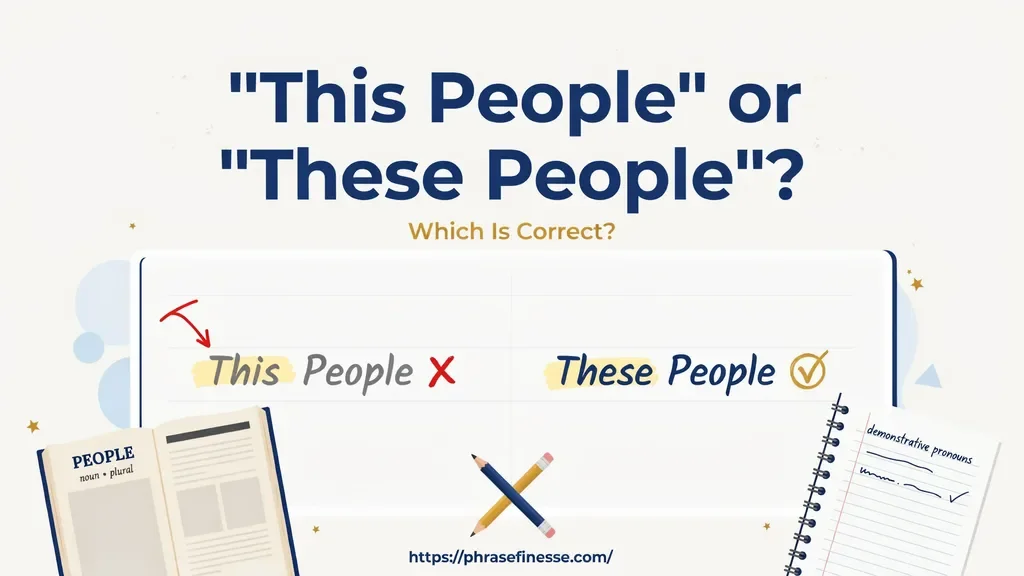
The correct phrase is:
✅ These people
The incorrect phrase in standard English is:
❌ This people
Examples
- ✅ These people are waiting outside.
2.✅ These people helped me find the station.
3. ✅ These people work in the marketing department.
❌ This people are waiting outside.
❌ This people helped me find the station.
The reason is straightforward: people is normally a plural noun, and plural nouns require the plural demonstrative these rather than the singular demonstrative this.
Quick Comparison Table
| Phrase | Correct? | Explanation |
| These people | ✅ Yes | Plural demonstrative matches plural noun |
| This people | ❌ No | Singular demonstrative used with plural noun |
| Those people | ✅ Yes | Plural demonstrative matches plural noun |
| This person | ✅ Yes | Singular demonstrative matches singular noun |
Understanding “This” And “These”
Before examining why these people is correct, it helps to understand the difference between this and these.
Both words belong to a category called demonstrative determiners or demonstrative pronouns.
They point to specific people, objects, or ideas.
What Does “This” Mean?
The word this refers to:
- One person
- One object
- One idea
- Something near the speaker
Examples
- This person is my manager.
- This book belongs to me.
- This chair is comfortable.
- This solution works perfectly.
Notice something important.
Every noun above is singular.
That’s the key rule.
This = singular
What Does “These” Mean?
The word these refers to:
- More than one person
- More than one object
- More than one idea
- Things near the speaker
Examples
- These people are my neighbors.
- These books belong to the library.
- These chairs need repairs.
- These solutions are effective.
Each noun is plural.
Therefore:
These = plural
Demonstratives At A Glance
| Singular | Plural |
| This | These |
| That | Those |
Think of it like matching socks.
A singular demonstrative must match a singular noun.
A plural demonstrative must match a plural noun.
If they don’t match, the sentence feels grammatically awkward.
Why “These People” Is Correct
The answer comes down to grammatical agreement.
English requires demonstratives and nouns to agree in number.
Since people is usually plural, it must pair with these.
Correct Pairing
- These people
- These students
- These workers
- These children
Incorrect Pairing
- This people
- This students
- This workers
- This children
The pattern remains consistent across English grammar.
“People” Is Normally A Plural Noun
Many learners become confused because people doesn’t end in -s like most plural nouns.
Compare:
| Singular | Plural |
| Person | People |
| Child | Children |
| Man | Men |
| Woman | Women |
| Mouse | Mice |
These are called irregular plurals.
Instead of adding -s, the word changes form completely.
Therefore:
- One person
- Two people
Because people means more than one person, it naturally requires plural grammar.
Examples
- These people are friendly.
- These people understand the problem.
- These people arrived early.
The plural noun and plural demonstrative work together perfectly.
Understanding Agreement Between Demonstratives And Nouns
One of the most fundamental rules in English grammar is agreement.
Agreement means that certain words must match each other.
For demonstratives, the noun and demonstrative must agree in number.
Demonstrative Agreement Table
| Demonstrative | Noun Type | Example |
| This | Singular | This person is happy. |
| These | Plural | These people are happy. |
| That | Singular | That person is happy. |
| Those | Plural | Those people are happy. |
Whenever you write or speak, ask yourself:
Is the noun singular or plural?
The answer tells you which demonstrative to use.
Why Do Some People Say “This People”?
If the phrase is incorrect, why does it appear so often?
Several factors contribute to the confusion.
Influence From Other Languages
Many languages use demonstratives differently from English.
In some languages, the equivalent of this can function with collective groups in ways that English does not allow.
As a result, learners sometimes translate directly from their native language.
Example
A learner may think:
- This group
- This team
- Therefore, this people
However, English treats people differently because it is grammatically plural.
Confusion Between “Person” And “People”
Another common issue involves mixing singular and plural forms.
Consider:
- This person
- These people
The words are closely related.
When speaking quickly, learners sometimes apply the singular pattern to the plural noun.
The Brain Loves Patterns
Interestingly, language experts have observed that people naturally search for patterns.
When someone learns:
- This book
- This chair
- This student
They may incorrectly assume:
- This people
The brain is attempting to simplify grammar rules.
Unfortunately, English often refuses to cooperate.
Correct Examples Of “These People”
Let’s look at real-world situations.
Everyday Conversations
Examples
- These people live next door.
- These people helped me carry the boxes.
- These people know the neighborhood well.
- These people arrived before noon.
Each sentence sounds natural because the demonstrative matches the plural noun.
Workplace Examples
In professional environments, you’ll frequently encounter this structure.
Examples
- These people manage the company’s finances.
- These people supervise new employees.
- These people approved the proposal.
- These people oversee quality control.
Using proper grammar helps your communication sound more polished and professional.
Academic Writing Examples
Researchers and academics also use this construction regularly.
Examples
- These people participated in the survey.
- These people represent the study population.
- These people demonstrated significant improvement.
- These people provided valuable feedback.
Notice how often these people appears in formal writing.
That’s because it follows standard grammatical conventions.
Incorrect Examples Of “This People”
Examining mistakes can be just as helpful as studying correct usage.
Common Errors
Incorrect
❌ This people are waiting outside.
Correct
✅ These people are waiting outside.
Incorrect
❌ This people work in accounting.
Correct
✅ These people work in accounting.
Incorrect
❌ This people know the answer.
Correct
✅ These people know the answer.
Why The Correction Works
The correction isn’t random.
It follows a simple formula:
| Noun Type | Demonstrative |
| Singular | This |
| Plural | These |
Since people is plural, these must be used.
Can “People” Ever Be Singular?
Now we reach an interesting grammatical twist.
Most grammar guides stop after explaining that people is plural.
However, the complete story is slightly more nuanced.
The Special Expression “A People”
In certain contexts, people can function as a singular collective noun.
When this happens, it usually refers to:
- A nation
- An ethnic group
- A cultural community
- A population sharing common traditions
Examples
- A people united by history.
- A people shaped by migration.
- A people known for resilience.
- A people connected by language.
In these examples, people means an entire cultural group rather than several individual persons.

Historical And Academic Usage
You may encounter this usage in:
- Anthropology
- Sociology
- History
- Political science
- Cultural studies
For example:
“A people without knowledge of their history loses part of its identity.”
Here, people refers to a collective community.
Does This Make “This People” Correct?
Generally, no.
Even in academic contexts, native speakers rarely say:
❌ This people
Instead, they often write:
- This nation
- This ethnic group
- These people
- This community
The phrase this people occasionally appears in older translations, religious texts, or highly specialized writing, but it is extremely uncommon in modern English.
For practical purposes, learners should treat this people as incorrect.
See More :3 Terms for Questions You Already Know
“These People” Vs. “Those People”
Many learners understand these people but become uncertain when choosing between these and those.
The distinction involves distance.
When To Use “These People”
Use these people when referring to people who are:
- Physically nearby
- Present in the current context
- Closely connected to the discussion
Examples
- These people are standing beside me.
- These people work in my office.
- These people are my friends.
When To Use “Those People”
Use those people when referring to people who are:
- Farther away
- Previously mentioned
- Less connected to the immediate situation
Examples
- Those people across the street are musicians.
- Those people we met yesterday were helpful.
- Those people made an important contribution.
Comparison Table
| Phrase | Typical Usage |
| These people | Near the speaker |
| Those people | Far from the speaker |
| This person | One nearby person |
| That person | One distant person |
Common Mistakes Similar To “This People”
The same grammar mistake appears with many plural nouns.
Understanding these patterns helps reinforce the rule.
This Students Vs. These Students
❌ This students
✅ These students
This Children Vs. These Children
❌ This children
✅ These children
This Men Vs. These Men
❌ This men
✅ These men
This Women Vs. These Women
❌ This women
✅ These women
This Cars Vs. These Cars
❌ This cars
✅ These cars
Pattern Recognition Table
| Incorrect | Correct |
| This people | These people |
| This students | These students |
| This children | These children |
| This women | These women |
| This men | These men |
| This cars | These cars |
The rule never changes.
Plural nouns require plural demonstratives.
A Simple Rule To Remember
If you remember only one thing from this article, make it this:
The Grammar Formula
This + Singular Noun
These + Plural Noun
That + Singular Noun
Those + Plural Noun
Memory Trick
Imagine a classroom.
You point at one student.
You say:
This student is absent.
Now imagine twenty students.
You say:
These students are absent.
The same pattern applies to people.
This person
These people
That’s all there is to it.
Real-Life Case Study: Why This Mistake Happens
Consider a student named Maria learning English.
She learns:
- This book
- This table
- This teacher
Later she wants to talk about a group.
She says:
❌ This people are friendly.
Her teacher corrects her:
✅ These people are friendly.
Maria realizes that people functions as a plural noun, just like students or workers.
Once she understands the singular-plural relationship, the mistake disappears.
This learning process mirrors what thousands of English learners experience every year.
Quick Practice Quiz
Choose the correct answer.
Question 1
___ people are waiting outside.
A. This
B. These
Answer: These
Question 2
___ person is my manager.
A. This
B. These
Answer: This
Question 3
___ children are playing soccer.
A. This
B. These
Answer: These
Question 4
___ student submitted the assignment.
A. This
B. These
Answer: This
Question 5
___ people helped us during the project.
A. This
B. These
Answer: These
FAQs
Is “this people” grammatically correct?
No. In standard modern English, “this people” is generally considered grammatically incorrect because “this” is singular, while “people” is plural.
Why is “these people” correct?
“These” is a plural demonstrative pronoun that matches the plural noun “people.” Therefore, “these people” follows standard grammar rules.
Can “this people” ever be used?
In rare historical, literary, or religious contexts, “this people” may appear when referring to a group as a collective entity. However, it is uncommon in modern English.
What is the difference between “this person” and “these people”?
“This person” refers to one individual, while “these people” refers to two or more individuals. The demonstrative pronoun must match the noun’s number.
Is “those people” also correct?
Yes. “Those people” is correct when referring to a group of people that is farther away in distance, time, or context than “these people.”
How can I avoid mistakes with “this” and “these”?
Remember a simple rule: use “this” with singular nouns and “these” with plural nouns. For example, “this book” and “these books.” Since “people” is plural, the correct phrase is “these people.”
Conclusion
Choosing between “this people” and “these people” is easier once you understand the basic rule of English grammar. Since “people” is a plural noun, it should normally be paired with the plural demonstrative “these.” As a result, “these people” is the grammatically correct phrase in standard English, while “this people” is generally considered incorrect in modern usage.
Using the right demonstrative pronoun improves clarity, consistency, and formal writing quality. Whether you’re writing emails, preparing reports, participating in business communication, or simply having everyday conversations, understanding this rule helps you communicate more naturally and professionally.
The key takeaway is simple: if you are referring to more than one person, use “these people.” Remembering this small grammar rule can make a noticeable difference in your overall English usage and writing confidence.

Emma Brooke is an English language specialist, editor, and content writer at Phrase Finesse, where she helps readers develop stronger writing and communication skills through clear, practical, and engaging content. With a passion for the English language, she specializes in simplifying grammar rules, vocabulary, spelling, punctuation, and word usage for learners at every level.
Emma has extensive experience creating educational content that is accurate, well-researched, and easy to understand. She is particularly skilled at explaining confusing word pairs, grammar concepts, idioms, sentence structure, and effective writing techniques, making complex topics approachable for students, professionals, educators, and English learners worldwide.