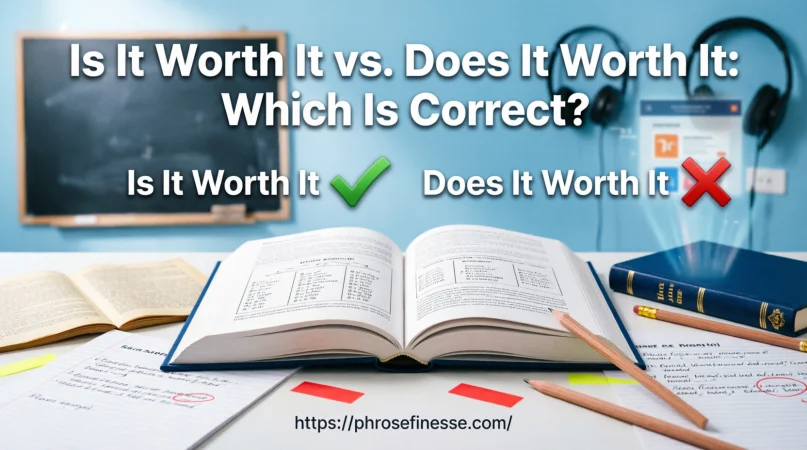
Have you ever stopped mid-sentence and wondered whether Is It Worth It vs. Does It Worth It: Which Is Correct? is the correct expression? You’re not alone. This common English usage mistake appears in everyday conversations, business communication, emails, social media, and even professional documents. Knowing which phrase is grammatically correct helps you communicate with greater consistency, confidence, and clarity.
In this guide, you’ll discover the grammatical difference between these two expressions, why one is correct and the other is not, and how native speakers naturally use them. We’ll explain the underlying grammar rules with practical examples, highlight common mistakes, and show you how to choose the right phrase in both casual and formal writing.
Whether you’re discussing scheduling, time management, meetings, project management, online booking, broadcasting, or updating a calendar, using accurate language strengthens your message.
By the end of this article, you’ll understand when to use “Is it worth it” correctly, why “Does it worth it” is grammatically incorrect, and how to avoid similar sentence patterns in the future. With clear explanations, real-world examples, and expert writing tips, you’ll improve your English grammar, write more naturally, and communicate with greater precision in every situation.
Quick Answer:
If you’re looking for the short answer, here it is:
| Phrase | Correct? |
| Is it worth it? | ✅ Yes |
| Does it worth it? | ❌ No |
The correct expression is:
Is it worth it?
The incorrect expression is:
Does it worth it?
Native English speakers consistently use “is it worth it?” when asking whether something provides enough value, benefit, or reward to justify its cost, effort, or time.
Examples
- ✅ Is this course worth it?
2. ✅ Is the upgrade worth it?
3. ✅ Is the trip worth it?
4. ❌ Does this course worth it?
5. ❌ Does the upgrade worth it?
6. ❌ Does the trip worth it?
The reason becomes much clearer once you understand the role of the word worth.
What Does “Worth” Mean in English?
Many grammar mistakes happen because people misunderstand how a word functions in a sentence.
The word worth generally refers to the value, usefulness, importance, or benefit of something.
Dictionary Meaning of Worth
In modern English, worth means:
Having a value equal to or greater than a particular amount, effort, time, or sacrifice.
Examples:
- The movie was worth the ticket price.
- The experience was worth the wait.
- The project is worth pursuing.
- The investment was worth the risk.
Whenever people ask “Is it worth it?”, they are really asking:
- Does it have sufficient value?
- Is the benefit greater than the cost?
- Is the effort justified?
- Should I do it?
Is “Worth” a Verb?
This is where many learners become confused.
Worth is not a verb.
That’s the key point.
Instead, worth usually functions as an adjective or a preposition-like adjective in modern English.
Because it is not a verb, it cannot directly follow auxiliary verbs such as:
- do
- does
- did
Compare These Examples
| Word | Part of Speech |
| Work | Verb |
| Help | Verb |
| Matter | Verb |
| Cost | Verb |
| Worth | Adjective |
Look at the difference:
- ✅ Does it work?
2. ✅ Does it matter?
3. ✅ Does it help?
4. ❌ Does it worth?
The first three examples work because work, matter, and help are verbs.
The last example fails because worth is not a verb.
The Grammar Behind “Is It Worth It”
The phrase follows a very simple structure:
Subject + Be Verb + Worth + Object
Examples:
- It is worth the money.
- It is worth the effort.
- It is worth reading.
- It is worth trying.
When we turn that statement into a question, we simply invert the subject and the verb:
Statement:
It is worth it.
Question:
Is it worth it?
That’s why “is it worth it” sounds natural and correct.
Why “Does It Worth It” Is Incorrect
The error comes from using the auxiliary verb does where a form of be is required.
When English speakers ask questions with does, they typically use a main verb afterward.
Correct Pattern
Does + Subject + Verb
Examples:
- Does it work?
- Does it cost much?
- Does it matter?
- Does it help?
Each sentence contains a real verb.
Now look at the incorrect version:
Does + Subject + Worth
Because worth isn’t a verb, the structure breaks down grammatically.
That is why:
❌ Does it worth it?
sounds wrong to native speakers.
Understanding Auxiliary Verbs
Auxiliary verbs help form questions, negatives, and different tenses.
The most common auxiliary verbs include:
| Auxiliary Verb | Example |
| Be | Is it ready? |
| Do | Does it work? |
| Have | Have you finished? |
| Will | Will it help? |
The phrase worth it requires the auxiliary verb be.
Examples:
- Is it worth it?
- Was it worth it?
- Will it be worth it?
- Would it be worth it?
Notice how every correct version contains a form of be.
The Correct Ways to Ask If Something Is Worth It
English gives you several ways to ask this question depending on the time frame.
Is It Worth It?
Used for present situations.
Examples:
- Is this laptop worth it?
- Is the membership worth it?
- Is the software worth it?
Was It Worth It?
Used when discussing past experiences.
Examples:
- Was the vacation worth it?
- Was the investment worth it?
- Was the training worth it?
Will It Be Worth It?
Used when discussing future possibilities.
Examples:
- Will the degree be worth it?
- Will the upgrade be worth it?
- Will the move be worth it?
Would It Be Worth It?
Used for hypothetical situations.
Examples:
- Would it be worth it to switch careers?
- Would it be worth it to relocate?
- Would it be worth it to start a business?
Real-Life Examples of “Is It Worth It?”
People use this phrase every day in many contexts.
Let’s look at some common situations.
Is It Worth It for Expensive Purchases?
Consumers frequently ask this question before spending money.
Examples:
- Is the premium phone worth it?
- Is the luxury watch worth it?
- Is the gaming PC worth it?
People often compare:
| Factor | Questions Asked |
| Price | Is it affordable? |
| Quality | Is it durable? |
| Features | Does it solve my problem? |
| Value | Is it worth it? |
The final decision usually depends on the balance between cost and benefit.
Is It Worth It for Education?
Education often requires substantial investments of time and money.
Examples:
- Is a master’s degree worth it?
- Is law school worth it?
- Is an MBA worth it?
People evaluate:
- Tuition costs
- Career opportunities
- Salary growth
- Skill development
- Professional networking
In these situations, worth it means receiving enough long-term value to justify the investment.
Is It Worth It for Career Decisions?
Career choices involve risks and rewards.
Questions often include:
- Is changing jobs worth it?
- Is freelancing worth it?
- Is starting a business worth it?
Mini Case Study
Sarah worked in marketing for eight years. She considered switching to data analytics. The transition required six months of study and certification expenses.
After completing her training, she secured a position with a significantly higher salary and stronger growth prospects.
For Sarah:
The effort was worth it.
The short-term sacrifice produced long-term benefits.
Is It Worth It for Relationships and Personal Growth?
People also use the phrase when discussing emotional investments.
Examples:
- Is counseling worth it?
- Is the relationship worth it?
- Is rebuilding trust worth it?
These situations often involve personal values rather than financial returns.
Common Mistakes English Learners Make With “Worth”
Learning English involves trial and error. Certain mistakes appear repeatedly.
Let’s examine them.
Mistake: Does It Worth It
Incorrect:
Does it worth it?
Correct:
Is it worth it?
Reason:
Worth is not a verb.
Mistake: It Worth It
Incorrect:
It worth it.
Correct:
It is worth it.
Reason:
The sentence requires a form of be.
See More :“This People” or “These People”? Which Is Correct?
Mistake: Is It Worth?
Incorrect:
Is it worth?
Correct:
Is it worth it?
or
Is it worth the money?
Reason:
The sentence usually needs a complement.
Mistake: Worthy vs. Worth It
Many learners confuse these expressions.
Worth It
Means valuable enough to justify the cost.
Example:
The course was worth it.
Worthy
Means deserving respect, attention, or support.
Example:
The charity supports a worthy cause.
These expressions are related but not interchangeable.
Common Expressions Using “Worth”
English speakers use worth in many fixed expressions.
Learning them will make your English sound more natural.
Worth the Money
Example:
The new laptop is worth the money.
Meaning:
The quality justifies the price.
Worth the Effort
Example:
Learning a second language is worth the effort.
Meaning:
The results justify the work involved.
Worth a Try
Example:
This strategy is worth a try.
Meaning:
Testing it makes sense because potential benefits exist.
Worth Considering
Example:
The proposal is worth considering.
Meaning:
The idea deserves attention.
Worth Mentioning
Example:
It’s worth mentioning that prices may change.
Meaning:
The information is important enough to note.
Worth Knowing
Example:
It’s worth knowing how interest rates work.
Meaning:
The information has practical value.
Alternative Ways to Say “Is It Worth It?”
Repeating the same phrase can make writing sound repetitive.
Here are some useful alternatives.
| Alternative Expression | Meaning |
| Is it valuable? | Does it have value? |
| Is it beneficial? | Does it provide benefits? |
| Is it worthwhile? | Is it worth the effort? |
| Is it a good investment? | Does it provide a return? |
| Does it provide value? | Does it justify the cost? |
| Is it worth the time? | Is the time investment justified? |
Examples:
- Is the course worthwhile?
- Is the software a good investment?
- Does the subscription provide value?
Why Native Speakers Always Say “Is It Worth It”
Native speakers learn language patterns naturally through exposure.
Over time, certain structures become fixed.
“Is it worth it?” is one of those fixed expressions.
You will encounter it everywhere:
- Business discussions
- Product reviews
- Career advice
- Social media posts
- Academic conversations
- Everyday speech
Common Examples
- Is the upgrade worth it?
2. Is college worth it?
3. Is the membership worth it?
4. Is moving abroad worth it?
The phrase sounds natural because it follows standard English grammar.
Why Many Learners Say “Does It Worth It”
Understanding the source of a mistake often helps eliminate it.
Several factors contribute to this error.
Direct Translation From Other Languages
Many languages use different sentence structures.
When learners translate directly into English, grammatical errors often appear.
For example, a structure that works perfectly in another language may not match English grammar.
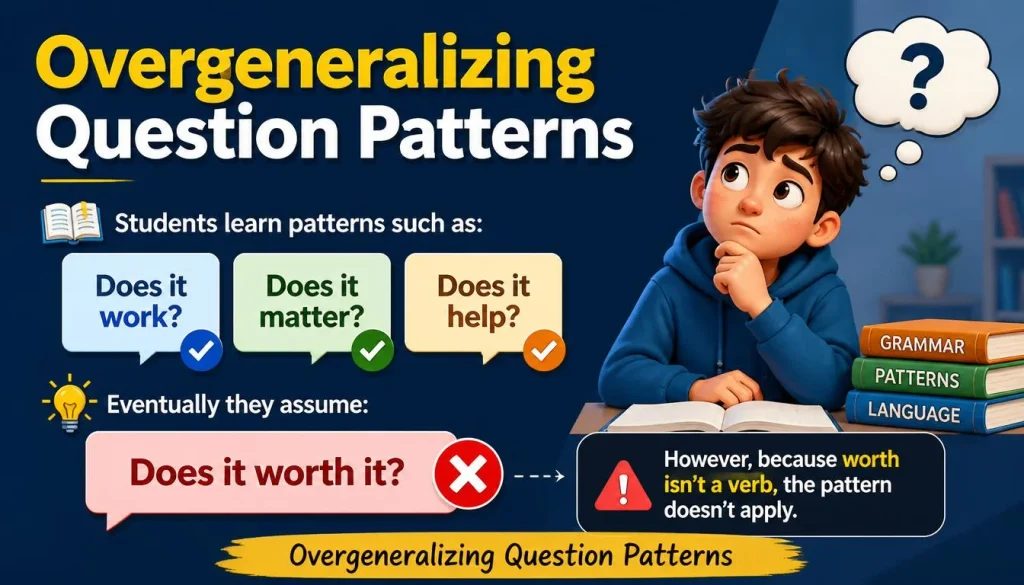
Overgeneralizing Question Patterns
Students learn patterns such as:
- Does it work?
- Does it matter?
- Does it help?
Eventually they assume:
- Does it worth it?
should also work.
However, because worth isn’t a verb, the pattern doesn’t apply.
Lack of Exposure to Native Usage
The more authentic English content you consume, the easier it becomes to recognize correct patterns.
Reading books, articles, and professional writing reinforces proper grammar naturally.
A Simple Memory Trick to Remember the Correct Phrase
Here’s an easy trick.
Replace worth with another adjective.
Examples:
- Is it useful?
- Is it valuable?
- Is it important?
Notice that all three use is.
Now try using does:
- Does it useful?
- Does it valuable?
- Does it important?
They sound obviously wrong.
The same logic applies to worth.
Correct:
Is it worth it?
Incorrect:
Does it worth it?
Quick Rule
If the word describes something rather than performs an action, use a form of be, not do.
That one rule eliminates the mistake immediately.
Comparison Chart: Correct vs. Incorrect Usage
| Incorrect | Correct |
| Does it worth it? | Is it worth it? |
| It worth it. | It is worth it. |
| Does the course worth it? | Is the course worth it? |
| Does the upgrade worth it? | Is the upgrade worth it? |
| Does this investment worth it? | Is this investment worth it? |
Practical Examples You Can Use Today
Shopping
✅ Is this phone worth it?
✅ Is the extended warranty worth it?
Education
✅ Is the certification worth it?
✅ Is the online course worth it?
Travel
✅ Is the trip worth it?
✅ Is first-class seating worth it?
Business
✅ Is the software worth it?
✅ Is the marketing campaign worth it?
Personal Development
✅ Is learning coding worth it?
✅ Is public speaking training worth it?
Expert Grammar Insight
“Worth” functions as a complement after a form of the verb “be.” Because it is not a lexical verb, it cannot directly follow auxiliary verbs such as “do” or “does.”
This principle appears consistently throughout modern English grammar.
Once you understand the grammatical role of worth, the confusion disappears.
FAQs
1. Which is correct: “Is it worth it” or “Does it worth it”?
“Is it worth it” is the correct expression. It uses the linking verb is with the adjective worth. “Does it worth it” is grammatically incorrect because worth is not a verb.
Example:
- Is it worth buying the premium plan?
- ❌ Does it worth buying the premium plan?
2. Why is “Does it worth it” incorrect?
The verb does must be followed by the base form of a verb. Since worth functions as an adjective rather than a verb, it cannot follow does in this sentence.
Correct examples:
- Is it worth the effort?
- Does it matter?
- Does it work?
3. Can I say “Was it worth it”?
Yes. “Was it worth it” is the correct past-tense form when referring to something that has already happened.
Example:
- Was it worth waiting for two hours?
4. Is “Worth” a verb or an adjective?
In expressions such as “It is worth it,” worth functions as an adjective. It describes the value of something rather than an action.
Example:
- The course is worth the money.
- The experience was worth every minute.
5. What are some alternatives to “Is it worth it”?
Depending on the context, you can use several natural alternatives, including:
- Is it worthwhile?
- Is it valuable?
- Is it beneficial?
- Is it a good investment?
- Does it provide enough value?
These expressions work well in both everyday conversations and formal writing.
6. How can I avoid making this grammar mistake?
Remember one simple rule:
- Use is/was + worth.
- Never use does + worth.
Reading English regularly, practicing sentence patterns, and proofreading your writing will help you develop stronger English us
Conclusion
Understanding the difference between “Is it worth it” and “Does it worth it” is a simple but important step toward improving your English grammar. While “Is it worth it” is the only grammatically correct expression, “Does it worth it” is a common mistake because the auxiliary verb does must be followed by the base form of the verb, not the adjective worth.
Whether you’re writing emails, participating in business communication, speaking in meetings, or having everyday conversations, using the correct phrase makes your language sound more natural and professional.
By learning the grammar rule, practicing with real-life examples, and avoiding common errors, you’ll build greater confidence and maintain consistency in both spoken and written English.

Alyan Ashraf is an English language writer and editor at Phrase Finesse, where he specializes in grammar, vocabulary, spelling, word usage, and clear communication. Passionate about the English language, he creates practical, research-backed content that helps readers avoid common mistakes and write with greater accuracy and confidence.
Known for his clear writing style and attention to detail, Alyan simplifies complex language topics into easy-to-understand guides filled with real-world examples and actionable insights. His work covers confusing word pairs, grammar rules, idioms, punctuation, and everyday English usage, making learning both accessible and engaging for students, professionals, writers, and non-native English speakers.
Every article Alyan writes is carefully researched, fact-checked, and designed to meet high editorial standards. His goal is to help readers strengthen their English skills, expand their vocabulary, and communicate more effectively in academic, professional, and everyday settings.
Through Phrase Finesse, Alyan is committed to publishing trusted language resources that make mastering English simpler, clearer, and more enjoyable for learners around the world