Have you ever wondered why people often use the terms rocket and missile interchangeably, even though they are not the same thing? Understanding Rocket vs. Missile: 2 Important Differences (Complete Guide) is essential for anyone interested in military technology, aerospace engineering, guided weapons, and rocket propulsion systems.
While both travel through the air using powerful engines, their design, purpose, and control systems differ significantly. This guide breaks down those distinctions in a simple, accurate, and easy-to-understand way.
Many readers search for the difference between a rocket and a missile because the terms frequently appear in news reports, defense discussions, documentaries, and educational content.
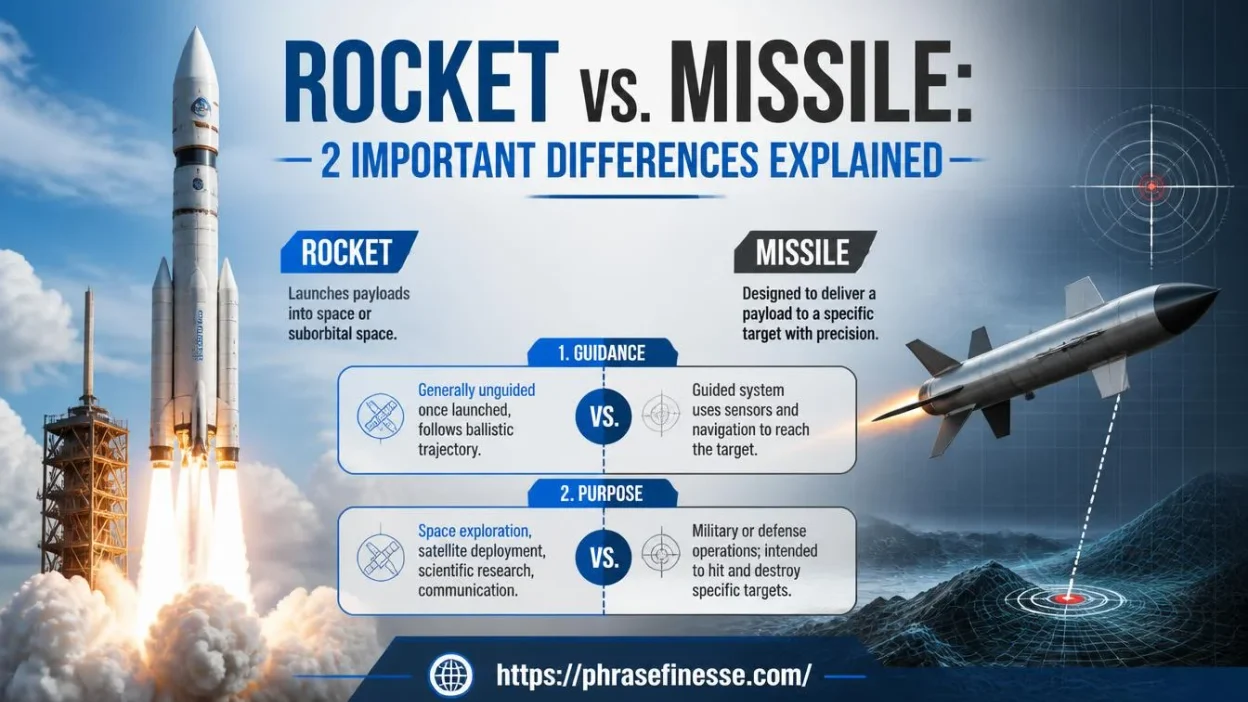
A rocket is generally a vehicle powered by a rocket engine that follows a predetermined path, whereas a missile is typically a guided weapon capable of adjusting its course to reach a target.
Understanding concepts such as guidance systems, navigation technology, trajectory control, payload delivery, and aerospace applications helps clarify why these technologies serve different purposes despite sharing similar propulsion principles.
In this complete guide, you’ll learn the two most important differences between rockets and missiles, explore their real-world uses, and discover common misconceptions that often cause confusion.
We’ll also examine key terms related to defense technology, space exploration, ballistic flight, precision targeting, engineering design, and technical communication. By the end, you’ll have a clear understanding of how rockets and missiles work, when each term should be used, and why the distinction matters in both professional and everyday discussions.
Rockets Are Built to Provide Propulsion
At its core, a rocket is a propulsion system.
Its purpose may include:
- Launching satellites
- Carrying astronauts into space
- Supporting scientific research
- Delivering cargo
- Providing battlefield fire support
- Creating visual displays such as fireworks
The rocket itself is not necessarily the end goal.
For example, when a satellite launch occurs, the rocket serves as the transportation system. The real objective is delivering the satellite into orbit.
A useful analogy is a delivery truck.
The truck’s purpose is transportation. What matters most is the cargo it carries.
Similarly, a rocket’s mission is often to transport a payload efficiently.
Missiles Are Built to Strike Targets
A missile exists for a much narrower objective.
Its mission is usually:
- Destroying enemy equipment
- Neutralizing threats
- Defending strategic locations
- Intercepting incoming weapons
- Supporting military operations
Everything inside a missile supports target engagement.
That includes:
- Guidance systems
- Tracking sensors
- Navigation computers
- Control surfaces
- Warheads
Unlike space rockets, missiles are optimized for accuracy rather than payload transportation.
Why Purpose Changes the Design
When engineers build rockets, they focus on:
- Thrust
- Payload capacity
- Reliability
- Range
- Fuel efficiency
When engineers build missiles, they focus on:
- Precision
- Target tracking
- Survivability
- Maneuverability
- Guidance accuracy
As a result, missiles often contain sophisticated electronics that ordinary rockets do not require.
Rocket vs. Missile Purpose Comparison
| Feature | Rocket | Missile |
| Primary Goal | Transport payloads or provide propulsion | Strike a target |
| Civilian Uses | Common | Extremely limited |
| Space Exploration | Yes | No |
| Scientific Research | Yes | No |
| Military Attack Role | Sometimes | Primary role |
| Guidance Requirement | Optional | Essential |
| Target Tracking | Usually absent | Core function |
Can a Missile Be a Rocket?
This question causes more confusion than almost any other aspect of the debate.
The answer is:
Many missiles use rocket propulsion, but not every rocket is a missile.
The terms describe different characteristics.
- Rocket describes the propulsion method.
- Missile describes the mission and guidance capability.
Think about automobiles.
A sports car and a delivery van may both use gasoline engines. However, they serve different purposes.
Likewise, a missile may use a rocket motor while remaining fundamentally different from a space rocket.
Why Many Missiles Use Rocket Engines
Rocket engines offer several advantages:
High Acceleration
Missiles often need to reach high speeds very quickly.
Rocket propulsion delivers enormous thrust immediately after launch.
Simplicity
Rocket motors contain fewer moving parts than many jet engines.
This can improve reliability under combat conditions.
Operation at High Altitudes
Because rockets carry their own oxidizer, they can function where atmospheric oxygen is unavailable.
This capability is especially useful for certain missile designs.
Examples of Missiles That Use Rocket Propulsion
Many missile systems use rocket motors during part or all of their flight.
Examples include:
- Air-to-air missiles
- Surface-to-air missiles
- Anti-tank missiles
- Ballistic missiles
The presence of a rocket motor does not automatically make something a rocket in the broader classification sense.
The guidance system and mission profile still define it as a missile.
Why Not Every Rocket Is a Missile
The reverse statement is even more important.
Most rockets are not missiles.
In fact, many rockets have nothing to do with weapons.
Space Exploration Rockets
Modern spaceflight depends entirely on rockets.
Examples include:
- Satellite launch vehicles
- Lunar mission rockets
- Deep-space exploration systems
- Human spaceflight launch vehicles
These systems are designed to transport payloads into orbit or beyond.
Their objective is exploration rather than target destruction.
Scientific Research Rockets
Scientists frequently use rockets to gather valuable data.
Research rockets help study:
- Atmospheric layers
- Space weather
- Radiation environments
- Climate conditions
These missions improve scientific understanding rather than supporting military objectives.
Read More :Hundred Thousands or Hundreds of Thousands? Which Is Correct?
Commercial Rockets
The commercial space industry has grown rapidly.
Private companies now launch:
- Internet satellites
- Weather satellites
- Earth observation systems
- Commercial research payloads
These rockets operate as transportation systems for space infrastructure.
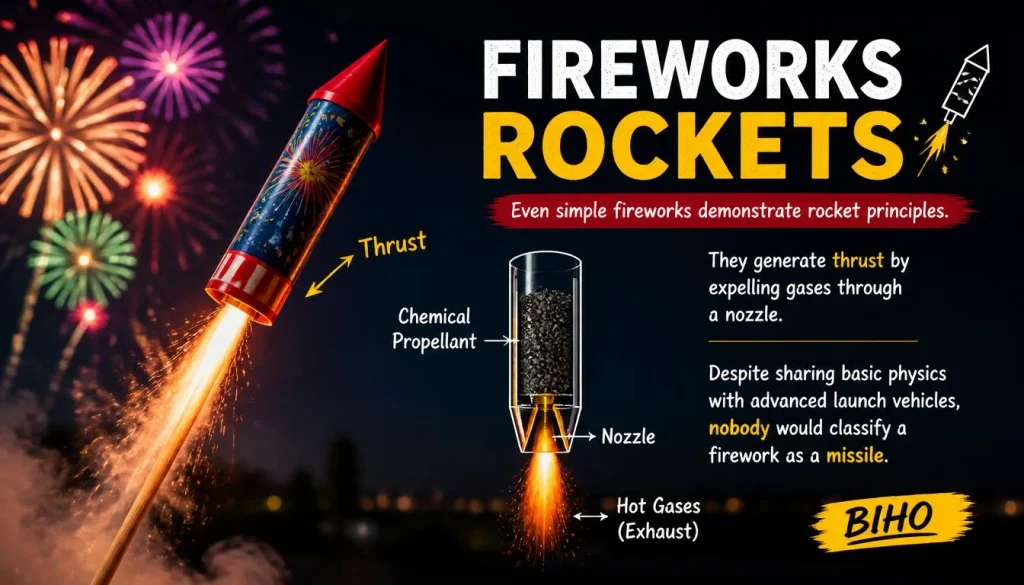
Fireworks Rockets
Even simple fireworks demonstrate rocket principles.
They generate thrust by expelling gases through a nozzle.
Despite sharing basic physics with advanced launch vehicles, nobody would classify a firework as a missile.
Real-World Case Study: Apollo Moon Missions
One of the best examples of a rocket that is not a missile is the Apollo program.
The Apollo missions relied on the massive Saturn V rocket.
Key facts:
| Characteristic | Saturn V |
| Height | 363 feet (110.6 meters) |
| Launch Weight | About 6.2 million pounds |
| Purpose | Carry astronauts to the Moon |
| Guidance | Mission navigation, not target tracking |
| Classification | Rocket |
The Saturn V remains one of the most powerful rockets ever built.
Its purpose was transportation and exploration, not attacking a target.
This makes it a perfect example of why rockets and missiles should not be treated as interchangeable terms.
Real-World Case Study: Modern Guided Missiles
Modern guided missiles demonstrate the opposite principle.
A missile’s defining characteristic is not its engine.
It is the ability to locate and strike a designated target.
For example, advanced air-defense missiles can:
- Detect incoming aircraft
- Calculate intercept paths
- Adjust course continuously
- Engage moving targets
Without guidance systems, these weapons would lose much of their effectiveness.
This capability separates missiles from traditional rockets.
Common Misconceptions About Rockets and Missiles
Several myths continue to create confusion.
Let’s clear them up.
Myth: All Missiles Are Rockets
Not always.
Some missiles rely on propulsion systems other than pure rocket motors.
Certain cruise missiles use jet engines for much of their flight.
Because of this, missile classification depends on mission and guidance rather than propulsion alone.
Myth: All Rockets Are Weapons
This is one of the most common misunderstandings.
Many rockets serve peaceful purposes.
Examples include:
- Satellite launches
- Scientific experiments
- Space exploration
- Commercial missions
The majority of large rockets built today support civilian and scientific activities.
Myth: Rockets and Missiles Are Just Different Names for the Same Thing
Although the terms are often used interchangeably in casual conversation, aerospace and defense professionals treat them as distinct technologies.
The difference is not merely semantic.
It reflects major engineering and operational distinctions.
Myth: Missiles Always Travel Faster Than Rockets
Speed alone does not determine classification.
Some space launch rockets reach velocities far beyond many missile systems.
What matters is guidance capability and mission purpose.
Rocket vs. Missile: Side-by-Side Comparison
The following table summarizes the key differences.
| Feature | Rocket | Missile |
| Definition | Vehicle propelled by rocket thrust | Guided weapon system |
| Main Purpose | Transport payloads or provide propulsion | Strike a target |
| Guidance | Usually limited or absent | Essential component |
| Target Tracking | No | Yes |
| Civilian Applications | Extensive | Very limited |
| Scientific Uses | Common | Rare |
| Space Missions | Primary technology | Not used |
| Military Applications | Sometimes | Primary role |
| Navigation Corrections | Usually none | Continuous corrections possible |
| Cost Complexity | Generally lower | Generally higher |
Key Takeaways
If you remember only two things from this guide, remember these:
Guidance
A rocket usually follows a predetermined path.
A missile actively guides itself toward a target.
Purpose
A rocket provides propulsion or transportation.
A missile exists to strike a specific target.
Everything else flows from those two distinctions.
FAQs
What is the main difference between a rocket and a missile?
The main difference is that a rocket is usually an unguided vehicle powered by a rocket engine, while a missile is a guided system designed to adjust its path and accurately reach a specific target using guidance and navigation technology.
Is every missile a rocket?
Not always. Many missiles use rocket propulsion, but some use other propulsion methods, such as jet engines. Therefore, not every missile is technically a rocket, even though many share similar technologies.
Can a rocket be used as a weapon?
Yes. Some rockets are designed for military purposes and can carry explosive payloads. However, unlike missiles, most rockets lack advanced target-tracking and guidance systems, making them less precise.
Are space launch vehicles considered rockets or missiles?
Space launch vehicles are considered rockets because their primary purpose is to carry satellites, spacecraft, or cargo into space. They are not designed as guided weapons and therefore are not classified as missiles.
Why are missiles more accurate than rockets?
Missiles are more accurate because they use sophisticated guidance systems, sensors, and navigation controls that allow them to change direction during flight and track their targets.
Why do people confuse rockets and missiles?
People often confuse the two because both use powerful propulsion systems and can travel at high speeds. News reports, movies, and casual conversations frequently use the terms interchangeably, even though they have different technical meanings.
Conclusion
Understanding Rocket vs. Missile: 2 Important Differences (Complete Guide) becomes much easier once you focus on their core functions. A rocket is primarily a propulsion-driven vehicle that follows a planned trajectory, while a missile is a guided system capable of steering itself toward a target.
Although both rely on similar propulsion principles, their purposes, control mechanisms, and applications are significantly different.
Whether you’re interested in aerospace engineering, military technology, space exploration, or simply improving your technical knowledge, knowing the distinction helps you use these terms accurately.
By understanding how guidance systems, rocket propulsion, trajectory control, and precision targeting work, you can better interpret news reports, educational resources, and discussions involving modern defense and space technologies.

Alyan Ashraf is an English language writer and editor at Phrase Finesse, where he specializes in grammar, vocabulary, spelling, word usage, and clear communication. Passionate about the English language, he creates practical, research-backed content that helps readers avoid common mistakes and write with greater accuracy and confidence.
Known for his clear writing style and attention to detail, Alyan simplifies complex language topics into easy-to-understand guides filled with real-world examples and actionable insights. His work covers confusing word pairs, grammar rules, idioms, punctuation, and everyday English usage, making learning both accessible and engaging for students, professionals, writers, and non-native English speakers.
Every article Alyan writes is carefully researched, fact-checked, and designed to meet high editorial standards. His goal is to help readers strengthen their English skills, expand their vocabulary, and communicate more effectively in academic, professional, and everyday settings.
Through Phrase Finesse, Alyan is committed to publishing trusted language resources that make mastering English simpler, clearer, and more enjoyable for learners around the world