Have you ever paused mid-sentence and wondered whether the next word should begin with a capital letter? If so, you’re not alone.Do You Capitalize After an Ellipsis? Grammar Guide With Examples is a common question among writers, students, editors, and professionals who want to improve their grammar, English usage, and overall writing accuracy.
Since ellipses often signal a pause, omission, or trailing thought, knowing the correct capitalization rule can make your writing look more polished and professional.
Understanding capitalization after an ellipsis is especially important in formal writing, business communication, academic content, and digital messaging. Whether you’re drafting emails, managing project management documents, organizing a calendar, coordinating meetings, or creating content for broadcasting, proper punctuation supports clarity and consistency.
Even in areas such as scheduling, time management, and online booking, clear written communication helps prevent confusion and ensures your message is understood correctly.
In this guide, you’ll learn when to capitalize after an ellipsis, when lowercase is the better choice, and how context affects the rule. Through practical examples and easy-to-follow explanations, we’ll break down the key principles of grammar, punctuation, and sentence structure.
By the end, you’ll have a clear understanding of how ellipses work and how to apply capitalization rules confidently in both everyday and professional writing.
What Is an Ellipsis?
An ellipsis is a punctuation mark consisting of three consecutive dots:
…
Writers use ellipses for several reasons, including omitting words from quotations, showing hesitation, indicating pauses, and representing incomplete thoughts.
Think of an ellipsis as a bridge. Sometimes it connects pieces of a sentence. Other times it signals that part of the text has been intentionally left out.
Common Uses of an Ellipsis
Omitting Words From Quotations
Researchers, journalists, and students frequently remove unnecessary words from quotations while preserving the original meaning.
Example:
Original: “The committee reviewed all applications and determined that additional funding was necessary.”
Edited: “The committee reviewed all applications … additional funding was necessary.”
Showing Hesitation
People rarely speak in perfectly polished sentences. Ellipses help writers capture natural pauses.
Example:
“Well … I’m not sure that’s the best idea.”
Indicating an Unfinished Thought
Sometimes a thought trails off instead of reaching a clear conclusion.
Example:
“I thought I saw something in the woods…”
Creating Suspense
Creative writers often use ellipses to build anticipation.
Example:
“When she opened the door, she discovered…”
Quick Reference: What an Ellipsis Does
| Purpose | Example |
| Omitted words | “The report stated … further review was needed.” |
| Pause | “I guess … you’re right.” |
| Unfinished thought | “Maybe someday…” |
| Suspense | “The answer was finally revealed…” |
| Dialogue hesitation | “I don’t know … maybe.” |
Do You Capitalize After an Ellipsis?
The short answer is:
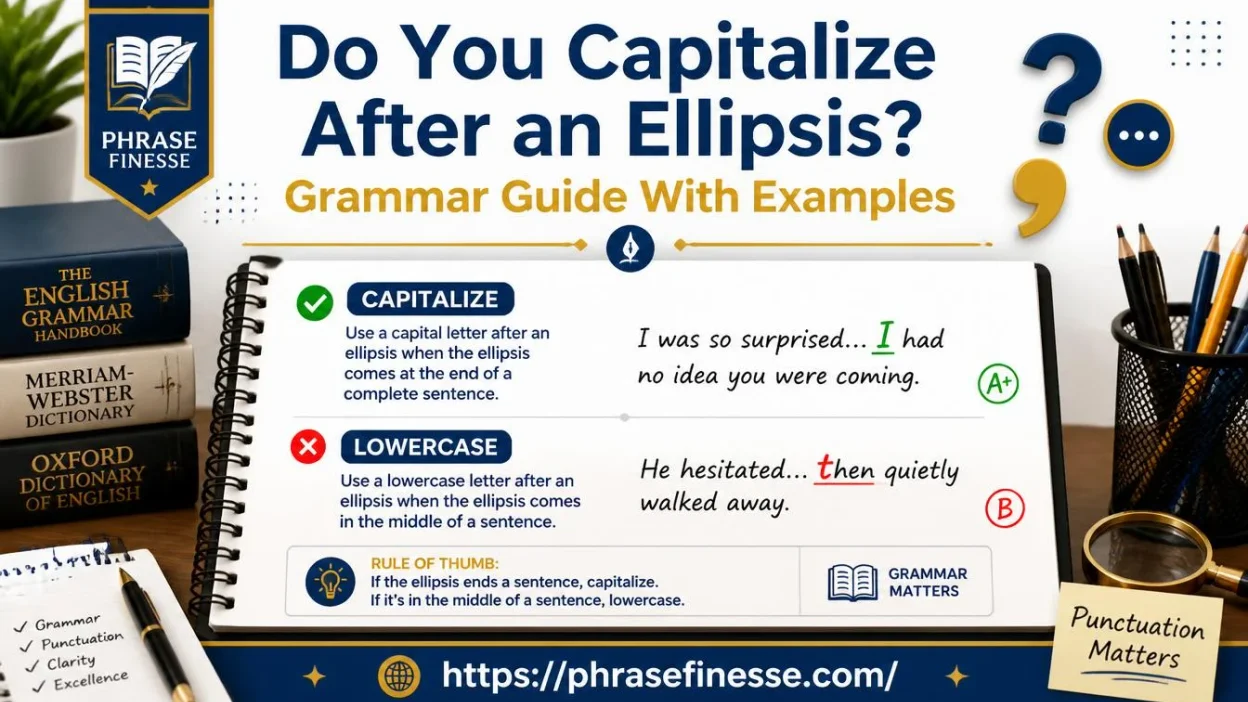
Capitalize after an ellipsis only when the following word begins a new sentence.
If the sentence continues after the ellipsis, use lowercase.
This single rule solves almost every capitalization question involving ellipses.
Let’s break it down.
When You Should NOT Capitalize After an Ellipsis
Most of the time, writers use ellipses within a sentence rather than between sentences.
When the sentence continues after the ellipsis, the next word should remain lowercase.
Ellipsis Within a Single Sentence
Consider this example:
“She wanted to attend the conference … but she had another commitment.”
The sentence never actually ends. The thought continues after the ellipsis.
Therefore:
✅ Correct:
“She wanted to attend the conference … but she had another commitment.”
❌ Incorrect:
“She wanted to attend the conference … But she had another commitment.”
The word but is not beginning a new sentence.
More Examples of Lowercase After an Ellipsis
Example One
“The instructions seemed simple … until we started the project.”
Example Two
“I was ready to leave … then my phone rang.”
Example Three
“The movie looked promising … although the ending disappointed me.”
In every example, the sentence continues naturally after the ellipsis.
A Simple Test
Ask yourself:
Could I replace the ellipsis with a comma and keep the sentence intact?
If the answer is yes, lowercase is usually correct.
Example:
“I wanted to call … but it was too late.”
Can become:
“I wanted to call, but it was too late.”
Since the sentence remains one continuous thought, lowercase works after the ellipsis.
When You SHOULD Capitalize After an Ellipsis
Now let’s look at situations where capitalization is required.
Whenever the ellipsis is followed by a completely new sentence, capitalize the first word of that sentence.
Ellipsis Between Two Sentences
Example:
“The meeting ended earlier than expected. … Everyone headed home.”
The word Everyone begins a new sentence.
Therefore:
✅ Correct:
“The meeting ended earlier than expected. … Everyone headed home.”
❌ Incorrect:
“The meeting ended earlier than expected. … everyone headed home.”
Additional Examples
Example One
“The storm finally passed. … The streets remained flooded.”
Example Two
“No one answered the phone. … The office had already closed.”
Example Three
“The experiment was successful. … Researchers immediately began further testing.”
In each case, a new sentence begins after the ellipsis.
Why Capitalization Matters
Capital letters signal sentence boundaries.
Readers rely on those visual cues to understand where one thought ends and another begins.
Without proper capitalization, writing can become confusing and difficult to follow.
Think of capitalization as a road sign. It tells readers where the next sentence starts.
Capitalization After an Ellipsis in Quotations
Quotations introduce a slightly different situation.
When using ellipses inside quoted material, your goal is to preserve the original structure and meaning.
Omitting Words Within a Sentence
Suppose the original sentence reads:
“The board unanimously agreed that immediate action was necessary.”
Edited version:
“The board unanimously agreed … immediate action was necessary.”
Notice that immediate remains lowercase because it continues the original sentence.
Omitting One or More Complete Sentences
Original text:
“The investigation concluded in May. Several recommendations followed. Further monitoring remains necessary.”
Edited version:
“The investigation concluded in May. … Further monitoring remains necessary.”
The word Further begins a new sentence.
Capitalization is therefore required.
Academic Writing and Ellipses
Many academic style guides provide specific rules.
APA Style
The American Psychological Association (APA) recommends preserving original capitalization whenever possible.
MLA Style
The Modern Language Association (MLA) generally follows the original sentence structure when using ellipses.
Chicago Style
The Chicago Manual of Style emphasizes maintaining grammatical clarity and preserving meaning.
Regardless of style guide differences, capitalization usually depends on whether the remaining text starts a new sentence.
Academic Example Table
| Original Structure | Correct After Ellipsis |
| Sentence continues | Lowercase |
| New sentence begins | Capitalize |
| Mid-sentence omission | Lowercase |
| Omitted entire sentence | Capitalize |
Ellipsis at the End of a Sentence
One of the most common areas of confusion occurs when an ellipsis appears at the end of a thought.
Consider this sentence:
“Maybe one day…”
The sentence trails off.
Now add another sentence:
“Maybe one day… We’ll find out.”
Notice the capitalization.
We’ll begins a new sentence.
Therefore, capitalization is required.
More Examples
Example One
“I thought things would change… They didn’t.”
Example Two
“Perhaps there’s another solution… We’ll discuss it tomorrow.”
Example Three
“The answer seemed obvious… At least at first.”
Each example starts a new sentence after the ellipsis.
Ellipsis in Dialogue and Fiction Writing
Fiction writers use ellipses constantly.
Dialogue often includes pauses, interruptions, uncertainty, and unfinished thoughts.
Because of that, capitalization rules depend heavily on context.
Showing Hesitation
Example:
“I don’t know … maybe you’re right.”
The sentence continues.
No capitalization is needed.
Showing Uncertainty
Example:
“Well … I suppose we could try.”
Again, lowercase works because the thought continues.
Showing a New Sentence
Example:
“I wanted to explain. … But the opportunity never came.”
Now But starts a new sentence.
Capitalization becomes necessary.
Dialogue Comparison
| Dialogue Example | Capitalize? |
| “Maybe … we should leave.” | No |
| “I thought so. … Then everything changed.” | Yes |
| “Well … that’s awkward.” | No |
| “The plan failed. … Everyone knew why.” | Yes |
Common Mistakes Writers Make With Ellipses
Even experienced writers occasionally misuse ellipses.
Let’s examine the most frequent errors.
Capitalizing Every Word After an Ellipsis
Many writers assume every ellipsis automatically requires a capital letter.
Example:
❌ Incorrect
“I wasn’t sure … Maybe.”
✅ Correct
“I wasn’t sure … maybe.”
The sentence continues, so lowercase is appropriate.
Forgetting to Capitalize a New Sentence
Example:
❌ Incorrect
“The event ended. … everyone left.”
✅ Correct
“The event ended. … Everyone left.”
A new sentence requires capitalization.
See More :6 Words for Someone Who Won’t Admit They’re Wrong
Using Ellipses Instead of Proper Punctuation
Ellipses are not a replacement for every pause.
Example:
❌ Weak
“The report was finished … and it was submitted … and everyone celebrated.”
✅ Better
“The report was finished, submitted, and celebrated.”
Sometimes a simple comma works better.
Overusing Ellipses
Too many ellipses make writing feel hesitant and fragmented.
Consider this example:
“I went to the store … bought milk … came home … made dinner … watched television…”
The rhythm feels sluggish.
A cleaner version reads:
“I went to the store, bought milk, came home, made dinner, and watched television.”
Ellipsis vs. Other Punctuation Marks
Many punctuation problems arise because writers choose the wrong mark.
Understanding the differences helps avoid mistakes.
Ellipsis vs. Period
Ellipsis
Indicates omission, hesitation, or an unfinished thought.
Example:
“I thought I heard something…”
Period
Ends a complete sentence.
Example:
“I thought I heard something.”
Ellipsis vs. Em Dash
Ellipsis
Suggests a fading or trailing thought.
Example:
“I was thinking…”
Em Dash
Signals interruption or sudden change.
Example:
“I was thinking—but never mind.”
Ellipsis vs. Comma
Ellipsis
Longer pause.
Example:
“Well … perhaps.”
Comma
Short pause.
Example:
“Well, perhaps.”
Ellipsis vs. Semicolon
Ellipsis
Creates omission or uncertainty.
Semicolon
Connects closely related ideas.
Example:
“The deadline passed; nobody complained.”
Punctuation Comparison Table
| Punctuation | Purpose | Example |
| Ellipsis (…) | Omission or trailing thought | “Maybe…” |
| Period (.) | End sentence | “Maybe.” |
| Em Dash (—) | Interruption | “Maybe—but…” |
| Comma (,) | Brief pause | “Maybe, yes.” |
| Semicolon (;) | Connect clauses | “Maybe; we’ll see.” |
Real-World Case Study: Why Capitalization After an Ellipsis Matters
Imagine a company sending this message:
“The project is complete … everyone can begin implementation.”
Readers may wonder whether the sentence intentionally continues.
Now compare:
“The project is complete. … Everyone can begin implementation.”
The meaning becomes much clearer.
The second version signals a definite sentence break.
This small capitalization choice improves readability and professionalism.
Expert Tips for Using Ellipses Correctly
Mastering ellipses doesn’t require memorizing dozens of rules.
Instead, focus on a few practical principles.
Determine Whether the Sentence Continues
This is the most important rule.
Ask:
Is the thought still ongoing?
If yes, use lowercase.
If no, capitalize.
Let Grammar Guide You
Don’t let the ellipsis decide capitalization.
Let the sentence structure decide.
Grammar comes first.
Punctuation supports grammar—not the other way around.
Follow Your Style Guide
Academic papers, novels, newspapers, and blogs may apply slightly different formatting standards.
When writing professionally, always check the preferred style guide.
Use Ellipses Sparingly
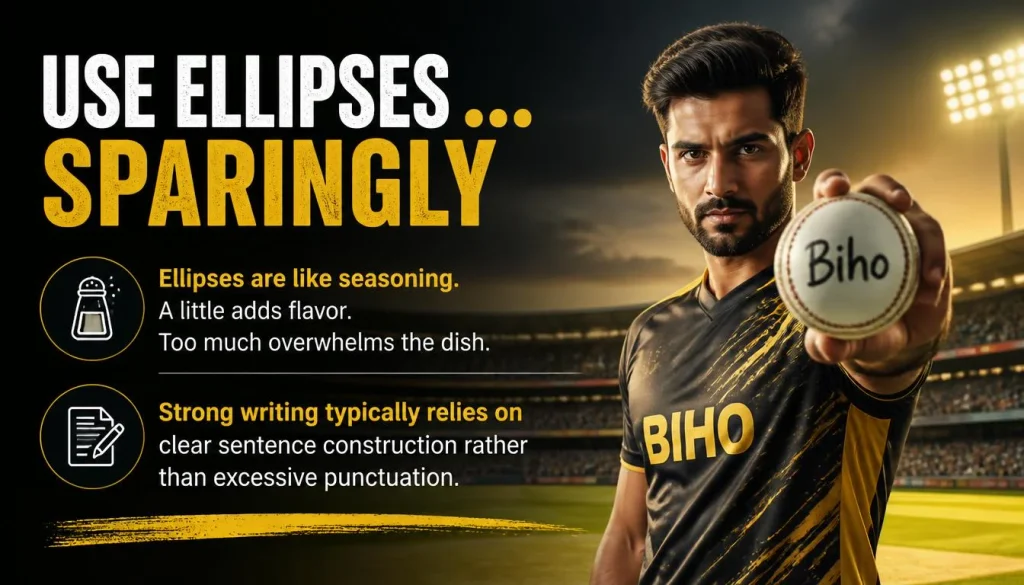
Ellipses are like seasoning.
A little adds flavor.
Too much overwhelms the dish.
Strong writing typically relies on clear sentence construction rather than excessive punctuation.
Quick Cheat Sheet: Do You Capitalize After an Ellipsis?
| Situation | Capitalize? |
| Sentence continues | No |
| Same thought continues | No |
| Mid-sentence quotation omission | No |
| New sentence starts | Yes |
| Entire sentence omitted in quotation | Yes |
| New thought begins after trailing sentence | Yes |
| Dialogue continues | No |
| Dialogue starts new sentence | Yes |
FAQs
Is the First Word After an Ellipsis Always Capitalized?
No. The word after an ellipsis is only capitalized when it begins a new sentence or when standard capitalization rules require it. If the ellipsis appears within the same sentence, the following word usually remains lowercase.
Do You Capitalize After an Ellipsis in Formal Writing?
In formal writing, capitalization depends on whether the ellipsis ends one sentence and starts another. If a new sentence begins after the ellipsis, capitalize the first word. Otherwise, keep it lowercase.
How Do Ellipses Affect Grammar and Punctuation?
Ellipses indicate omitted words, unfinished thoughts, or pauses in writing. They do not automatically change capitalization rules. Writers should determine whether the text following the ellipsis starts a new sentence.
Can You Use a Lowercase Letter After an Ellipsis?
Yes. When the ellipsis appears in the middle of a sentence and the sentence continues afterward, the next word should generally begin with a lowercase letter.
What Happens When Quoting Text With an Ellipsis?
When using an ellipsis in a quotation, capitalization depends on the original sentence structure and the way the quote is presented. If the ellipsis precedes the start of a new sentence, capitalization is usually appropriate.
Why Is Correct Capitalization After an Ellipsis Important?
Correct capitalization improves clarity, consistency, and readability. It helps readers understand sentence boundaries and ensures your writing follows accepted English grammar and formal writing conventions.
Conclusion
Understanding whether to capitalize after an ellipsis is easier once you focus on the sentence structure rather than the punctuation mark itself. An ellipsis does not automatically require a capital letter. Instead, capitalization depends on whether the words following the ellipsis begin a new sentence or continue the existing one.
By applying these rules consistently, you can strengthen your grammar, improve formal writing, and communicate more effectively in everything from business communication and project management documents to emails, reports, and everyday conversations. The examples in this guide provide a practical reference, helping you use ellipses with confidence and maintain professional, polished writing.

Emma Brooke is an English language specialist, editor, and content writer at Phrase Finesse, where she helps readers develop stronger writing and communication skills through clear, practical, and engaging content. With a passion for the English language, she specializes in simplifying grammar rules, vocabulary, spelling, punctuation, and word usage for learners at every level.
Emma has extensive experience creating educational content that is accurate, well-researched, and easy to understand. She is particularly skilled at explaining confusing word pairs, grammar concepts, idioms, sentence structure, and effective writing techniques, making complex topics approachable for students, professionals, educators, and English learners worldwide.