Have you ever accidentally missed a deadline, sent the wrong message, or made a simple mistake in a conversation and replied with “My Bad” Learn If It Is Proper English? This popular expression appears everywhere, from casual texts to social media posts.
Yet many English learners and professionals wonder whether “my bad” is considered proper English, when it should be used, and whether it fits different communication settings.
Understanding the meaning and acceptability of “my bad” is important for effective English usage, accurate grammar, and confident communication. While the phrase is common in informal speech, its suitability can vary depending on the context. In professional environments involving business communication, formal writing, meetings, project management, or broadcasting, word choice can influence clarity and credibility.
Even in situations involving scheduling, time management, calendar management, or online booking, choosing the right expression helps maintain professionalism and consistency.
In this guide, you’ll learn whether “my bad” is proper English, where the phrase originated, and how native speakers use it today. We’ll also explore its meaning, grammar, tone, and practical alternatives for formal and informal situations.
By the end, you’ll know exactly when “my bad” works well and when a different expression may be the better choice.
Is “My Bad” Proper English?
The question “Is my bad proper English?” comes up frequently among students, professionals, and writers.
The short answer is:
Yes, “my bad” is proper English in informal contexts, but it is not considered appropriate for formal writing or professional communication.
Today, most native English speakers immediately understand the phrase.
If someone says:
“My bad. I forgot to send the attachment.”
Nobody is confused.
The phrase clearly communicates responsibility and acknowledges a mistake.
However, understanding doesn’t automatically make an expression suitable for every situation.
Why Some People Think “My Bad” Is Incorrect
Traditional grammar experts often criticize the phrase because it appears incomplete.
Consider these examples:
- My mistake.
- My fault.
- My error.
Each phrase contains a noun after “my.”
Now look at:
- My bad.
The word bad is normally an adjective rather than a noun.
That’s why some people argue the phrase breaks conventional grammar rules.
However, English contains countless expressions that don’t strictly follow textbook patterns.
Examples include:
- Long time no see.
- So far so good.
- No worries.
- You bet.
Despite their unconventional structure, native speakers accept them because they communicate effectively.
Why Native Speakers Use It So Often
The main reason is simplicity.
Instead of saying:
“I apologize for making that mistake.”
People can simply say:
“My bad.”
It’s short.
It’s direct.
And it immediately acknowledges responsibility.
What Does “My Bad” Mean?
At its core, “my bad” means “my mistake” or “my fault.”
People use it to admit they caused a problem or made an error.
Basic Definition
My bad = I made a mistake.
Common Meanings
The phrase can communicate:
- Responsibility
- Acknowledgment
- Regret
- A casual apology
- Recognition of an error
Examples
Forgotten appointment
“My bad. I completely forgot about today’s meeting.”
Wrong information
“My bad. I gave you the wrong address.”
Accidental interruption
“My bad. Please continue.”
What Makes It Different From an Apology?
Interestingly, “my bad” doesn’t always function as a full apology.
Instead, it often serves as a quick acknowledgment.
Compare these:
| Expression | Meaning |
| My bad | I made a mistake |
| Sorry | I feel regret |
| I apologize | Formal expression of regret |
| My fault | Direct acceptance of blame |
This subtle distinction matters in professional settings.
Where Did “My Bad” Come From?
Many people assume “my bad” is a modern internet phrase.
In reality, its roots go back several decades.
Early Origins
Most language historians trace the expression to American urban slang during the 1970s.
It gained popularity through basketball culture.
Imagine a player missing an easy shot.
Instead of delivering a long explanation, they simply said:
“My bad.”
The phrase quickly communicated responsibility without slowing down the game.
Why Basketball Helped Spread It
Basketball requires rapid communication.
Players don’t have time for lengthy apologies.
They need quick phrases that everyone understands.
“My bad” fit perfectly.
Moving Into Mainstream English
During the 1980s and 1990s, the expression expanded beyond sports.
Television shows, movies, and music introduced it to wider audiences.
Eventually, people began using it in:
- Schools
- Offices
- Friend groups
- Online communities
- Social media
Today, the phrase is recognized throughout the English-speaking world.
Is “My Bad” Grammatically Correct?
This question deserves a deeper look.
The Traditional Grammar Perspective
Strictly speaking, the phrase doesn’t follow the typical pattern expected after a possessive adjective.
Normally, you would expect:
- My mistake
- My error
- My responsibility
Instead, “bad” acts unusually.
This is why some grammar traditionalists object to it.
The Modern Linguistic Perspective
Modern linguists focus heavily on actual usage.
If millions of native speakers understand and use a phrase consistently, it becomes part of the language.
That’s exactly what happened with “my bad.”
Elliptical Expressions in English
“My bad” belongs to a category called elliptical expressions.
An elliptical expression leaves out words that listeners automatically understand.
For example:
| Expression | Full Meaning |
| Sounds good | That sounds good |
| Got it | I have got it |
| No problem | There is no problem |
| My bad | That was my bad mistake |
The omitted words are understood through context.
The Bottom Line
“My bad” is grammatically unconventional but widely accepted in informal English.
When Should You Use “My Bad”?
Context is everything.
In the right situation, the phrase sounds natural and friendly.
Casual Conversations
Friends use it constantly.
Examples:
“My bad. I forgot your birthday.”
“My bad. I thought the movie started at eight.”
Text Messages
The phrase works exceptionally well in texting because it is brief.
Examples:
“My bad. Just saw your message.”
“My bad. Wrong group chat.”
Informal Workplace Conversations
Many modern workplaces have relaxed communication styles.
In team chats or casual discussions, “my bad” often sounds acceptable.
Example:
“My bad. I uploaded the old version.”
Social Media
You’ll see the phrase everywhere online.
Examples include:
- Comments
- Tweets
- Posts
- Discussion forums
Quick Reference Table
| Situation | Suitable? |
| Text message | Yes |
| Conversation with friends | Yes |
| Casual workplace chat | Usually |
| Academic paper | No |
| Formal email | No |
| Legal document | No |
When Should You Avoid “My Bad”?
Not every mistake deserves a casual response.
Sometimes professionalism matters.
Formal Business Communication
Imagine sending a message to a client after losing important data.
Writing:
“My bad.”
Would likely sound unprofessional.
Instead:
“I apologize for the error and take full responsibility.”
sounds more appropriate.
Academic Writing
Schools and universities generally expect formal language.
Avoid using:
“My bad.”
Use:
“This was an oversight on my part.”
Serious Situations
Major mistakes require stronger accountability.
Examples include:
- Financial errors
- Medical mistakes
- Customer complaints
- Contract issues
A casual phrase may appear dismissive.
Read More :6 Words to Describe Someone Who Is Always Negative
Case Study: When “My Bad” Backfires
A customer service representative accidentally shipped the wrong product.
Response:
“My bad.”
The customer felt their concern wasn’t taken seriously.
A better response:
“I apologize for the mistake. We’re shipping a replacement immediately.”
The difference is significant.
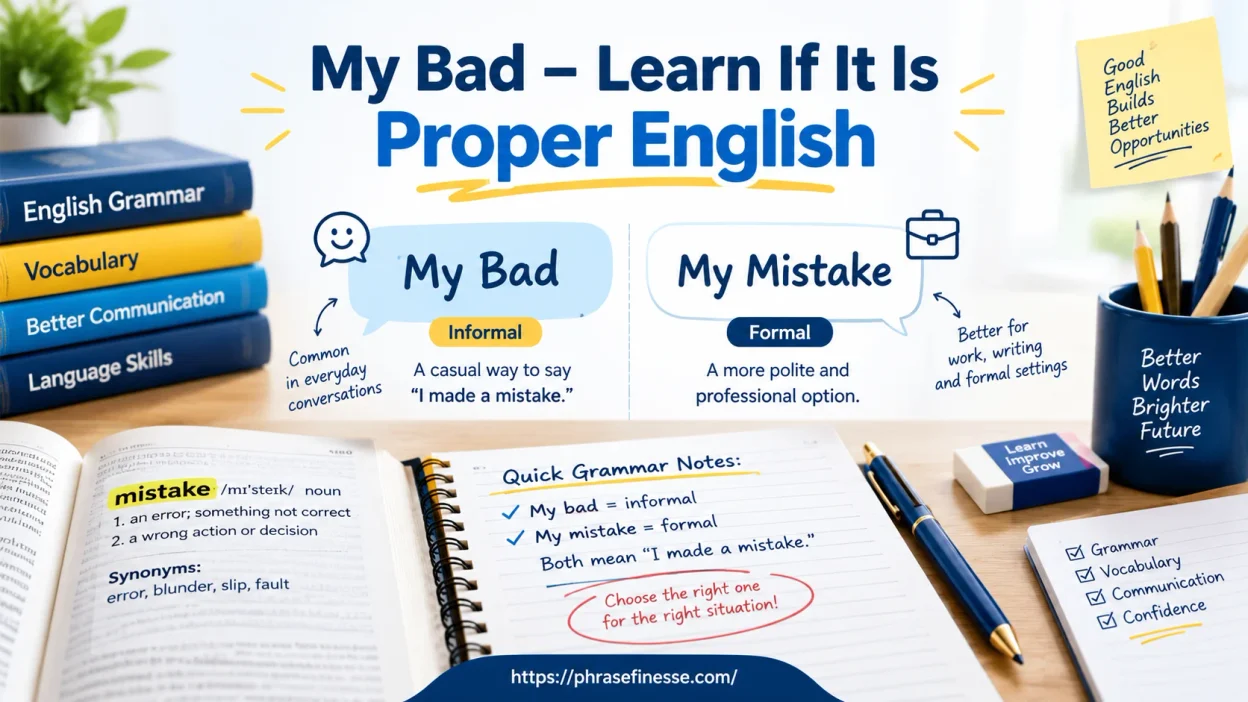
My Bad vs. My Mistake
Many learners struggle to choose between these expressions.
Comparison Table
| Feature | My Bad | My Mistake |
| Formality | Informal | Neutral |
| Workplace Use | Limited | Common |
| Academic Use | Not Recommended | Acceptable |
| Professional Emails | Rarely | Frequently |
| Casual Conversation | Very Common | Common |
Which Should You Choose?
Use “my bad” when speaking casually.
Use “my mistake” when professionalism matters.
Example Comparison
Casual:
“My bad. I forgot.”
Professional:
“My mistake. I’ll correct it immediately.”
My Bad vs. Sorry
Although these expressions overlap, they aren’t identical.
“My Bad” Focuses on Responsibility
It emphasizes:
I made the mistake.
“Sorry” Focuses on Regret
It emphasizes:
I feel bad about what happened.
Examples
My bad
“My bad. I gave you the wrong link.”
Sorry
“Sorry you had trouble accessing the file.”
Best Practice
For stronger communication, combine them.
Example:
“Sorry about that. My bad.”
This acknowledges both responsibility and regret.
Better Alternatives to “My Bad”
Sometimes another phrase fits better.
Casual Alternatives
- My fault
- That’s on me
- I messed up
- Oops
- I slipped up
Examples
“That’s on me.”
“I messed up.”
“Oops. Wrong file.”
Professional Alternatives
- I apologize.
- That was my mistake.
- I take responsibility.
- Thank you for bringing this to my attention.
- I appreciate your patience.
Professional Example
“I take responsibility for the oversight and have corrected the issue.”
Examples of “My Bad” in Sentences
Seeing real examples helps you understand natural usage.
Everyday Conversation
“My bad. I forgot to lock the door.”
“My bad. I thought you already knew.”
“My bad. I misunderstood your question.”
Workplace Chat
“My bad. I uploaded the draft instead of the final version.”
“My bad. I missed that email.”
Text Messages
“My bad. Just woke up.”
“My bad. Wrong number.”
Social Media
“My bad. Didn’t see your comment earlier.”
“My bad. Read the headline too quickly.”
Can You Use “My Bad” in Writing?
Yes—but only in certain types of writing.
Informal Writing
Acceptable in:
- Personal emails
- Text messages
- Online comments
- Social media posts
- Casual blog content
Formal Writing
Avoid it in:
- Academic papers
- Research articles
- Business proposals
- Professional correspondence
- Legal documents
Rule of Thumb
Ask yourself:
Would I say this in a job interview?
If the answer is no, avoid using it in formal writing.
How Dictionaries and Language Experts View “My Bad”
Major dictionaries recognize the phrase.
Most label it as:
- Informal
- Slang
- Conversational English
This classification is important.
It means the phrase is legitimate but context-sensitive.
What Experts Generally Agree On
Most language professionals accept three facts:
- Native speakers widely use it.
- Most listeners understand it immediately.
- Formal alternatives remain preferable in professional settings.
Practical Reality
Language isn’t frozen.
Expressions become accepted because people use them.
“My bad” demonstrates how real-world communication shapes modern English.
Common Mistakes People Make With “My Bad”
Even simple phrases can be misused.
Using It in Serious Situations
A major error deserves more than a casual acknowledgment.
Poor Example
“My bad. We lost your financial records.”
Better Example
“I sincerely apologize for the error and understand its impact.”
Overusing It
Repeating the phrase constantly can make you sound careless.
Instead of saying:
“My bad.”
every time, vary your language.
Use:
- My mistake
- That’s on me
- I apologize
- I overlooked that
Using It in Professional Emails
Many professionals avoid it entirely in external communication.
Clients often expect a higher level of formality.
Treating It as a Complete Apology
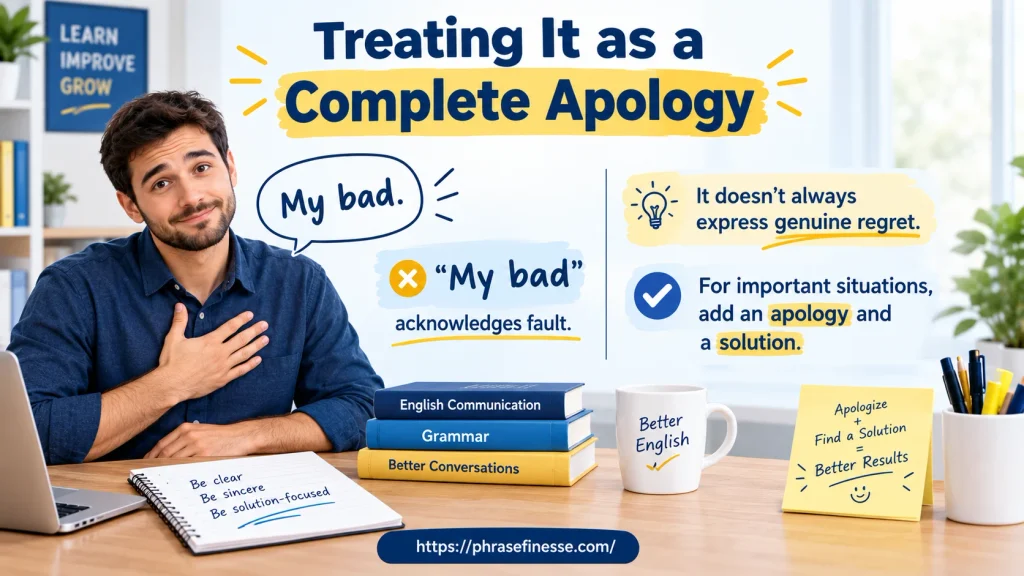
Remember:
“My bad” acknowledges fault.
It doesn’t always express genuine regret.
For important situations, add an apology and a solution.
FAQs
Is “my bad” proper English?
Yes, “my bad” is considered acceptable English in informal situations. However, it is slang-based and is usually not recommended for formal or professional communication.
What does “my bad” mean?
“My bad” means “my mistake” or “I am responsible for the error.” It is a quick and casual way to acknowledge a fault.
Can I use “my bad” in a business email?
In most cases, no. For professional business communication, it is better to use phrases such as “I apologize,” “That was my mistake,” or “I take responsibility for the error.”
Is “my bad” grammatically correct?
From a traditional grammar perspective, the phrase is unconventional because it omits words that would make it a complete grammatical statement. However, it is widely accepted in modern spoken English.
When should I avoid using “my bad”?
You should generally avoid using “my bad” in formal writing, academic papers, official reports, legal documents, and important workplace communications where professionalism matters.
What are some professional alternatives to “my bad”?
Professional alternatives include:
- “I apologize.”
- “That was my mistake.”
- “I take responsibility for the error.”
- “Please accept my apologies.”
- “I overlooked that det
Conclusion
The phrase “my bad” is a widely recognized informal expression used to admit a mistake or take responsibility for a minor error. Although it is common in everyday conversations, text messages, and social media interactions, it is generally not considered appropriate for formal writing or professional business communication.
Understanding the context is key to using the phrase correctly and maintaining effective English usage.
Whether you’re communicating during meetings, managing project management tasks, handling scheduling issues, or discussing time management concerns, choosing language that matches the situation helps ensure clarity and professionalism.
By knowing when to use “my bad” and when to choose more formal alternatives such as “I apologize” or “That was my mistake,” you can communicate with greater confidence and consistency in any setting.