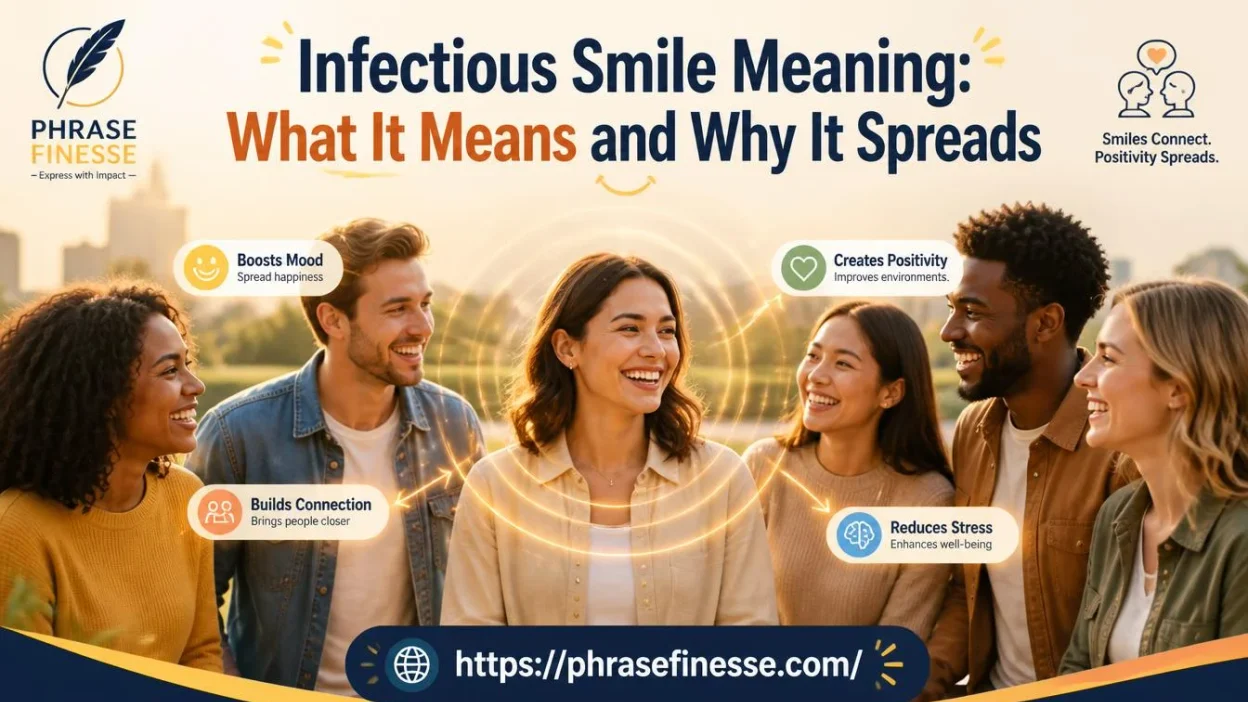
Have you ever noticed how one person’s smile can instantly brighten an entire room? The phrase Infectious Smile Meaning: What It Means and Why It Spreads is often used to describe a smile so warm, genuine, and uplifting that it naturally encourages others to smile as well.
Whether you encounter it in everyday conversation, social media posts, or professional settings, understanding the meaning of an infectious smile can help you communicate more effectively and appreciate its positive impact on human interaction.
In English, certain expressions carry emotional depth beyond their literal definitions, and “infectious smile” is a perfect example. It reflects positivity, friendliness, charisma, and emotional connection, making it a common phrase in both personal and professional communication.
From business communication and meetings to broadcasting, customer interactions, and team environments, this expression is frequently used to highlight someone’s ability to create a welcoming atmosphere through a simple smile.
In this guide, you’ll learn the exact meaning of an infectious smile, how to use the phrase correctly, and why it remains popular in modern English usage. We’ll also explore practical examples, common contexts, and related language concepts that support clear grammar, formal writing, and communication consistency.
Along the way, we’ll touch on real-world situations involving project management, time management, scheduling, calendar coordination, online booking, and workplace relationships, showing how a positive attitude and an infectious smile can influence both personal and professional success.
What Does “Infectious Smile” Mean?
An infectious smile is a smile that causes other people to smile or feel happier simply by seeing it.
The word infectious doesn’t refer to illness in this context. Instead, it describes something that spreads easily from person to person.
When someone says:
“She has an infectious smile.”
They mean:
“Her smile is so warm and genuine that it makes others smile too.”
The phrase is almost always intended as a compliment.
Simple Definition
Infectious smile (noun phrase):
A smile that spreads happiness, positivity, or joy to other people through its warmth and authenticity.
Dictionary Meaning of “Infectious”
The word infectious has two common meanings.
| Meaning | Definition | Example |
| Literal | Capable of spreading disease | An infectious virus |
| Figurative | Easily spreading emotions or attitudes | Infectious laughter |
The phrase infectious smile uses the figurative meaning.
Other examples include:
- Infectious enthusiasm
- Infectious energy
- Infectious laughter
- Infectious optimism
- Infectious excitement
In each case, emotions spread naturally among people.
Definition of an Infectious Smile
An infectious smile usually communicates:
- Happiness
- Kindness
- Warmth
- Confidence
- Friendliness
- Approachability
Unlike a forced smile, an infectious smile feels natural. People respond positively because they sense authenticity.
Imagine entering a coffee shop early in the morning. The employee behind the counter greets you with a sincere smile that reaches their eyes. Suddenly, your mood improves.
That’s the power of an infectious smile.
Why Is It Called an “Infectious” Smile?
The phrase may sound unusual at first.
After all, smiles aren’t diseases.
However, emotions often spread through groups in surprisingly similar ways.
When people witness genuine happiness, they frequently mirror that emotion without realizing it.
That’s why the word infectious fits so well.
The Metaphorical Use of “Infectious”
Language often borrows terms from one area to describe another.
For example:
| Expression | Meaning |
| Infectious laughter | Laughter that makes others laugh |
| Infectious enthusiasm | Excitement that spreads |
| Infectious energy | Motivation that influences others |
| Infectious smile | A smile that encourages smiling |
The common theme is simple:
Positive emotions spread.
The Science Behind Emotional Contagion
Psychologists use the term emotional contagion to describe how feelings move between people.
When someone smiles genuinely, observers often:
- Mimic the facial expression
- Experience similar emotions
- Feel more comfortable socially
- Become more receptive to interaction
This process happens rapidly.
Many people don’t even realize it’s occurring.
How Mirror Neurons Contribute
Researchers believe mirror neurons help explain this phenomenon.
Mirror neurons are brain cells that activate both when we perform an action and when we observe someone else performing it.
When you see somebody smiling:
- Your brain recognizes the smile.
- Similar neural pathways activate.
- You become more likely to smile.
- Positive feelings increase.
In simple terms, your brain often mirrors what it sees.
Emotional Contagion in Everyday Life
You’ve likely experienced emotional contagion many times.
Examples include:
- Laughing because others are laughing
- Feeling nervous around anxious people
- Becoming excited during celebrations
- Smiling when someone smiles warmly at you
An infectious smile works through the same principle.
Characteristics of an Infectious Smile
Not every smile qualifies as infectious.
Some smiles appear polite.
Others seem forced.
The most memorable smiles share several characteristics.
Genuine Versus Forced Smiles
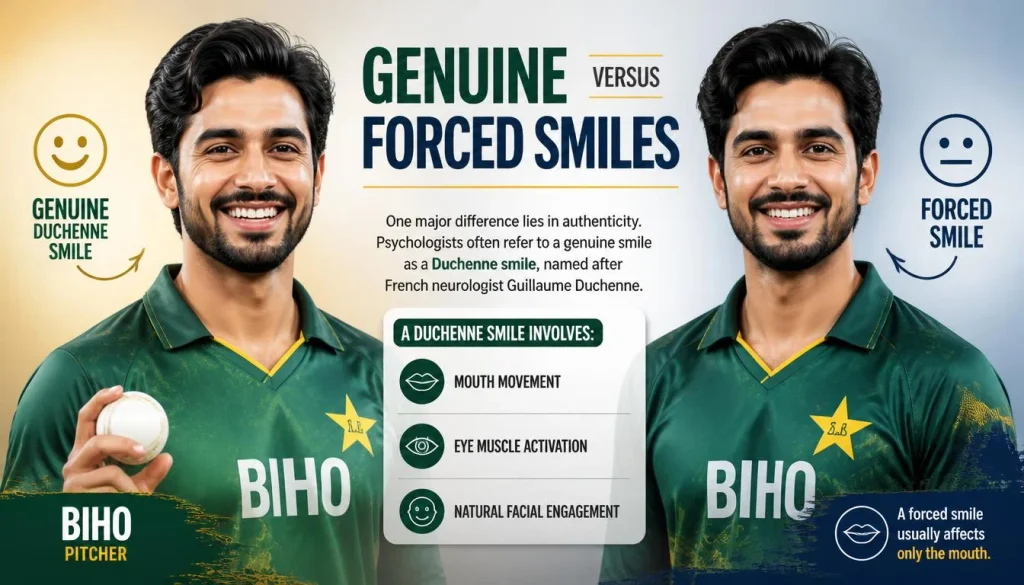
One major difference lies in authenticity.
Psychologists often refer to a genuine smile as a Duchenne smile, named after French neurologist Guillaume Duchenne.
A Duchenne smile involves:
- Mouth movement
- Eye muscle activation
- Natural facial engagement
A forced smile usually affects only the mouth.
Comparison Table
| Genuine Smile | Forced Smile |
| Reaches the eyes | Primarily affects the mouth |
| Appears natural | Appears rehearsed |
| Creates trust | May create skepticism |
| Feels warm | Feels formal |
| Encourages connection | Creates less emotional impact |
People instinctively recognize the difference.
Common Traits of an Infectious Smile
Warmth
Warm smiles make people feel welcome.
They’re like sunshine breaking through clouds after a rainy morning.
Eye Engagement
The eyes communicate sincerity.
When someone’s eyes brighten while smiling, authenticity becomes obvious.
Confidence
An infectious smile often reflects self-assurance.
Not arrogance.
Just quiet confidence.
Friendliness
People naturally gravitate toward individuals who seem approachable.
A genuine smile lowers social barriers.
Positive Body Language
Smiles become more powerful when paired with:
- Open posture
- Relaxed shoulders
- Friendly eye contact
- Natural gestures
What Makes Some Smiles More Memorable?
Several factors contribute.
Authentic Emotion
People remember genuine emotional experiences.
A sincere smile creates one.
Timing
A smile offered at the right moment can transform an interaction.
Human Connection
The strongest smiles make people feel seen and valued.
That emotional connection leaves a lasting impression.
Examples of “Infectious Smile” in Sentences
Understanding usage becomes easier with examples.
Everyday Conversation Examples
- “Her infectious smile brightened the entire room.”
- “Everyone loves Jake because of his infectious smile.”
- “The child’s infectious smile made strangers smile back.”
- “Despite the rain, she walked around with an infectious smile.”
Workplace Examples
- “His infectious smile helps clients feel comfortable.”
- “Customers often mention her infectious smile in reviews.”
- “The manager’s infectious smile improved team morale.”
Writing and Storytelling Examples
- “He entered the room wearing an infectious smile that immediately eased everyone’s tension.”
- “The actress became famous not only for her talent but also for her infectious smile.”
- “Her infectious smile remained unforgettable years after their first meeting.”
Situations Where People Use the Phrase
The expression appears across many settings.
Describing Personality
People frequently use it when discussing character traits.
Example:
“She’s incredibly kind and has an infectious smile.”
This suggests warmth and positivity.
Complimenting Friends or Family
An infectious smile is often considered one of the nicest compliments.
It acknowledges both appearance and personality.
Social Media Captions
Common examples include:
- “That infectious smile says it all.”
- “Keep sharing that infectious smile.”
- “A smile this infectious deserves its own spotlight.”
Professional Recommendations
Employers often mention infectious smiles when describing excellent customer service.
Why?
Because smiling affects customer experiences.
A positive interaction often starts with a welcoming expression.
Public Figures and Celebrities
Many well-known personalities become recognizable partly because of their smiles.
Fans frequently describe them as having:
- Infectious smiles
- Charming smiles
- Radiant smiles
- Warm smiles
These qualities help build public appeal.
Synonyms for “Infectious Smile”
Several alternatives express similar meanings.
| Expression | Meaning | Best Use |
| Radiant smile | Bright and glowing | Compliments |
| Warm smile | Friendly and welcoming | Professional settings |
| Charming smile | Attractive and appealing | Personal descriptions |
| Winning smile | Likable and persuasive | Leadership |
| Heartwarming smile | Emotionally touching | Personal stories |
| Genuine smile | Authentic and sincere | Character descriptions |
| Beaming smile | Extremely happy | Celebrations |
| Contagious smile | Nearly identical meaning | Everyday use |
Is “Infectious Smile” a Compliment?
Absolutely.
In nearly every context, the phrase carries positive meaning.
When someone says you have an infectious smile, they’re usually praising more than your appearance.
They’re acknowledging your ability to make others feel good.
See More: 6 Words for Someone Who Won’t Admit They’re Wrong
Why It’s Considered Positive
An infectious smile suggests:
- Kindness
- Positivity
- Confidence
- Emotional warmth
- Social attractiveness
Many people value these traits more than physical appearance alone.
What the Phrase Says About a Person
People with infectious smiles are often perceived as:
| Trait | Why |
| Friendly | They appear approachable |
| Trustworthy | Genuine smiles build trust |
| Optimistic | Smiling signals positivity |
| Charismatic | Others enjoy being around them |
| Confident | Natural smiles reflect comfort |
Infectious Smile vs. Contagious Smile
Many people wonder whether these expressions differ.
The short answer:
Not much.
Are They the Same?
Both phrases describe smiles that encourage others to smile.
Examples:
- Infectious smile
- Contagious smile
The meanings overlap almost entirely.
Small Difference in Tone
Some speakers prefer infectious smile because it sounds slightly more polished and descriptive.
Meanwhile, contagious smile often feels more casual.
In practice, both are widely accepted.
Can an Infectious Smile Improve Social Relationships?
Research consistently suggests that smiling influences social interactions.
An infectious smile can strengthen both personal and professional relationships.
Better First Impressions
First impressions form quickly.
Within seconds, people evaluate:
- Friendliness
- Trustworthiness
- Confidence
A genuine smile positively affects all three.
Building Trust
Trust develops faster when people feel comfortable.
An authentic smile signals:
- Safety
- Openness
- Good intentions
That signal helps relationships grow.
Strengthening Personal Connections
Relationships thrive on positive emotional experiences.
A warm smile can:
- Reduce tension
- Encourage conversation
- Increase comfort
- Create memorable interactions
Benefits in Leadership and Customer Service
Leaders who smile authentically often:
- Encourage teamwork
- Improve morale
- Foster collaboration
Similarly, customer-facing professionals benefit because positive expressions improve customer experiences.
How to Develop a More Genuine and Infectious Smile
An infectious smile cannot be faked successfully for long.
Instead, focus on authenticity.
Focus on Positive Emotions
Think about:
- Gratitude
- Happy memories
- Meaningful achievements
- Loved ones
Genuine emotions naturally influence facial expressions.
Improve Eye Contact
Balanced eye contact enhances connection.
It communicates confidence and sincerity.
Practice Open Body Language
Try:
- Relaxed posture
- Uncrossed arms
- Natural gestures
- Attentive listening
Your smile becomes more believable when body language matches.
Avoid Forced Expressions
People detect insincerity surprisingly well.
Rather than forcing a smile:
- Engage genuinely
- Listen actively
- Stay present
Authenticity produces better results.
Build Confidence Naturally
Confidence often improves smiling behavior.
Ways to increase confidence include:
- Learning new skills
- Taking care of your health
- Practicing communication
- Celebrating small successes
Confidence and genuine smiles frequently grow together.
Common Misunderstandings About an Infectious Smile
Several myths surround the phrase.
It Doesn’t Refer to Illness
Despite the wording, no medical meaning exists here.
The phrase is entirely figurative.
Bigger Isn’t Always Better
A massive grin isn’t automatically infectious.
Sometimes subtle smiles feel more genuine.
Authenticity matters more than size.
Appearance Isn’t the Main Factor
People often assume beautiful teeth create infectious smiles.
In reality, warmth matters more.
A genuine smile usually outperforms a perfect-looking smile.
Related Expressions and Idioms
English contains many similar expressions.
Smile Is Contagious
This phrase directly reflects the idea behind an infectious smile.
Meaning:
Smiling encourages others to smile.
Light Up the Room
Meaning:
To make a place feel happier through one’s presence.
Example:
“Her smile could light up the room.”
Grin From Ear to Ear
Meaning:
To smile very broadly because of happiness.
Wear a Smile
Meaning:
To have a smile on one’s face.
Beam With Happiness
Meaning:
To show visible joy through facial expressions.
Real-Life Case Study: The Power of an Infectious Smile
Consider two customer service employees.
Employee A
- Avoids eye contact
- Rarely smiles
- Appears distracted
Employee B
- Smiles genuinely
- Maintains friendly eye contact
- Greets customers warmly
Which employee creates a better experience?
Most people choose Employee B.
Studies in customer experience consistently show that friendliness and emotional connection improve satisfaction.
An infectious smile acts as a social shortcut.
It communicates goodwill instantly.
Quick Reference Guide
| Question | Answer |
| What is an infectious smile? | A smile that encourages others to smile |
| Is it a compliment? | Yes |
| Is it the same as contagious smile? | Almost identical |
| Does it refer to illness? | No |
| Why do people respond to it? | Emotional contagion and social connection |
| Can it improve relationships? | Yes |
FAQs
What does an infectious smile mean?
An infectious smile is a smile that is so cheerful, genuine, and uplifting that it encourages other people to smile or feel happier as well.
Is “infectious smile” a compliment?
Yes. Calling someone’s smile infectious is generally considered a positive compliment because it suggests their happiness and positivity affect others in a good way.
Can an infectious smile be used in professional settings?
Absolutely. The phrase can be used in business communication, performance reviews, networking events, and workplace conversations to describe someone who creates a welcoming and positive environment.
Why is the word “infectious” used in this phrase?
The word infectious is used figuratively, not literally. It means that the smile spreads positive emotions from one person to another, much like enthusiasm or laughter can spread through a group.
Is “infectious smile” appropriate in formal writing?
Yes, it can be appropriate in certain forms of formal writing, especially when describing a person’s personality, customer service skills, leadership qualities, or public image.
What are some synonyms for “infectious smile”?
Common alternatives include radiant smile, warm smile, contagious smile, welcoming smile, charming smile, and bright smile. Each carries a similar sense of positivity and friendliness.
Conclusion
An infectious smile is more than just a pleasant facial expression. It describes a smile that naturally spreads happiness, warmth, and positivity to the people around you. Because it creates an immediate emotional connection, the phrase is commonly used to compliment someone’s friendly personality, approachable nature, and uplifting presence.
Understanding the meaning of “infectious smile” can help you recognize how language captures human emotions and social interactions. Whether you encounter the expression in everyday conversations, professional settings, social media, or formal writing, it consistently conveys a sense of genuine positivity and charm.
By learning when and how to use this phrase correctly, you can improve your English usage, strengthen your communication skills, and better express admiration for someone who brightens the mood of others with a simple smile.

Mia Rose is an English language specialist and editorial writer at Phrase Finesse, where she helps readers master grammar, vocabulary, spelling, and effective communication. Passionate about making English simple and practical, she creates well-researched, reader-friendly content that explains complex language concepts in a clear and engaging way.
With extensive experience in English language education, content writing, and editorial review, Mia specializes in grammar, punctuation, word choice, idioms, confusing word pairs, and writing style. Her articles are carefully researched, fact-checked, and designed to help students, professionals, writers, and English learners build confidence in both written and spoken English.