Have you ever paused while writing and wondered whether a comma belongs after “during” at the beginning of a sentence? If so, you are not alone. Start A Sentence With “During” Comma Rules Explained is a topic that often confuses writers, students, and professionals alike. Whether you are working on formal writing, improving your English usage, or aiming for greater grammar accuracy, understanding how “during” functions at the start of a sentence can make your writing clearer and more effective.
The word “during” frequently appears in everyday communication, from business communication and meetings to broadcasting, project management, and online booking instructions. It helps establish time relationships and context, making it valuable for discussing scheduling, time management, and calendar events.
However, many writers are unsure when a comma is necessary and when it should be omitted. Applying the correct punctuation improves readability and strengthens consistency across different writing styles.
In this guide, you will learn the essential comma rules for sentences that begin with “during,” along with practical examples that demonstrate correct usage.
We will examine common mistakes, explain the grammatical principles behind them, and show how professional writers handle these constructions. By the end, you will know exactly how to use “during” confidently in both casual and professional contexts.
Can You Start a Sentence With “During”?
Yes. Starting a sentence with “during” is completely grammatically correct.
In English grammar, during functions as a preposition. It introduces a period of time during which an action occurs.
For example:
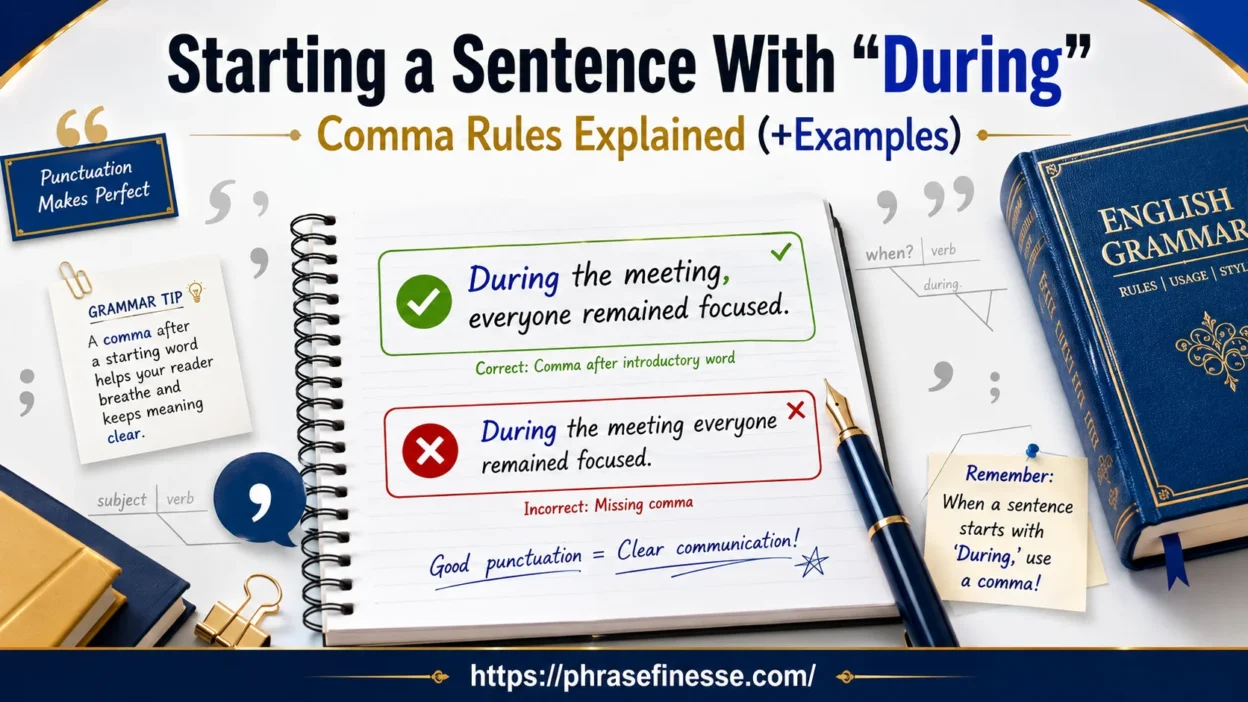
- During the meeting, everyone remained focused.
- During summer vacation we traveled across the country.
- During the investigation, new evidence emerged.
These sentences are natural, correct, and commonly used in professional, academic, and everyday writing.
Many people mistakenly believe that beginning a sentence with during sounds awkward or formal. In reality, writers use it frequently because it immediately establishes a time frame for the reader.
Consider these examples:
| Sentence | Correct? |
| During the storm, several roads closed. | Yes |
| During lunch we discussed the proposal. | Yes |
| During the conference, industry leaders shared insights. | Yes |
| During yesterday’s presentation the audience remained engaged. | Yes |
The word itself presents no grammatical problem. The real question is punctuation.
What Does “During” Mean in a Sentence?
Before discussing comma rules, it helps to understand what during actually does.
Definition and Grammatical Function
During is a preposition that means:
Throughout a period of time or at some point within a period of time.
It connects an event, action, or condition to a specific timeframe.
Examples:
- During the game, fans cheered loudly.
- During the semester students completed several projects.
- During the flight passengers watched movies.
In each example, during identifies when something happened.
Common Time References Used After “During”
The word commonly appears before:
- Events
- Seasons
- Meetings
- Holidays
- Historical periods
- Projects
- Investigations
- Classes
- Conferences
Examples include:
- During the meeting
- During the summer
- During the holidays
- During the project
- During the pandemic
- During the workshop
- During the ceremony
Common “During” Phrases and Their Meanings
| Phrase | Meaning |
| During the meeting | While the meeting was happening |
| During the game | While the game was being played |
| During the trip | While traveling |
| During the investigation | While authorities were investigating |
| During the conference | While the conference was taking place |
| During the semester | While classes were in session |
| During the ceremony | While the ceremony occurred |
Understanding this function makes comma decisions easier because punctuation depends on how the phrase interacts with the rest of the sentence.
Do You Need a Comma After “During” at the Beginning of a Sentence?
This is the question most writers ask.
The answer is:
The comma rule depends on the entire introductory phrase, not the word “during” itself.
Many grammar mistakes happen because people focus on the word rather than the phrase.
Compare these examples:
- During lunch we talked.
- During the final week of the company’s international conference, executives discussed expansion plans.
The first sentence generally doesn’t require a comma.
The second sentence benefits from one because the introductory phrase is much longer.
The Core Rule
Grammar authorities generally agree on this principle:
Short introductory prepositional phrases often do not need commas. Longer phrases usually do.
The goal is readability.
If readers can move through the sentence effortlessly, a comma may be unnecessary.
If the sentence feels crowded or confusing, a comma improves clarity.
When a Comma Is Usually Required After a “During” Phrase
Long introductory phrases often require a comma because they create a natural pause.
Consider these examples:
- During the final weeks of the merger negotiations, executives revised the agreement.
- During the early stages of the archaeological excavation, researchers uncovered ancient tools.
- During the first quarter of the fiscal year, revenue exceeded expectations.
Without commas, these sentences feel compressed and harder to process.
Why Longer Phrases Need Commas
Long introductory phrases create more cognitive load for readers.
A comma acts as a signal.
It tells readers:
“The introduction is finished. The main sentence begins now.”
This small punctuation mark improves readability dramatically.
Examples
Correct
- During the extensive review of company policies, management identified several issues.
- During the final phase of product development, engineers conducted additional testing.
Less Readable
- During the extensive review of company policies management identified several issues.
- During the final phase of product development engineers conducted additional testing.
Both versions may be grammatically acceptable, but the comma improves clarity.
When a Comma Is Usually Not Necessary
Short introductory phrases rarely need commas.
Examples:
- During lunch we talked.
- During class students completed exercises.
- During practice athletes refined their skills.
- During winter many animals hibernate.
These sentences are short, direct, and easy to understand.
Adding a comma isn’t wrong in many style contexts, but it usually isn’t necessary.
Why Writers Often Skip the Comma
Short phrases create little risk of confusion.
Readers immediately recognize the time expression and move into the main clause without difficulty.
For example:
- During breakfast we planned the day.
The phrase during breakfast contains only two words after the preposition. The sentence flows naturally without punctuation.
When the Comma Is Optional
Many sentences fall into a gray area.
Examples:
- During the summer we traveled across Europe.
- During the summer, we traveled across Europe.
Both versions are acceptable.
Factors That Influence the Choice
Writers often consider:
- Formality
- House style
- Audience expectations
- Rhythm
- Readability
Academic writers tend to use commas more frequently.
Journalists often omit them when phrases remain short.
Business writers usually choose whichever version reads more smoothly.
Optional Comma Examples
| Sentence | Acceptable? |
| During the summer we traveled. | Yes |
| During the summer, we traveled. | Yes |
| During the conference attendees networked. | Yes |
| During the conference, attendees networked. | Yes |
Both choices work.
The difference lies primarily in style.
Why Introductory Phrase Length Matters
Length plays a significant role in comma decisions.
The longer the introductory phrase becomes, the stronger the case for a comma.
Short Introductory “During” Phrases
Examples:
- During lunch we met.
- During class students listened.
- During practice players improved.
- During winter roads become icy.
These phrases are easy to process.
Readers rarely need punctuation assistance.
Long Introductory “During” Phrases
Examples:
- During the final month of the nationwide fundraising campaign, donations increased significantly.
- During the early stages of the company’s international expansion strategy, leaders encountered regulatory challenges.
Without commas, readers may need to reread the sentence.
Short vs. Long Phrase Comparison
| Introductory Phrase | Comma Recommendation |
| During lunch | Usually unnecessary |
| During practice | Usually unnecessary |
| During the conference | Optional |
| During the first week of the international conference | Recommended |
| During the final stages of the complex legal review process | Strongly recommended |
Examples of Sentences Beginning With “During”
Understanding real-world examples helps reinforce the rule.
Business Writing Examples
Business communication often uses during to establish timing.
Examples:
- During the quarterly review, leadership evaluated performance metrics.
- During the acquisition process, legal teams reviewed contracts.
- During the training session employees learned new procedures.
Academic Writing Examples
Researchers frequently use introductory during phrases.
Examples:
- During the experiment, participants completed several assessments.
- During the observation period researchers collected extensive data.
- During the study, investigators identified meaningful trends.
Creative Writing Examples
Authors use during to establish atmosphere and context.
Examples:
- During the storm, the old house seemed alive.
- During the long winter, hope became scarce.
- During the celebration, laughter echoed through the streets.
Journalism Examples
News writing commonly uses concise introductory phrases.
Examples:
- During the meeting, officials announced new measures.
- During the investigation, detectives uncovered additional evidence.
- During the hearing, lawmakers questioned industry leaders.
Common Comma Mistakes With “During”
Many punctuation errors appear repeatedly across professional and casual writing.
Automatically Adding a Comma Every Time
Some writers assume every sentence beginning with during requires a comma.
Example:
- During lunch, we talked.
This isn’t wrong.
However, the comma isn’t required.
Many writers would simply write:
- During lunch we talked.
Omitting Commas in Long Introductory Phrases
This mistake causes readability problems.
Incorrect:
- During the final stages of the company’s extensive restructuring initiative executives revised operational procedures.
Better:
- During the final stages of the company’s extensive restructuring initiative, executives revised operational procedures.
The second version is much easier to read.
Confusing Phrases and Clauses
Many writers confuse introductory phrases with introductory clauses.
Consider:
- During the meeting, executives discussed strategy.
Now compare:
- While the meeting was taking place, executives discussed strategy.
The first sentence begins with a prepositional phrase.
The second begins with a dependent clause.
Although both often use commas, they follow different grammatical structures.
“During” vs. Other Introductory Time Expressions
Writers frequently choose between during, while, throughout, and in.
Each serves a different purpose.
During vs. While
During is a preposition.
While is usually a conjunction.
Examples:
- During the conference, attendees networked.
- While the conference was underway, attendees networked.
The meanings are similar, but the structures differ.
During vs. Throughout
Throughout emphasizes an entire duration.
Examples:
- During the meeting, several concerns emerged.
- Throughout the meeting, participants remained engaged.
The second sentence stresses continuity.
During vs. In
In often provides a broader time reference.
Examples:
- In 2025, the company expanded.
- During 2025, the company launched several initiatives.
The second sentence focuses more specifically on actions occurring within the year.
Comparison Table
| Expression | Part of Speech | Example |
| During | Preposition | During the event, guests arrived. |
| While | Conjunction | While the event was occurring, guests arrived. |
| Throughout | Preposition | Throughout the event, guests participated. |
| In | Preposition | In 2025, guests attended. |
Style Guide Perspectives on Introductory Commas
Different style guides approach introductory commas with flexibility.
AP Style
Journalists following Associated Press style generally prioritize readability.
Short phrases often appear without commas.
Long phrases usually include them.
Chicago Manual of Style
Chicago adopts a flexible approach.
Writers may omit commas after short introductory phrases if confusion is unlikely.
Academic Writing Standards
Universities often encourage commas after introductory elements.
The goal is consistency and clarity.
Because academic writing values precision, commas frequently appear even after medium-length introductory phrases.
Advanced Usage: Complex Sentences Beginning With “During”
As sentences become more sophisticated, punctuation decisions become more important.
Multiple Introductory Elements
Example:
- During the final phase of development, after several rounds of testing, engineers approved the design.
Here, commas separate multiple introductory components.
Parenthetical Information
Example:
- During the conference, which attracted experts from around the world, attendees explored emerging technologies.
The parenthetical phrase requires additional punctuation.
Avoiding Ambiguity
Consider this sentence:
- During the presentation managers reviewing performance reports asked several questions.
Readers may stumble.
A better version:
- During the presentation, managers reviewing performance reports asked several questions.
The comma immediately improves comprehension.
Read More: Can You Start a Sentence With “While”? Real Life Examples
Case Study: How a Single Comma Changes Readability
Imagine a company memo.
Version One
During the final phase of the organization’s extensive modernization project senior executives reviewed operational efficiencies.
Most readers need an extra second to understand it.
Version Two
During the final phase of the organization’s extensive modernization project, senior executives reviewed operational efficiencies.
The comma creates a clear boundary.
Nothing about the meaning changes.
Everything about readability improves.
This demonstrates why punctuation should serve readers rather than rigid rules.
Quick Reference Guide for Starting a Sentence With “During”
Should You Use a Comma?
| Situation | Recommendation |
| Very short phrase | Usually no comma |
| Short phrase | Often optional |
| Medium-length phrase | Writer’s choice |
| Long phrase | Usually use a comma |
| Potential confusion | Use a comma |
| Academic writing | Often recommended |
| Professional reports | Usually recommended |
| Readability improves | Use a comma |
Easy Rule to Remember
Think of it this way:
The longer the introduction, the stronger the need for a comma.
That simple guideline resolves most punctuation questions.
FAQs
1. Can you start a sentence with “during”?
Yes, you can start a sentence with “during”. It is a common and grammatically correct way to introduce a time period or event. For example: “During the meeting, several important decisions were made.”
2. Do you always need a comma after “during” at the beginning of a sentence?
No, a comma is not always required. A comma is often used when the introductory phrase is longer or when it improves readability. Short introductory phrases may not need a comma. For example: “During lunch we discussed the project.”
3. When should you use a comma after a sentence that starts with “during”?
Use a comma when the introductory during-phrase is long, contains additional details, or could cause confusion without punctuation. For example: “During the final stages of the project, the team identified several risks.”
4. Is it incorrect to omit the comma after “during”?
Not necessarily. In many cases, especially with short introductory phrases, omitting the comma is acceptable. However, writers often include it to improve clarity and maintain consistency in formal writing.
5. Is starting a sentence with “during” appropriate in professional writing?
Absolutely. Beginning a sentence with “during” is common in business communication, reports, emails, academic papers, and other professional documents. It helps establish a clear time frame for the information that follows.
6. What are some examples of sentences that start with “during”?
Here are a few examples:
- “During the conference, industry experts shared valuable insights.”
- “During the online booking process, customers can select their preferred dates.”
- “During the project review meeting, the team updated the calendar and timeline.”
- “During the broadcast, viewers submitted questions in real time.”
Conclusion
Understanding how to use “during” at the beginning of a sentence can significantly improve your grammar, English usage, and overall writing clarity. While a comma is not always necessary, it is often helpful when the introductory phrase is lengthy or when readability benefits from a pause. By recognizing the difference between situations that require a comma and those that do not, you can write with greater confidence and consistency.
Whether you are handling business communication, managing project management documents, discussing scheduling and time management, or simply refining your formal writing skills, mastering these comma rules will make your sentences more polished and professional. The key is to prioritize clarity and choose punctuation that helps readers understand your message effortlessly.

Alyan Ashraf is an English language writer and editor at Phrase Finesse, where he specializes in grammar, vocabulary, spelling, word usage, and clear communication. Passionate about the English language, he creates practical, research-backed content that helps readers avoid common mistakes and write with greater accuracy and confidence.
Known for his clear writing style and attention to detail, Alyan simplifies complex language topics into easy-to-understand guides filled with real-world examples and actionable insights. His work covers confusing word pairs, grammar rules, idioms, punctuation, and everyday English usage, making learning both accessible and engaging for students, professionals, writers, and non-native English speakers.
Every article Alyan writes is carefully researched, fact-checked, and designed to meet high editorial standards. His goal is to help readers strengthen their English skills, expand their vocabulary, and communicate more effectively in academic, professional, and everyday settings.
Through Phrase Finesse, Alyan is committed to publishing trusted language resources that make mastering English simpler, clearer, and more enjoyable for learners around the world