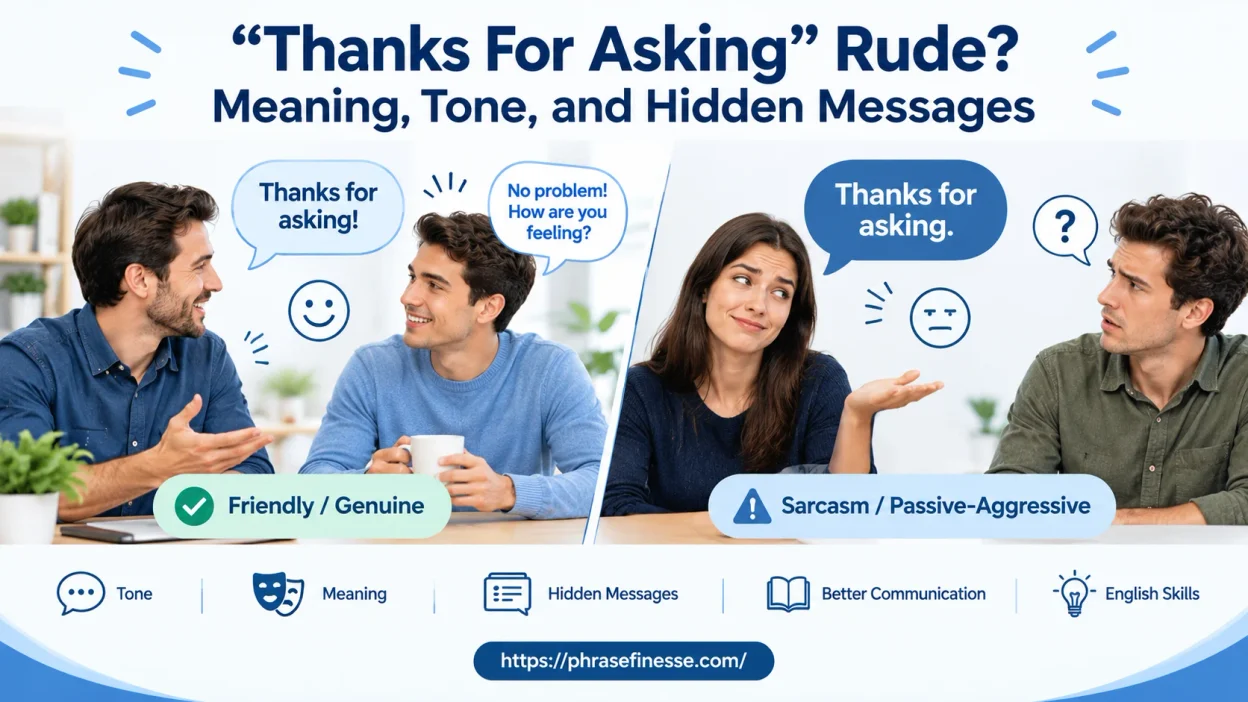
Have you ever wondered whether “Thanks For Asking” sounds warm and appreciative or unexpectedly dismissive? If you’ve searched Is“Thanks For Asking” Rude? Meaning, Tone, and Hidden Messages, you’re not alone. Small wording choices can shape how others perceive your tone, politeness, and professional communication, whether you’re replying in everyday conversations, business communication, meetings, or written messages.
Although “Thanks for asking” is usually a polite expression, its meaning depends heavily on context, delivery, and English usage. In some situations, it conveys genuine appreciation, while in others, it may sound brief, sarcastic, or emotionally distant.
Understanding this distinction helps you communicate with greater clarity, consistency, and confidence in both casual and formal writing. It also strengthens your grammar awareness and improves communication across emails, chats, and workplace interactions.
Even in environments focused on project management, scheduling, time management, calendar coordination, online booking, or broadcasting, choosing the right words helps maintain positive relationships.
In this guide, you’ll discover whether “Thanks For Asking” is ever considered rude, explore the situations where it works best, and learn three better ways to thank someone for asking without sounding awkward or impersonal.
You’ll also find practical examples, common mistakes to avoid, and expert tips for selecting the most natural response in different personal and professional settings. By the end, you’ll know exactly which expression fits your situation and how to communicate with greater confidence and authenticity.
What Does “Thanks For Asking” Mean?
At its most basic level, “thanks for asking” is an expression of gratitude.
The speaker is thanking another person for showing interest, concern, curiosity, or care about something happening in their life.
For example:
“How did your surgery go?”
“It went really well. Thanks for asking.”
In this situation, the phrase communicates appreciation. The speaker recognizes that the other person took the time to ask about something important.
The Literal Meaning
The phrase breaks down into two simple parts:
- Thanks = an expression of gratitude
- For asking = appreciation for someone’s question or concern
Put together, it means:
“I appreciate that you asked about this.”
Simple enough.
However, everyday communication rarely stays that simple.
Why People Use “Thanks For Asking”
People commonly use the phrase when someone asks about:
- Their health
- Family members
- Work projects
- School performance
- Travel plans
- Personal achievements
- Difficult situations
- Life updates
The phrase often serves as a bridge into a longer conversation.
For example:
“Thanks for asking. My interview actually went really well.”
Or:
“Thanks for asking. My dog is recovering nicely now.”
In these examples, the phrase functions as both gratitude and a conversation starter.
Is “Thanks For Asking” Always Polite?
The short answer is no.
But that doesn’t mean it’s automatically rude either.
The phrase itself is neutral. What changes is the context surrounding it.
Think of it like a chameleon. The words stay the same, but their emotional color changes depending on where they appear.
Why Context Matters More Than the Words
Consider these two examples.
Example One
“How’s your mom doing after her surgery?”
“She’s recovering well. Thanks for asking.”
Most people would interpret this as sincere gratitude.
Now compare it to this.
Example Two
“I was in the hospital all week.”
“Really?”
“Yeah. Thanks for asking.”
Suddenly the phrase feels very different.
Instead of gratitude, it may imply:
- You didn’t care enough to ask.
- You should have checked on me.
- I’m disappointed in your lack of concern.
Same words.
Different message.
That’s why understanding context is essential.
How Tone Changes the Meaning of “Thanks For Asking”
When spoken aloud, tone often reveals the speaker’s true intent.
The table below shows how dramatically interpretation can change.
| Tone of Voice | Likely Meaning |
| Warm and cheerful | Genuine appreciation |
| Friendly and relaxed | Polite acknowledgment |
| Neutral | Simple gratitude |
| Dry and flat | Mild frustration |
| Sharp or sarcastic | Passive-aggressive criticism |
| Exaggerated emphasis | Mocking or sarcastic intent |
Compare These Examples
Warm Tone
“Thanks for asking! I’m feeling much better now.”
Interpretation:
- Genuine gratitude
- Friendly conversation
- Positive interaction
Neutral Tone
“Thanks for asking. Everything’s going well.”
Interpretation:
- Professional
- Polite
- Straightforward
Sarcastic Tone
“Oh, thanks for asking.”
Interpretation:
- You should have asked earlier
- I’m annoyed
- I feel overlooked
Notice how the words never changed.
Only the tone did.
When “Thanks For Asking” Is Genuinely Polite
Most uses of the phrase are actually positive.
In everyday life, people generally use it as intended: to express appreciation.
Let’s look at common situations where it sounds completely polite.
When Someone Shows Genuine Concern
People often appreciate being asked about difficult situations.
Examples include:
- Recovering from illness
- Family emergencies
- Job searches
- Academic challenges
- Personal struggles
Example:
“How are you feeling after the accident?”
“Much better now. Thanks for asking.”
The phrase acknowledges kindness.
When Someone Remembers Important Details
People notice when others remember previous conversations.
Imagine mentioning a big presentation next week.
A few days later, a coworker asks:
“How did your presentation go?”
Your response might naturally be:
“It went great. Thanks for asking.”
Why?
Because remembering details demonstrates attentiveness.
Human beings appreciate feeling remembered.
In Professional Communication
Many professionals use the phrase regularly.
For example:
“How is the project progressing?”
“It’s on schedule. Thanks for asking.”
This usage sounds courteous and professional.
There’s no hidden meaning.
It’s simply workplace politeness.
In Customer Service Situations
Customer support representatives often thank customers for their interest.
Examples include:
- Product inquiries
- Service updates
- Feedback requests
- Follow-up questions
In these situations, the phrase helps maintain a positive relationship.
When “Thanks For Asking” Can Sound Rude or Passive-Aggressive
Here’s where things become interesting.
Sometimes the phrase serves as a subtle expression of frustration.
People may use it to point out what they perceive as neglect, indifference, or lack of concern.
When Someone Failed to Ask Earlier
Imagine your friend knew you had an important surgery.
Days pass.
No message, no call and no check-in.
Then you casually mention your recovery.
You might say:
“The surgery went well, thanks for asking.”
The hidden message becomes:
“You should have checked on me sooner.”
The phrase transforms into a gentle criticism.
When Someone Feels Ignored
Feeling overlooked often triggers passive-aggressive language.
Consider this example:
“I got promoted last month.”
“Oh really?”
“Yep. Thanks for asking.”
The speaker may feel disappointed that nobody showed interest.
Instead of directly expressing hurt feelings, they use sarcasm.
When Written Without Additional Context
Text messages remove important communication signals.
Readers cannot hear:
- Voice inflection
- Tone
- Emphasis
- Emotion
Because of this, short messages often feel colder than intended.
Example:
“Thanks for asking.”
That’s it.
No emoji., no follow-up and no explanation.
Some readers may perceive:
- Annoyance
- Frustration
- Distance
Even when none exists.
When Combined With Sarcasm
Sarcasm completely changes the phrase.
For example:
“Wow. Thanks for asking.”
Or:
“Well, thanks for asking.”
The added wording signals criticism.
In these cases, gratitude isn’t the real message.
Disappointment is.
How to Tell Whether “Thanks For Asking” Is Sincere or Sarcastic
Because context matters so much, it’s important to evaluate the entire conversation.
Don’t focus solely on the phrase itself.
Look at What Happened Before
Ask yourself:
- Was there tension?
- Did someone feel ignored?
- Was there an argument?
- Did expectations go unmet?
Previous events often reveal the intended meaning.
Pay Attention to Body Language
Communication experts frequently cite research showing that nonverbal cues strongly influence interpretation.
Look for:
- Smiles
- Eye contact
- Facial expressions
- Posture
- Gestures
A smiling person saying:
“Thanks for asking.”
usually sounds sincere.
An eye roll suggests something entirely different.
Listen to What Comes Next
The following sentence often reveals everything.
Sincere Example
“Thanks for asking. The treatment worked perfectly.”
Passive-Aggressive Example
“Thanks for asking. Nobody else seemed interested.”
The second sentence exposes the speaker’s frustration.
Examples of “Thanks For Asking” in Different Contexts
Let’s examine how interpretation changes across settings.
Friendly Conversations
Example
“How was your vacation?”
“Amazing. Thanks for asking.”
Meaning:
- Friendly
- Appreciative
- Positive
No hidden message.
Workplace Communication
Example
“How’s the quarterly report coming along?”
“Almost finished. Thanks for asking.”
Meaning:
- Professional
- Courteous
- Respectful
Family Discussions
Example
“How’s Grandma feeling?”
“Much stronger now. Thanks for asking.”
Meaning:
- Genuine gratitude
- Appreciation for concern
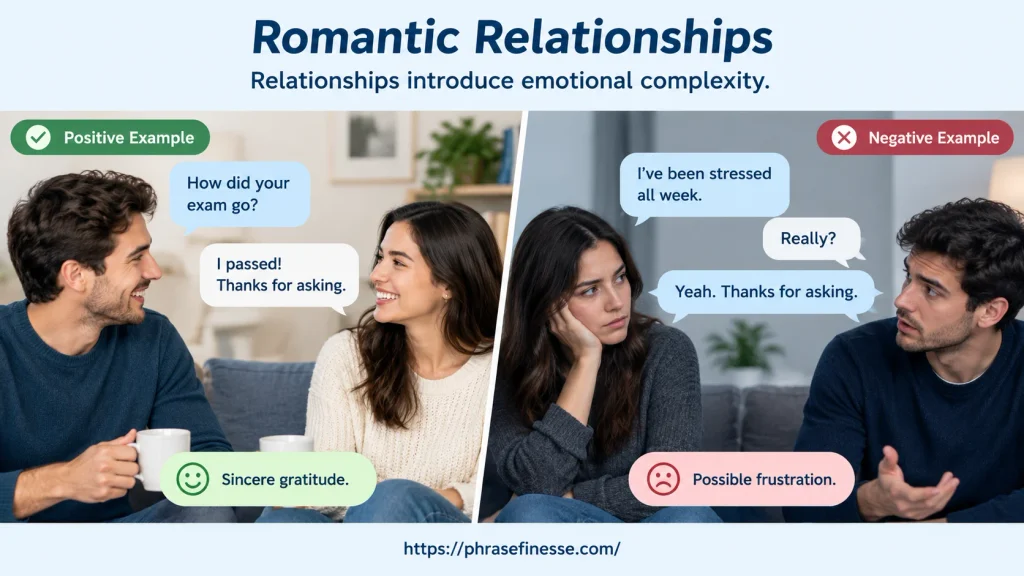
Romantic Relationships
Relationships introduce emotional complexity.
Positive Example
“How did your exam go?”
“I passed! Thanks for asking.”
Sincere gratitude.
Negative Example
“I’ve been stressed all week.”
“Really?”
“Yeah. Thanks for asking.”
Possible frustration.
Read More :5 Words For Answering A Question With A Question
Social Media Interactions
Social media often amplifies misunderstandings.
A post saying:
“I’m finally doing better. Thanks for asking.”
may be interpreted in two ways:
- Genuine appreciation
- Sarcastic complaint
Readers lack context.
Interpretations vary.
Customer and Client Conversations
Example:
“Have there been any updates?”
“Yes. Thanks for asking.”
Professional and polite.
No negative undertones.
Better Alternatives to “Thanks For Asking”
If you’re concerned about sounding sarcastic, several alternatives communicate gratitude more clearly.
Warm and Friendly Alternatives
- I appreciate you asking.
- That’s very thoughtful of you.
- I’m glad you asked.
- Thanks for checking in.
- It means a lot that you asked.
- I appreciate your concern.
These alternatives often feel warmer than the original phrase.
Professional Alternatives
| Alternative | Best Use |
| Thank you for your interest | Business communication |
| I appreciate your follow-up | Workplace updates |
| Thank you for reaching out | Client communication |
| Thanks for checking in | Team communication |
| I appreciate your inquiry | Formal correspondence |
More Personal Alternatives
For close relationships, personal wording often feels more genuine.
Examples:
- “That was thoughtful of you.”
- “I’m grateful you remembered.”
- “It means a lot that you checked in.”
- “Thanks for thinking of me.”
These phrases reduce ambiguity.
Why People Sometimes Interpret Neutral Phrases as Rude
Human communication isn’t always logical.
People bring emotions, assumptions, and experiences into every interaction.
Lack of Vocal Cues in Text Messages
Text strips away valuable information.
You can’t hear:
- Warmth
- Humor
- Sarcasm
- Sincerity
As a result, readers fill in the gaps themselves.
Sometimes incorrectly.
Existing Relationship Tensions
A phrase may sound different depending on the relationship.
If two friends recently argued, even a neutral message may seem hostile.
The words haven’t changed.
The relationship has.
Different Communication Styles
Some people communicate directly.
Others communicate indirectly.
A direct communicator might say:
“I wish you’d checked on me.”
An indirect communicator might say:
“Thanks for asking.”
Both may mean the same thing.
Cultural and Generational Differences
Communication norms vary widely.
In some cultures:
- Indirect criticism is common.
- Subtle hints are expected.
In others:
- Direct communication is preferred.
- Hidden meanings are discouraged.
These differences affect interpretation.
Common Misunderstandings About “Thanks For Asking”
Many assumptions about this phrase simply aren’t true.
Let’s clear them up.
Myth: “Thanks For Asking” Is Always Sarcastic
False.
Most uses are sincere.
Millions of people use the phrase every day without any negative intent.
Myth: “Thanks For Asking” Is Always Polite
Also false.
Context can transform the phrase into criticism.
Words alone don’t determine meaning.
Myth: Short Responses Are Automatically Rude
Not necessarily.
Some people simply communicate briefly.
For example:
“Doing great. Thanks for asking.”
Short doesn’t automatically mean unfriendly.
Myth: Intent and Impact Are Always the Same
A speaker may intend gratitude.
A listener may hear sarcasm.
Both experiences can exist simultaneously.
That’s why clarity matters.
Case Study: How Context Completely Changes Meaning
Consider the following scenarios.
Scenario A
Sarah undergoes surgery.
Her coworker asks:
“How are you feeling now?”
Sarah replies:
“Much better. Thanks for asking.”
Interpretation:
- Genuine appreciation
- Positive interaction
Scenario B
Sarah undergoes surgery.
Nobody checks on her for two weeks.
Later she mentions it.
A coworker responds:
“Oh, I didn’t know.”
Sarah replies:
“Yeah. Thanks for asking.”
Interpretation:
- Disappointment
- Frustration
- Possible passive aggression
Key Lesson
The phrase didn’t change.
The circumstances did.
Context creates meaning.
Quick Reference Guide: Is “Thanks For Asking” Rude?
| Situation | Usually Rude? | Interpretation |
| Friend checks on your recovery | No | Genuine gratitude |
| Coworker asks for project update | No | Professional courtesy |
| Spoken warmly | No | Appreciation |
| Written with sarcasm | Yes | Passive-aggressive |
| Used after being ignored | Sometimes | Frustration |
| Accompanied by eye rolling | Usually | Criticism |
| Used in customer service | No | Polite communication |
| Text message with no context | Depends | Ambiguous |
Should You Use “Thanks For Asking”?
Absolutely.
The phrase remains a normal, polite part of English conversation.
Most people understand it as gratitude.
However, if you want to avoid ambiguity, consider your audience and situation.
Use It When
- Someone shows genuine concern
- You’re expressing appreciation
- You’re responding to a question
- You’re having a friendly conversation
- You’re communicating professionally
Consider Alternatives When
- Emotions are already tense
- Misunderstandings are likely
- Written communication lacks context
- You want to sound especially warm
A little extra clarity can go a long way.
FAQs
1. Is “Thanks for asking” always polite?
Yes. In most cases, “Thanks for asking” is considered a polite and appreciative response. It simply acknowledges that someone cared enough to ask about you or a situation.
2. Can “Thanks for asking” sound sarcastic?
Yes. Although the phrase itself is polite, it may sound sarcastic if it is spoken with an irritated tone or used in a context where the speaker feels ignored or frustrated.
3. What are better alternatives to “Thanks for asking”?
Some natural alternatives include:
- I appreciate you asking.
- Thank you for checking in.
- That’s very thoughtful of you.
- I’m glad you asked.
These options often sound warmer and more personal.
4. Is “Thanks for asking” appropriate in professional emails?
Absolutely. It’s suitable for business communication and professional emails, especially when responding to someone who has asked about your well-being, progress, or availability. For a more formal tone, you can use “I appreciate your inquiry” or “Thank you for checking in.”
5. Should I say “Thanks for asking” after someone asks how I am?
Yes. If someone genuinely asks how you’re doing, responding with “Thanks for asking” before answering is considered courteous and helps create a friendly, respectful conversation.
6. Is “Thanks for asking” grammatically correct?
Yes. “Thanks for asking” is grammatically correct English. It is an idiomatic expression in which asking functions as a gerund after the preposition for, making the phrase both natural and correct in everyday and professional communication.
Conclusion
So, is “Thanks For Asking” rude? In most situations, the answer is no. It’s a polite and thoughtful expression that acknowledges another person’s interest or concern. However, the way it is received depends on your tone, context, and the relationship you have with the other person.
A sincere delivery makes the phrase feel warm and appreciative, while a short or sarcastic tone can create the opposite impression.
If you want to sound even more genuine, choosing alternatives such as “I appreciate you asking,” “That’s thoughtful of you,” or “Thank you for checking in” can make your response feel more personal. By understanding these subtle differences, you can improve your English communication, professional writing, and everyday conversations while expressing gratitude with confidence and clarity.

Mia Rose is an English language specialist and editorial writer at Phrase Finesse, where she helps readers master grammar, vocabulary, spelling, and effective communication. Passionate about making English simple and practical, she creates well-researched, reader-friendly content that explains complex language concepts in a clear and engaging way.
With extensive experience in English language education, content writing, and editorial review, Mia specializes in grammar, punctuation, word choice, idioms, confusing word pairs, and writing style. Her articles are carefully researched, fact-checked, and designed to help students, professionals, writers, and English learners build confidence in both written and spoken English.